Skip to content

Southern Fried Science

Over 15 years of ocean science and conservation online

  • Home
  • About SFS
  • Authors
  • Support SFS

Tag: sex

The Sex Lives of Spoonworms: 10 marine animals with parasitic, dwarf, and otherwise reduced males

Posted on May 31, 2013September 19, 2013 By Andrew Thaler 8 Comments on The Sex Lives of Spoonworms: 10 marine animals with parasitic, dwarf, and otherwise reduced males
Science

Earlier this week, Fox News commentator and all-around terrific guy* Erick Erickson, while discussing a recent Pew Study that revealed that women were the sole breadwinners in 40% of US households that contain children, had this to say:

“I’m so used to liberals telling conservatives that they’re anti-science. But liberals who defend this and say it is not a bad thing are very anti-science. When you look at biology—when you look at the natural world—the roles of a male and a female in society and in other animals, the male typically is the dominant role. The female, it’s not antithesis, or it’s not competing, it’s a complementary role.”

source

headshot-thalerSMALL

I’m not sure where Erickson got his science education from, but it’s pretty clear he should have spent a little more time shopping around on the free market, because he sure is wrong. How wrong? I managed to assemble this list of 10 marine species with dwarf, parasitic, or otherwise reduced males (including an entire female-only class) while waiting for my toast**. So have a seat and let me show you how much weirder and more wonderful the world is than Erickson’s Disney-esque misinterpretation of biology.

1. Anglerfish

The deep-sea Anglerfish is among the most common examples of parasitic males in the marine world. Anglerfish comprise a variety of taxa in the order Lophiiformes. Almost all (females) possess a specialized appendage that acts as a lure to attract unwary prey. Life in the deep sea is rough–even though it is the largest and most diverse ecosystem on Earth, biomass is fairly low–so finding a mate is a struggle for these slow swimming fishes. The solution: carry your partner with you.

Male anglerfish are tiny, often less than 5% the size of the female, but they possess powerful olfactory receptors, allowing them to seek out females. Once a mate is located, the male anglerfish latches on to her abdomen, fuses his circulatory system with hers, and is then slowly digested until there’s nothing left but a sac of gonads surrounded by basic life-supporting tissues. Female anglerfish are not monogamous, either. At any given time she could be covered by a half-dozen parasitic males. Kinky.

Read More “The Sex Lives of Spoonworms: 10 marine animals with parasitic, dwarf, and otherwise reduced males” »

America’s lust for gigantic breasts leads to impotence: the population genetics of captive-reared turkeys

Posted on November 23, 2011November 27, 2013 By Andrew Thaler 2 Comments on America’s lust for gigantic breasts leads to impotence: the population genetics of captive-reared turkeys
Conservation, Science
Gobble? image from http://www.public-domain-image.com

The noble turkey, a centerpiece of the American Thanksgiving supper. It looms large from its prominent position on the dining room table. The master of ceremonies – or, in my case, the guy who keeps slicing himself open with various sharp objects yet is inexplicably the one people call on when there’s knife-work needs doing – draws a set of fine, honed knives, set aside for this particular task, and carves, delicately yet firmly, into the hefty white meat of the turkey’s breast. Sure, some favor the dark, rich meat around the legs, but this white meat, soaked in gravy and topped with cranberry sauce or stuffing, that is what we crave.

“We give thanks,” the benediction may begin, “to Charles Darwin, for determining the underlying mechanism by which a theropod may, over the course of 65 million years, through a process of gradual change by means of the retention of beneficial traits through successive generations, evolve into this delicious, delicious bird.” And then, perhaps, that surly teenager, the one determined to point out the social inequalities inherent in the holiday and the colonialist attitudes which led to the wholesale extermination of America’s native peoples – every family has at least one – will chime in to quip “you know, evolution didn’t shape the turkey. The modern Thanksgiving turkey is the product of an extensive selective breeding program that began in the 1940’s. Commercial turkeys can’t even reproduce naturally, they have to be artificially inseminated.” At which point the older members of your family may blush and/or faint at such an unseemly turn of phrase.

Read More “America’s lust for gigantic breasts leads to impotence: the population genetics of captive-reared turkeys” »

In sexual selection and thermoregulation, bigger is better, at least for fiddler crabs

Posted on September 21, 2011October 20, 2011 By Andrew Thaler 2 Comments on In sexual selection and thermoregulation, bigger is better, at least for fiddler crabs
Science
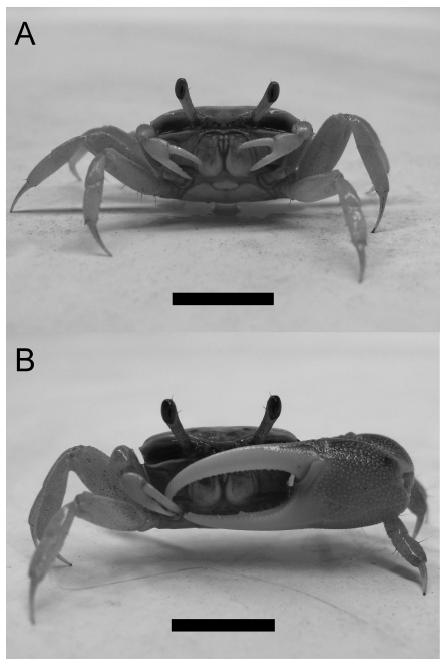
Sexual dimorphism in fiddler crabs. Female (A) and male (B) Uca panacea. Scale bars indicate 1 cm. From Darnell and Munguia 2011

Imagine yourself a fiddler crab. For this exercise, imagine yourself a male fiddler crab. Are you with me? Great. Check out your right claw, it’s a sleek, slender machine, perfect for picking through the sand as you sift out bacteria and other microorganisms for food. It also makes a handy shovel for digging nice deep burrows to protect you from harsh conditions. Now check out your left claw. Wow! This thing is massive. If you possess a particularly vivid mind and have place your ego within the carapace of Uca panacea, your giant claw is more than a quarter of your body weight. This comically mis-proportioned appendage is why those pesky bipeds call you and your cousins “Fiddler Crabs”.

See that female fiddler crab at the perimeter of your territory? Yes, she is checking you out. That giant claw of yours is primarily used to attract mates, signalling to interested parties that your are fit and fecund. You even have a special dance, unique to each fiddler crab species, to announce your vitality. And if some other, lesser-clawed, male tries to move in to your territory, why, you’re equipped with a serious piece of hardware to drive off that interloper.

Read More “In sexual selection and thermoregulation, bigger is better, at least for fiddler crabs” »

Bed Bugs: better bitten than smitten

Posted on October 11, 2010October 14, 2010 By Andrew Thaler 7 Comments on Bed Bugs: better bitten than smitten
Science
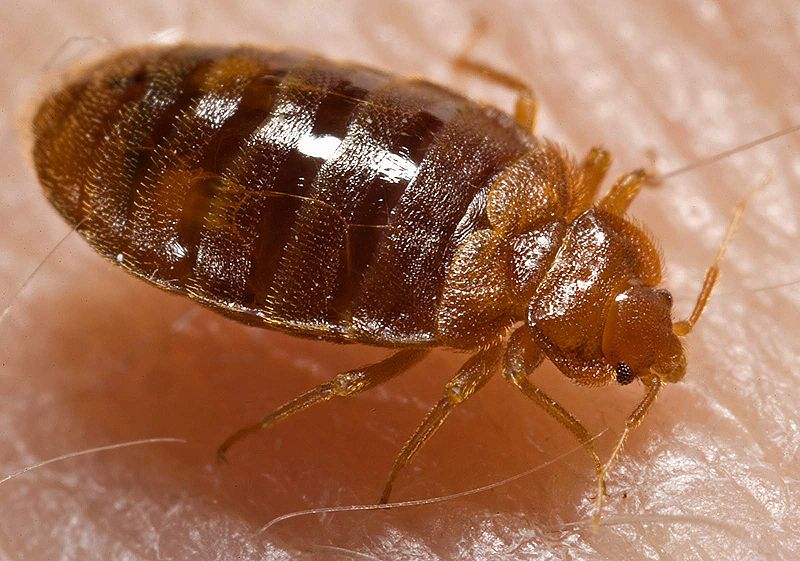
Common bed bug Cimex lectularius

Bed bugs, the nasty nocturnal nursery rhyme nightmares than are making a comeback throughout the northeastern United States. Infestations, previously relegated to the status of urban legend in much of the developed world, are on the rise due to a combination of more frequent travel, pesticide resistance, and the end of the ‘better living through chemistry” era when DDT was a perfectly acceptable thing to spray into your baby’s crib. They’re mean, nasty blood suckers that have risen over the summer to become the scourge of hotel managers everywhere. Except, they’re really pretty harmless. Most people don’t even have a reaction to the bite, they are shockingly poor vectors for disease, and, when you get past the blood sucking, they’re rather cute as far as bugs go. There is one rather disagreeable feature about these critters, and it’s the reason we should all be thankful that we’re only bitten by them.

Traumatic Insemination.

Read More “Bed Bugs: better bitten than smitten” »

Non-Monophyly within Syngnathidae

Posted on September 16, 2010December 6, 2011 By Andrew Thaler 2 Comments on Non-Monophyly within Syngnathidae
Non-Monophyly within Syngnathidae
Science

ResearchBlogging.org

Objective 1: Develop the least publicly accessible title for a blog post about seadragons, mate selection, and evolution

Objective 1 Status: complete

Objective 2: Draw in whatever readers push passed the unwieldy title with an unconventional narrative structure.

Objective 2 Status: complete

Objective 3: Hook the reader with a fascinating, though brief, background on seahorses, seadragons, and pipefish.

Read More “Non-Monophyly within Syngnathidae” »

Popular Posts

Shark scientists want their research to help save threatened species, but don’t know how. Our new paper can help.Shark scientists want their research to help save threatened species, but don’t know how. Our new paper can help.December 1, 2025David Shiffman
Norway and Cook Islands put their deep-sea mining plans on pause.Norway and Cook Islands put their deep-sea mining plans on pause.December 3, 2025Andrew Thaler
What Ocean Ramsey does is not shark science or conservation: some brief thoughts on "the Shark Whisperer" documentaryWhat Ocean Ramsey does is not shark science or conservation: some brief thoughts on "the Shark Whisperer" documentaryJuly 2, 2025David Shiffman
The Trouble with Teacup PigsThe Trouble with Teacup PigsOctober 14, 2012Andrew Thaler
What we know we don't know: impacts of deep-sea mining on whales, dolphins, sharks, turtles, and other migratory species.What we know we don't know: impacts of deep-sea mining on whales, dolphins, sharks, turtles, and other migratory species.November 20, 2025Andrew Thaler
2025: My year in writing, public speaking, and media interviews2025: My year in writing, public speaking, and media interviewsDecember 3, 2025David Shiffman
Urea and Shark OsmoregulationUrea and Shark OsmoregulationNovember 15, 2010David Shiffman
Shark of Darkness: Wrath of Submarine is a fake documentaryShark of Darkness: Wrath of Submarine is a fake documentaryAugust 10, 2014Michelle Jewell
How tiny satellites are tracking marine wildlifeDecember 1, 2025Andrew Thaler
Build a dirt cheap, tough-as-nails field computer in a Pelican caseBuild a dirt cheap, tough-as-nails field computer in a Pelican caseJuly 21, 2015Andrew Thaler
Subscribe to our RSS Feed for updates whenever new articles are published.

We recommend Feedly for RSS management. It's like Google Reader, except it still exists.

Southern Fried Science

  • Home
  • About SFS
  • Authors
  • Support SFS


If you enjoy Southern Fried Science, consider contributing to our Patreon campaign.

Copyright © 2025 Southern Fried Science.

Theme: Oceanly Premium by ScriptsTown