
Skip to content

Southern Fried Science

Over 15 years of ocean science and conservation online

  • Home
  • About SFS
  • Authors
  • Support SFS

Tag: shark fin soup

Donald Trump and Sharks: An Annotated Timeline

Posted on June 27, 2024 By David Shiffman
Donald Trump and Sharks: An Annotated Timeline
Blogging, Popular Culture

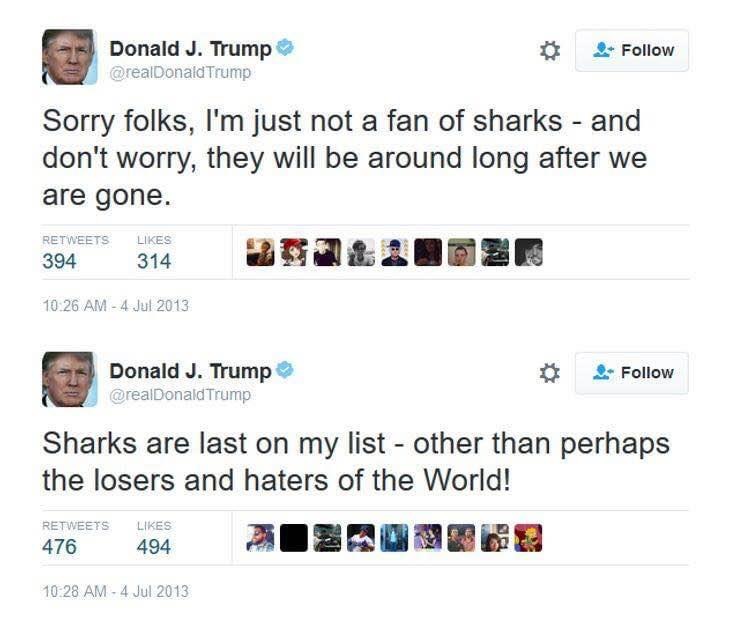
The former President’s recent bizarre rant about sharks has gone viral on social media, but this is just the latest in a long and weird saga. These tweets are real. Did you know their backstory? July 2007: Donald Trump meets with adult film star Stormy Daniels, inviting her to his hotel room. Upon arrival, he … Read More “Donald Trump and Sharks: An Annotated Timeline” »

Meet me in Borneo, exploitation on the high seas, navy sonars, creature reports, and more! Monday Morning Salvage: March 12, 2018.

Posted on March 12, 2018March 12, 2018 By Andrew Thaler
Weekly Salvage

Happy Monday-est Monday!

Foghorn (A Call to Action!)

  • This is the final week to get you abstracts in for the International Marine Conservation Congress, the premier ocean conservation conference, coming to you from Kuching, Malaysia this June! We got a cracking good symposium on human impacts in the deep sea and plenty of travel grants available for researchers in need. And, for the first time, we’ll be hosting Make for the Planet, Borneo!

Flotsam (what we’re obsessed with right now)

  • An outstanding piece on exploitation in the high seas by Jeff Marlow. The High Seas Are Being Exploited. Exploration Must Keep Pace.
  • This is a thing that happened:

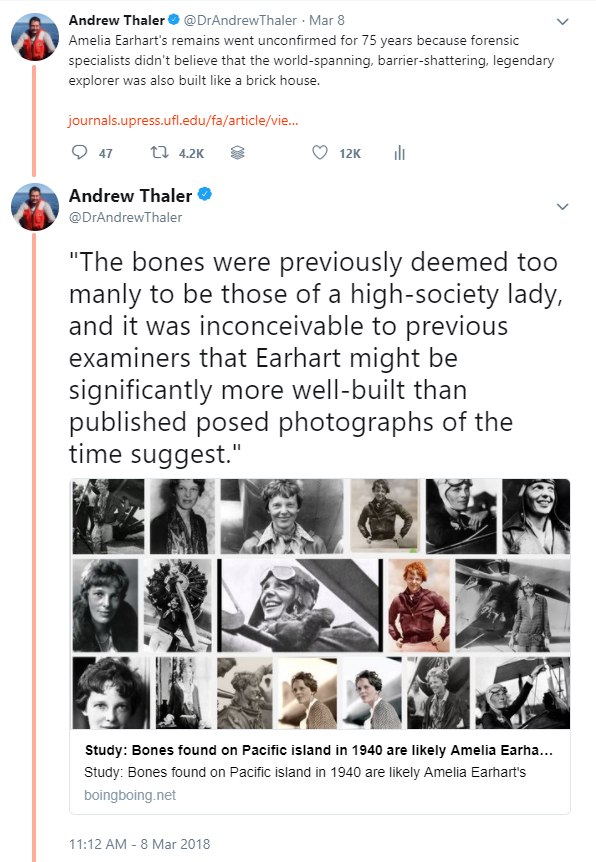
Tweet about potential confirmation of Amelia Earhart's remains.

Read More “Meet me in Borneo, exploitation on the high seas, navy sonars, creature reports, and more! Monday Morning Salvage: March 12, 2018.” »

The Case Against Shark Fin Trade Bans

Posted on May 12, 2017May 12, 2017 By David Shiffman
Conservation, Science
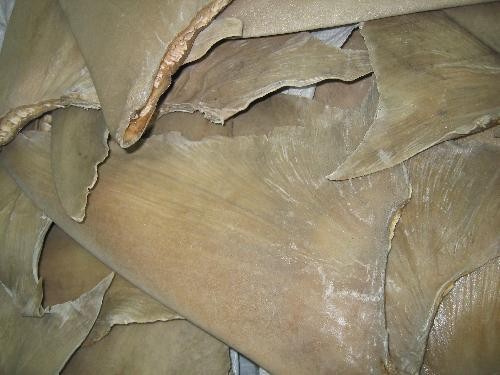
Photo credit: Jessica King, Marine Photobank

The United States Congress is considering a nationwide ban on buying, selling, or trading shark fins. While several of my posts and tweets have briefly discussed my stance on such policies, I’ve never laid out my full argument in one post. Here is why I, as a shark conservation biologist, oppose banning the shark fin trade within the United States.  The short answer is that the US represents a tiny percentage of overall consumers of shark fin, but provide some of the most sustainably caught sharks on Earth, as well as important examples of successful management, to the world. This means that banning the US shark fin trade won’t reduce total shark mortality by very much, but will remove an important example of fins coming from a well-managed fishery while also hurting American fishermen who follow the rules. Also, a focus on these policies promotes the incorrect belief that shark fin soup is the only significant threat to sharks, and that addressing the tiny part of that problem locally represents the end of all threats. For the longer answer, read on. And for the case for shark fin bans, please see this guest post from Oceana scientist Mariah Pfleger.

Read More “The Case Against Shark Fin Trade Bans” »

How much shark fin soup could you make from an adult megalodon?

Posted on April 26, 2014 By David Shiffman
Blogging

Carcharocles megalodon, commonly known as the megalodon, was likely the largest shark that ever lived. I say “was”, because despite claims by certain Discovery Channel “documentaries”, there is absolutely no doubt whatsoever that the megalodon is extinct and has been for millions of years.

It isn’t surprising, though, that the largest shark that ever lived has such an impact on pop culture. Recently, we watched the latest in the spectacular “mega shark vs.” science fiction series, one of my favorite movie series based on extinct giant sharks coming back to life and wreaking havoc on the modern world.  The Southern Fried Scientist, who recently calculated how much Old Bay seasoning you’d need to properly cook the latest Aquaman villain,  asked me how much shark fin soup you could get from an adult megalodon.

Based on my calculations, the answer is about 70,000 bowls of shark fin soup, more than enough for everyone who lives in Greenland to have a bowl. Explaining where this number comes from can tell us a lot abTTout one of the most important ocean conservation issues facing the world today.

Read More “How much shark fin soup could you make from an adult megalodon?” »

10 components of a sustainable shark fishery, and how you can help implement them

Posted on November 7, 2013November 7, 2013 By David Shiffman 1 Comment on 10 components of a sustainable shark fishery, and how you can help implement them
Conservation, Science

x3170e00In 1999, government officials from all over the world gathered in Rome for a meeting of the United Nations Food and Agricultural Organization’s Committee on Fisheries. The Committee meets every two years,  but one of the numerous outputs of this meeting was particularly significant, at least for sharks. Based on years of consultation and discussion by experts, the group agreed on a formal set of general principles that should make up sustainable and well-managed shark fisheries.

These 10 principles, part of a larger International Plan of Action for Sharks (IPOA-Sharks) , have helped shape more than a decade of scientific research and management priorities for the chondrichthyan fishes. When properly implemented and enforced, they allow people to use sharks (and rays and skates and chimeras, included in the IPOA-Sharks definition of “sharks”) as a natural resource while keeping populations healthy and allowing depleted stocks to recover.

According to the IPOA-Sharks, a national shark plan should aim to:

Read More “10 components of a sustainable shark fishery, and how you can help implement them” »

U.S. government: shark fin bans “significantly undermine conservation and management of Federal shark fisheries”

Posted on May 2, 2013May 2, 2013 By David Shiffman 47 Comments on U.S. government: shark fin bans “significantly undermine conservation and management of Federal shark fisheries”
Conservation, Science

davesquare

Photo Credit: Jessica King, Marine Photobank

I’ve written in the past about why shark fin bans might not be the best tool for the conservation and management of sharks. Though specific details vary, these so-called “blanket bans” typically make it illegal for anyone to buy, sell, or possess shark fins regardless of the source *. Additionally, to date most of these fin bans have taken place in a few U.S. states and Canadian towns. If the goal of these state-level fin bans is to reduce the supply of fins to the global market, proponents should consider that  according to TRAFFIC, more than 95% of the supply of shark products comes from countries outside of the U.S. and Canada.  Even if every U.S. state passed a fin ban, it would have a negligible  direct impact on global supply. Additionally, the United States has some of the most sustainably managed shark fisheries in the world (hammerhead sharks and a few others are an exception). We want other countries to emulate out management practices, not to remove our management practices from the global marketplace.

If the goal of these local fin bans is to reduce global demand, proponents should consider that the overwhelming majority of the demand for shark fin soup is in China and Southeast Asia, where passing such bans will pose a significant challenge. Some proponents of fin bans say (after the negligible impact on supply and demand is pointed out) that fin bans help with  “raising awareness of the problem of overfishing of sharks”. While these fin bans do result in (relatively) positive media coverage for shark conservation, “raising awareness” is not the publicly stated goal of these bans. If your goal is to educate people about a problem, educate people about the problem.

Instead of inflexible and ineffective fin bans that penalize fishermen who have adopted best practices * without impacting the global market, I’ve advocated for a science-based approach to sustainable shark management following the 10 basic principles in line with what has been laid out in the United Nations Fisheries and Aquaculture Organization’s International Plan of Action for Sharks and IUCN Shark Specialist Group guidance. These principles include banning finning of sharks by requiring that carcasses be landed whole (recall that finning is a specific fishing practice not synonymous with the fin trade), using science-based quotas to manage the fisheries of sharks whose populations can support a fishery, and restricting the harvest of species whose populations cannot.

Recently, the United States National Marine Fisheries Service (which, once again, manages some of the most sustainable shark fisheries on Earth) has started to officially speak out against state level fin bans.

Read More “U.S. government: shark fin bans “significantly undermine conservation and management of Federal shark fisheries”” »

15 important shark conservation and management terms explained with memes

Posted on April 1, 2013April 2, 2013 By David Shiffman 9 Comments on 15 important shark conservation and management terms explained with memes
Conservation, Popular Culture, Science

davesquare

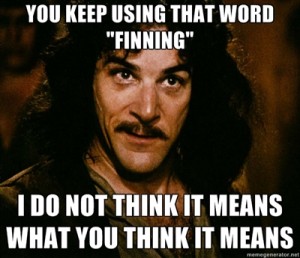
inigo-montoya-you-keep-using-that-word-i-dont-think-it-means-what-you-th-3b4b2920-sz625x625-animateIf interested citizens want to get involved in conservation and management policy, it’s absolutely vital to use proper terminology. The policy world can be full of confusing jargon, but there are few ways to discredit yourself in the eyes of decision makers as quickly as using a critical term incorrectly. In fact, it isn’t uncommon for a decision maker’s response to a petition or public comment to consist entirely of correcting  inaccurate terminology, if a response is issued at all. There are well over 100 acronyms and terms that I’ve seen regularly used, but in the interest of brevity, I’ve selected what I believe to be the 15 most important terms that I’ve seen people repeatedly use incorrectly.

For each term, I’ve provided a definition from a scientific paper or technical report whenever possible.  I have also  provided some additional explanation in my own words, and some assistance from familiar memes. Whenever possible, I’ve linked to blog posts, articles, or websites that provide even more information. Most of these terms are broadly applicable to fisheries management policy, but some are specific to shark fisheries. It is not my intention with this post to strongly advocate for or against any specific policy (I do plenty of that with other posts), but to make sure everyone is speaking the same language.

Read More “15 important shark conservation and management terms explained with memes” »

13 wrong things about sharks that conservation advocates should stop saying in 2013 (and what they should say instead)

Posted on December 27, 2012December 27, 2012 By David Shiffman 64 Comments on 13 wrong things about sharks that conservation advocates should stop saying in 2013 (and what they should say instead)
Conservation, Science

davesquare

While the rest of the scientific and management community and I are grateful for the passionate support of many shark conservation advocates, passion is no substitute for knowledge and accuracy.  Some conservation issues are a matter of opinion and can (and should) be reasonably be discussed by people with different views, but many others are a matter of fact. Presented here, in no particular order, are 13  incorrect statements and arguments commonly made by well-intentioned but uninformed shark conservation advocates, along with the reality of the situation.

From MemeGenerator.net

1) “Shark finning” is synonymous and interchangeable with “the global shark fin trade.” Shark finning is a specific fishing method. It is not the only way to catch sharks, and it is not the only way to provide shark fins for the global fin trade. Stopping shark finning is a worthy goal (that has largely been accomplished already *) because it is a wasteful and brutal fishing method that complicates management, but stopping shark finning does not stop the global shark fin trade. Many people calling for a ban on finning really seem to want no shark fishing and no fin trade of any kind (a viewpoint I disagree with, but regardless, proper terminology matters). For more on the difference between shark fishing and shark finning, see this post from June 2012.

2) 100 million sharks a year are killed for their fins. The origin of this number is still debated, but it was popularized by Sharkwater. While we will likely never know exactly how many sharks are “killed for their fins”, the best scientific estimate of the scope of the fin trade we have comes from a 2006 paper by Dr. Shelley Clarke. She found that the fins of between 26 and 73 million sharks end up in the fin trade each year, with a simulation average of 38 million.  Dr. Clarke wrote an essay for SeaWeb on the misuse of her work, which is worth a read.

3) 1 in 3 species of sharks face extinction. This one is actually relatively close to accurate, and can be fixed with the addition of just two words. An IUCN Shark Specialist Group report found that 1 in 3 species of “open ocean” sharks are Threatened with extinction (Threatened means Vulnerable, Endangered or Critically Endangered according to IUCN Red List standards). 1 in 6 species of shark, skate, ray, or chimera are Threatened- while still a troubling number indicative of a very bad situation, it’s half as bad as claimed by many advocates. Also, please note that I included skates and rays, which are similarly threatened but often ignored by conservation advocates (with one notable exception from 2012).

Read More “13 wrong things about sharks that conservation advocates should stop saying in 2013 (and what they should say instead)” »

What shark finning means (and doesn’t mean): a primer and quiz

Posted on June 18, 2012June 26, 2012 By David Shiffman 82 Comments on What shark finning means (and doesn’t mean): a primer and quiz
Conservation, Science

Shark finning, one of the most wasteful, unsustainable, and inhumane methods of gathering food in the history of human civilization, has rightly become a hot topic in the marine conservation movement. However, there is a great deal of confusion among activists concerning this problem and the best way to solve it. Those of you who follow me on twitter have seen me point out numerous recent anti-finning “awareness campaigns” which feature photographs of sharks that have not actually been finned.

Shark finning does not mean removing the fins from a shark. This is really important and seems to be a source of some confusion- not every shark fin for sale in markets is the result of shark finning! Shark finning means removing the fins from a shark while still on the fishing vessel and dumping the rest of the shark overboard. This is a problem because its wasteful (less than 10% of the weight of a shark is used), because its easy to quickly overfish a population even from a small boat (fins don’t take up a lot of space on board), and because its almost impossible for managers to know how many of each species were harvested. As stated above, this practice is also shockingly inhumane, as the sharks are often still alive when they are dumped overboard.

Read More “What shark finning means (and doesn’t mean): a primer and quiz” »

Shark fin bans: A storify of this week’s twitter discussion

Posted on May 8, 2012 By David Shiffman 20 Comments on Shark fin bans: A storify of this week’s twitter discussion
Conservation, Science

Earlier this week, I asked my twitter followers what they thought about shark fin bans, which prompted a long and stimulating discussion. What follows is my first attempt at “Storify”, shared in the hopes that the discussion can continue here.

As I’ve said before, I’m not a big supporter of shark fin bans because they don’t allow for sustainable, well-managed fisheries to supply the market. Additionally, they promote the common (and false) belief that shark fin soup is the only major problem facing sharks, and don’t address many of the other important issues associated with shark conservation.

Instead, I favor a comprehensive approach to shark management, including requiring that sharks be landed with fins attached (i.e. a ban on “finning” but the fins can still be used if the shark is landed whole), special protections for threatened and endangered species, science-based fisheries quotas for species that can sustain fishing, time/area closures or gear restrictions when necessary, and  careful monitoring (including requiring that all fishing nations report the species composition of their catch).

Check out the great discussion if you missed it, and let me know what you think of this important issue in the comments of this post.

Read More “Shark fin bans: A storify of this week’s twitter discussion” »

Posts pagination

1 2 Next

Popular Posts

Shark scientists want their research to help save threatened species, but don’t know how. Our new paper can help.Shark scientists want their research to help save threatened species, but don’t know how. Our new paper can help.December 1, 2025David Shiffman
Norway and Cook Islands put their deep-sea mining plans on pause.Norway and Cook Islands put their deep-sea mining plans on pause.December 3, 2025Andrew Thaler
What Ocean Ramsey does is not shark science or conservation: some brief thoughts on "the Shark Whisperer" documentaryWhat Ocean Ramsey does is not shark science or conservation: some brief thoughts on "the Shark Whisperer" documentaryJuly 2, 2025David Shiffman
The Trouble with Teacup PigsThe Trouble with Teacup PigsOctober 14, 2012Andrew Thaler
What we know we don't know: impacts of deep-sea mining on whales, dolphins, sharks, turtles, and other migratory species.What we know we don't know: impacts of deep-sea mining on whales, dolphins, sharks, turtles, and other migratory species.November 20, 2025Andrew Thaler
2025: My year in writing, public speaking, and media interviews2025: My year in writing, public speaking, and media interviewsDecember 3, 2025David Shiffman
Urea and Shark OsmoregulationUrea and Shark OsmoregulationNovember 15, 2010David Shiffman
Shark of Darkness: Wrath of Submarine is a fake documentaryShark of Darkness: Wrath of Submarine is a fake documentaryAugust 10, 2014Michelle Jewell
Build a dirt cheap, tough-as-nails field computer in a Pelican caseBuild a dirt cheap, tough-as-nails field computer in a Pelican caseJuly 21, 2015Andrew Thaler
How tiny satellites are tracking marine wildlifeDecember 1, 2025Andrew Thaler
Subscribe to our RSS Feed for updates whenever new articles are published.

We recommend Feedly for RSS management. It's like Google Reader, except it still exists.

Southern Fried Science

  • Home
  • About SFS
  • Authors
  • Support SFS


If you enjoy Southern Fried Science, consider contributing to our Patreon campaign.

Copyright © 2025 Southern Fried Science.

Theme: Oceanly Premium by ScriptsTown