This article originally appeared in the October/November 2020 issue of the Deep-sea Mining Observer. It is reprinted here with permission. For the latest news and analysis about the development of the deep-sea mining industry, subscribe to DSM Observer here: http://dsmobserver.com/subscribe/
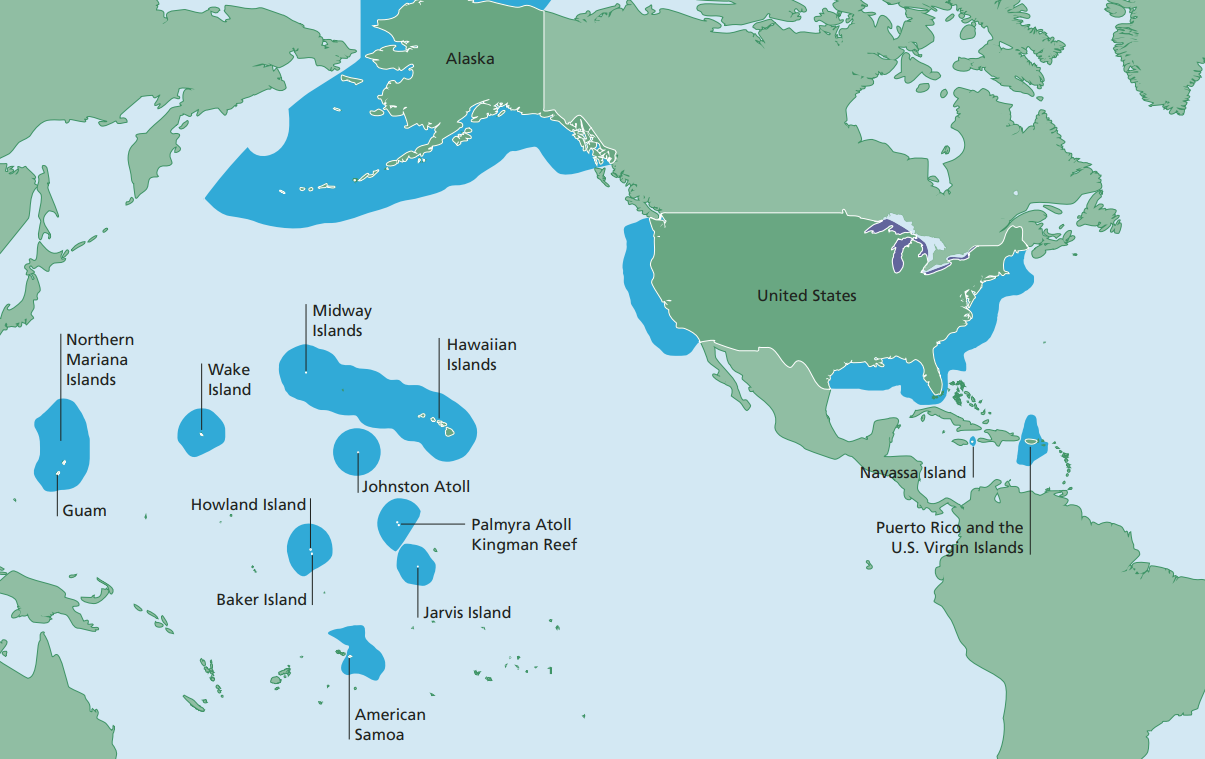
Since the signing of the UN Convention on the Law of the Sea and the creation of the International Seabed Authority, the United States of America has been a shadow partner in the growing deep-sea mining industry. Though the United States provides scientific and technical expertise, and is a de facto participant through American-owned subsidiaries incorporated in sponsoring states, the nation with the world’s second largest exclusive economic zone never ratified the core treaties and thus has limited influence at negotiations.
While the United States made significant contributions to the early development of the industry, it has been largely inactive since the mid 1980’s, focusing instead on its offshore fossil fuel resources and leaving critical minerals in the deep ocean largely untouched. Within the US EEZ surrounding the country’s Pacific territories, in particular, a push for large, remote marine protected areas in the form of the Pacific Remote Islands Marine National Monument, Rose Atoll Marine National Monument, Marianas Trench Marine National Monument, and Papahānaumokuākea Marine National Monument, deep-sea mining has been effectively prohibited.
The United States continues to assert claims over two large lease blocks in the Clarion-Clipperton Zone, citing existing precedent from prior to the ISA’s creation, though no recent attempts have been made to exploit those blocks. The ISA, for its part, continues to hold those lease blocks in reserve, should the US eventually join all but a few nations who have ratified the Law of the Sea.
That general non-involvement at the policy level may soon change. In a recent Executive Order on Addressing the Threat to the Domestic Supply Chain from Reliance on Critical Minerals from Foreign Adversaries by the now-outgoing President of the United States tasked the Department of the Interior with assessing any potential national security threat posed by the nation’s reliance on critical mineral imports, securing a domestic supply chain, and funding projects to increase critical mineral production within the United States.
“By signing the Executive Order, President Trump declared a National Emergency and called for action to expand the domestic mining industry, support mining jobs, alleviate unnecessary permitting delays, and reduce our Nation’s dependence on China for critical minerals.” says Beverly Winston of BOEM’s Office of Public Affairs. “In the few weeks since the order was signed, leadership at relevant Department of the Interior agencies have been actively engaged in identifying specific actions that can be taken to implement the order.”
Executive Orders are not always the best indicator of changing government priorities. A more definitive approach to identifying significant policy shifts is to examine contracting opportunities through the US General Services Administration. Soon after the President’s Executive Order, a solicitation for Geophysical, Geological, and Environmental Data Collection and Analysis supporting Outer Continental Shelf Marine Minerals Stewardship contract bids of indefinite duration and indefinite quantity was posted, providing funding for a four year marine critical minerals exploration campaign through the US Department of the Interior.
This call is a much more substantial indicator that the US is planning a more aggressive push into deep-sea minerals in the coming years. In a possibly unrelated move, the US Geological Survey is recruiting a postdoctoral fellow in Geology, geochemistry and global context of deep-ocean marine minerals.
With respect to BOEM’s four-year horizon, Winston adds that “BOEM is actively collaborating with partner agencies, such as USGS and NOAA, to better understand our marine mineral resources and associated biological communities. BOEM is a member of the newly created National Ocean Mapping, Exploration, and Characterization Council, and also co-chairs the Interagency Working Group on Ocean Exploration and Characterization. Both of these bodies will work to identify priority areas for exploration and characterization, and to coordinate personnel and funds to study the priority areas.”
While these moves point to increased deep-sea mining exploration within the US EEZ, they don’t provide nearly as much clarity on the United States’ future plans for the Area. In recent ISA council meetings, the US delegation has intervened to assert their existing claims in the CCZ, however no recent actions suggest an intent to attempt to exploit those claims.
Notably, the recent Executive Order is directed at the Department of the Interior, while it is the Department of Commerce, within which the National Oceanic and Atmospheric Administration is housed, who would initiate any exploration or exploitation in Areas Beyond National Jurisdiction.
“Currently under the Outer Continental Shelf Lands Act (OCSLA),” concludes Winston, “BOEM’s leasing authority is limited to the Outer Continental Shelf offshore the coastal states. NOAA is the implementing agency for the Deep Sea Hard Minerals Resource Act, which establishes an interim domestic licensing and permitting regime for deep seabed hard mineral exploration and mining beyond the EEZ pending adoption of an acceptable international regime.”
Though the election of President-Elect Joe Biden will likely have substantial influence on future priorities for the Bureau of Ocean Energy Management, it is too early to know, according to BOEM representatives, how a new administration will impact critical minerals policy. With a core policy focus on climate change, it is almost certain that securing access to the critical minerals necessary to building next-generation energy infrastructure will remain a priority for the next administration.