As in-person negotiations on the future of exploitation in the deep ocean resume this week in Kingston Jamaica, we reflect back on the last two years of development as reported on our sister site, the Deep-sea Mining Observer. This article first appeared on May 22, 2020.
In the late 1980s, as the first wave of deep-sea mining exploration approached a decade of hibernation, researchers launched an ambitious experiment to understand the long-term environmental impact of harvesting polymetallic nodules from the abyssal plain. The Disturbance and recolonization experiment in a manganese nodule area of the deep South Pacific (DISCOL) remains the most ambitious attempt to understand how nodule extraction affects deep ocean ecosystems. Though interest (and funding) waxed and waned with the prevailing interest in deep-sea mining, now, more than 30 years later, DISCOL provides the only large, multi-decade impact study from which contractors, regulators, and environmental advocacy groups can draw inferences about the recovery and resilience of deep-sea ecosystems following mining-induced disturbances throughout the lifetime of an ISA-issued mining exploration or exploitation lease.
The 1980s saw a surge in interest for deep-sea mining. The successful early campaigns of the late 1970s, bolstered by CIA funding for Project Azorian, presented a future of seemingly limitless profit scattered across the seafloor. That the early financial projections were supported by covert government funding was not yet widely known, and, even for those who were privy to the operation, regardless of initial funding the value had been established, the ship built, the technology sea-trialed. The profit potential was there. What was still tabula rasa was the environmental consequences of extraction on an almost completely unknown ecosystem.
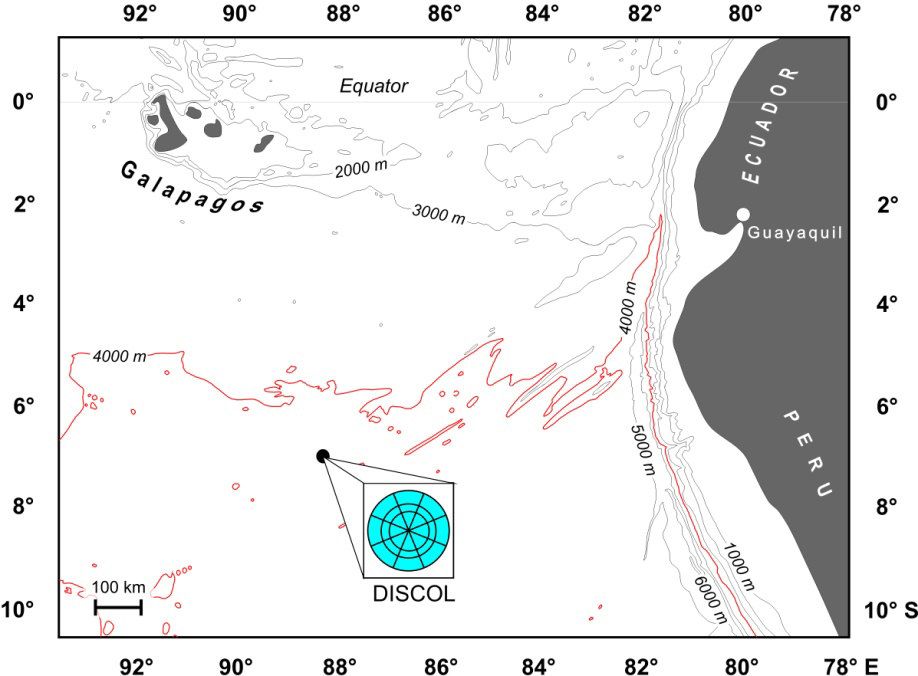
DISCOL built upon two earlier, smaller deep-sea disturbance studies, one carried out in the eastern Pacific and another in the Red Sea. Located in the Peru Basin just south of the equator off the coast of Peru, DISCOL is situated in a region rich in polymetallic nodules. Initially funded by the Republic of Germany, four cruises were conducted between 1988 and 1996 to assess impacts. Following a major effort to analyze the results of those four cruises, which concluded in 2001, the project went dormant until it was revived under the European JPI Oceans framework in 2015. Since then, an additional two research cruises have sampled and surveyed the DISCOL Experimental Area.
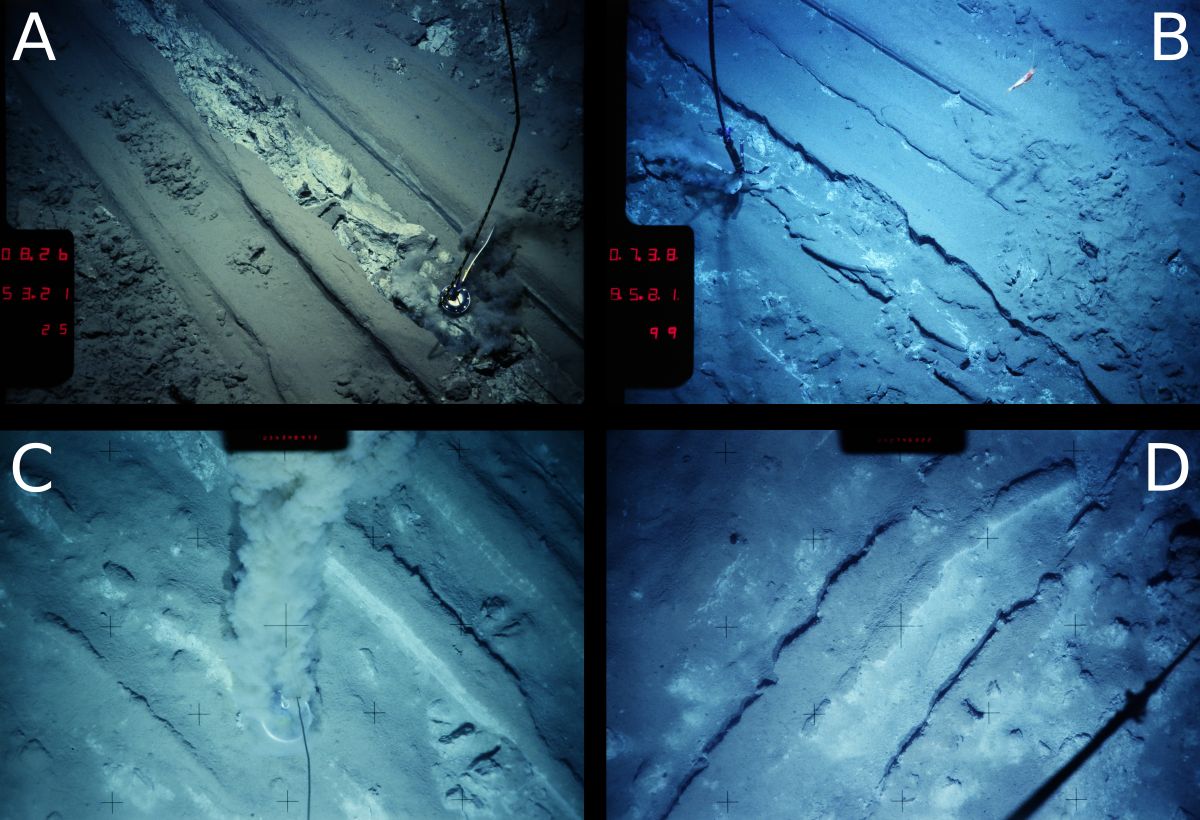
The DISCOL Experimental Area was disturbed using a plough-harrow — a custom device that was dragged across the seafloor, burying polymetallic nodules and creating 8-meter wide troughs of intense disturbance. Rather than conventional straight transects, the DISCOL tracks were ploughed radially, creating a circle of impact in which the areas towards the inner circle were more disturbed while the outer rings were relatively less disturbed. In total, 78 plough-harrow rings were cut into the seafloor. Instead of collecting nodules, the plough-harrow buried them, simulating their removal without actually harvesting them from the seafloor. Following those first passes, few nodules were observed within the disturbance area, megafaunal communities were reported as “destroyed”, and the telltale evidence of a sediment plume extended outward, beyond the disturbed region.
The first major deep-sea mining impact experiment was underway.
Follow-up cruises were conducted in 1989, 1992, and 1996. During these cruises they characterized faunal recovery across a variety of characteristics which were broadly classified into four tiers:
- Undisturbed. “Undisturbed areas found within the DEA and outside the experimental area, characterized by different manganese nodule densities.”
- Apparently Disturbed. “Areas within the DEA not directly influenced by the disturber, but showing different degrees of re-sedimentation and sediment coverage on the manganese nodules.”
- Partially Disturbed. “Areas immediately adjacent to the disturbed area. The upper sediment layers are compressed laterally and heaped up by the “plough-harrow” activity. The manganese nodules are heavily covered with sediment. The transition to undisturbed or apparently undisturbed area is gradual.”
- Disturbed. “Areas directly influenced by the “plough-harrow”. The sediment is disrupted and may be covered with a thin layer of resettled sediment. Only a few manganese nodules are not buried.”
Interest in deep-sea mining was already beginning to fade when the final DISCOL cruise left port. The price of manganese and other metals was falling, major technological promises had failed to come to fruition, and the Glomar Challenger, itself a relic of the industry’s clandestine legacy, looked less like a symbol of a prosperous deep ocean future and more like an aging cast off from the Cold War.
DISCOL would sit, undisturbed for another 15 years. A new surge in interest for deep-ocean minerals, spurred by the boom in renewable technology and a massive new demand in next-generation battery materials, brought the industry back to the forefront. As new contractors began obtaining new lease blocks and exploration permits, the fundamental question of deep-sea mining–what is the environmental harm?–gained new urgency. Under the JPI Oceans framework, two new research cruises set sail to examine the DISCOL Experimental Area 26 years after the RV Sonne first dragged a plough-harrow across the abyssal plain.
Over the last few years, numerous studies have resulted from those cruises looking at the long term potential for seafloor recovery (or not) following extensive mining. Earlier this year we reported on a comprehensive study looking at megafauna, which demonstrated that many benthic filter feeders showed no sign of recovery even after 26 years, while mobile scavengers were returning, but the community composition was different from pre-disturbance communities, suggesting that changes to the immediate benthic ecosystem following mining may be dramatic and irreversible on a decadal time scale.
Microbes at the experimental mining site, however, have been much less thoroughly studied. Recent research has pointed to the importance of microbial systems in the deep sea for regulating carbon capture and facilitating biomass transport. In the most recent study to examine the impacts of simulated mining at DISCOL, researchers from Germany reported that, even 26 years later, microbial communities within the plough-harrow tracks had only partially recovered and that full recovery could be on the order of 50 years to return to pre-disturbance levels.
The DISCOL experiment was a visionary attempt to quantify the impacts of polymetallic nodule mining on the seafloor and continues to serve as the best model system for understanding environmental impacts. As the deep-sea mining industry inches towards production, having a 30-year head start on understanding what recovery looks like following a mining event will prove invaluable to future management and mitigation plans.
Featured Image: disturbed areas, courtesy DISCOL: https://www.discol.de/initial-impact-study