
 Wandering through the grocery store the other day, I noticed something strange in the fish bin. Now, in general I’m pretty conscious of where my fish comes from, how it was caught, whether the fishery as a whole or the specific population is sustainable. I pay attention to those details and I can usually tell when a company’s branding is legitimate and when it’s just greenwashing.
Imagine my shock when I found a packet of Orange Roughy, sold by the Full Circle brand, and marketed as sustainable.
Orange Roughy, Hoplostethus atlanticus, is a large deep-sea fish found in both the Atlantic and Pacific Oceans. Like many deep-sea vertebrates, it has a very long life history, taking several decades to reach maturity and living for 100 years or more. Orange roughy occur at abundant on seamounts, making them prime target for deep-sea trawlers.
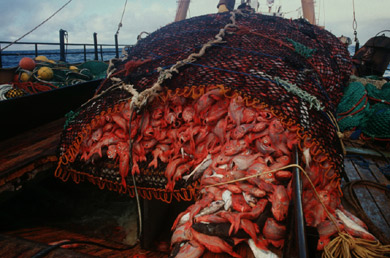 About 25 years ago, Orange Roughy were discovered as an easily exploitable deep-sea fishery. Roughy were caught in huge numbers to be turned into white fish fillets and served as luxury meals. They quickly became a very valuable fish, but were caught in such great numbers that many catches had to be thrown out to prevent market saturation.
It should be no surprise that roughy populations were quickly fished to near extinction. In a 2001 paper, orange roughy populations off the coast of New Zealand were assessed to determine if responsible management could allow the roughy to recover while still supporting a fishery. The results were promising but inconclusive. Some populations showed signs of recovery, but others were still declining.
The orange roughy life-cycle makes it incredibly vulnerable to exploitation, so why is this fillet wrapped in the trappings of sustainable fisheries?
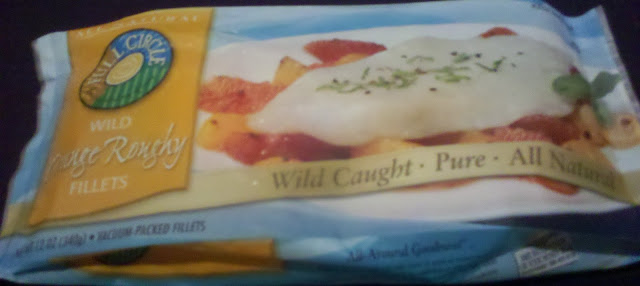
Full Circle is Lowes Food’s eco-brand. They sell everything from diapers to seafood, all in packaging that screams all-natural and environmentally friendly. Some of their seafood bears the stamp of the Marine Stewardship Council.
On their website, part of their mission statement is:
Sustainability Comes Full Circle
“At Full Circle™ we are dedicated to helping you “Return to a natural way of living.”™ In turn, we believe our own actions must always embody the principle of sustainability. We’re committed to improving the quality of life for each of our customers, lessening the impact of our products on the environment, and promoting a return to a more natural, sustainable lifestyle.”
…
“Sustainability—for the individual and for the Earth—is the mission of the Full Circle™ line of quality products. We offer better, more affordable alternatives to allow you to “Return to a natural way of living.”™ … to improve the quality of life for our families, our friends, and the planet. That’s the Full Circle™ promise!”
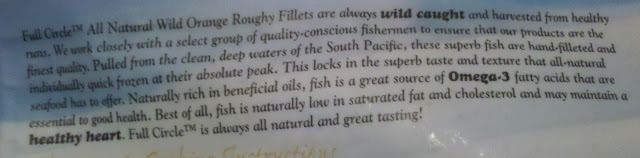
Even the Orange Roughy label itself reads as though this fish is a good choice for the environment. If you can’t read the label, it says:
Full Circle All Natural Wild Orange Roughy Fillets are always wild caught and harvested from healthy runs. We work closely with a select group of quality-conscious fishermen to ensure that our products are the finest quality. [the rest is a discussion of health benefits]
What immediately caught my eye was the statement that their roughy were harvested from healthy runs. What exactly is a run of deep-sea fish? This deceptive labeling reads as though someone took the copy from their Salmon packaging and replaced “Salmon” with “Orange Roughy”. Regardless, the label is false advertising because there is no such thing as a roughy ‘run’.
The packaging point consumers to their website for more information. If there is any actual information about the sustainability of their individual seafood products, 3 veteran bloggers could not find it.
More importantly though, is the claim that the roughy is fished from a healthy source and that this product somehow exists under their umbrella of sustainability.
Can there really be such a thing as sustainable orange roughy?
Despite attempts to fish at maximum sustainable yield (don’t worry, we’ll be addressing MSY later this week), the New Zealand fishery has continuously overestimated and revised it’s catch quotas. Orange roughy is listed as conservation dependent by the IUCN. Many retailers refuse to stock the fish. The world’s largest container shipping company has declared that it will not transport orange roughy (along with several other over-fished species). Even Red Lobster has a franchise-wide ban on serving Orange Roughy. As it stands now, orange roughy is not a sustainable fishery.
There may, with wise, informed management, be a future for orange roughy on the dinner table, but that future is not here yet. For a company to market orange roughy as a healthy, sustainable fishery is simply greenwashing.
~Southern Fried Scientist
UPDATE: Twitter user @highlyanne has sent in a picture of the text from the back of a Full Circle Wild Alaskan Salmon packet. As suspected, the text is identical, with the exception of changing Salmon to Roughy and updating the location. Guess we know where the “run” came from. See for yourself!
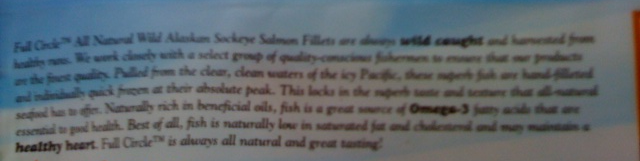
If you can’t read it, it says:
Full Circle All Natural Alaskan Sockeye Salmon Fillets are always wild caught and harvested from healthy runs. We work closely with a select group of quality-conscious fishermen to ensure that our products are the finest quality. [the rest is a discussion of health benefits, identical to the text for orange roughy]
UPDATE 2: After checking my local Lowes Foods, it appears that the packaging for Orange Roughy, Salmon, Cod, Halibut, and Swordfish all have the exact same wording, with changes only to the names of the fish and the location.

Clark, M. (2001). Are deepwater fisheries sustainable? — the example of orange roughy (Hoplostethus atlanticus) in New Zealand Fisheries Research, 51 (2-3), 123-135 DOI: 10.1016/S0165-7836(01)00240-5
orange roughy
One of our grocery stores sells a brand of frozen fish, and the packaging says “our company supports sustainable seafood practices”. Note that it does not say “this product is sustainable”. It drives me nuts.
There are a number of organizations (such as Seafood Watch from Monterey Bay Aquarium, or the Blue Ocean Institute’s Guide to Ocean Friendly Seafood. The Blue Ocean Institute is based at the School of Marine and Atmospheric Sciences, Stony Brook University (my home institution) so I know more about their process. They often hire students in marine sciences to do extensive literature searches to score certain seafoods as safe and sustainable vs those whose consumption is bad for the environment. With the increasing use of technology, they developed an iPhone app called FishPhone, which you can download and use while you are seafood shopping. Just wanted to put that out there so maybe your concerned readers with advanced technology (I am still using a flip-phone!) could use it.
To quote my deep-sea ecologist office mate: “Runs? They live on seamounts.”
What I really want to see is evidence that bottom trawling fishing methods like those used to harvest orange roughy, are sustainable. I suspect it’s about as sustainable as mountaintop removal mining.
See here for a discussion on the effects of bottom trawling.
I can’t believe anyone would even try and claim “sustainability” for orange roughy… the situation of the stocks in New Zealand, and the increasing rejection of the species by retailers, is summarised in a briefing here: http://www.greenpeace.org/raw/content/new-zealand/press/reports/orange-roughy-rejection.pdf – as for Australia it’s listed as a threatened species there.
I assume the US has some sort of advertising standards authority to ensure that companies don’t outright lie to consumers in their advertising… perhaps someone should take them to court for their misleading (to put it mildly) claims. It worked in the UK against supermarket chain Morrisons who had to pull a TV advert that claimed their seafood was sustainably sourced but could not defend that claim:
http://www.fis.com/fis/worldnews/worldnews.asp?l=e&country=0&special=&monthyear=&day=&id=34551&ndb=1&df=0
Get a life. I’m gonna eat all the roughy I want I don’t care how few there are left.