Hagfish. You love them. I love them. The owner of this sedan has no choice but to love them:
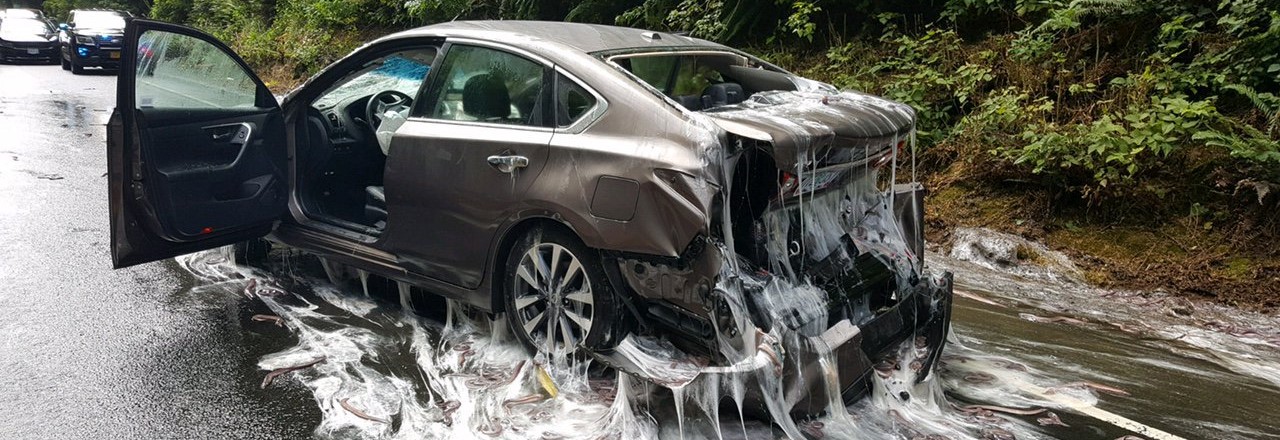
2017 was a big year for hagfish science.
Big Ideas (the ecologic paradigms that hagfish shifted)
Heincke’s law is one of those ecologic principles that more often acts as a foil for rejecting the null hypothesis than as a consistent pattern in ecology. It’s most basic summary is: The further from shore and the deeper dwelling a fish is, the bigger it grows. Heincke’s law does not appear to be true for hagfish, whose size appear to have no relation to the depth at which they occur. On the other hand, phylogenetic relationships do seem to play some role in regulating body size in hagfish.
- Schumacher and friends (2017) No support for Heincke’s law in hagfish (Myxinidae): lack of an association between body size and the depth of species occurrence. DOI: 10.1111/jfb.13361.
Defense and Behavior (how hagfish do the things that they do)
Hagfish are master escape artists, capable of squeezing in and out of tight spaces barely half the width of their body. This great for getting in an out of rotting whale carcasses on the sea floor, creeping into crevices, and avoiding predators. But how do they accomplish this incredible feat? Hagfish have a flaccid sinus under their skin which allows them to control the distribution of venous blood and alter their body width as they wriggle through narrow passages. Freedman and Fudge identified 9 distinct behaviors which take advantage of this adaptation, including anchoring, forming tight loops to push the body through an opening, and bending the hagfish head 90 degrees to force it through a slit. And there are videos!
- Freedman and Fudge (2017) Hagfish Houdinis: biomechanics and behavior of squeezing through small openings. DOI: 10.1242/jeb.151233.
The Fudge lab has been busy this year, cranking out some of the most noteworthy work on the incredible behavior of hagfish. In addition to examining hagfish motility, Boggett and friends looked into how those flaccid sinuses aid predator avoidance. The team build wee little guillotines loaded with shark teeth to see how hagfish skin protects the animal from vicious bites. In a year when a truckload of hagfish spectacularly crushed a car, the fact that this research was the biggest breakout sensation in hagfish pop culture says everything you need to know about the compelling results of this study. You can read more about this study at The Verge, Futurity, Popular Science, and plenty of other outlets.
- Boggett and friends (2017) Flaccid skin protects hagfishes from shark bites. DOI: 10.1098/rsif.2017.0765.
Biogeography (hagfish and their place in the world)
Not a huge surprise, but hagfish are more genetically distinct than you might think.
- Kase and friends (2017) Brown hagfish from the northwest and east coasts of Honshu, Japan are genetically different. DOI: 10.1266/ggs.17-00004.
Hagfish are notably absent from the waters around India, but it turns out we may just not have been looking hard enough. It’s pretty likely that 2018 will welcome in a new species of hagfish from Indian waters.
- Fernholm and friends (2017) First record of hagfish (Cyclostomata: Myxinidae) in Indian waters. DOI: 10.11609/jott.2526.9.6.10365-10368.
Physiology (how hagfish work)
Hagfish have… immersive feeding behaviors. They don’t just eat. They absorb nutrient through their skin and gills. Pause. Take a moment. Let that sink in.
Back? That’s pretty wild, right? Hagfish eat, even when they’re just chilling inside the slowly decomposing abdominal cavity of a dead sea lion. Hagfish are the only vertebrate that can absorb dissolved nutrients across multiple epithelial membranes, not just the intestines. Weinrauch and friends looked into what happens as hagfish ‘feed’ by absorbing nutrients ex vivo.
- Weinrauch and friends (2017) Post-prandial physiology and intestinal morphology of the Pacific hagfish (Eptatretus stoutii). DOI: 10.1007/s00360-017-1118-1.
Eating lots of dead and decomposing critters is a great way to digest a whole mess of ammonia, especially if you’re chowing down on some dead sharks. In order to deal with all the excess ammonia, hagfish should be able to produce and excrete huge amounts of urea in a relatively short amount of time. It turns out that they absolutely can and one of the ways they accomplish this task is by producing some exceptional ammonia-handling proteins in their skin and sequectering ammonia in different parts of their body.
- Wilkie and friends (2017) Wide scope for ammonia and urea excretion in foraging Pacific hagfish. DOI: 10.1007/s00227-017-3148-3.
- Clifford and friends (2017) Flexible ammonia handling strategies using both cutaneous and branchial epithelia in the highly ammonia-tolerant Pacific hagfish. DOI: 10.1152/ajpregu.00351.2016.
Folks, if you’re feeling anemic, you can get some more iron by eating iron-rich food or taking a supplement. Unless you’re a hagfish. Iron that enters a hagfish gut leaves, practically untouched, through a hagfish butt. Hagfish absorb iron through their skin. This process is unaffected by environmental oxygen concentration, which makes hagfish more resilient to hypoxia than other fish, which is probably a good think when you’re eating your way through a blue fin tuna from the inside out.
- Glover and friends (2017) Iron transport across the skin and gut epithelia of Pacific hagfish: Kinetic characterisation and effect of hypoxia. DOI: 10.1016/j.cbpa.2016.04.018.
Hagfish don’t drink.
- Glover and friends (2017) Drinking and water permeability in the Pacific hagfish, Eptatretus stoutii. DOI: 10.1007/s00360-017-1097-2.
Bioinsight (what hagfish inspire within ourselves)
Bioinsights are new ways of looking at the world that we gain through exploring and understanding wild, weird, wonderful places for the sheer joy of discovery. Hagfish, being wild, weird, and wonderful, abound with potential insights. The structure of hagfish slime is incredible and is being studied as the inspiration for a whole host of new fibers.
- Fu and friends (2017) Artificial hagfish protein fibers with ultra-high and tunable stiffness. DOI: 10.1039/C7NR02527K.
Hagfish. You knew they were amazing, but it turns out they’re even more amazing than expected. Raise a slime-covered mug to another grand year in hagfish science, then pour it over your head and soak it in through your skin. The hagfish way.
If you enjoy Southern Fried Science, consider contributing to my Patreon campaign to help us keep the servers humming and support other innovative ocean science and conservation initiatives. Patreon contributors this month can get their very own Hagfish Love sticker! Because everybody loves hagfish.