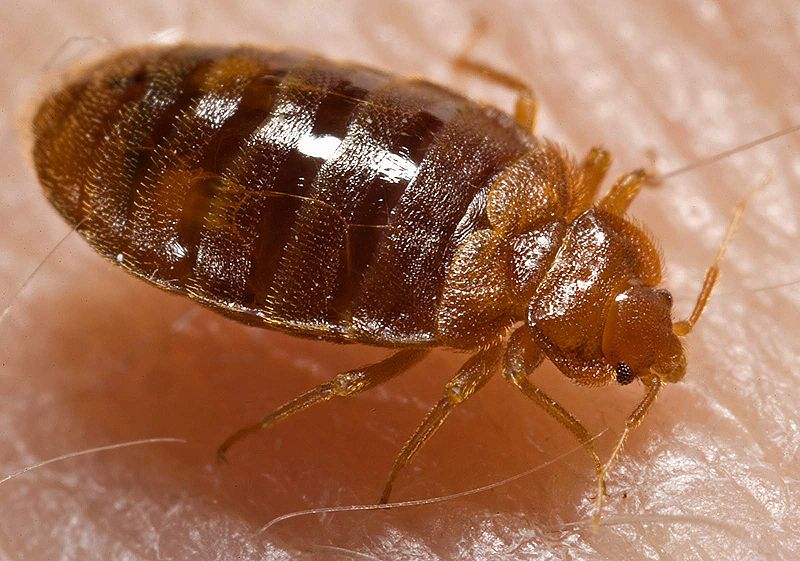

Bed bugs, the nasty nocturnal nursery rhyme nightmares than are making a comeback throughout the northeastern United States. Infestations, previously relegated to the status of urban legend in much of the developed world, are on the rise due to a combination of more frequent travel, pesticide resistance, and the end of the ‘better living through chemistry” era when DDT was a perfectly acceptable thing to spray into your baby’s crib. They’re mean, nasty blood suckers that have risen over the summer to become the scourge of hotel managers everywhere. Except, they’re really pretty harmless. Most people don’t even have a reaction to the bite, they are shockingly poor vectors for disease, and, when you get past the blood sucking, they’re rather cute as far as bugs go. There is one rather disagreeable feature about these critters, and it’s the reason we should all be thankful that we’re only bitten by them.
Traumatic Insemination.
Yes, it is exactly what it sounds like. Professor Rossallini, would you care to explain?
Probably NSFGW* (also trigger warning for sexualized violence)
From an evolutionary standpoint, this doesn’t seem like a terribly good strategy. Females have developed a hardened plate, called the spermalege to absorb the male’s copulatory blow, however, if a male misses the spermalege, the damage is severe and the total lifetime egg production of the female is cut in half. Apparently, male bed bugs aren’t terribly observant and will attempt to mate with any individual that has recently fed. Larval bed bugs secrete a “don’t mate with me pheromone” to protect themselves from the males’ phallus sikarious and even adult males have a special warning pheromone that’s triggered after another male attempts to mate.
The sex lives of bed bugs are not for the faint of heart.
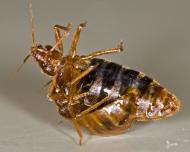
What is the evolutionary advantage to such a brutal and potentially damaging strategy? The answer seems to lie in the interactions between male beg bugs. After stabbing, the sperm travels through the bed bug’s blood stream to the ovaries, where eggs are fertilized and become the next generation of annoying pests. But that isn’t limited to females and female reproductive organs. Sperm in the bloodstream doesn’t know whether it’s in a male or a female, so, even when a male is traumatically inseminated, the sperm will travel toward the reproductive organs. Males so assaulted aren’t killed by the encounter, and go on to mate happily.
Of course, there’s a catch.
The male that has been traumatically inseminated is now carrying the sperm from the victorious male. He will then go on to spread not his genetic material, but the genes of the more successful bed bug. This ensures that each bed bug generation will come from stocks selected to mate with anyone that crawls into bed. This strategy has been observed in other species, but is only hypothesized to occur in bed bugs. The female spermalege and the juvenile pheromones are responses to an increasingly aggressive reproductive strategy. The trade off to investing in armored plates or producing complex molecules is weighed against the enormous advantage inherent in having multiple males mating for you. Since there would be no advantage to delivering another male’s genes to the next generation instead of your own, the only successful way to build such an auto-reproductive entourage is by force.
I’ll take a few annoying bug bites over that any day.
~Southern Fried Scientist
Wondering is you’ve got bed bugs? Check out Bug Girl’s guide to inspecting a room for bed bugs.
This post is submitted for the NESCent Science Online 2011 travel award.
*Not Suitable for Government Work

Morrow, E., & Arnqvist, G. (2003). Costly traumatic insemination and a female counter-adaptation in bed bugs Proceedings of the Royal Society B: Biological Sciences, 270 (1531), 2377-2381 DOI: 10.1098/rspb.2003.2514
Ryne, C. (2009). Homosexual interactions in bed bugs: alarm pheromones as male recognition signals Animal Behaviour, 78 (6), 1471-1475 DOI: 10.1016/j.anbehav.2009.09.033
Stutt AD, & Siva-Jothy MT (2001). Traumatic insemination and sexual conflict in the bed bug Cimex lectularius. Proceedings of the National Academy of Sciences of the United States of America, 98 (10), 5683-7 PMID: 11331783
Siva-Jothy, M. (2006). Trauma, disease and collateral damage: conflict in cimicids Philosophical Transactions of the Royal Society B: Biological Sciences, 361 (1466), 269-275 DOI: 10.1098/rstb.2005.1789
Abele, L., & Gilchrist, S. (1977). Homosexual rape and sexual selection in acanthocephalan worms Science, 197 (4298), 81-83 DOI: 10.1126/science.867055
Can the “do not mate” pheromone be used as a population control method?
That hadn’t even occurred to me, but I don’t see why not.
“Females have developed a hardened plate, called the spermalege to absorb the male’s copulatory blow, however, if a male misses the spermalege, the damage is severe…”
Isn’t that neat? Just like people!
Haha! Awesome video:D
“Their mean, nasty blood suckers…”
They’re not their.
They’re not their what?
http://www.theonion.com/articles/cockroach-king-concerned-over-recent-rise-of-bedbu,18289/