Skip to content

Southern Fried Science

Over 15 years of ocean science and conservation online

  • Home
  • About SFS
  • Authors
  • Support SFS

Author: Andrew Thaler

Marine science and conservation. Deep-sea ecology. Population genetics. Underwater robots. Open-source instrumentation. The deep sea is Earth's last great wilderness.

Probing the submerged caves of Bermuda with Trident

Posted on January 28, 2020January 28, 2020 By Andrew Thaler
Science
Dr. Blanco-Bercial pilots the Trident ROV in one of Bermuda’s submerged caves.

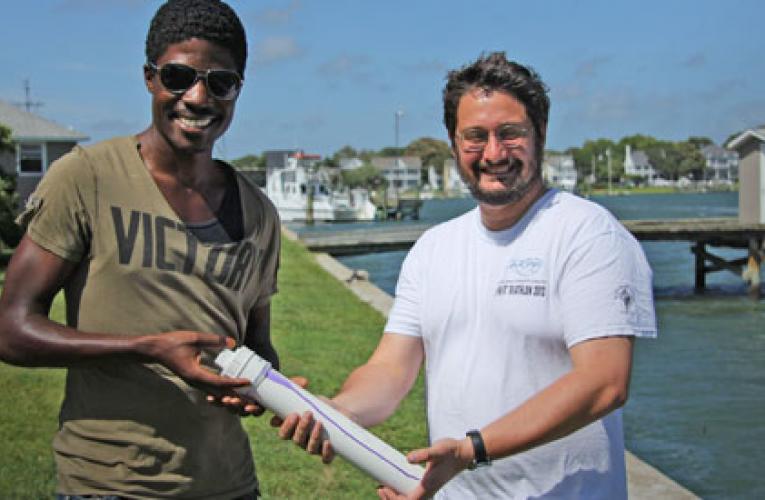
Conservation research in submarine caves is among the clearest and most compelling use-cases for a small observation-class ROV like Trident, which is why, last week, we delivered the very first ROV for Good Sofar Ocean Trident to Dr. Leocadio Blanco-Bercial at the Bermuda Institute of Ocean Sciences to study the hidden biodiversity in Bermuda’s Anchialine Caves.

Dr. Blanco-Bercial is a marine biologist who studies the diversity and evolution in invertebrates, especially those in marine cave ecosystems. Bermuda is home to a network of anchialine caves (caves connected to the sea through underwater passageways) which are home to a diverse array of rare and ancient arthropod lineages, many of which are unique to Bermuda. These species are under threat from land development and other human activities.

“From the science standpoint,” says Dr.  Blanco-Bercial, “the Trident will give us independence from specialized divers availability, and will simplify the logistics associated with the sampling process – the Trident is easy to carry even by a single person – and sampling attachments and other gear is easily transportable by another colleague.”

Read More “Probing the submerged caves of Bermuda with Trident” »

We want to give you an ROV!

Posted on January 13, 2020January 13, 2020 By Andrew Thaler 1 Comment on We want to give you an ROV!
Open Science, Science

If you have access to a small, observation-class remotely operated vehicle to explore the ocean, where would you go? Would you use it to discover something new about marine ecosystems? Would you give students the opportunity to journey beneath the waves and learn about their local waterways? Would you hunt for lost lobster traps, track … Read More “We want to give you an ROV!” »

The next generation of low-cost, open-source oceanographic instruments is here! Meet the OpenCTD rev 2!

Posted on January 7, 2020January 7, 2020 By Andrew Thaler 1 Comment on The next generation of low-cost, open-source oceanographic instruments is here! Meet the OpenCTD rev 2!
Oceanography for Everyone, Open Science, Science
Four generations of OpenCTD. Left to Right: Prototype 2, which went through sea trials in Lake Superior, rev 1, rev 1 in the smaller form factor (this one was deployed in Alaska), and OpenCTD rev 2.

In 2013, Kersey Sturdivant and I embarked upon a quixotic quest to create an open-source CTD — the core tool of all oceanographic research that measures the baseline parameters of salinity, temperature, and depth. We weren’t engineers; neither of us had any formal training in electronics or sensing. And, full confession, we weren’t (and still aren’t) even oceanographers! What we were were post-doc marine ecologists working with tight budgets who saw a desperate need among our peers and colleagues for low-cost alternatives to insurmountably expensive equipment. And we had ties to the growing Maker and DIY electronics movements: Kersey through his work developing Wormcam and me through my involvement with OpenROV. 

We had no idea what we were getting ourselves into. 

The very first OpenCTD prototype.

Seven years and five iterations later, we are releasing the long anticipated OpenCTD rev 2 as well as the comprehensive Construction and Operation Manual! OpenCTD rev 2 builds on over half a decade of iteration and testing, consultation with oceanographers, engineers, developers, and makers around the world, extensive coastal and sea trials, and a series of workshops designed to test and validate the assembly process. 

Read More “The next generation of low-cost, open-source oceanographic instruments is here! Meet the OpenCTD rev 2!” »

Vanishing Islands, nuclear leaks, oceans of plastic, and one feisty Beluga. Weekly Salvage: November 18, 2019

Posted on November 18, 2019November 17, 2019 By Andrew Thaler
Weekly Salvage

Transcript available below.

Read More “Vanishing Islands, nuclear leaks, oceans of plastic, and one feisty Beluga. Weekly Salvage: November 18, 2019” »

Finding the best dirt-cheap, field-tough 3D printer for science and conservation work: six months later.

Posted on November 15, 2019November 15, 2019 By Andrew Thaler
Uncategorized
A fully upgraded Ender-3.

Four years ago, I had the chance to lead a research cruise on Lake Superior to explore the potential of low-cost, open-source tools for marine field work. This was the proving ground for the OpenCTD, the Niskin3D, the OpenROV 2.7, and the idea that, rather than packing cases and case of gear, we could put everything we needed on a flash drive and print it at sea. 

During that cruise, as my trusty Printrbot, was churning out Niskin bottles, we caught a wave and the 3D printer was thrown to the ground. I came down hours later to find it upside down on the floor of a retrofitted fish hold, happily chugging along. I picked it up, put it back on the counter, and went back to sleep. The print didn’t even fail.

That is the kind of beast we need. 

Over the years, whenever someone asked me what the best 3D Printer for field work was, the answer was always the same: The Printrbot Simple Metal. But Printrbot is gone (for now) and we needed a replacement.

Half a year ago, we completed an exhaustive review of the cheapest 3D-printers on the market, with an eye towards low-cost, robust tools that would endure the rigors of field work without blowing our grant budget. We wanted 3D printers that were workhorses. They didn’t have to be pretty, they didn’t have to produce perfect prints, they just had to spit out strong serviceable parts with minimal fuss. They had to be reasonably portable. And they had to be able to take a beating and keep on printing.

We never found a replacement for the absolute tank that is the Printrbot Simple Metal, but after months of testing, settled on a pair of good alternatives (notably for a fraction of the cost of the Printrbot when it was still in production): for those who need big build volumes, the Creality Ender-3. For those who need portability above all, the Monoprice Mini-Delta. 

But that was six months ago. I promised to put these two machines into heavy use. After several hundred hours of printing, we’re ready to update our review of both machines. 

Executive Summary. My recommendation still stands, both both printers need a few modifications before you can call them the ultimate field machine. 

Read More “Finding the best dirt-cheap, field-tough 3D printer for science and conservation work: six months later.” »

“We’re in the midst of a sea change in who has access to the core tools of marine scientific research,” Weekly Salvage: November 11, 2019

Posted on November 11, 2019November 11, 2019 By Andrew Thaler
Weekly Salvage

Transcript available below.

Read More ““We’re in the midst of a sea change in who has access to the core tools of marine scientific research,” Weekly Salvage: November 11, 2019″ »

Mining historic shipwrecks for lead and other old things from the bottom of the sea. Also, Robots! Weekly Salvage: November 4, 2019

Posted on November 4, 2019November 4, 2019 By Andrew Thaler
Weekly Salvage

Transcript available below.

Read More “Mining historic shipwrecks for lead and other old things from the bottom of the sea. Also, Robots! Weekly Salvage: November 4, 2019” »

Unprecedented destruction in the deep Gulf of Mexico, The Ocean Cleanup’s River Pivot, and More! Weekly Salvage: October 28, 2019.

Posted on October 28, 2019October 28, 2019 By Andrew Thaler
Weekly Salvage

Transcript below.

Read More “Unprecedented destruction in the deep Gulf of Mexico, The Ocean Cleanup’s River Pivot, and More! Weekly Salvage: October 28, 2019.” »

Space whales. Space. Whales. SPAAAAACE WHAAAAALES! Weekly Salvage: October 21, 2019

Posted on October 21, 2019October 20, 2019 By Andrew Thaler
Weekly Salvage

Transcript below.

Read More “Space whales. Space. Whales. SPAAAAACE WHAAAAALES! Weekly Salvage: October 21, 2019” »

Dead whales, glass sponges, 3D-printing for the ocean, and more! Weekly Salvage: October 14, 2019

Posted on October 14, 2019October 13, 2019 By Andrew Thaler
Weekly Salvage

Transcript below.

Read More “Dead whales, glass sponges, 3D-printing for the ocean, and more! Weekly Salvage: October 14, 2019” »

Posts pagination

Previous 1 … 17 18 19 … 149 Next

Popular Posts

The story of the pride flag made from NASA imagery: Bluesky's most-liked imageThe story of the pride flag made from NASA imagery: Bluesky's most-liked imageSeptember 27, 2024David Shiffman
"Why Sustainable Seafood Matters" is now available for preorder! Here's what it's about, and why I decided to write it."Why Sustainable Seafood Matters" is now available for preorder! Here's what it's about, and why I decided to write it.June 8, 2026David Shiffman
What Ocean Ramsey does is not shark science or conservation: some brief thoughts on "the Shark Whisperer" documentaryWhat Ocean Ramsey does is not shark science or conservation: some brief thoughts on "the Shark Whisperer" documentaryJuly 2, 2025David Shiffman
Tackling the least important debate in deep-sea mining: the desultory hyphenTackling the least important debate in deep-sea mining: the desultory hyphenJune 8, 2026Andrew Thaler
Deep-sea Mining, Domestic Cats, Star Trek, and Ocean Exploration: Andrew's mid-year podcast round-up.Deep-sea Mining, Domestic Cats, Star Trek, and Ocean Exploration: Andrew's mid-year podcast round-up.June 6, 2026Andrew Thaler
Shark of Darkness: Wrath of Submarine is a fake documentaryShark of Darkness: Wrath of Submarine is a fake documentaryAugust 10, 2014Michelle Jewell
What is a Sand Shark?What is a Sand Shark?November 12, 2017Chuck Bangley
I just told 850 shark scientists a hard truth: We’re not communicating shark conservation correctly.I just told 850 shark scientists a hard truth: We’re not communicating shark conservation correctly.June 1, 2026David Shiffman
That's not a blobfish: Deep Sea Social Media is Flooded by AI SlopThat's not a blobfish: Deep Sea Social Media is Flooded by AI SlopDecember 19, 2025Andrew Thaler
Why ocean science is still one of the worst-funded scientific fields worldwideWhy ocean science is still one of the worst-funded scientific fields worldwideJune 3, 2026Chris Parsons
Subscribe to our RSS Feed for updates whenever new articles are published.

We recommend Feedly for RSS management. It's like Google Reader, except it still exists.

Southern Fried Science

  • Home
  • About SFS
  • Authors
  • Support SFS


If you enjoy Southern Fried Science, consider contributing to our Patreon campaign.

Copyright © 2026 Southern Fried Science.

Theme: Oceanly Premium by ScriptsTown