Over 15 years of ocean science and conservation online
Author: Andrew Thaler
Marine science and conservation. Deep-sea ecology. Population genetics. Underwater robots. Open-source instrumentation. The deep sea is Earth's last great wilderness.
Happy Friday Everyone! We frequently link to other important marine and general science blogs, to the extent that regular readers can probably guess which science blogs we read and how often, but science isn’t everything. We decided to take a moment to tell y’all about the non-science blogs that we enjoy.
The Deep Sea Conservation Coalition (DSCC), an alliance of over 70 international organizations working to promote the conservation of deep sea biodiversity, has officially launch their blog – Save the Deep Sea. We all care about the wondrous life that exists in the deep sea – both known and unknown – and we all recognize … Read More “Saving the Deep Sea” »
We are in the midst of a global extinction crisis. Biodiversity is in decline as species after species disappear. Some estimates predict that up to 50% of species will be committed to extinction by 2050. Other estimates claim the current rate of extinction may be 10,000 times the background rate. Many ecologists and conservationists have declared the current species decline the sixth great mass extinction.
A recent paper published in the journal Nature argues that our current estimates of species loss are based on a flawed model and tend to overestimate the magnitude of species decline. The paper has received plenty of attention, and has been heavily criticized by ecologists and conservation biologists. The paper is wrong, but it is wrong for the right reasons, and the criticisms it has garnered point to a gaping hole in our understanding of population dynamics.
The SeaMonster has posted a lengthy e-mail discussion among several key players in fisheries science regarding Ray Hilborn’s recent “Let us eat fish” Op-Ed in the New York Times. The discussion is, quite frankly, epic, and I encourage anyone interested in fish, ecology, fisheries, or seafood to give it a read. Forum on fish, food, … Read More “Forum on fish, food, and people at the SeaMonster” »
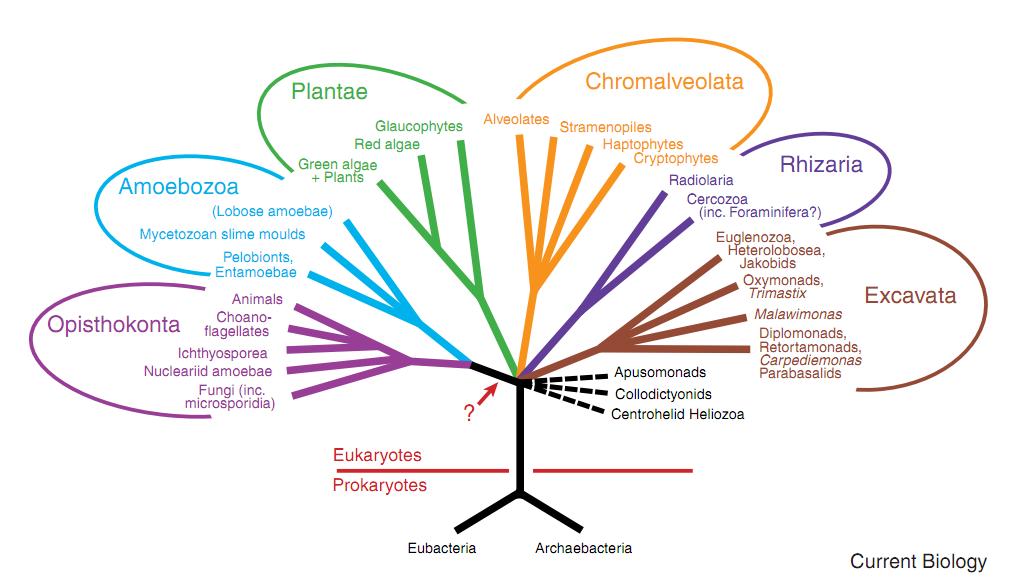
A diagrammatic tree depicting the organisation of most eukaryotes into six major groups. The relationships amongst most of the major groups and the position of the ‘root’ of the tree are shown as unresolved (note however, the grouping of Opisthokonta and Amoebozoa). The arrow shows a possible precise placement of the root, based on gene fusion data. (Simpson and Roger 2004)
Depending on your view of phylogenetics, a recent publication in Nature reporting the discovery of a new kingdom-level branch on the tree of life, basal to Kingdom Fungi, is either a major revision of our current view of taxonomy or completely unsurprising and expected. While we mostly refer to the four kingdoms within Domain Eukarya as Protista, Plantae, Fungi, and Animalia, it’s understood by the scientific community that Protista is essentially a catch-all category, not a true clade, for eukaryotes that don’t quite fit into the other three groups. While this is convenient for organization, it fails to adequately express the diversity of protists. Four kingdoms is a useful system, but there’s no reason why diversity at the kingdom level couldn’t be much higher. A strict cladist could create hundreds, if not thousands of kingdoms from Protista alone.
The wildfire that ignited in Dare County last week is still burning, as many coastal residents were reminded last night when the wind changed and brought smoke inland. Fortunately, the incident command is reporting that the fire is more than 50% contained, has not reached the town of Stumpy Point, and did not penetrate to … Read More “Short update on the North Carolina Wildfire and Red Wolves” »
Question: If your elected officials fail basic taxonomy, promote anti-science curriculum, and consistently attempt to undermine the fundamental underpinning of all biology, what happens when they start trying to legislate from this flawed view of reality?
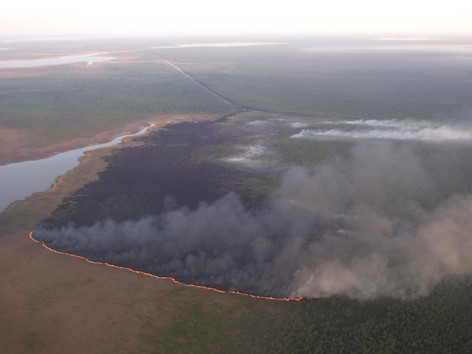
Early hours of the wildfire in Dare Country. Image NCFWS
In Beaufort, the first sign that something was amiss occurred on Sunday night. The air became thick with haze and smelled like of burning mulch. At first we thought it was just an overzealous barbecue somewhere down the road, but as we drove over the Morehead City highrise bridge, we discovered that the smoke was everywhere. This wasn’t an isolated grilling accident, trash burn, or house on fire, some thing was burning, something big. It could only be a forest fire, and, judging by the direction of the wind, it was blowing in from somewhere near the Outer Banks.
Bonehenge is our community outreach project of choice here at Southern Fried Science. Over the last few years we’ve been raising money and publicity to help make Bonehenge a reality. There is a widget on the left side of the page where you can make a donation to help build Bonhenge. We’ll match all donations up to $250 dollars, so you can make you contribution count double. Here are three reasons why you should contribute to Bonehenge:
 We are in the midst of a global extinction crisis. Biodiversity is in decline as species after species disappear. Some estimates predict that up to 50% of species will be committed to extinction by 2050. Other estimates claim the current rate of extinction may be 10,000 times the background rate. Many ecologists and conservationists have declared the current species decline the sixth great mass extinction.