Skip to content

Southern Fried Science

Over 15 years of ocean science and conservation online

  • Home
  • About SFS
  • Authors
  • Support SFS

Category: Blogging

Mr Darcy’s Guide to Conference Etiquette – Part 1

Posted on September 4, 2014September 5, 2014 By Chris Parsons
Blogging

It is a truth universally acknowledged that conferences are a necessity for the professional growth of an academic. They are important occurrences for learning about the methods and results of peers in one’s field, cutting edge techniques and the latest information that could be incorporated into one’s own studies and papers. With the vast quantity of scientific publications now available that would fill library upon library in my family seat of Pemberley, conferences veritably serve up a buffet of the latest and most relevant research results, saving one weeks of searching and heaven forbid, reading. Conferences are also opportunities for informal colloquies where one can receive and give advice, share ideas and develop research and writing partnerships. Many of these latter activities occur, of course, outside of the lecture halls, over a bottle of claret or a glass of port – or, for the less refined, a dram of Scotch whisky. Rare is the conference where one does not come home with a leather-bound notebook full of contacts with whom to correspond, studies to cite and methods to apply to one’s own work. Occasionally conferences have even been known to foster romantic liaisons, and there has been more than one highly advantageous and amicable marriage that has resulted from an academic meeting.

Oh yes, conferences are also places where one may share one’s own work. They give one a chance to share data and ideas with academic peers, to receive support, or possibly criticism, so that one can strengthen and refine one’s analysis and one’s interpretation of data.

However, it is becoming all too common that, for many, the latter is the only reason to go to a conference. Moreover, an oral presentation is increasingly the only format of worth and if one’s abstract is not accepted, or if one is offered “merely” an alternative format, such as a poster, one will refuse to attend.

Quite frankly, I view any academics who would refuse to attend a conference on their own specialist topic because they are denied an oral presentation, as poor and narrow-minded. Nothing grows in a vacuum, and innovative science is no exception. To refuse to attend a meeting because one is not presenting a talk is to figuratively cut off one’s nose to spite one’s face. It is the academic who suffers who denies himself the latest research results from, and direct interaction with, the best scholars in his field.

I recognize that there are many academic institutions that will provide funding for conferences only when one has an oral presentation accepted, but if one belongs to such an institution, then work to change its policy! Such institutions are stifling academic growth, and moreover ultimately reducing their visibility, reputation and enrollment. Each academic that goes to a conference is potentially an opportunity to market and advertise a university, and potentially attract and recruit students. The tuition from just a single graduate student persuaded to come to a university or college by talking to a conference goer, pays back the expenses of sending that person to the conference tenfold. This also encompasses funding graduate students, as potential students would as likely, if not more so, listen to their peers about an institution. A single happy, enthusiastic graduate student at a conference could potentially attract dozens of other students to apply to a college or university, a fact that many academic administrators overlook to their financial disadvantage.

Moreover, do not look down upon alternative presentation formats. Posters give one a unique ability to talk directly to conference goers, often while they are well flown on a glass or two of wine, in a depth one cannot achieve with the audience at an oral presentation. A single good, well-designed poster is also very memorable, much more so than dozens of slides in an oral presentation. Speed presentations likewise are excellent conveyors of certain types of information, such as innovative ideas or hypotheses, and like the poster can often be more memorable. Moreover, if one can describe one’s research in a three minute window clearly and concisely, one can also present one’s information in a way that might be more palatable to the general public, the press or policy makers. If one has a project that needs to reach a wider audience – for example, research on the conservation of an endangered species, or highlighting a new threat to the environment – a speed presentation might indeed be the best format.

As for other aspects of participating in conferences, if one volunteers to review abstracts, please do so promptly. Many people are waiting to make travel plans and visa applications, or finalize grant applications based on these decisions. By dilly-dallying, one may not only frustrate the organizers (who very often are senior members of one’s field who will likely remember those who are reliable and efficient reviewers and those who are lazy wastrels who do not live up to their commitments – I certainly do!) but also deny colleagues the chance of attending the conference, ultimately impacting their careers. Also, when and if reviewing, be ethical. If one is given the abstract of a colleague in one’s department, a student or similar, or even a competitor, and one clearly has a conflict of interest, do the right thing and declare it.  The organizers will respect honesty and professional integrity, and one will earn their respect, whereas if one’s conflict is not declared and is later discovered, it could be extremely detrimental, even ruinous, to one’s professional reputation.

If one’s submitted abstract is not accepted, do not write to organizers an angry tirade. “Do you not know who I am!” emails will not work, as they can easily see who one is – an entitled ego-ridden oik! Threats that one will not attend, or that one will tell one’s colleagues not to attend either, unless one’s abstract is accepted, will also not work. The organizers will likely respond not to let the carriage door hit one on the nether regions on the way out. Their job is already difficult, and having a recognized childish and obnoxious attendee at their meeting will not make their job any easier, or more pleasant for the other attendees. Moreover, such behavior is an attempt to circumvent the peer-review process. Peer-review is one of the foundations of academic quality control. Peer-review may have its faults, but it is the best feedback process academia has. Trying to circumvent peer-review by bullying and threats will only make one appear unethical and unprofessional in the eyes of the organizers, who as noted above, are likely to be senior. Most certainly they will be well connected, and will likely tell others about one’s unethical and unprofessional behavior (this again I have seen all too frequently).

It has also become all too common for would-be presenters to berate the scientific program committee if their presentation was chosen as an alternate format, even though the presenter indicated said format was their preferred alternate. Often such admonishments are accompanied with polemics along the lines of “there is no way I can convey the magnificence of my work in a speed presentation” or “I can guarantee that everyone will want to see my talk because it is so important/innovative/will single-handedly save the world/will change our understanding of the universe as we know it, so how can it be relegated to a poster.” Oh the arrogance…

However, people often must cancel attendance at conferences, and presentation slots may become available at the eleventh hour. If one would really prefer a different format for one’s presentation or a chance to present if rejected, politely (and I emphasize politely) contact the organizers and ask if one might be placed in a queue of some sort to take advantage of such last minute cancellations. A polite, good natured request is remembered, whereas an angry tirade… well, it too will be remembered but not in an advantageous way.

Assuming that all goes well and one’s abstract is accepted (even if it is not one’s first choice of format), one should note that many conferences require presenters to register in advance of the meeting, often by the early registration deadline to provide time for the organizers to build the program, and to contact wait-listed presenters in a timely manner. It is simply one’s own fault if one ignores email notifications and does not read submission instructions, and arrives at a meeting to find that one does not have one’s presentation in the program, because one did not register as required; a mistake which might be financially costly.

If the meeting approaches and one realizes that one cannot attend, do tell the organizers as quickly as possible. Conferences typically have a limited number of presentation slots and a queue of hopeful attendees, as noted above. If one informs the organizers swiftly, it will mean that perhaps someone else can present a talk in one’s absence, and as funding is often (sadly) dependent on presenting, perhaps even attend the meeting. By procrastinating and not informing organizers that one cannot attend, one has basically denied colleagues the potential to progress their careers, and for conservation meetings, perhaps even to help protect the environment. Moreover, do not pass on one’s work for another to present in one’s stead (another troubling trend). They will not be able to present it as well and will not be able to answer any questions appropriately. Again this is more likely to reflect badly upon oneself, as well as irritate the organizers who could have gifted one’s presentation slot to someone else, as noted above.

In my next installment I will describe the proper etiquette once a conference is actually upon one. But for now I must be away as my butler tells me that members of the local gentry are calling and I must play the gracious host. I only hope that they do not have a half of unmarried daughters in tow, looking for a suitable husband of means. Sometimes it is truly wearisome to have such a large and sought-after endowment.

???????????????????????????????

Sharks aren’t always the top of the food chain

Posted on September 3, 2014 By David Shiffman 1 Comment on Sharks aren’t always the top of the food chain
Blogging, Science

Most people think of sharks as being apex predators, large, fearsome  hunters sitting right at the top of the ocean food chain.  Of course, that isn’t always the case. There are more than 500 known species of sharks, and they vary in size from the size of a pencil to the size of a school bus. In many cases, there’s a larger predator in their environment, which can lead to some surprising and amazing  interactions.

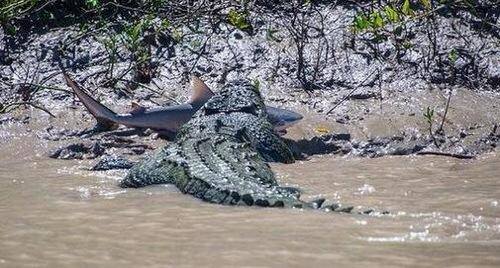
A crocodile ate a bull shark

Brutus, a famous crocodile in Australia, was recently photographed eating a juvenile bull shark. Southern Fried Science writer Sarah Keartes has the full story at EarthTouch.

Photo by Andrew Paice

Read More “Sharks aren’t always the top of the food chain” »

Throwback Thursday: The Birth of @WhySharksMatter

Posted on August 28, 2014 By Andrew Thaler 2 Comments on Throwback Thursday: The Birth of @WhySharksMatter
Blogging

Today we celebrate the 30th birthday of David Shiffman, but the entity known as WhySharksMatter was born on an entirely different day. On January 26, 2009, David officially joined Southern Fried Science and assumed the handle that would soon become the most prolific shark conservation activist online. Here, for posterity, is the original chatlog where we discussed his future handle.

Read More “Throwback Thursday: The Birth of @WhySharksMatter” »

Shark Week 2014: documentary reviews, tweets, and media coverage

Posted on August 26, 2014 By David Shiffman 3 Comments on Shark Week 2014: documentary reviews, tweets, and media coverage
Blogging, Popular Culture, Reviews and Interviews, Science

Another Shark Week has come and gone, and despite being out of the country at the time, I’ve managed to keep up my record of never having missed a single Shark Week documentary. I gotta tell you, though, some of them are really hard to watch. While there there is undoubtedly some great educational programming focusing on science, natural history and conservation, the Discovery Channel is doubling down on the troubling recent trend of blatantly lying to viewers with fake documentaries that use actor playing scientists and CGI video. In a time when public misunderstanding and distrust of science and scientists is already high, the Discovery Channel has decided to actively perpetuate misunderstanding and distrust of science and scientists. I’ve included my reviews (which originally were posted on my Facebook page after each show) of each of the documentaries below, along with a link to the Storify of my twitter reactions and links to some of the media coverage.

Upwell held another successful Sharkinar, bringing together scientists, conservationists, communicators and educators to talk about how “Team Ocean” can best take advantage of the increased public interest in sharks during Shark Week. Indeed, many members of Team Ocean were able to use the temporary increase in public interest in sharks to get important messages out to the media, and I’ve linked to and summarized some of the best examples below, but imagine how much more effective we could be if we didn’t have to first debunk the lies aired on a supposedly educational non-fiction television channel?

Read More “Shark Week 2014: documentary reviews, tweets, and media coverage” »

Can Shark Week do more for its female viewers?

Posted on August 14, 2014August 14, 2014 By Guest Writer
Blogging

???????????????????????????????Vicky Vásquez is a Moss Landing Marine Labs graduate student under the Pacific Shark Research Center. Her Master’s thesis focuses on the soupfin shark population of San Francisco Bay. Before beginning her graduate program, Vicky worked in marine education for over 7 years with groups like the Ocean Discovery Institute and the Marine Science Institute. This work has fostered Vicky’s passion in outreach education with a special interest in working with at-risk students and under-served communities. She has continued this work as the founding Deputy Director of a new non-profit in San Francisco Bay, the Ocean Research Foundation (ORF). You can follow Vicky on Twitter @VickyV_TeamORF and get updates about ORF through their Facebook Page. 

Was anybody else bothered by Shark Week’s King of Summer campaign? I wasn’t at first. I thought it was hilarious! I found this light-hearted commercial of a guy riding two sharks to be on par with the ridiculousness of SyFy shark movies like Sharknado or Ghost Shark. It’s just too silly to take seriously.  More so, I was just relieved they finally moved away from their Snuffy the Seal theme which vilified and eventually killed a shark for eating its natural prey of seal. However, after watching the subsequent versions which include Bob the Shark and Rob Lowe, I couldn’t help but get a annoyed. What is with that freaking mermaid?!

So men are kings and women are mermaids?

Perhaps some of you may think I’m spoiling the fun of Shark Week by bringing this up, but the Be the King of Summer promotion reflects my point. People were asked to insert their own faces into this add. Although women did participate, they most commonly posted their faces as the mermaid at the King’s knees. I understand that this is all in good fun and obviously those women did too. However, very similar to this mermaid persona, is the growing number of women whose shark conservation work has been recognized for their sole approach of being sexy while swimming with large sharks. Despite that sounding like a jab against them, it really is not. My concern is that there is an equal number, if not more, women who are protecting sharks through research. For instance, there were 60 female scientists that presented research at the 2014 Sharks International Conference. Nevertheless, Shark Week predominantly features white male hosts and researchers despite the slowly growing number of women (as well as people of color) in the science and engineering fields. I therefore can’t help but wonder, where are they on TV? 

Read More “Can Shark Week do more for its female viewers?” »

A roundup of misleading, deceptive, and dangerous shows produced by Discovery Communications

Posted on August 12, 2014August 12, 2014 By Andrew Thaler 1 Comment on A roundup of misleading, deceptive, and dangerous shows produced by Discovery Communications
Blogging

It’s no secret that we’ve produced quite a bit of critical commentary regarding Discovery Communications (whose properties include Shark Week, Animal Planet, TLC, and many others) over the years. This Shark Week, we’re seeing a massive spike in interest around their less-than-factual productions. Here, for your convenience, is a quick roundup of articles we’ve written about misleading, deceptive, and dangerous shows produced by Discovery Communications.

The Big Three:

  • Mermaids: The New Evidence is a Fake Documentary
  • Megalodon: the New Evidence is a fake documentary
  • Shark of Darkness: Wrath of Submarine is a fake documentary

Read More “A roundup of misleading, deceptive, and dangerous shows produced by Discovery Communications” »

Megalodon: the New Evidence is a fake documentary

Posted on August 7, 2014 By David Shiffman 3 Comments on Megalodon: the New Evidence is a fake documentary
Blogging, Popular Culture, Science

So was last year’s “Megalodon: the monster shark lives.”  Both Shark Week specials claim to show evidence that Carcharocles megalodon, the largest predatory shark that ever lived, is still alive. In both cases, the evidence is 100% completely and totally fake. A disclaimer from “the monster shark lives” Video evidence is CGI, images are photoshopped, and … Read More “Megalodon: the New Evidence is a fake documentary” »

The Dark Side of Academia

Posted on August 7, 2014September 2, 2014 By Chris Parsons
Blogging, Science

ParsonsDr. Chris Parsons has been involved in whale and dolphin research for over two decades and has been involved in research projects in every continent except Antarctica. Dr. Parsons is an Associate Professor at George Mason University as well as the undergraduate coordinator for their environmental science program. He’s a member of the scientific committee of the International Whaling Commission (IWC), has been involved in organizing the International Marine Conservation Congress (IMCC) (the world’s  largest academic marine conservation conference) and is currently the Conference Chair and a Governor of the Society for Conservation Biology. In addition, Dr. Parsons has published over 100 scientific papers and book chapters and has written a textbook on marine mammal biology & conservation.

Listen, my Sith apprentice, strong in knowledge you are but there are those who are stronger and more intelligent than you, but to persevere and gain in status, strong in the dark side you must become. In these times funding is limited, tenured positions are few, and competition is great. Graduate students are many, and many of these have ideas for new research and new hypotheses that pose a threat to the current order. The hierarchy must be maintained with us at the apex, and no competition must be allowed.  Nurturing, cooperation, and egalitarianism -those are the characteristics of the light side and the light side is weak, and progress on the light side is slow. So my Sith apprentice, here is my advice to you to progress and succeed, especially when there are those around you who are more innovative, knowledgeable and intelligent than you.

Read More “The Dark Side of Academia” »

About those lionfish

Posted on July 28, 2014July 28, 2014 By Andrew Thaler 3 Comments on About those lionfish
Blogging

We’ve been monitoring the situation surrounding a south Florida lionfish study that’s been blowing up the headlines thanks to a feel-good story about a young student’s science fair project and a subsequent controversy surrounding a former grad student who feels slighted for having his name left out of the research. We decided not to comment … Read More “About those lionfish” »

Cascading planetary-wide ecosystem effects of the extirpation of apex predatory Krayt dragons on Tatooine

Posted on July 22, 2014 By David Shiffman
Blogging, Conservation, Popular Culture, Science

Author’s note: this post is part of the “Science of Tatooine” blog carnival. Though obviously about science fiction and not the real world, it includes real ecological theories,  and it uses some real peer-reviewed scientific papers as references. Whenever possible, I’ve linked to accessible copies of those papers and explainers of these ecological terms. Many of the same issues are associated with shark population declines. 

ABSTRACT

Predators play an important role in structuring ecosystems, with predator population declines being linked to a variety of negative ecological effects. Here, we present evidence that the planet Tatooine, famous throughout the Galaxy for being a desert planet, experienced desertification as a result of unintended changes in herbivore populations caused by the intentional large-scale killing of apex predators by offworld colonists. Fossil evidence and interviews showing traditional ecological knowledge suggest that once-abundant Krayt dragons were hunted to near extinction by early human colonists. As a result of the decline in predation, populations of large herbivorous banthas populations grew out of control and overgrazed the plants once found throughout Tatooine.

INTRODUCTION

Studies of numerous ecosystems have consistently shown the importance of intact populations predators to healthy ecosystems, with a recent review (Estes et al. 2011 “trophic downgrading of planet Earth”) noting that “the loss of apex consumers is arguably humankind’s most pervasive influence on the natural world.” Population declines of top predators can cause a trophic cascade, resulting in unintended consequences that ripple through a food chain. Sea otter population declines in the Pacific Northwest of the United States resulted in predation release of otter prey (sea urchins), and an overabundance of sea urchins destroyed entire kelp forest ecosystems by overgrazing (Estes et al. 1998 “killer whale predation on sea otters linking oceanic and nearshore systems.) Wolf population declines in Yellowstone National Park resulted in predation release of wolf prey (elk,) and an overabundance of elk destroyed aspen pine forests by overgrazing (Ripple et al. 2011 “trophic cascades among wolves, elk, and aspen on Yellowstone National Park’s northern range.”)  Ecosystem-wide effects stemming from the loss of predators has also been listed as the proximate cause of disease outbreaks (Pongsiri et al. 2009 “biodiversity loss affects global disease ecology,”), increasing destructive wildfires (Perrings et al. 1997 “biodiversity resilience and the control of ecological-economic systems: the case of fire-driven rangelands,”) and overall biodiversity loss (Paine 1969, “Pisaster-tegular interaction: prey patches, predator food preference, and intertidal community structure.”)

Though the planet Tatooine in the Tatoo system of the Outer Rim is known by researchers to have once been covered by oceans and lush vegetation, it is commonly known now as a desert planet (source). While it is famous in Republic circles primarily for being the home of Jedi Master Skywalker, Tatooine also has native sentient species, including Jawas and Tusken Raiders (the latter are derisively referred to by locals as “sand people” ).  Native non-sentient animals include banthas (large herbivores used as beasts of burden) and the now mostly extinct Krayt dragon (a large predatory species that fed on banthas).

Read More “Cascading planetary-wide ecosystem effects of the extirpation of apex predatory Krayt dragons on Tatooine” »

Posts pagination

Previous 1 … 12 13 14 … 19 Next

Popular Posts

Shark scientists want their research to help save threatened species, but don’t know how. Our new paper can help.Shark scientists want their research to help save threatened species, but don’t know how. Our new paper can help.December 1, 2025David Shiffman
Norway and Cook Islands put their deep-sea mining plans on pause.Norway and Cook Islands put their deep-sea mining plans on pause.December 3, 2025Andrew Thaler
What Ocean Ramsey does is not shark science or conservation: some brief thoughts on "the Shark Whisperer" documentaryWhat Ocean Ramsey does is not shark science or conservation: some brief thoughts on "the Shark Whisperer" documentaryJuly 2, 2025David Shiffman
2025: My year in writing, public speaking, and media interviews2025: My year in writing, public speaking, and media interviewsDecember 3, 2025David Shiffman
What we know we don't know: impacts of deep-sea mining on whales, dolphins, sharks, turtles, and other migratory species.What we know we don't know: impacts of deep-sea mining on whales, dolphins, sharks, turtles, and other migratory species.November 20, 2025Andrew Thaler
What is a Sand Shark?What is a Sand Shark?November 12, 2017Chuck Bangley
Shark of Darkness: Wrath of Submarine is a fake documentaryShark of Darkness: Wrath of Submarine is a fake documentaryAugust 10, 2014Michelle Jewell
Build a dirt cheap, tough-as-nails field computer in a Pelican caseBuild a dirt cheap, tough-as-nails field computer in a Pelican caseJuly 21, 2015Andrew Thaler
Alberta, Canada is the proud owner of the largest man-made pyramid on the planetAlberta, Canada is the proud owner of the largest man-made pyramid on the planetOctober 16, 2012Andrew Thaler
"Twitter sucks now and all the cool kids are moving to Bluesky:" Our new survey shows that scientists no longer find Twitter professionally useful or pleasant"Twitter sucks now and all the cool kids are moving to Bluesky:" Our new survey shows that scientists no longer find Twitter professionally useful or pleasantAugust 19, 2025David Shiffman
Subscribe to our RSS Feed for updates whenever new articles are published.

We recommend Feedly for RSS management. It's like Google Reader, except it still exists.

Southern Fried Science

  • Home
  • About SFS
  • Authors
  • Support SFS


If you enjoy Southern Fried Science, consider contributing to our Patreon campaign.

Copyright © 2025 Southern Fried Science.

Theme: Oceanly Premium by ScriptsTown