Skip to content

Southern Fried Science

Over 15 years of ocean science and conservation online

  • Home
  • About SFS
  • Authors
  • Support SFS

Category: Popular Culture

Seven ways the heroes of the Marvel Cinematic Universe could stop runaway climate change.

Posted on April 9, 2018November 11, 2018 By Andrew Thaler
Popular Culture

One of the big ironies of superhero comics and movies is that these beings of immense power, though committed to saving the world, do so by punching things pretty hard. Even when far more obvious solutions to world shaking challenges are presented, the question is not “what will do the most good for the most people” but “can I punch at it really, really hard?” Superman could have done far more for his adoptive home world if he used his limitless strength to turn a crank on an alternator.
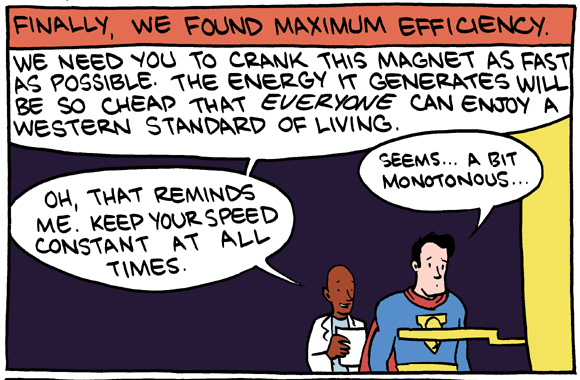
Weinersmith knows what’s up.

Heroes in the Marvel Cinematic Universe don’t fair much better. While off avenging, sorcering, and civil warring, they’ve managed to overlook some fairly self-evident solutions to the most pressing global crisis of our time. So how could Earth’s Mightiest Heroes bring an end to runaway climate change?

1. Tony Stark creates unlimited free energy.

We can get the obvious one out of the way, first. Stark’s Arc Reactor is, for all intents and purposes, a free energy machine. Miniaturization means Arc Reactors could be used to power anything, from cars to aircraft carriers to entire cities. Switching the world’s power grid and transportation network to Arc tech would result in an immediate reduction in CO2 emissions and halt the accumulating damage of continuous energy growth as demand for technology increases around the world.

Ok, that’s the obvious one that has to be mentioned in order to avoid insufferable Twitter comments. Now on the the good stuff.

2. Use Pym Particles to sequester CO2 in the Quantum Realm. 

Pym Particles are particles that “shrink the spaces between atoms” allowing an object bombarded with these particles to shrink continuously while maintaining its mass, unless it’s a tank on a key-chain, for some reason. Comic books are ridiculous, ok?

Unfortunately, the shrinking power of Pym Particles is limitless, and once an object shrinks to the point where it’s smaller than an atom, somehow, it enters the Quantum Realm, where the laws of Newtonian physics no longer apply, time is meaningless, and you can never escape (except when you can). Shrink into the Quantum Realm and you shrink forever. That really seems like the ideal place to sequester CO2 , doesn’t it?

The big problem with carbon sequestration is that it’s not always a permanent solution. Sequestered CO2 in trees is only sequestered so long as no one cuts those trees down and burns them. The carbon is still out there in the world, waiting to be re-mobilized into the environment. But! If we could sequester carbon by bombarding it with Pym Particles and sending it to the Quantum Realm, it would shrink forever, permanently locked away in a world of very poorly interpreted quantum physics. That seems safe.

Read More “Seven ways the heroes of the Marvel Cinematic Universe could stop runaway climate change.” »

Shiver me whiskers! What would it cost to fund the Octonauts’ undersea adventures?

Posted on March 11, 2018March 12, 2018 By Andrew Thaler 1 Comment on Shiver me whiskers! What would it cost to fund the Octonauts’ undersea adventures?
Popular Culture

Octonauts live in the sea. Hardware’s their specialty. While ocean grants are a struggle… their source of funding, it really is a puzzle!

Explore! Rescue! Protect! The Octonauts have an ambitious undersea mission and an equally ambitious fleet of marine vehicles. How they pay for it is a mystery. Are they backed by the federal government? The UN? Is Professor Inkling financing this venture by selling genetically engineered vegetable-fish hybrids? Is a billionaire film-maker backing the venture? One thing’s for certain, an Octonaut-level research program does not come cheap. So how much does this operation actually cost?

Actuaries! To your stations!

The Octopod

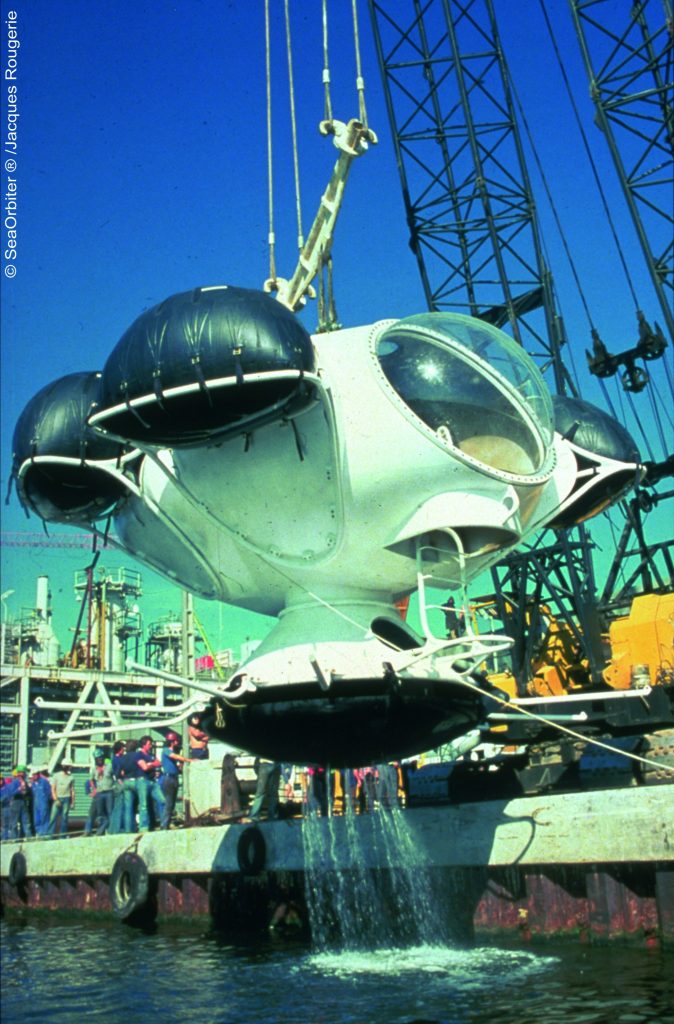
With 4 housing/laboratory units and a central command bay, the Octopod would be the largest and most sophisticated underwater research station ever operated. There’s nothing in the marine research world the even comes close. Aquarius Reef Base is currently the only working undersea research laboratory. I can’t find the initial budget to build and install Reef Base, but a modern (albeit unrealized) aquatic residential habitat comes with a $10 million startup costs. Reef Base itself has a wildly variable annual budget, with a baseline around $1 million per year. The Octopod, on the other hand, has four Octo… Pods? each of which is similar in function to Reef Base (though the whole structure more closely resembles the extremely French Galathée Underwater Laboratory).

Galathée Underwater Laboratory

The central command bay is both the core of the Octopod and its power supply. Not much is known about where the Octopod gets its seemingly limitless power, but if the Octonauts are anything like the US Navy, there’s a nuclear reactor in the, somewhere. Meet Nerwin. NR-1 was the USA’s only nuclear-powered, deep-diving research submarine. With room for 16 crew and scientists and a multi-month endurance, Nerwin could hand both covert and scientific missions. The NR-1 was equipped with a wheeled base, allowing it to roll across the sea floor. Unfortunately, NR-1 was a strictly off-book asset for most of its life, so we don’t really know what it cost, but the initial build estimate was $58.3 million. As the military is not often known for bringing projects in under budget, that seems like a reasonable baseline. For annual operating costs, we might as well assume the upper end of Reef Base at $3 million to start. It’s almost certainly much *much* higher.

Cost to build: $98.3 million.

Annual operating cost: $7 million.

Read More “Shiver me whiskers! What would it cost to fund the Octonauts’ undersea adventures?” »

The importance of being Aquaman, or how to save the Atlantean from his briny fate

Posted on October 26, 2017 By Andrew Thaler
Popular Culture

This is an update and repost of our follow-up article on the science of Aquaman, revised and expanded. 


Aquaman has an unpleasant lunch. From New 52 Aquaman #1
Aquaman has an unpleasant lunch. From New 52 Aquaman #1 DC Comics.

Yesterday, I challenged you to consider how the greatest hero in the DC Universe would fair if forced to survive in the real world. The result was a hypothermic, brain-dead lump of jerky with brittle bones, forced to suffer through constant screams of agony even as he consumes sea life at a rate that would impress Galactus. In short, the ocean is a rough place, even for Aquaman.

But this is Southern Fried Science, and we’re not here to trash the greatest comic book hero of all time without offering some solutions, too. I went back to my comic books and my textbooks to assemble an Aquaman with a suite of evolutionary adaptations that would allow a largely humanoid organism to rule the waves, trident triumphantly raised.

Essential assumptions

Many people commented that Aquaman is not human, he is Atlantean, and thus is not bound by human limitations. This is wrong on at least two counts. First, in most iterations, Aquaman is half-human, which means that Atlanteans must be similar enough to humans, both physiologically and evolutionarily, to produce a viable hybrid. While there may be some minor differences between us and the children of Atlantis, functionally speaking, we’re the same. Second, these are not issues that plague only humans. Whales get the bends, amphibians freeze to death, fish need to regulate their internal osmolality. These are the problems inherent in being alive in the ocean, Atlantean or otherwise.

Read More “The importance of being Aquaman, or how to save the Atlantean from his briny fate” »

The horrifying physiological and psychological consequences of being Aquaman

Posted on October 25, 2017 By Andrew Thaler
Popular Culture

This is an update and repost of our seminal article on the science of Aquaman, revised and expanded. 


Aquaman. DC Comics.
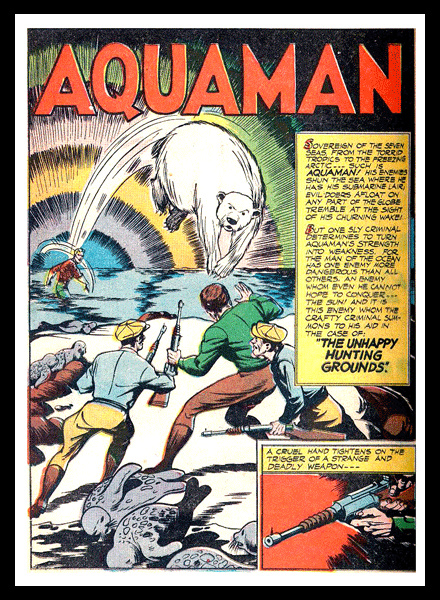
Aquaman. DC Comics. A rational response to seal poaching is to lob a polar bear at the aggressors.

Aquaman may not be everybody’s favorite superhero, but since his creation in 1941, he has been among DC’s most enduring icons. During the Golden Age of comics, he held his own against Superman, Batman, and Wonder Woman. Silver Age Aquaman was a founding member and eventually leader of the Justice League. His powers, tied to the ocean, forced writers to create a compelling, complex hero with explicit limitations. In the early days, when Superman’s strength was practically infinite, and Batman’s brilliance was unmatched, Aquaman had to become more than just a superhero, he had to be a person.

If Superman existed to show us how high the human spirit could fly, and Batman to show us the darkness within even our most noble, Aquaman is here to show us the world that triumphs in our absence. The ocean is not ours, and no matter how great our technology, we will never master it as we have mastered land. Aquaman has. Through this lonely ocean wanderer, we can experience a world that we can never truly command. In many ways, Aquaman was stronger than the Man of Steel and darker than the Dark Knight. He knew loneliness that the orphan and the alien exile never could.

Even though Aquaman had to fight harder, endure the jokes of other, less interesting heroes, and find relevance in an ecosystem hostile to the humans that had to empathize with him, Aquaman was never forced to confront the truly horrifying consequences of life in the ocean.

The penetrating cold

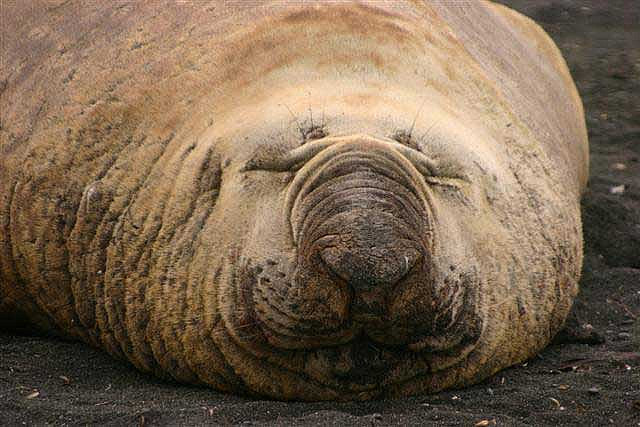
Aquaman is, for all intents and purposes, a marine mammal. With the exception of a healthy mane in later incarnations, he is effectively hairless. As a human, we would expect his internal body temperature to hover around 99°F, or about 37°C. Even at its warmest points, the surface temperature of the ocean around the equator is only about 80°F/27°C. At the poles, ocean temperature can actually drop a few degrees below freezing. In the deep sea, ambient temperature levels out around 2 to 4°C. The ocean is cold, and water is a much better thermal conductor than air. Warm blooded species have evolved many different systems to manage these gradients, including countercurrent heat exchangers, insulating fur, and heavy layers of blubber. This is what a marine mammal that can handle cold waters look like:

Elephant Seal. NSF, photo by Mike Usher

Aquaman is not just a human, he is an atypically uninsulated human. If the man has more than 2% body fat, I’d be shocked. In contrast, warm-water bottlenose dolphins have at least 18 to 20% body fat. Anyone who SCUBA dives knows that, even with a 12 millimeter neoprene wet suit, after a few hours in 80°F water, you get cold. Aquaman, lacking any visible insulation, should have slipped into hypothermia sometime early in More Fun Comics #73. He is built for the beach rather than the frigid deep.

Jason Momoa is not a man blessed with an over-abundance of “bioprene”.

Read More “The horrifying physiological and psychological consequences of being Aquaman” »

Desert island discs – the marine conservation edition

Posted on August 4, 2017August 4, 2017 By Chris Parsons
Conservation, Open Science, Popular Culture

In the UK, there is a famous and long-running radio show called Desert Island Discs. On this show celebrities are asked to imagine that they are marooned on a desert island, but they have rescued 10 discs (mp3s I suppose these days…) of songs that they have rescued from their sinking ship to keep them company on the desert island.

clipart credit: istock.com

My chum – marine mammal scientist and general ocean hero – Asha De Vos recently asked for a list of key papers in marine conservation that she could pass onto students working on marine conservation issues in Sri Lanka. So I decided to write up my top ten “desert island” marine conservation papers that I think have been influential, and that all marine conservation students should read.

So after much pondering, this is my list:

Read More “Desert island discs – the marine conservation edition” »

The sorting hat of conservation

Posted on August 1, 2017 By Chris Parsons
Conservation, Popular Culture

The Hogwarts Sorting Hat divides students into their respective houses in their first year at the school of witchcraft and wizardry. Each house is known for having its own “personality.” In addition to potential wizards/witches, one can also sort those involved in conservation into the four Hogwarts houses.

  • Hufflepuff – This house stands for dedication and hard work, but also patience, tolerance, fair play and kindness. Most conservationists working in NGOs, especially those related to protection of megafauna species, are Hufflepuffs. One famous Hufflepuff was Newton Scamander, a socially awkward wizard who took it upon himself to try to save endangered magical creatures, when others just saw them as pests. Most of the herbology teachers at Hogwarts were Hufflepuffs (Neville Longbottom being a notable exception).

Read More “The sorting hat of conservation” »

The Game of Thrones – is this real life, or is this just fantasy…?

Posted on August 1, 2017August 4, 2017 By Chris Parsons
Popular Culture

“I trust the eyes of an honest man more than ‘what everybody knows’ “

– Tyrion Lannister to Jon Snow, as Jon tries to convince everyone that he has seen the Army of the Dead coming.


In the current season of Game of Thrones, Cersei Lannister is unexpectedly sitting on the Iron Throne of Westeros after immolating most of the existing peerage in King’s Landing. Because of this purge, most of the seats in the Privy Council are empty (assuming she even means to establish one), and her inner circle consists of: the Hand of the Queen, a clever ex-Maester with no morals or ethics; the commander of the Queen’s Guard, a conscience-less zombie; and two military commanders, one a troubled brother/lover and one an ambitious wily psychopath, of uncertain loyalty.

Read More “The Game of Thrones – is this real life, or is this just fantasy…?” »

How to spot a scam shark documentary producer

Posted on July 24, 2017 By Michelle Jewell
Popular Culture

Many aspects of science-ing are not explicitly taught, and scientists become accustomed to mastering the deep end.  While this tactic can make you stronger, there are situations where the deep end is a vulnerable place where nasty critters are very happy to take advantage.

One such area?  How to handle being contacted by “producers.”  In my experience, for every 1 exceptional producer you speak with, you will be contacted by at least 4 scammers.  Scam producers will particularly target naïve early-career scientists, just like white sharks and seal pups.  In light of this week, I’ve put together a guide to aid YOY scientists rising in the ranks of popularity and make the deep end a little safer.  Here are 13 ways to spot scam shark documentary producers, with a few 🚩🚩:

Read More “How to spot a scam shark documentary producer” »

Dear John: Farming and technology in the near future.

Posted on March 29, 2017March 29, 2017 By Andrew Thaler
Popular Culture

I wrote this story a couple of years ago and have been trying to find a home for it ever since. As the issue of proprietary software’s relationship to agricultural technology is back in the news, I figure it’s time to stop shopping this short science fiction story around and put it in front of a real audience. For some real-world background reading, see:

  • Why American Farmers Are Hacking Their Tractors With Ukrainian Firmware.
  • Hacking the Tractor: what the future of farming means for open science.
  • New High-Tech Farm Equipment Is a Nightmare for Farmers.
  • We Can’t Let John Deere Destroy the Very Idea of Ownership.

DEAR JOHN.

It started with the tractor. Or, rather, it stopped with the tractor. John Willis climbed down from the cabin of his dead machine and removed the cowling. Everything looked fine. The diesel engine shined, its green accents still brilliant.

After years trading his skill with a wrench and a soldering iron for access to his neighbors’ equipment, he finally owned a tractor of his own. The latest model, too. Not ostentatious, but with just enough comforts to make up for the last ten years. The tractor was new, bought debt-free through the Farm Act and a decade of careful planning and backbreaking labor. Expensive, but built to last.

Except it didn’t last. For the third time in an hour, the engine seized, the wheels locked, the console went dead. Willis sighed. He had acres to till and he wasn’t in the mood to spend a day stripping the engine, hunting for some tiny defect. He could send it to the service yard, but he couldn’t afford to wait for an authorized repair. The quote alone would set him back a week.

He couldn’t afford another late planting. Not this year.

He started the tractor. It roared back to life, the engine purred but the console beeped and flashed with panic, a thousand different alarms. The manual, a massive, multi-gigabyte document, was sitting on his work computer, back in the barn. For whatever reason, he couldn’t get it to download to his field tablet. He put the tractor in gear and continued down the field.

Fifteen minutes later, the tractor was dead again.

Well, he thought to himself, at least there’s a rhythm to it. He limped down the rows in quarter-hour bursts.

Read More “Dear John: Farming and technology in the near future.” »

Why do wizards go adventuring ? Or …. you thought that your tenure requirements were tough?!

Posted on February 23, 2017February 23, 2017 By Chris Parsons
Academic life, Popular Culture

Something that has been bothering me for a while, is why do wizards go adventuring?

Source: ClipArtLord.com

Now if you are a big geek like me, you’ll know that practically every adventuring party has a wizard. But these wizards are incredibly unprepared for exploring dungeons and have a shockingly high mortality rate. In the dungeons and dragons* of my youth, a starting wizard had a mere 1 to 4 hit points and was equipped with dagger (or is they were luck a staff). Did these budding Gandalfs get armor? Of course not, they faced ogres and basilisks in the fantasy equivalent of sweat pants.

The statistics of a starting wizard meant that they could easily be killed by a house cat. Also they had just one spell. Cast “light” so that your party could see in a cave, and you were done for the day. If you had the most destructive spell of the first level wizard, you would fire a “magic missile” that always hit, but did a miserable 2 to 5 (1d4+1)  points of damage. So if  jumped by  above mentioned angry house cat, you literally had a 50/50 chance of killing it before it killed you**.

So why do all these highly educated, highly intelligent wizards leave their ivory (or mithril) towers and trudge through cold, dank dungeons with groups of characters that generally make the knights in Monty Python and the Holy Grail look like Seal Team 6  in comparison?

Why does every early career academic pursue elusive gold and put their common sense and lives on the line? Why…? To get tenure of course…

Read More “Why do wizards go adventuring ? Or …. you thought that your tenure requirements were tough?!” »

Posts pagination

Previous 1 2 3 4 … 19 Next

Popular Posts

Shark scientists want their research to help save threatened species, but don’t know how. Our new paper can help.Shark scientists want their research to help save threatened species, but don’t know how. Our new paper can help.December 1, 2025David Shiffman
Norway and Cook Islands put their deep-sea mining plans on pause.Norway and Cook Islands put their deep-sea mining plans on pause.December 3, 2025Andrew Thaler
What Ocean Ramsey does is not shark science or conservation: some brief thoughts on "the Shark Whisperer" documentaryWhat Ocean Ramsey does is not shark science or conservation: some brief thoughts on "the Shark Whisperer" documentaryJuly 2, 2025David Shiffman
2025: My year in writing, public speaking, and media interviews2025: My year in writing, public speaking, and media interviewsDecember 3, 2025David Shiffman
What we know we don't know: impacts of deep-sea mining on whales, dolphins, sharks, turtles, and other migratory species.What we know we don't know: impacts of deep-sea mining on whales, dolphins, sharks, turtles, and other migratory species.November 20, 2025Andrew Thaler
The Trouble with Teacup PigsThe Trouble with Teacup PigsOctober 14, 2012Andrew Thaler
Urea and Shark OsmoregulationUrea and Shark OsmoregulationNovember 15, 2010David Shiffman
How tiny satellites are tracking marine wildlifeDecember 1, 2025Andrew Thaler
Shark of Darkness: Wrath of Submarine is a fake documentaryShark of Darkness: Wrath of Submarine is a fake documentaryAugust 10, 2014Michelle Jewell
What is a Sand Shark?What is a Sand Shark?November 12, 2017Chuck Bangley
Subscribe to our RSS Feed for updates whenever new articles are published.

We recommend Feedly for RSS management. It's like Google Reader, except it still exists.

Southern Fried Science

  • Home
  • About SFS
  • Authors
  • Support SFS


If you enjoy Southern Fried Science, consider contributing to our Patreon campaign.

Copyright © 2025 Southern Fried Science.

Theme: Oceanly Premium by ScriptsTown