

Skip to content

Southern Fried Science

Over 15 years of ocean science and conservation online

  • Home
  • About SFS
  • Authors
  • Support SFS

Category: Reviews and Interviews

People and Ideas You Should Know: 5 Questions with Anupa Asokan

Posted on January 22, 2025 By Angelo Villagomez
People and Ideas You Should Know: 5 Questions with Anupa Asokan
Conservation, Education, Featured, Policy, Reviews and Interviews, Science

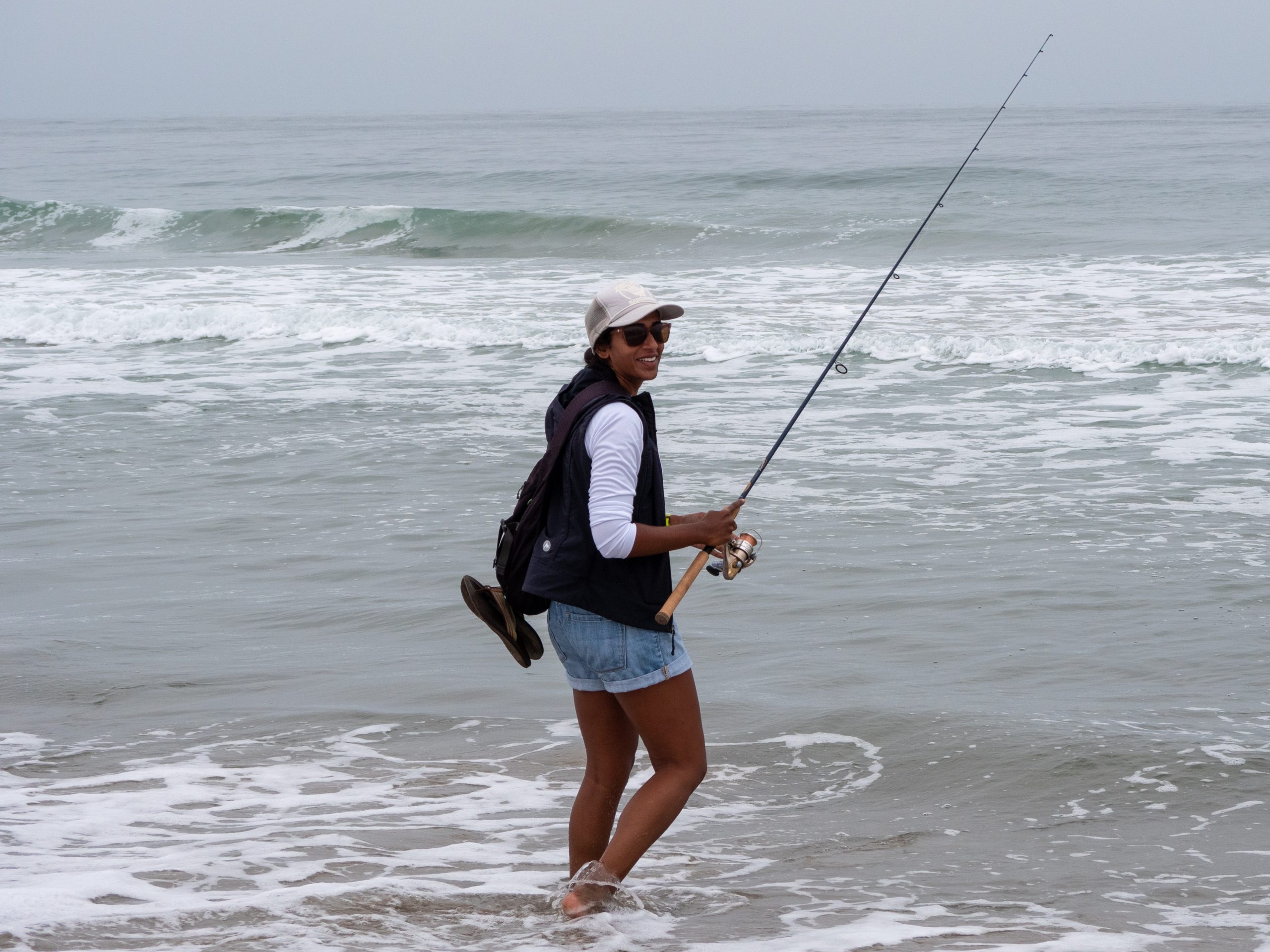
Anupa Asokan, founder and executive director of Fish On—a new fishing interest organization working to advance ocean conservation policy—recently published a peer-reviewed perspective in Frontiers, “Marine Protected Areas as a Tool for Environmental Justice.” Anupa is a lifelong fisherwoman and has become a passionate advocate for ocean conservation and justice.  I’ve known her for several … Read More “People and Ideas You Should Know: 5 Questions with Anupa Asokan” »

“The Shark is Broken” is a Broadway-loving shark scientist’s dream come true

Posted on October 2, 2023January 4, 2024 By David Shiffman 1 Comment on “The Shark is Broken” is a Broadway-loving shark scientist’s dream come true
“The Shark is Broken” is a Broadway-loving shark scientist’s dream come true
Popular Culture, Reviews and Interviews

A new Broadway show based on the making of Jaws, co-written by and starring Robert Shaw’s son, is some of the most fun I’ve had at the theater in years. Wearing my finest elasmo-swag to the theater “Jaws” changed the world, with scientific, cultural, and political impacts that continue to this day. Jaws made the … Read More ““The Shark is Broken” is a Broadway-loving shark scientist’s dream come true” »

Oh Hell No: Ten Years of SharkNado

Posted on August 16, 2023January 4, 2024 By David Shiffman
Oh Hell No: Ten Years of SharkNado
Featured, Popular Culture, Reviews and Interviews, Science

Summer 2023 marks an important cultural milestone. That’s right, it has now been ten years since the release of SharkNado, which became a full-blown franchise with six movies, tens of millions in ad revenue and merchandise sales, real-world references in the floor of Congress, and near-universal awareness- all things that are otherwise unheard of for … Read More “Oh Hell No: Ten Years of SharkNado” »

Shark Week 2019 reviews and thoughts

Posted on December 24, 2019December 24, 2019 By David Shiffman
Popular Culture, Reviews and Interviews, Science

I wasn’t able to watch live this year, but I DVR-ed all 18 specials and watched them eventually! Here are my reviews, ratings, and thoughts. I did not watch the feature-length movie, which they claim is the first fictional entertainment content they’ve ever produced… causing me to stare in megalodon. Overall, this was not a strong year for science, facts, or diversity (of either sharks or shark researchers).

As a reminder, I grade on the following aspects of a show: is there actual science or natural history educational content / is there made up nonsense, are actual credentialed experts with relevant expertise featured or are they self-proclaimed “shark experts” who say wrong nonsense all the time, what species are featured (with bonus points for species we rarely or never see), and do they feature diverse experts or just the same white men (reminder: my field is more than 50% women)? It’s not a perfect rubric, but it’s better than this actual system for ranking shark news introduced this year in “sharks gone wild 2:”

Rankings appear in no particular order, if you care about the order the shows actually aired in please see this Discovery press release.

Read More “Shark Week 2019 reviews and thoughts” »

Book review: “Shark Research: Emerging Technologies and Applications for the Field and Laboratory”

Posted on June 7, 2019June 7, 2019 By David Shiffman
Reviews and Interviews, Science, Uncategorized

Editors: Jeffrey C. Carrier, Michael R. Heithaus, Colin A. Simpfendorfer. CRC Press, available here.

I can’t imagine a more useful introductory reference guide for new or prospective graduate students starting their career in marine biology than “Shark Research: Emerging Technologies and Applications for the Field And Laboratory”. This book is designed for people who have little to no familiarity with a research discipline but are about to start working in that discipline, a large and important audience that is often ignored by books and review papers geared towards people who are already experts. So many graduate students are told to learn a new research method by reading technical literature that assumes they already know this stuff, resulting in stress and frustration.

Read More “Book review: “Shark Research: Emerging Technologies and Applications for the Field and Laboratory”” »

The Quest for the best tough 3D Printer for under $200: Our final recommendations

Posted on May 8, 2019November 15, 2019 By Andrew Thaler
Reviews and Interviews

You thought we were done, here. You were wrong. After extensively reviewing 5 3D printers for sale under $200 and picking the best from the reviews, we went back to our two favorites and put them through their paces, abusing both for an extra month to make sure that when I say this is the best printer for field work, I mean it.

  • Creality Ender-3 (with upgrades): A
  • Monoprice Select Mini: B+
  • Monoprice Mini Delta: B-
  • Creality Ender-3 (unmodified): B-
  • Anet A6: D+
  • iNSTONE Desktop DIY: No

These printers have been dragged around, beaten up, put in the hands of children and child-like adults, and run through the wringer to ensure that they stand up to the kind of abuse you might expect from the field. Now we’re really ready to make the call and tell you which are the best dirt-cheap, field-ready 3D printers.

Read More “The Quest for the best tough 3D Printer for under $200: Our final recommendations” »

At last, a $200 3D Printer that might actually hold up to a field season. The Creality Ender-3 (review).

Posted on April 1, 2019November 15, 2019 By Andrew Thaler
Reviews and Interviews

[NOTE: Please see our update regarding this printer: Finding the best dirt-cheap, field-tough 3D printer for science and conservation work: six months later.]

Somewhere between the Prusa printers with their paired z-axis motors and the cantilever systems with a gantry arm spanning the x- or y-axis with only a single point of support, lies printers like the Creality Ender-3. Where a more conventional 3D printer uses rails and linear bearings to drive the axes, these printers forgo the standard model.

You won’t find a single linear bearing on the Creality Ender-3 or it’s clones. Instead, rubber rollers pass through v-slot grooves in extruded aluminum, removing the need for complex gantry systems.

This is an incredibly robust method for cutting costs, but it is not a compromise. Roller and v-slot printers can be just as precise as their rail and bearing counterparts, and the mandated all aluminum construction makes them strong and durable.

Creality Ender-3. Photo by Author.

For a general-use field-ready 3D printer, you could not do much better than the Creality Ender-3.

Read More “At last, a $200 3D Printer that might actually hold up to a field season. The Creality Ender-3 (review).” »

I built the cheapest 3D printer available online so that you don’t have to: iNSTONE Desktop DIY (review)

Posted on March 14, 2019November 15, 2019 By Andrew Thaler
Reviews and Interviews

How cheap can a 3D printer be and still function? Although they seemed plucked out of science fiction, there’s not really that much to these machines. A few stepper motors, some switches, a control board, a heating element, and a nozzle are really all you need. It’s the software, and the expiration of a bunch of patents, that kicked the 3D printing revolution into high gear.

Is it possible to assemble the right collection of components to make a functional 3D printer for less than $100? iNSTONE thinks you can, and they are not wrong.

Behold, the iNSTONE Desktop DIY.

iNSTONE Desktop DIY. Photo by Author.

This is the best printer you could build for $99. It’s terrible. I love it. You absolutely should not buy it.

Read More “I built the cheapest 3D printer available online so that you don’t have to: iNSTONE Desktop DIY (review)” »

The ongoing search for an inexpensive, field-ready 3D printer: Monoprice Select Mini (review)

Posted on March 7, 2019November 15, 2019 By Andrew Thaler
Reviews and Interviews

Monoprice, the king of rebadged 3D printers, has two entries in the sub-$200 printer category. We already dug into the guts of the Mini Delta, a great little delta-style printer, and now it’s time for the Monoprice Select Mini! This is a pretty standard cantilever printer, with the x-axis tied to the print bed and an y-axis connected by a single support to a moving gantry. It’s basic, but solid, with a bare-bones set of features that gets the job done.

The Monoprice Select Mini is currently for sale on Amazon for $189. I got mine in white because every other printer manufacturer has decided that you can have whatever color you want as long at it’s matte black.

Monoprice Select Mini. Photo by author.

There is also a Select Mini Pro which, since this review series started, has been discounted to $199. It does look like it has some nice features that make it wort the extra $11, including an automatic bed leveler, magnetic build plate, and touch screen. The budget for this series is blown, but if Monoprice wants to send us one *hint hint* I’ll be happy to put it through the wringer.

Monoprice is a rebadger, as we explained in the Delta review, and this printer is identical to the Malyan M200, which itself seems to be an improvement on the Infitary R100.

This is the only printer in our series with steel construction, so I have high hopes that it will stand up to the abuse I’m about to heap upon it.

For an explanation of our testing protocols, please see: We’re gonna beat the heck out of these machines: The search for the best dirt-cheap 3D printer for fieldwork.

Read More “The ongoing search for an inexpensive, field-ready 3D printer: Monoprice Select Mini (review)” »

The search for an inexpensive, field-ready 3D printer continues: Anet A6 (review)

Posted on February 21, 2019November 15, 2019 By Andrew Thaler
Reviews and Interviews

One of the reasons 3D printing exploded seemingly overnight a decade ago has a lot to do with the RepRap project, an initiative to build a fully open-source and largely 3D-printable 3D-printer. The idea of a machine that could replicate itself was pulled straight from the pages of science fiction, and yet, here were machines–janky, kludgey, barely functional, machines–assembled from parts clearly fabricated by those same machines. They were conceptually impressive, but not a particularly awe-inspiring sight to behold.

And then came Josef Průša and the Prusa Mendel.

Affectionately known as the Ford Model T of the 3D printing world, the Prusa Mendel was the first of the open-source 3D printers that was designed to be easily mass produced. It looked good and it ran great. Released under an open-source license, it was replicated and iterated on a massive scale. That didn’t prevent Průša from building a successful company. The current Prusa i3 MK2 is among the most successful desktop 3D printers in the world, and certainly one of the best.

There are a lot of Prusa i3 clones.

Clocking in at $197.69, the Anet A6 is the most expensive printer in this review series. It’s also the biggest, with a massive 220mm by 220mm by 250mm build area. It’s an upgraded version of the popular Anet A8, with a larger build volume and a better user interface, but not much else. From reviews, this printer seemed like a solid representation of what you can get at the top end of the menagerie of sub-$200 Prusa i3 clones. It (and its smaller A8 brother) certainly have the fan-base and hacking community to support its reputation.

Anet A6, working hard. Photo by author.

This acrylic-framed beast ships as a kit, so expect to spend half a day putting this printer together.

If you’re going off of dollar per cubic millimeter, this is the best bang for you buck by a wide margin. And that’s about the extent of the good things I have to say about this machine.

For an explanation of our testing protocols, please see: We’re gonna beat the heck out of these machines: The search for the best dirt-cheap 3D printer for fieldwork.

Read More “The search for an inexpensive, field-ready 3D printer continues: Anet A6 (review)” »

Posts pagination

1 2 Next

Popular Posts

Shark scientists want their research to help save threatened species, but don’t know how. Our new paper can help.Shark scientists want their research to help save threatened species, but don’t know how. Our new paper can help.December 1, 2025David Shiffman
Norway and Cook Islands put their deep-sea mining plans on pause.Norway and Cook Islands put their deep-sea mining plans on pause.December 3, 2025Andrew Thaler
What Ocean Ramsey does is not shark science or conservation: some brief thoughts on "the Shark Whisperer" documentaryWhat Ocean Ramsey does is not shark science or conservation: some brief thoughts on "the Shark Whisperer" documentaryJuly 2, 2025David Shiffman
The Trouble with Teacup PigsThe Trouble with Teacup PigsOctober 14, 2012Andrew Thaler
What we know we don't know: impacts of deep-sea mining on whales, dolphins, sharks, turtles, and other migratory species.What we know we don't know: impacts of deep-sea mining on whales, dolphins, sharks, turtles, and other migratory species.November 20, 2025Andrew Thaler
2025: My year in writing, public speaking, and media interviews2025: My year in writing, public speaking, and media interviewsDecember 3, 2025David Shiffman
Urea and Shark OsmoregulationUrea and Shark OsmoregulationNovember 15, 2010David Shiffman
Shark of Darkness: Wrath of Submarine is a fake documentaryShark of Darkness: Wrath of Submarine is a fake documentaryAugust 10, 2014Michelle Jewell
Build a dirt cheap, tough-as-nails field computer in a Pelican caseBuild a dirt cheap, tough-as-nails field computer in a Pelican caseJuly 21, 2015Andrew Thaler
How tiny satellites are tracking marine wildlifeDecember 1, 2025Andrew Thaler
Subscribe to our RSS Feed for updates whenever new articles are published.

We recommend Feedly for RSS management. It's like Google Reader, except it still exists.

Southern Fried Science

  • Home
  • About SFS
  • Authors
  • Support SFS


If you enjoy Southern Fried Science, consider contributing to our Patreon campaign.

Copyright © 2025 Southern Fried Science.

Theme: Oceanly Premium by ScriptsTown