Skip to content

Southern Fried Science

Over 15 years of ocean science and conservation online

  • Home
  • About SFS
  • Authors
  • Support SFS

Category: Science

Two Years of Deep-sea Mining in Review: ISA rushes forward

Posted on March 18, 2022March 17, 2022 By Andrew Thaler
Two Years of Deep-sea Mining in Review: ISA rushes forward
Science

As in-person negotiations on the future of exploitation in the deep ocean resume this week in Kingston Jamaica, we reflect back on the last two years of development as reported on our sister site, the Deep-sea Mining Observer. This editorial first appeared on September 30, 2021.


Opinion by Andrew Thaler, DSMO Editor-in-Chief

The International Seabed Authority published their provisional roadmap for the next two years of international negotiations, optimistically culminating with the approval of the Mining Code for polymetallic nodules in areas beyond national jurisdiction. This ambitious goal depends upon the ability to resume ISA sessions in Kingston, a scenario that continues to be unlikely, with many participants and stakeholders expressing doubt that in-person meetings will resume before boreal summer 2022. 

The ISA hopes to get at least a few delegations to return to Jamaica before the end of the year. As part of their new schedule, they expect to hold a much-abridged meeting of the Assembly and Council this December. The ISA is encouraging member states to send small delegations of no more than 2 individuals or use already in-country representatives from existing permanent missions. Observers are limited to sending a single individual. Even with a smaller format, several stakeholders have expressed doubts that the ISA will be able to gather enough members for a quorum. 

Read More “Two Years of Deep-sea Mining in Review: ISA rushes forward” »

Two Years of Deep-sea Mining in Review: Deep-sea Mining has Time.

Posted on March 18, 2022March 17, 2022 By Andrew Thaler
Two Years of Deep-sea Mining in Review: Deep-sea Mining has Time.
Science

As in-person negotiations on the future of exploitation in the deep ocean resume this week in Kingston Jamaica, we reflect back on the last two years of development as reported on our sister site, the Deep-sea Mining Observer. This editorial first appeared on August 27, 2021.


Opinion by Andrew Thaler, DSMO Editor-in-Chief

As we enter the final quarter of 2021, with a global pandemic still raging across all but a few countries and impacting supply chains and critical work throughout the world, it looks increasingly unlikely that an in-person session of the ISA will be possible before 2022, marking two years of substantially diminished progress on the development of the mining code and increasing frustration among stakeholders. Some of the most important voices at the negotiating table continue to struggle to get the latest outbreak under control. India, Russia, the UK, and Japan are not only among the top ten countries with the most new Covid cases as of this week but are ISA member states that sponsor mining contractors (at least one other contractor-sponsoring member state has stopped reporting new cases, while the United States, though not a member state, is also in the midst of a pandemic surge and contributes capacity and expertise to ISA negotiations).

In light of this global progress slowdown, not just for deep-sea mining, but among a host of international challenges and objectives, the push for urgency among some mining contractors and sponsoring states simply does not add up.

Read More “Two Years of Deep-sea Mining in Review: Deep-sea Mining has Time.” »

Two Years of Deep-sea Mining in Review: The Precarious Partnership Between Deep-sea Mining Contractors and Environmental NGOs

Posted on March 18, 2022March 17, 2022 By Andrew Thaler
Two Years of Deep-sea Mining in Review: The Precarious Partnership Between Deep-sea Mining Contractors and Environmental NGOs
Science

As in-person negotiations on the future of exploitation in the deep ocean resume this week in Kingston Jamaica, we reflect back on the last two years of development as reported on our sister site, the Deep-sea Mining Observer. This editorial first appeared on June 25, 2021.


Opinion by Andrew Thaler, DSMO Editor-in-Chief

Deep-sea mining occupies a unique niche in the annals of extractive exploration. Its modern manifestation owes as much to the surging demand of critical minerals as it does to the work of environmental organizations shining a light on the vast environmental and ethical catastrophes of terrestrial mining. In its current form, deep-sea mining is an industry motivated by the need to rapidly wean ourselves from fossil fuels. It is, in short, an industrial response to an environmental crisis. 

Whether or not it is the right response, for whatever “right” means in the midst of a global crisis while the clock is ticking, remains to be proven. No plans of work have been approved and no mining licenses have been issued by the International Seabed Authority for Areas Beyond National Jurisdiction. What few attempts have been made in territorial waters have not reached production or have collapsed under the complexity of the operation. Deep-sea mining is an industry that has been perpetually just over the horizon. That horizon creeps closer every year.

There is an precarious partnership between deep-sea mining contractors and environmental NGOs, two entities with wildly differing views of what the world needs to reach sustainable development, but a recognition, at least in principle, that negotiation and compromise are possible. Even the calls for moratoria leave room for the possibility that deep-sea mining can be shown to be sustainable.

Read More “Two Years of Deep-sea Mining in Review: The Precarious Partnership Between Deep-sea Mining Contractors and Environmental NGOs” »

Two Years of Deep-sea Mining in Review: A 3-decade-long disturbance study on the deep abyssal plain.

Posted on March 17, 2022March 17, 2022 By Andrew Thaler
Two Years of Deep-sea Mining in Review: A 3-decade-long disturbance study on the deep abyssal plain.
Science

As in-person negotiations on the future of exploitation in the deep ocean resume this week in Kingston Jamaica, we reflect back on the last two years of development as reported on our sister site, the Deep-sea Mining Observer. This article first appeared on May 22, 2020.


In the late 1980s, as the first wave of deep-sea mining exploration approached a decade of hibernation, researchers launched an ambitious experiment to understand the long-term environmental impact of harvesting polymetallic nodules from the abyssal plain. The Disturbance and recolonization experiment in a manganese nodule area of the deep South Pacific (DISCOL) remains the most ambitious attempt to understand how nodule extraction affects deep ocean ecosystems. Though interest (and funding) waxed and waned with the prevailing interest in deep-sea mining, now, more than 30 years later, DISCOL provides the only large, multi-decade impact study from which contractors, regulators, and environmental advocacy groups can draw inferences about the recovery and resilience of deep-sea ecosystems following mining-induced disturbances throughout the lifetime of an ISA-issued mining exploration or exploitation lease. 

The 1980s saw a surge in interest for deep-sea mining. The successful early campaigns of the late 1970s, bolstered by CIA funding for Project Azorian, presented a future of seemingly limitless profit scattered across the seafloor. That the early financial projections were supported by covert government funding was not yet widely known, and, even for those who were privy to the operation, regardless of initial funding the value had been established, the ship built, the technology sea-trialed. The profit potential was there. What was still tabula rasa was the environmental consequences of extraction on an almost completely unknown ecosystem.

Read More “Two Years of Deep-sea Mining in Review: A 3-decade-long disturbance study on the deep abyssal plain.” »

Two Years of Deep-sea Mining in Review: Confusion and Gridlock at the 26th Session of the International Seabed Authority

Posted on March 17, 2022March 17, 2022 By Andrew Thaler
Two Years of Deep-sea Mining in Review: Confusion and Gridlock at the 26th Session of the International Seabed Authority
Science

As in-person negotiations on the future of exploitation in the deep ocean resume this week in Kingston Jamaica, we reflect back on the last two years of development as reported on our sister site, the Deep-sea Mining Observer. This article first appeared two years ago, on March 19, 2020.


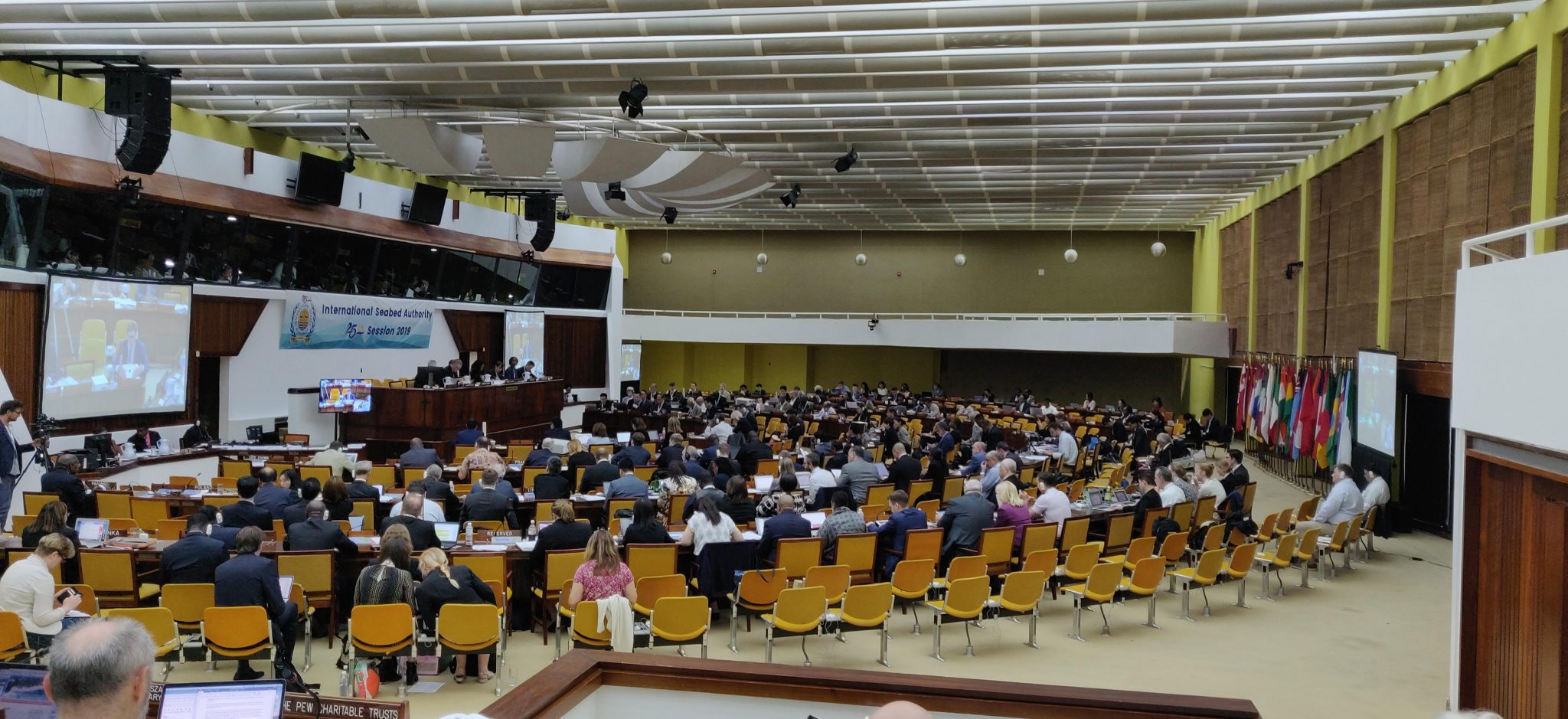
The 26th Session of the International Seabed Authority convened this February to continue the long and complex negotiations over the draft Mining Code and work towards consensus among the various stakeholders. 2020 was set as the target year to get the Mining Code finalized, but many delegates left Jamaica feeling frustrated with the pace of deliberations and a growing sense that the 2020 deadline was far too optimistic. Chief among the challenges was a recognition that the Council is now further from reaching agreement on the financial model than it was at the end of the 25th Session and a lack of clarity over the composition of the Legal and Technical Commission as it pertains to the representation of both geographic distribution and technical expertise.

Procedural Gridlock slows negotiations

The overwhelming sentiment of member state delegates, NGO’s, and even contractors was a sense of dysfunction and confusion, best highlighted by the fact that over a 5-day meeting, the Council went through three new presidents. First, as outgoing Council President Lumka Yengeni was absent from the meeting, outgoing regional Vice-president Luis del Solar assumed the chair to preside over the selection of a new council president. Usually, a Regional Group arrives at the ISA with a nominee for council president already prepared. Not this time. A three hour delay to select the president of the 26th Session of the ISA on the morning of the first day set the tone for the week. 

Read More “Two Years of Deep-sea Mining in Review: Confusion and Gridlock at the 26th Session of the International Seabed Authority” »

Two Years of Deep-sea Mining in Review: As deep-sea mining inches towards production, a global pandemic brings negotiations to a halt.

Posted on March 17, 2022 By Andrew Thaler
Two Years of Deep-sea Mining in Review: As deep-sea mining inches towards production, a global pandemic brings negotiations to a halt.
Science

As in-person negotiations on the future of exploitation in the deep ocean resume this week in Kingston Jamaica, we reflect back on the last two years of development as reported on our sister site, the Deep-sea Mining Observer. This article first appeared two years ago, on March 18, 2020.


When the first part of 26th Session of the International Seabed Authority convened last month, there was a new stakeholder impacting the pace of deliberations. COVID-19 had just begun to spread beyond China and nations across the world were limiting travel in the hopes of containing the outbreak. With Jamaica imposing a 14-day quarantine on any traveler coming from China, the Chinese delegation was notably absent, with a delegation from the New York mission standing in for their colleagues. But they weren’t the only delegation affected. Multiple delegates whose travel was supported by the Commonwealth we’re also unable to attend. 

Though those absences did slow down deliberations and cast a pallor over the proceedings, they were nothing compared with what happened next. 

Earlier this week, Forbes published a contributor article entitled “Will Ocean Seabed Mining Delay The Discovery Of Potential Coronavirus Vaccines?” Though hyperbolic in its reaction to an industry which has yet to even begin production, ironically Forbes may have gotten the situation reversed: long before deep-sea mining has even the remote potential to delay the development of novel pharmaceuticals, the COVID-19 pandemic will almost certainly delay the development of deep-sea mining. 

Read More “Two Years of Deep-sea Mining in Review: As deep-sea mining inches towards production, a global pandemic brings negotiations to a halt.” »

I built a horrifying cyborg sea turtle hatchling so you can learn a little bit about behavioral ecology

Posted on April 22, 2021April 22, 2021 By Andrew Thaler
I built a horrifying cyborg sea turtle hatchling so you can learn a little bit about behavioral ecology
Science

Sea turtles, in case you didn’t know, are pretty great. These giant marine reptiles have been chilling out in the ocean for over 100 million years, largely unchanged. But their evolutionary foray onto land along with the rest of the tetrapods (a move largely regarded as a mistake by most extant species) left them with one one critical vulnerability: they have to return to land to lay their eggs, and their hatchlings must survive a grueling march to the sea within minutes of emerging into the world.

To find their way back to the sea, sea turtle hatchlings emerge from their nests in the darkness and track light cues on the horizon, tracking the glow of starlight on waves. This becomes a huge problem when the beach is littered with the pollution of artificial lights, leading hatchlings away from the sea and towards streets, resorts, and beachfront bars. Light pollution is such a serious problem for sea turtle survival, that many municipalities which host turtle nesting beaches ban the use of superfluous lighting during nesting season. 

Protecting sea turtle nests and nesting sea turtles, particularly the massive, primordial leatherback sea turtle, is a core mission of the Dominica Sea Turtle Conservation Organization (DomSetCO). Leatherbacks are exceptionally sensitive to light. On the top of their heads is a translucent patch of skin directly above the pineal gland. This window to the turtle’s brain serves as a rudimentary third eye which can sense how light changes.

You can help support DomSetCO by donating to our campaign to build the Rosalie Conservation Center, a hybrid rum distillery, fish hatchery, and conservation center in Dominica. Drink rum, save turtles. 

Read More “I built a horrifying cyborg sea turtle hatchling so you can learn a little bit about behavioral ecology” »

The most massive ‘massive sardine’ discovered in the deep waters of Japan

Posted on March 8, 2021March 8, 2021 By Andrew Thaler
Science

This article originally appeared in the February 2021 issue of the Deep-sea Mining Observer. It is reprinted here with permission. For the latest news and analysis about the development of the deep-sea mining industry, subscribe to DSM Observer here: http://dsmobserver.com/subscribe/

Featured image: Colossal Slickhead, from Fujiwara et al. 2021

Even with the intense research focus of the last twenty years, the deep sea is still almost entirely unexplored. New species are par for the course every time a fresh sample is recovered from the abyssal plain. The vast biodiversity of the deep seafloor is offset by a biomass deficit; the denizens of the deep sea, with a few notable exceptions, are few and far between, their size often limited by the paucity of food available to them. While giants like the Japanese King Crab or the Giant Deep-sea Isopod do occur, the vast majority of deep-sea species are relatively small. 

The discovery of new species in the deep ocean is common, but the discovery of new giants in the deep sea is extremely rare. 

Last month, a research team from the Japan Agency for Marine-Earth Science and Technology (JAMSTEC) led by Dr. Yoshihiro Fujiwara and the Deep-sea Biodiversity Research Group announced the discovery of a new species of slickhead from the deep waters around Suruga Bay. Weighing in at 25 kilograms and measuring 140 centimeters, the Colossal Slickhead, described from four specimens recovered from depths greater than 2000 meters, is the largest species of slickhead (a group of deep-sea fishes found in waters deeper than 1,000 meters) yet described. 

In Japan, slickheads are commonly called sekitori iwashi–’massive sardines’. In recognition of its immense size, the researchers gave this most massive of massive sardines the common name yokozuna iwashi, after the title given to champion sumo wrestlers. 

Read More “The most massive ‘massive sardine’ discovered in the deep waters of Japan” »

Where is the Biden Ocean Team?

Posted on January 18, 2021January 18, 2021 By Andrew Thaler
Where is the Biden Ocean Team?
Science

In forty-eight hours, and amidst the largest peacetime deployment of a military force in any nation’s capitol, President Joe Biden will be sworn in as the 46th President of the United States of America. Biden will inherit a civil service bureaucracy that has been deconstructed by the twice-impeached President Trump. To build back a federal government that has been decimated and demoralized, President-Elect Biden has begun rolling out nominees for critical agencies throughout the federal government. And though these appointments have been met will enthusiasm from the environmental and scientific community, a nagging question lingers among America’s Ocean Stakeholders:

Where is the Biden Ocean Team?

Read More “Where is the Biden Ocean Team?” »

Beyond Batteries: exploring the demand for scandium and tellurium from the deep ocean

Posted on December 17, 2020December 11, 2020 By Andrew Thaler
Science

This article originally appeared in the October/November 2020 issue of the Deep-sea Mining Observer. It is reprinted here with permission. For the latest news and analysis about the development of the deep-sea mining industry, subscribe to DSM Observer here: http://dsmobserver.com/subscribe/ For the last decade, next-generation batteries have been the motivating force for the deep-sea mining industry. The … Read More “Beyond Batteries: exploring the demand for scandium and tellurium from the deep ocean” »

Posts pagination

Previous 1 … 8 9 10 … 82 Next

Popular Posts

What Ocean Ramsey does is not shark science or conservation: some brief thoughts on "the Shark Whisperer" documentaryWhat Ocean Ramsey does is not shark science or conservation: some brief thoughts on "the Shark Whisperer" documentaryJuly 2, 2025David Shiffman
Save the seals.  Congress is trying to shoot its way to salmon recoverySave the seals.  Congress is trying to shoot its way to salmon recoveryJuly 22, 2026Southern Fried Science
Shark of Darkness: Wrath of Submarine is a fake documentaryShark of Darkness: Wrath of Submarine is a fake documentaryAugust 10, 2014Michelle Jewell
What is a Sand Shark?What is a Sand Shark?November 12, 2017Chuck Bangley
That's not a blobfish: Deep Sea Social Media is Flooded by AI SlopThat's not a blobfish: Deep Sea Social Media is Flooded by AI SlopDecember 19, 2025Andrew Thaler
What can the funniest shark memes on the internetz teach us about ocean science and conservation?What can the funniest shark memes on the internetz teach us about ocean science and conservation?November 8, 2013David Shiffman
The “Conservation Paywall”: why saving the planet has become a luxury sportThe “Conservation Paywall”: why saving the planet has become a luxury sportJuly 23, 2026Chris Parsons
Our favorite sea monsters – Ningen (#4)Our favorite sea monsters – Ningen (#4)September 7, 2010Andrew Thaler
Jumping the shark: New study reviews the breaching behavior of sharks and raysJumping the shark: New study reviews the breaching behavior of sharks and raysSeptember 19, 2024David Shiffman
The story of the pride flag made from NASA imagery: Bluesky's most-liked imageThe story of the pride flag made from NASA imagery: Bluesky's most-liked imageSeptember 27, 2024David Shiffman
Subscribe to our RSS Feed for updates whenever new articles are published.

We recommend Feedly for RSS management. It's like Google Reader, except it still exists.

Southern Fried Science

  • Home
  • About SFS
  • Authors
  • Support SFS


If you enjoy Southern Fried Science, consider contributing to our Patreon campaign.

Copyright © 2026 Southern Fried Science.

Theme: Oceanly Premium by ScriptsTown