Skip to content

Southern Fried Science

Over 15 years of ocean science and conservation online

  • Home
  • About SFS
  • Authors
  • Support SFS

Category: Uncategorized

Fun Science FRIEDay – Beauty Sleep

Posted on November 28, 2014November 27, 2014 By Kersey Sturdivant
Blogging, Uncategorized

Happy Fun Science FRIEDay!!!

It’s the Turkey Holiday, and aside from eating and socializing, I suspect quite a many of you have also been getting lots of sleep!

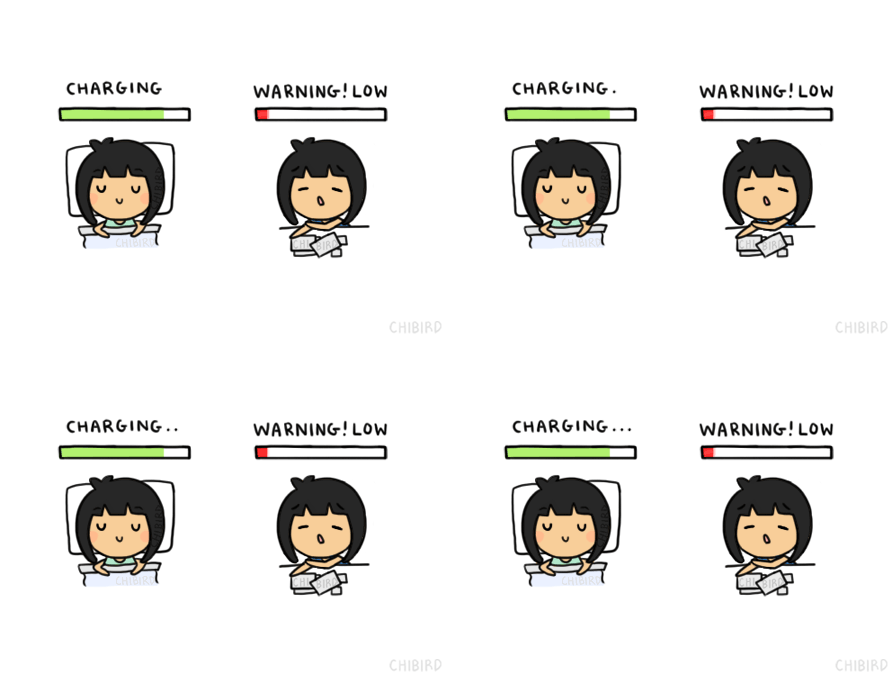
Despite how little of it some of us get during our normal routine, sleep is important… right? We know that sleep has tons of benefits for the body such as allowing our muscles and bones to repair themselves, and keeping our immune system healthy. Sleep is also important for our brains, allowing for memories to be consolidated and other important functions to be performed.

Sleeping is like recharging your batteries. ^u^  (Photo credit: Chibird, http://rebloggy.com/post/cute-sleep-animation/42472951026)
Sleeping is like recharging your batteries. ^u^
(Photo credit: Chibird, http://rebloggy.com/post/cute-sleep-animation/42472951026)

Read More “Fun Science FRIEDay – Beauty Sleep” »

Why #DoctorWho needs a science advisor!

Posted on November 5, 2014November 5, 2014 By Chris Parsons 2 Comments on Why #DoctorWho needs a science advisor!
Uncategorized

There is probably no one in the science geek/nerd community who has not heard of Doctor Who, even if they can’t recite the names of all 13 actors who have played a regenerating incarnation of the Doctor (I’m including the awesome John Hurt in this list), or don’t own an exceedingly long, multi-colored scarf. Doctor Who is the longest running science fiction TV show in the world (first airing in 1963) and consistently gains peak viewing figures in the UK, and has a substantial number of viewers around the world. It’s the British equivalent of Star Trek, although instead of phasers the Doctor has a sonic screwdriver – which is basically the science/engineering equivalent of a magic wand. Also there is distinctly less snogging of aliens and gratuitous bare-chested scenes in Doctor Who compared to Star Trek.

I’ve watched Doctor Who almost religiously since 1974, and as a youngster owned a complete set of Doctor Who novelizations, decades of annuals and a subscription to the magazine. I’m a dyed in the multi-colored wool Whovian (as fans are called).

Read More “Why #DoctorWho needs a science advisor!” »

Mr Darcy’s Guide to Conference Etiquette – Part 2

Posted on October 1, 2014October 8, 2014 By Chris Parsons 1 Comment on Mr Darcy’s Guide to Conference Etiquette – Part 2
Uncategorized

(click to see part 1)

It is indeed most vexing when an uninvited guest appears on one’s doorstep unexpectedly. So why is turning up at a conference without registering considered to be acceptable? When invited to dinner, one is expected to RSVP so that the host knows to expect one, and it is common courtesy to do the same for a conference – by registering early the organizers can plan in advance for catering, for transportation, for room sizes – a whole host of activities where knowing numbers in advance is helpful. If one does not register until the last moment, one cannot complain if rooms for presentations are fully scheduled with no space for additions, or they run out of biscuits at the coffee break. Late registrations are also more expensive, so unless one’s attendance at the meeting was literally a last moment decision, one has just wasted one’s own money purely because one was not organized.

Even worse is the person who “gatecrashes” a conference. Many meetings are organized by professional societies and/ or charities. Yet I have observed with mine own eyes people who exploit the open nature of conferences and attend sessions, parties and other activities without having paid, even to the extent of eating and drinking fare that others have paid for. Such people are the worst of scoundrels and are in effect stealing large amounts of money from said charities. Conferences are expensive to run and someone has to pay for the food that freeloading cad is eating. That is money that could have been spent, for example, on grants for participants who are students or from developing countries, but that now has to be spent paying for the shortfall caused by stowaway delegates.

Read More “Mr Darcy’s Guide to Conference Etiquette – Part 2” »

Fun Science FRIEDay – One microbial trash is another’s microbial treasure!

Posted on August 1, 2014September 1, 2014 By Kersey Sturdivant 1 Comment on Fun Science FRIEDay – One microbial trash is another’s microbial treasure!
Science, Uncategorized

Happy FSF!

You know that old saying, the one that explains how something devalued by one person is of the utmost value to another.

Well this week we bring you an analogy of that quote in nature, and in the form of microbes.

Leishmaniasis… have you heard of it? If not, do not worry, I had not either before I began writing this piece, and subsequently almost gagged while googling “appropriate” photos to accompany this piece.  Leishmaniasis is a disease caused by the protozoan parasite Leishmana. The vector that spreads this wonderful treasure? Sand flies. If you are unfortunate enough to get this disease it can turn your skin into all manner of foul lookingness. See Exhibit A.

Exhibit A

Skin ulcer on the hand due to leishmaniasis. (Photo credit: CDC Dr. S. Martin)

Read More “Fun Science FRIEDay – One microbial trash is another’s microbial treasure!” »

Connecting the Town and Gown: Cooperative Extension

Posted on July 31, 2014July 31, 2014 By Bluegrass Blue Crab
Uncategorized

Over the last few months, I’ve seen a few efforts proposed to better connect universities to local community research needs. While whole practices and skill sets around participatory action research, community-based research, etc., exist, these don’t quite meet the need these recent proposals attempt to address. These proposals are not talking one faculty research program implementing participatory methods, they want a fundamentally different relationship between researchers and the community surrounding them – which, in many ways, gets back to the roots of many universities in the United States: land-grant universities.

In 1862 and 1890, the Morrill Acts granted land to create universities to focus on practical education: agriculture, science, military, and engineering. Students and faculty research from these institutions, in return, would advance important industries and changing social class relations. The Smith-Lever Act of 1914 later extended the mission of these schools to extend the research results to users – creating the cooperative extension system. In short, science in service of society.

Read More “Connecting the Town and Gown: Cooperative Extension” »

Busting Ocean Myths: How many containers are really lost at sea?

Posted on July 27, 2014July 27, 2014 By Andrew Thaler
Uncategorized

The Claim: 10,000 containers are lost at sea every year.

Who said it: Monterey Bay Aquarium Research Institute, Slashdot, Yahoo News, NOAA, me, and many others.

Status: False.

10,000 is one of those numbers that’s big enough to be surprising, but not so huge to inspire immediate incredulity. The worldwide shipping industry is enormous and containers do get lost overboard. With a few recent high-profile maritime accidents, it’s not hard to believe that 10,000 containers could be sent to swim with the fishes every year.

The MOL Comfort breaks its back. Image via gCaptain.

Fortunately, it’s pretty hard to hide a missing container and the number of containers lost at sea is actually much lower than 10,000. In 2011 and 2014, the World Shipping Council surveyed it’s members to find out exactly how many containers are lost at sea each year. What they found was that not only was the number of lost containers an order of magnitude less than the 10,000 figure, but that the average was driven up by two catastrophic accidents–the sinking of the MOL Comfort and the grounding of the MV Rena.

Read More “Busting Ocean Myths: How many containers are really lost at sea?” »

Fun Science FRIEDay – All About the Benjamins Baby!

Posted on July 25, 2014July 24, 2014 By Kersey Sturdivant
Uncategorized

To quote the Notorious BIG, “It’s all about the Benjamins, BABY!”

That quote unfortunately holds true in many walks of life, and is especially applicable to this weeks FSF where Dr. Costanza, from Australian National University, and a number of colleagues puts a price tag on the world’s natural environment. Some of you are probably thinking, “Dude, that’s old news!”  In summary, yes, this is old news.. sorta.

(Photo credit: dreamstime.com)

Read More “Fun Science FRIEDay – All About the Benjamins Baby!” »

Education and Experience are Not Mutually Exclusive: Job Market Pet Peeves

Posted on July 22, 2014July 22, 2014 By Bluegrass Blue Crab 2 Comments on Education and Experience are Not Mutually Exclusive: Job Market Pet Peeves
Uncategorized

While looking at positions that allow me to jump off the sinking ship of academia, I’ve seen plenty of rewarding, fun, and excitingly challenging job announcements out there. Most of them require two to five years of experience in the field, and I’ve looked at those, said ‘yep, I qualify’, and turned in the application. I can’t say what happens after, but here’s the type of experience I thought I could safely check off, which met with a surprisingly negative response:

  • communicating complex technical issues to a diverse audience
  • social media and online outreach
  • project management
  • volunteer coordination
  • budget management
  • community engagement
  • mentoring and training employees
  • grant management and program development

When did I learn these tasks? In graduate school. And here’s where I can feel the doors shut on interest in my application. After applying for positions doing any one of the careers listed above, I’ve met the following responses many times:

Read More “Education and Experience are Not Mutually Exclusive: Job Market Pet Peeves” »

Good fish, bad fish: new draft FDA guidance considering mercury exposures

Posted on June 12, 2014June 13, 2014 By Bluegrass Blue Crab 2 Comments on Good fish, bad fish: new draft FDA guidance considering mercury exposures
Uncategorized

After years of scaring pregnant women away from fishy nutrition, the FDA is finally updating its recommendations to encourage them to eat 8-12  ounces of low-mercury fish a week. That’s 2 or 3 meals per week in order to support fetal growth and development. Curious about what fish are low mercury? Stay away from tilefish from the Gulf of Mexico, swordfish, shark, and king mackerel and limit albacore tuna to 6 ounces a week. Better options include “some of the most commonly eaten fish such as shrimp, pollock, salmon, canned light tuna, tilapia, catfish, and cod”. For locally caught fish, you should check with your local authorities. The new recommendations aren’t final – read the draft and write in if you want more information that would help you make safe and healthy seafood choices. Here’s some things you should consider.

Read More “Good fish, bad fish: new draft FDA guidance considering mercury exposures” »

We need a different economic model for supporting conservation work. Here’s my story.

Posted on May 12, 2014May 12, 2014 By Bluegrass Blue Crab 3 Comments on We need a different economic model for supporting conservation work. Here’s my story.
Uncategorized

Many years ago, I was offered a job doing restoration work at a coal company while perusing festival booths in Fairbanks, Alaska. Still wearing my college-aged rose colored glasses, I was skeptical of working for conservation within industry, said thanks-but-no-thanks, and returned to upstate New York to finish my degree. Looking back, I honestly believe I could have enacted more positive change for the earth had I taken that job than I have in the almost decade since.

I recall this story because while at a recent all-volunteer biodiversity festival, a friend asked me ‘why can’t people do all this great work as their paid work?’ A group of us stood around silently for a few minutes, realizing that this question derived of innocent curiosity delved deep into issues of societal values, our current economic system, and conservation philosophy. In short, the answer is that because conservation brings in none of its own revenue, but depends on the tax money or philanthropy of others. When that dries up, no conservation careers are available. And even when they are, a high percentage of time on the job is spent looking for future funding through grants.

Read More “We need a different economic model for supporting conservation work. Here’s my story.” »

Posts pagination

Previous 1 … 30 31 32 … 119 Next

Popular Posts

Playing God - How the ESA "God Squad" just voted for the extinction of a uniquely American whalePlaying God - How the ESA "God Squad" just voted for the extinction of a uniquely American whaleApril 9, 2026Southern Fried Science
The story of the pride flag made from NASA imagery: Bluesky's most-liked imageThe story of the pride flag made from NASA imagery: Bluesky's most-liked imageSeptember 27, 2024David Shiffman
Here's how to join my IMCC8 symposium, "Ocean Science Communication: What's New and What's Next?"Here's how to join my IMCC8 symposium, "Ocean Science Communication: What's New and What's Next?"April 22, 2026David Shiffman
What Ocean Ramsey does is not shark science or conservation: some brief thoughts on "the Shark Whisperer" documentaryWhat Ocean Ramsey does is not shark science or conservation: some brief thoughts on "the Shark Whisperer" documentaryJuly 2, 2025David Shiffman
Our favorite sea monsters – Ningen (#4)Our favorite sea monsters – Ningen (#4)September 7, 2010Andrew Thaler
Join Me at Upwell: A Wave of Ocean Justice — Our Fourth Year!Join Me at Upwell: A Wave of Ocean Justice — Our Fourth Year!March 24, 2026Angelo Villagomez
On the clarity of animals: the art and science of clearing and stainingOn the clarity of animals: the art and science of clearing and stainingDecember 17, 2013Guest Writer
Shark of Darkness: Wrath of Submarine is a fake documentaryShark of Darkness: Wrath of Submarine is a fake documentaryAugust 10, 2014Michelle Jewell
What can the funniest shark memes on the internetz teach us about ocean science and conservation?What can the funniest shark memes on the internetz teach us about ocean science and conservation?November 8, 2013David Shiffman
That's not a blobfish: Deep Sea Social Media is Flooded by AI SlopThat's not a blobfish: Deep Sea Social Media is Flooded by AI SlopDecember 19, 2025Andrew Thaler
Subscribe to our RSS Feed for updates whenever new articles are published.

We recommend Feedly for RSS management. It's like Google Reader, except it still exists.

Southern Fried Science

  • Home
  • About SFS
  • Authors
  • Support SFS


If you enjoy Southern Fried Science, consider contributing to our Patreon campaign.

Copyright © 2026 Southern Fried Science.

Theme: Oceanly Premium by ScriptsTown