Skip to content

Southern Fried Science

Over 15 years of ocean science and conservation online

  • Home
  • About SFS
  • Authors
  • Support SFS

Fun Science FRIEDay – Harnessing Synthetic Biology to Fight Ocean Pollution

Posted on December 16, 2016December 16, 2016 By Kersey Sturdivant
Conservation, Science

Plastics, more importantly microplastics, clog our oceans. This phenomena in the ocean has been likened to smog around cities. These plastic particles are dangerous because they can absorb toxins, subsequently be consumed by zooplankton and invertebrates, and bioaccumluate up the food web to fish that are consumed by humans. A study in Nature found that 25 percent of seafood sold contains microplastics! There has been a recent awareness of the unseen harm that exists when plastic pollution in the ocean degrades into microplastics. A report in Environmental Research Letters estimated that “accumulated number of micro plastic particles… ranges from 15 to 51 trillion particles, weighing between 93 and 236 thousand metric tons.” That is cray cray. Despite a better awareness of the impact of microplastics on marine ecology, we still have a poor spatial understanding of microplastics in the ocean. The presence and density of microplastics is determined by trawling the ocean (i.e., researchers go out with a net and physically count the pieces of plastic they pick up). As you can imagine, this is not very effective.
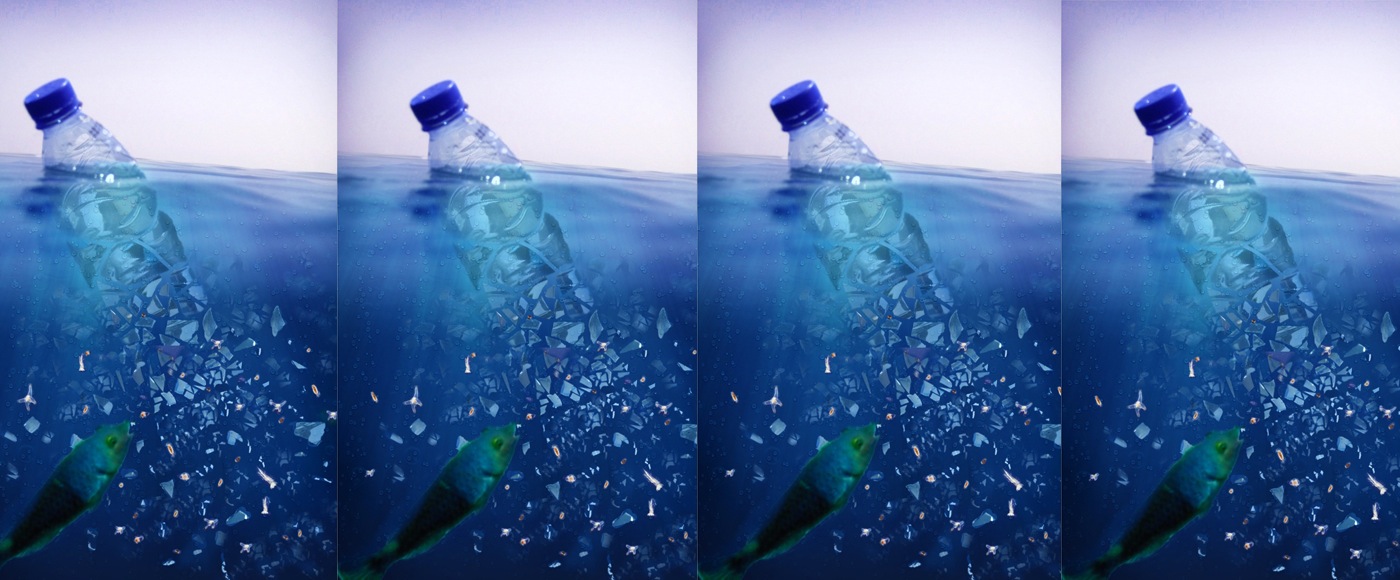
Conceptualization of plastic degrading in the ocean. (Photo credit: Archipelagos Institute)

This could soon change. A team of Harvard undergraduates developed a tool, Plastiback, that both identifies the presence of microplastics, and degrades them. Plastiback is an ingenuous floating bioreactor containing genetically modified E. coli bacteria. The bacteria are used to identify and degrade a specific type of microplastic called polyethylene terephthalate (PET) – commonly used in water bottles and fishing equipment. So how does Plastiback work? The genetically engineered E. coli secrete an enzyme that breaks down PET into terephthalic acid and ethylene glycol. A fluorescent protein glows green when the PET-degrading enzyme is expressed identifying the presence of microplastics. Because the byproducts of microplastic are toxic, the system goes a step further and the terephthalic acid is metabolized by a second type of bacteria, D. tsuruhatensis sp. nov.  producing electrons used to generate a small amount of voltage. The voltage is used to quantify how much PET was broken down by Plastiback, so the system both identifies the presence and quantifies the amount of microplastics broken down.
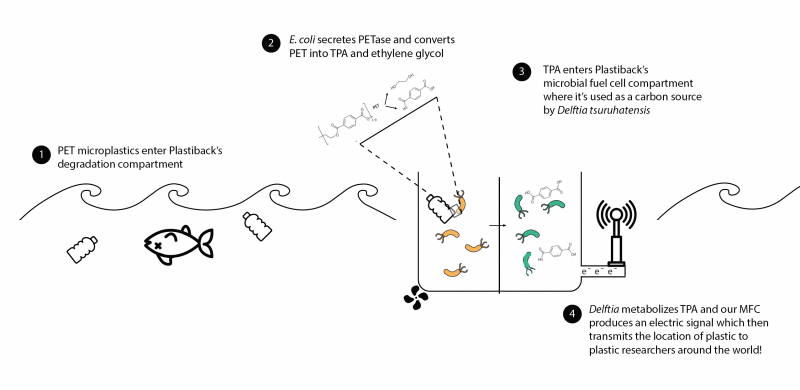
Conceptual diagram of how Plastiback works. (Photo credit: Harvard iGEM team)

This is an ingenious developent, and if scalable could be utilized to provide a better sense of the spatial distribution of microplastics while also working on reducing the concentrations of microplastics in the ocean. So lets give a big shoutout to the team which included students Gabriela Berner, Will Cho, Rebekah Chun, and Mofeyifoluwa Edun. They were mentored by Neel Joshi, Associate Professor of Chemical and Biological Engineering, and graduate students Pichet Praveschotinunt, David Lips, Kevin Hof, and Anita Chandrahas.

You can learn more about Plastiback at their website.

Share this:

  • Share on Bluesky (Opens in new window) Bluesky
  • Share on Facebook (Opens in new window) Facebook
  • Share on Reddit (Opens in new window) Reddit
  • Share on Threads (Opens in new window) Threads
  • Share on WhatsApp (Opens in new window) WhatsApp
  • Share on Mastodon (Opens in new window) Mastodon

Related

Tags: bacteria e-coli genetic engineering genetically modified microplastic plastiback synthetic life

Post navigation

❮ Previous Post: The Worlds First Empirical ‘How-To’ Get Into Graduate School Book
Next Post: Thursday Afternoon Dredging: December 22nd, 2016 ❯

You may also like

Uncategorized
Walking fish and microbe warfare: Thursday Afternoon Dredging, February 15, 2018
February 15, 2018
Weekly Salvage
Chesapeake Requiem, the Black Friday for Climate Change, whale earwax, killing the GRE, and more! Monday Morning Salvage: November 26, 2018
November 26, 2018
Science
Return from the Cayman Abyss: cruise post-mortem and some thoughts on media coverage
March 1, 2013
Science
Fun Science FRIEDay – Evolution, what’s it good for?
February 20, 2015

Popular Posts

How close did the world's first deep-sea mining come to the dredging the world's largest cold-water coral reef?How close did the world's first deep-sea mining come to the dredging the world's largest cold-water coral reef?March 17, 2026Andrew Thaler
What Ocean Ramsey does is not shark science or conservation: some brief thoughts on "the Shark Whisperer" documentaryWhat Ocean Ramsey does is not shark science or conservation: some brief thoughts on "the Shark Whisperer" documentaryJuly 2, 2025David Shiffman
That's not a blobfish: Deep Sea Social Media is Flooded by AI SlopThat's not a blobfish: Deep Sea Social Media is Flooded by AI SlopDecember 19, 2025Andrew Thaler
Urea and Shark OsmoregulationUrea and Shark OsmoregulationNovember 15, 2010David Shiffman
Tangier, an Island out of Time.Tangier, an Island out of Time.July 3, 2017Andrew Thaler
Here's what I teach my students about finding jobs in marine biology and conservationHere's what I teach my students about finding jobs in marine biology and conservationApril 10, 2024David Shiffman
Alberta, Canada is the proud owner of the largest man-made pyramid on the planetAlberta, Canada is the proud owner of the largest man-made pyramid on the planetOctober 16, 2012Andrew Thaler
The story of the pride flag made from NASA imagery: Bluesky's most-liked imageThe story of the pride flag made from NASA imagery: Bluesky's most-liked imageSeptember 27, 2024David Shiffman
Here are some ocean conservation technologies that I'm excited aboutHere are some ocean conservation technologies that I'm excited aboutFebruary 19, 2026David Shiffman
America's Second-Largest Estuary is a Lagoon Full of SharksAmerica's Second-Largest Estuary is a Lagoon Full of SharksApril 12, 2018Chuck Bangley
Subscribe to our RSS Feed for updates whenever new articles are published.

We recommend Feedly for RSS management. It's like Google Reader, except it still exists.

Southern Fried Science

  • Home
  • About SFS
  • Authors
  • Support SFS


If you enjoy Southern Fried Science, consider contributing to our Patreon campaign.

Copyright © 2026 Southern Fried Science.

Theme: Oceanly Premium by ScriptsTown