Skip to content

Southern Fried Science

Over 15 years of ocean science and conservation online

  • Home
  • About SFS
  • Authors
  • Support SFS

Independent ocean science requires local support: testing our mobile OpenCTD factory.

Posted on May 3, 2024May 3, 2024 By Andrew Thaler
Featured, Oceanography for Everyone, Open Science

What if you could drop an oceanography lab anywhere? Not just the instruments and equipment, but the expertise to maintain the equipment and train ocean knowledge seekers. What if you could deliver an instrumentation factory anywhere it is needed, so that people with the desire and need to study and understand the ocean had the skills and the capacity to maintain long-term oceanographic observations, independent of formal research institutions and operating on a budget that reflects the economic reality of those communities most directly impacted by climate change?

That’s the vision of COLaB, the Coastal Observation Lab in a Box, a program to address the critical lack of quality oceanographic data that exists for many coastal ocean regions, often due to lack of resources in island and rim nations. COLaB is collecting and assessing a variety of low cost and open source tools used for physical, chemical, and biological ocean sciences, with the goal of providing an al la carte collection of instruments from which knowledge seekers can build out a research kit. But beyond that, COLaB is developing training workshops and regional calibration and maintenance hubs so that the expertise to support, calibrate, and repair those tools remains with the community.

Last year, COLaB became part of the UN Ocean Decade. I’m very proud of the fact that the OpenCTD will be a key component of this effort.

A CTD is a device that measures salinity, temperature, and depth (the C stands for conductivity, which, along with temperature and pressure can be used to calculate salinity). It is an essential tool used in almost all marine scientific research.

Summer is coming and it is time, once again, to roll out the next iteration of the OpenCTD workshop. Last year, thanks to support from the Open Science Hardware Foundation, we held a wildly successful documentation workshop, designed to revise and improve the construction manual and supporting documents for the OpenCTD. This ultimately led to the publication of The OpenCTD: A Low-Cost, Open-Source CTD for Collecting Baseline Oceanographic Data in Coastal Waters.

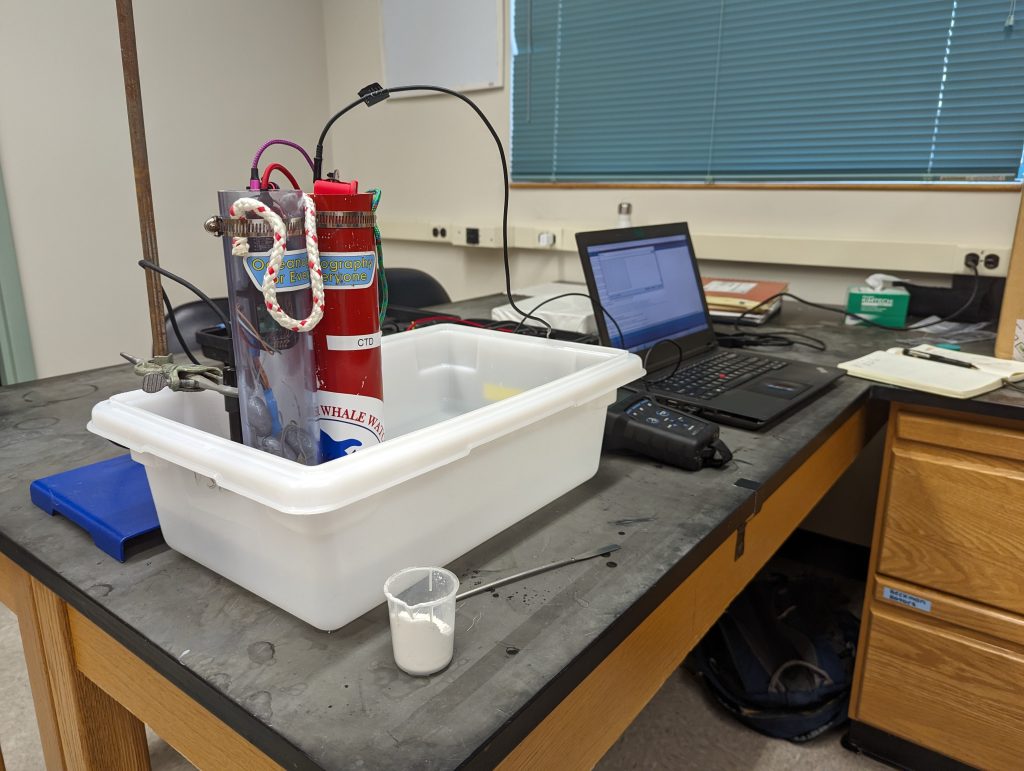
OpenCTDs being tested in the lab.

And that brings us to today, and the big question: What’s next? We’ve run several build-you-own CTD workshops. I am getting very good at teaching students of all ages (the youngest workshop we’ve run was with middle school students) how to build CTDs, but in order to make the program both sustainable and independent, we need to start training community leaders not just how to build, repair, and calibrate CTDs, but to run their own workshops.

This month, thanks to ongoing support for the Bureau of Ocean Energy Management, I’m heading up to Boston to trial the next iteration of the OpenCTD Capacity Building Workshop with Courageous Sailing, a Boston-based community sailing program that provides equitable access to sailing and ocean science programs in the greater Boston Area. Our goal this week is to lead Courageous staff through their first OpenCTD build, while focusing not just on how to build the instrument, but on how to lead others through the build process. Courageous will be set up with the tools an materials to build a flotilla of 4 additional OpenCTDs, which they can use to train more staff or as an in-depth STEM experience for their students.

And, of course, those CTDs are theirs to use in their ongoing ocean science and education programs.

I’m not exactly breaking new ground, here. Train-the-trainer workshops have become a stable of community-based conservation and we did something similar in Saipan with OpenROV several years ago, but this will be the first time I’m deploying a full mobile fabrication lab for the OpenCTD.

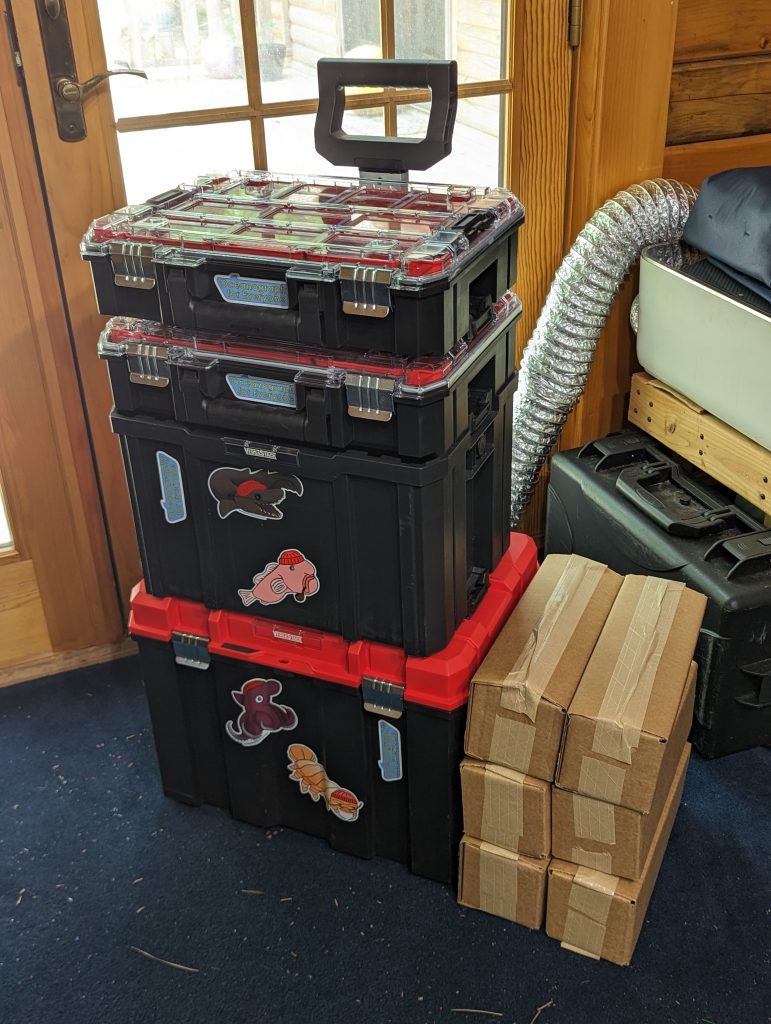
A mobile CTD factory, equipped to produce 6+ CTDs,
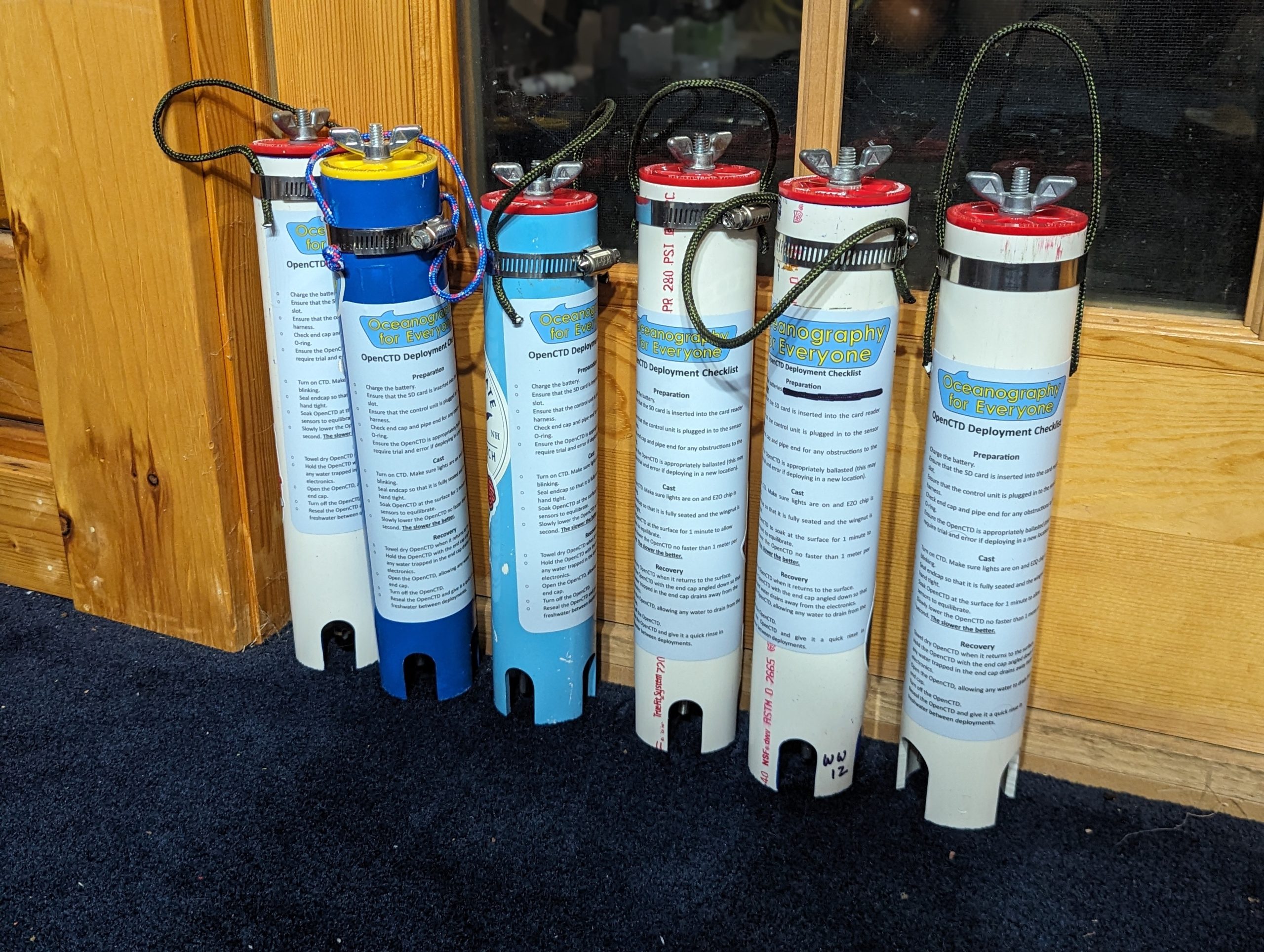
Next week, I get to trial this adorable mobile CTD factory. Follow me on Instagram for updates. And if you or you organization want to host a 3-day OpenCTD building workshop, get in touch with me through Blackbeard Biologic.


Southern Fried Science is free and ad-free. Southern Fried Science and the OpenCTD project are supported by funding from our Patreon Subscribers. If you value these resources, please consider contributing a few dollars to help keep the servers running and the coffee flowing. We have stickers.

Share this:

  • Share on Bluesky (Opens in new window) Bluesky
  • Share on Facebook (Opens in new window) Facebook
  • Share on Reddit (Opens in new window) Reddit
  • Share on Threads (Opens in new window) Threads
  • Share on WhatsApp (Opens in new window) WhatsApp
  • Share on Mastodon (Opens in new window) Mastodon

Related

Tags: OpenCTD

Post navigation

❮ Previous Post: Small drops make mighty oceans: 10 years as a scientist on Patreon
Next Post: International Seabed Authority gears up for a leadership challenge at the July meeting. ❯

You may also like

Weekly Salvage
“We’re in the midst of a sea change in who has access to the core tools of marine scientific research,” Weekly Salvage: November 11, 2019
November 11, 2019
Climate change
It is your ocean. You should have access to the tools to study it.
January 26, 2024
Science
What does an OpenCTD mean to marine ecologists?
July 26, 2013
Education
Getting your kids started in conservation technology: a quick guide for parents who have no idea where to begin.
March 16, 2022

Popular Posts

How close did the world's first deep-sea mining come to the dredging the world's largest cold-water coral reef?How close did the world's first deep-sea mining come to the dredging the world's largest cold-water coral reef?March 17, 2026Andrew Thaler
At least 74 practicing shark researchers: How a silly thing I said online raised thousands for conservationAt least 74 practicing shark researchers: How a silly thing I said online raised thousands for conservationFebruary 26, 2025David Shiffman
What Ocean Ramsey does is not shark science or conservation: some brief thoughts on "the Shark Whisperer" documentaryWhat Ocean Ramsey does is not shark science or conservation: some brief thoughts on "the Shark Whisperer" documentaryJuly 2, 2025David Shiffman
That's not a blobfish: Deep Sea Social Media is Flooded by AI SlopThat's not a blobfish: Deep Sea Social Media is Flooded by AI SlopDecember 19, 2025Andrew Thaler
Urea and Shark OsmoregulationUrea and Shark OsmoregulationNovember 15, 2010David Shiffman
Here's what I teach my students about finding jobs in marine biology and conservationHere's what I teach my students about finding jobs in marine biology and conservationApril 10, 2024David Shiffman
Here are some ocean conservation technologies that I'm excited aboutHere are some ocean conservation technologies that I'm excited aboutFebruary 19, 2026David Shiffman
I turned my woodshop into a personal solar farm.I turned my woodshop into a personal solar farm.June 21, 2021Andrew Thaler
Alberta, Canada is the proud owner of the largest man-made pyramid on the planetAlberta, Canada is the proud owner of the largest man-made pyramid on the planetOctober 16, 2012Andrew Thaler
Shark of Darkness: Wrath of Submarine is a fake documentaryShark of Darkness: Wrath of Submarine is a fake documentaryAugust 10, 2014Michelle Jewell
Subscribe to our RSS Feed for updates whenever new articles are published.

We recommend Feedly for RSS management. It's like Google Reader, except it still exists.

Southern Fried Science

  • Home
  • About SFS
  • Authors
  • Support SFS


If you enjoy Southern Fried Science, consider contributing to our Patreon campaign.

Copyright © 2026 Southern Fried Science.

Theme: Oceanly Premium by ScriptsTown