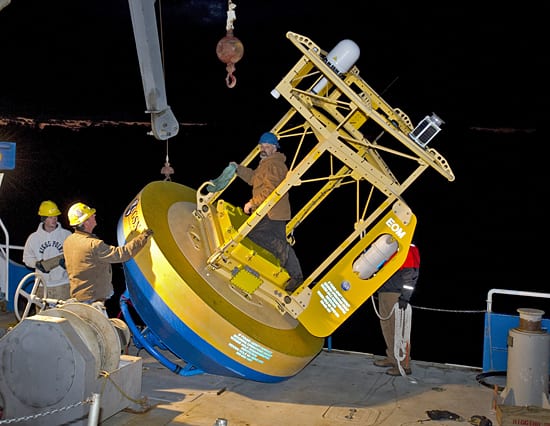

The Beneath The Waves Film Festival is accepting submissions for the 2013 event. Now in it’s fourth year, Beneath the Waves encourages dialogue and networking between documentary filmmakers, conservationists, and scientists. As in past years, the film festival is associated with the Benthic Ecology conference, which is taking place March 20th-23rd in Savannah, Georgia. There will … Read More “Submit your short ocean-themed movie to the Beneath The Waves Film Festival” »
The Open CTD Project
 As I mentioned during the last Blue Pints episode, this year I’m going to be attempting to build a low-cost open source CTD for basic oceanographic measurements. This is in addition to my ongoing work with the OpenROV. I have a pretty solid electronics background, but in order to accomplish this goal, I also need to learn how to program microcontrollers, something that I’ve never done before. For the next several months I’m going to tackle various small Arduino project to get comfortable with the fundamentals. I’ll be working out of Environmental Monitoring with Arduino: Building Simple Devices to Collect Data About the World Around Us and Arduino Projects to Save the World, both of which feature beginner to advanced projects based around environmental monitoring and data collection, as well as Programming Arduino Getting Started with Sketches for as a basic programming primer.
For my first project, I wanted to start with something that could eventually be implemented with the OpenROV–a magnetometer to provide compass headings while navigating the robot. As a first step, I wanted to learn how to program the Arduino board to calculate compass headings from a magnetometer and develop some sort of rough visual readout of that heading.
Read More “Arduino Project Log: Getting Started with a Digital Compass” »
Uncategorized
Today marks the first Tsukiji fish market tuna auction of 2013, and, as in the previous two years, the first fish sold broke all previous records. In 2011, the record breaking tuna sold for $396,000. Last year, we tipped the scales at $736,000. Early this morning, the record breaking bluefin tuna blew the previous records out of the water, fetching a whopping $1,800,000 at the auction block, making this 488-lb tuna the most expensive fish ever purchased.
Over the next few weeks, I’m certain that we’ll see this number presented as an argument against bluefin tuna fishing, as an example of an industry out-of-control, and as a symbol of how ruthlessly we’ll hunt the last few members of a species to put on our dinner plates. These issues are reflected in the tuna market, but I want to urge caution in drawing too many conclusions from this record breaking number.
Science
New and noteworthy publications in deep-sea science for the week of December 31st, 2012.
PLoS One: How Deep-Sea Wood Falls Sustain Chemosynthetic Life
Large organic food falls to the deep sea – such as whale carcasses and wood logs – are known to serve as stepping stones for the dispersal of highly adapted chemosynthetic organisms inhabiting hot vents and cold seeps. Here we investigated the biogeochemical and microbiological processes leading to the development of sulfidic niches by deploying wood colonization experiments at a depth of 1690 m in the Eastern Mediterranean for one year. Wood-boring bivalves of the genus Xylophaga played a key role in the degradation of the wood logs, facilitating the development of anoxic zones and anaerobic microbial processes such as sulfate reduction. Fauna and bacteria associated with the wood included types reported from other deep-sea habitats including chemosynthetic ecosystems, confirming the potential role of large organic food falls as biodiversity hot spots and stepping stones for vent and seep communities. Specific bacterial communities developed on and around the wood falls within one year and were distinct from freshly submerged wood and background sediments. These included sulfate-reducing and cellulolytic bacterial taxa, which are likely to play an important role in the utilization of wood by chemosynthetic life and other deep-sea animals
Conservation, Science

President, Shark Advocates International
 Sonja Fordham founded Shark Advocates International as a project of The Ocean Foundation in 2010 based on her two decades of shark conservation experience at Ocean Conservancy. She is Deputy Chair of the IUCN Shark Specialist Group and Conservation Committee Chair for the American Elasmobranch Society, has co-authored numerous publications on shark fisheries management, and serves on most of the U.S. federal and state government advisory panels relevant to sharks and rays. Her awards include the U.S. Department of Commerce Environmental Hero Award, the Peter Benchley Shark Conservation Award, and the IUCN Harry Messel Award for Conservation Leadership.
The last twelve months added up to another exciting year in shark and ray conservation policy. We certainly saw and should herald a lot of great progress in 2012. I think it’s also important to acknowledge what went wrong so we know where we stand and how best to move forward. I’ve taken a look back and compiled a top ten list of what I see as the best and worst events in shark fisheries management for 2012, based on my work at Shark Advocates International. I’m starting with the low points, but keep reading! It ends on a high note.
Read More “The ten best and worst events in shark fisheries management of 2012” »
Uncategorized
httpv://www.youtube.com/watch?v=3vuOrHXkMuk&feature=plcp
Uncategorized
We’re kicking off the new year by reviving our popular Google+ Hangout — Blue Pints! Join us tonight (Thursday, January 3) at 7 for a casual conversation about marine science and conservation. On this episode, we’ll be reflecting on our favorite moments from 2012 and giving you a peak at what we have planned for … Read More “Join us tonight at 7 for the first 2013 edition of Blue Pints!” »
Popular Culture, Science
There is no force more creative than the painstakingly slow process of evolution. Ever wanted to walk through walls? Naked mole rats can physically bore through concrete. How about fly? There are a couple dozen different ways to accomplish that goal, even if you’re a squid. Incredible power of regeneration? Flatworms, roundworms, and echinoderms have us beat. Among the vertebrates, species like the axolotl can regrow limbs, organs, and parts of their brain. For practically every super power we can imagine, something on the tree of life has come up with a real-world analog.
Some real super power are more super than others:
1. The immortal rotifer that absorbs the abilities of anything it touches.

Around 80 million years ago, a small, unassuming group of metazoa decided that sex just wasn’t for them. Instead of going through the effort of recombining their genetic material with a mate every generation to produce a viable offspring with a roughly 50% contribution from each parent, Bdelloid Rotifers started reproducing asexually. Males completely disappeared from class bdelloidea, leaving females to generate genetic duplicates through parthenogenesis. This is not their super power.
Bdelloid rotifers are incredibly tough. When environmental conditions are less than favorable, they can enter a dormant state. In this dormant state,they can survive the worst unscathed. Dehydrated, they can endure extreme temperatures, drought, even ionizing radiation. A bdelloid rotifer in its dormant state can even survive in space. If that isn’t enough, while dormant, these rotifers continue to produce offspring, which also remain dormant. This is not their super power.
Bdelloid rotifers’ super power appears when they recover from their dormant state. As they rehydrate and repair whatever damage their cells incurred, they incorporate DNA fragments from their environment. This includes partially digested food and any DNA in close proximity to them, even bacterial and archael DNA. It is this ability that allows bdelloid rotifers to overcome the limitations of asexual reproduction and survive for 80 million years without mates. They can literally absorb the attributes of those around them.
Their incredible toughness, celibate lifestyle, and ability to absorb the powers of anything they touch, put Bdelloid Rotifers firmly on par with X-Men perennial favorite: Rogue.
Read More “Five organisms with real super powers that rival their comic book counterparts” »
Conservation, Science

While the rest of the scientific and management community and I are grateful for the passionate support of many shark conservation advocates, passion is no substitute for knowledge and accuracy. Some conservation issues are a matter of opinion and can (and should) be reasonably be discussed by people with different views, but many others are a matter of fact. Presented here, in no particular order, are 13 incorrect statements and arguments commonly made by well-intentioned but uninformed shark conservation advocates, along with the reality of the situation.
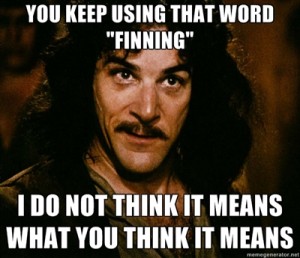
1) “Shark finning” is synonymous and interchangeable with “the global shark fin trade.” Shark finning is a specific fishing method. It is not the only way to catch sharks, and it is not the only way to provide shark fins for the global fin trade. Stopping shark finning is a worthy goal (that has largely been accomplished already *) because it is a wasteful and brutal fishing method that complicates management, but stopping shark finning does not stop the global shark fin trade. Many people calling for a ban on finning really seem to want no shark fishing and no fin trade of any kind (a viewpoint I disagree with, but regardless, proper terminology matters). For more on the difference between shark fishing and shark finning, see this post from June 2012.
2) 100 million sharks a year are killed for their fins. The origin of this number is still debated, but it was popularized by Sharkwater. While we will likely never know exactly how many sharks are “killed for their fins”, the best scientific estimate of the scope of the fin trade we have comes from a 2006 paper by Dr. Shelley Clarke. She found that the fins of between 26 and 73 million sharks end up in the fin trade each year, with a simulation average of 38 million. Dr. Clarke wrote an essay for SeaWeb on the misuse of her work, which is worth a read.
3) 1 in 3 species of sharks face extinction. This one is actually relatively close to accurate, and can be fixed with the addition of just two words. An IUCN Shark Specialist Group report found that 1 in 3 species of “open ocean” sharks are Threatened with extinction (Threatened means Vulnerable, Endangered or Critically Endangered according to IUCN Red List standards). 1 in 6 species of shark, skate, ray, or chimera are Threatened- while still a troubling number indicative of a very bad situation, it’s half as bad as claimed by many advocates. Also, please note that I included skates and rays, which are similarly threatened but often ignored by conservation advocates (with one notable exception from 2012).
Conservation, Science
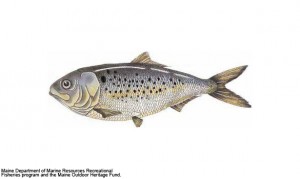
Despite their small size and plain appearance, menhaden have been called “the most important fish in the sea” because numerous coastal fish species rely on them for food. Although they aren’t typically eaten by humans, there is still a huge fishery for them for bait, aquaculture food, and oil. That fishery has been essentially unregulated, allowing fishermen to take as many as they want. Recently, there’s been a campaign among certain environmental groups to fix this problem and put catch limits in place for menhaden.
I was surprised to see PolitiFact, a non-partisan political fact-checking website, address this issue. I’ve checked PolitiFact pretty regularly for years, and I’ve never seen them cover a topic like this before. They focused on a claim by the Pew Environment Group that “In recent years, menhaden numbers along our coast have plummeted by 90 percent.” While I admit I am not familiar with specific details of menhaden population trends, anyone who has paid any attention at all to the ocean knows that we’re overfishing at alarming rates. According to the UN Food and Agriculture Organization, approximately 1/3 of all global fisheries are depleted or overexploited, many by more than the 90% referenced for menhaden. Shockingly, PolitiFact called the claim by Pew “mostly false”. Their reasoning for this ruling is even more ridiculous than the ruling itself:
Read More “PolitiFact calls claims of menhaden declines “Mostly False”, is completely wrong” »