

Skip to content

Southern Fried Science

Over 15 years of ocean science and conservation online

  • Home
  • About SFS
  • Authors
  • Support SFS

Recent Posts

5 things I learned helping to reassess the global conservation status of every species of tuna and billfish
September 15, 2026
Key takeaways from my Convention on Migratory Species report on fish aggregating devices in the Mediterranean Sea
September 3, 2026
Jabberwocks and Snallygasters: teaching environmental education with monsters, mayhem, and dice.
August 31, 2026
The conservation impacts of recreational fishing
August 25, 2026
How to help protect the deep sea in the Marianas and American Samoa today
August 20, 2026
Trump Administration Advances Mariana Trench Offshore Mineral Leasing Process
August 19, 2026

In sexual selection and thermoregulation, bigger is better, at least for fiddler crabs

Posted on September 21, 2011October 20, 2011 By Andrew Thaler 2 Comments on In sexual selection and thermoregulation, bigger is better, at least for fiddler crabs
Science

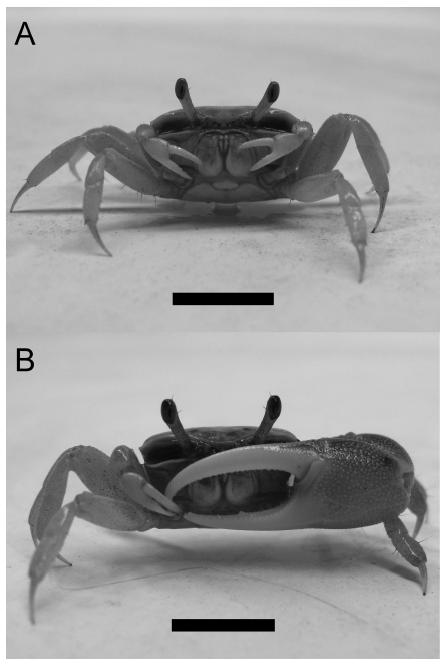
Sexual dimorphism in fiddler crabs. Female (A) and male (B) Uca panacea. Scale bars indicate 1 cm. From Darnell and Munguia 2011

Imagine yourself a fiddler crab. For this exercise, imagine yourself a male fiddler crab. Are you with me? Great. Check out your right claw, it’s a sleek, slender machine, perfect for picking through the sand as you sift out bacteria and other microorganisms for food. It also makes a handy shovel for digging nice deep burrows to protect you from harsh conditions. Now check out your left claw. Wow! This thing is massive. If you possess a particularly vivid mind and have place your ego within the carapace of Uca panacea, your giant claw is more than a quarter of your body weight. This comically mis-proportioned appendage is why those pesky bipeds call you and your cousins “Fiddler Crabs”.

See that female fiddler crab at the perimeter of your territory? Yes, she is checking you out. That giant claw of yours is primarily used to attract mates, signalling to interested parties that your are fit and fecund. You even have a special dance, unique to each fiddler crab species, to announce your vitality. And if some other, lesser-clawed, male tries to move in to your territory, why, you’re equipped with a serious piece of hardware to drive off that interloper.

Read More “In sexual selection and thermoregulation, bigger is better, at least for fiddler crabs” »

A brief comment on advertising

Posted on September 21, 2011 By Andrew Thaler 3 Comments on A brief comment on advertising
Uncategorized

You may have noticed a leaderboard across the very top of this page advertising various biotech companies. Over the next month we’ll be experimenting with the potential for hosting ads through Sproutnova, a new, science focused advertising company. Please use the comment field on this post as an open thread to discuss the new ads … Read More “A brief comment on advertising” »

Shark Science Monday: WhySharksMatter discusses social media and shark conservation

Posted on September 19, 2011September 19, 2011 By David Shiffman 1 Comment on Shark Science Monday: WhySharksMatter discusses social media and shark conservation
Conservation

For this week’s edition of Shark Science Monday, check out this video of a presentation I gave at the 2nd International Marine Conservation Congress last May. My talk focused on how social media technology can benefit (and has already benefited) the shark conservation movement. It was part of a symposium organized by the IUCN Shark Specialist … Read More “Shark Science Monday: WhySharksMatter discusses social media and shark conservation” »

All eyes on Halifax: Will fishery managers follow scientific recommendations to protect the thorny skate?

Posted on September 19, 2011September 19, 2011 By David Shiffman
Conservation, Science

NAFO's logo

Later today, the annual meeting of the Northwest Atlantic Fisheries Organization (NAFO) begins in Halifax, Nova Scotia. The marine conservation world should pay close attention. NAFO  made history in 2004 by becoming the first regional fisheries management organization to set a shared quota for a shark, skate, or ray fishery, but the future of that legacy is in question.

Read More “All eyes on Halifax: Will fishery managers follow scientific recommendations to protect the thorny skate?” »

Proposed fishery increase could harm critically endangered thorny skates

Posted on September 15, 2011 By David Shiffman 14 Comments on Proposed fishery increase could harm critically endangered thorny skates
Conservation, Science

In response to new analyses estimating  that greater numbers of some skate species can be safely fished,  the National Marine Fisheries Service has proposed an “emergency” increase in the catch limit for the Northeast Skate Complex Fishery. While its good news that some skate populations may be doing well enough to support increased fishing, this doesn’t tell the whole story of the Northeast Skate Complex.

Read More “Proposed fishery increase could harm critically endangered thorny skates” »

Book review: Discoveries of the Census of Marine Life

Posted on September 14, 2011September 14, 2011 By David Shiffman 1 Comment on Book review: Discoveries of the Census of Marine Life
Science

The Census of Marine Life is undoubtedly one of the most amazing scientific collaborative efforts of all time. All told, thousands of scientists from more than 80 countries participated in the decade-long project. They discovered thousands of new species, published thousands of papers, created and perfected new research techniques, and added countless datapoints to important databases- many of which are free and accessible online.  The story of the COML is nothing short of incredible, and it is told wonderfully in the new book “Discoveries of the Census of Marine Life: Making Ocean Life Count.”

Read More “Book review: Discoveries of the Census of Marine Life” »

Deep Fried Sea: Ratty just needs a hug

Posted on September 13, 2011September 13, 2011 By Andrew Thaler 5 Comments on Deep Fried Sea: Ratty just needs a hug
Uncategorized

The deep sea is worth saving!

The importance of failure in graduate student training

Posted on September 13, 2011September 13, 2011 By Andrew Thaler 6 Comments on The importance of failure in graduate student training
Science

Running the winch at dusk

The A-frame shuddered as the box core, heavy with mud and reeking of sulfur, emerged from the water. We knew that it had found its mark 2300 meters below. Soft sediment from the seafloor oozed out the sides as I slid the safety pins into the spade arm. There was nothing visibly special about this mud. No ancient arthropods or primeval polychaetes crawled through this muck. It was a cubic meter of sticky, stinking glop. My first sample.

We were in the middle of the Gulf of Mexico, aboard the R/V Cape Hatteras. Our cruise objectives were to characterize the pelagic and benthic fauna associated with deep-sea methane seeps. For me, it was a ship of opportunity. In exchange for and extra set of hands to work the gear and process samples, I could add my own small research project to the cruise objectives. My goal was to collect sediment cores from multiple sites and survey the diversity of fungi associated with these methane seeps.

The 12 hour shifts rarely left me enough time to eat meals. Though I had never seen the equipment before we left port I became the acoustic tracking technician, out of necessity. Things consistently went wrong. Nets tore, gear broke, a misfired box core almost crushed my leg. Two hurricanes, one a category 5, hit the Gulf of Mexico while we were at sea. Work was exhausting and rest was brief, when existent. I loved every minute of it.

The end of that cruise was the high point of a 4 year project that began with unbridled optimism and early, exciting results, only to decay into drudgery, failure, desperation, and collapse. In the end, it would rise from the past for one small victory. In hindsight, so much of those four years seems painfully trivial, but this story is really about how much of a human being is poured into a scientific manuscript.

Read More “The importance of failure in graduate student training” »

Shark Science Monday: Jen Caselle discusses the recovery of shark populations in California

Posted on September 12, 2011September 11, 2011 By David Shiffman 1 Comment on Shark Science Monday: Jen Caselle discusses the recovery of shark populations in California
Science

In this week’s edition of Shark Science Monday, Jen Caselle of UC Santa Barbara discusses how the banning of gill nets in Southern California led to population recoveries of several species of sharks. If you have a question for Jen, leave it below and I’ll make sure she gets it.

Hope for Fiji’s Sharks?

Posted on September 8, 2011September 4, 2011 By David Shiffman
Conservation, Science

Check out this trailer for “Shark Hope”, a soon-to-be-released documentary chronicling efforts to make a National Shark Sanctuary in Fiji! This movie is a partnership between Shark Defenders, the Coral Reef Alliance, and the Pew Environment Group. The movie will be released in Fiji later this month, and will soon be available online.

Posts pagination

Previous 1 … 164 165 166 … 277 Next

Popular Posts

REPORT: Trump rolling back 87% of the nation’s highly protected ocean watersREPORT: Trump rolling back 87% of the nation’s highly protected ocean watersOctober 22, 2026Angelo Villagomez
What Ocean Ramsey does is not shark science or conservation: some brief thoughts on "the Shark Whisperer" documentaryWhat Ocean Ramsey does is not shark science or conservation: some brief thoughts on "the Shark Whisperer" documentaryJuly 2, 2025David Shiffman
Our favorite sea monsters – The Kraken (#1)Our favorite sea monsters – The Kraken (#1)September 10, 2010Andrew Thaler
That's not a blobfish: Deep Sea Social Media is Flooded by AI SlopThat's not a blobfish: Deep Sea Social Media is Flooded by AI SlopDecember 19, 2025Andrew Thaler
Our favorite sea monsters – Ningen (#4)Our favorite sea monsters – Ningen (#4)September 7, 2010Andrew Thaler
What is a Sand Shark?What is a Sand Shark?November 12, 2017Chuck Bangley
Have we found the city of Atlantis?Have we found the city of Atlantis?September 1, 2026Chris Parsons
Shark of Darkness: Wrath of Submarine is a fake documentaryShark of Darkness: Wrath of Submarine is a fake documentaryAugust 10, 2014Michelle Jewell
What can the funniest shark memes on the internetz teach us about ocean science and conservation?What can the funniest shark memes on the internetz teach us about ocean science and conservation?November 8, 2013David Shiffman
When I talk about Climate Change, I don't talk about science.January 3, 2017Andrew Thaler

squishy

Subscribe to our RSS Feed for updates whenever new articles are published.

We recommend Feedly for RSS management. It's like Google Reader, except it still exists.

Southern Fried Science

  • Home
  • About SFS
  • Authors
  • Support SFS


If you enjoy Southern Fried Science, consider contributing to our Patreon campaign.

Copyright © 2026 Southern Fried Science.

Theme: Oceanly Premium by ScriptsTown