
Skip to content

Southern Fried Science

Over 15 years of ocean science and conservation online

  • Home
  • About SFS
  • Authors
  • Support SFS
Latest News
  • Norway and Cook Islands put their deep-sea mining plans on pause

Recent Posts

Join Me at Upwell: A Wave of Ocean Justice — Our Fourth Year!
March 24, 2026
How close did the world’s first deep-sea mining come to the dredging the world’s largest cold-water coral reef?
March 17, 2026
Here are some ocean conservation technologies that I’m excited about
February 19, 2026
Walking Backwards Into the Future: Applying Indigenous Knowledge to Deep Sea Mining
February 5, 2026
The Urgency Does Not Exist: My statement on Deep-sea Mining to the Subcommittee on Energy and Mineral Resources
January 24, 2026
Bipartisan Concern Expressed Over Deep Sea Mining at Congressional Hearing
January 23, 2026

Saturation diving, destroying the world with Bitcoin mining, deep-sea mining, Arctic shrinkage, and more! Monday Morning Salvage: May 21, 2018

Posted on May 21, 2018 By Andrew Thaler
Weekly Salvage

Foghorn (A Call to Action!)

  • Yale study: Newspaper op-eds change minds and The Long-lasting Effects of Newspaper Op-Eds on Public Opinion. Scientists and conservationists, this May, make an effort to publish a Letter to the Editor or OpEd in your local paper. If you’ve done so, please leave a link to it in the comments.

Flotsam (what we’re obsessed with right now)
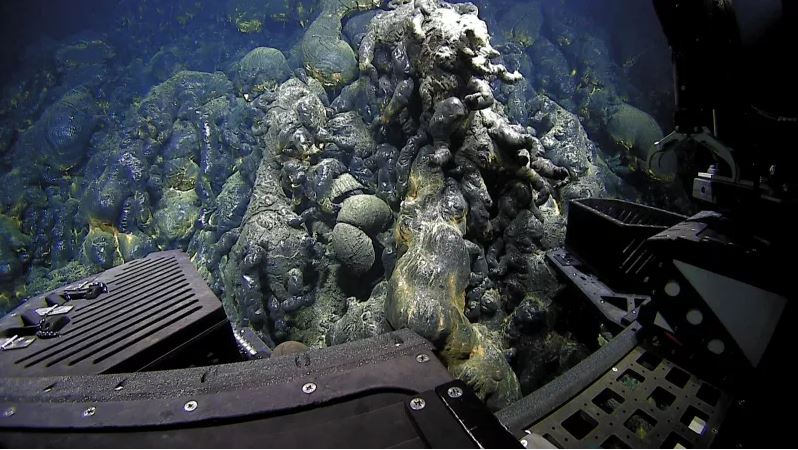
  • Immediately after college, my backup plan if I didn’t get into grad school was to go to work as an underwater welder doing saturation diving. After reading this, I’m pretty glad I didn’t go that route. The Weird, Dangerous, Isolated Life of the Saturation Diver.
  • Walking the talk in Vanuatu, the first country in the world to ban plastic straws.
  • We’ve been saying this for a awhile now. Cryptocurrencies that rely on ever increasing processing power to resolve transaction are an environmental disaster. Alarming Study Suggests Bitcoin Consumes an Astonishing Amount of Energy and It’s Only Getting Worse.

The Levee (A featured project that emerged from Oceandotcomm)

  • Stitching Hope for the Coast is still accepting contributions from knitters around the world. Join the fun!

Read More “Saturation diving, destroying the world with Bitcoin mining, deep-sea mining, Arctic shrinkage, and more! Monday Morning Salvage: May 21, 2018” »

Plastic Free Fish, Chainsaw Lobsters, and Artificial Horseshoe Crab Blood: Thursday Afternoon Dredging, May 17th 2018

Posted on May 17, 2018May 17, 2018 By David Shiffman
Uncategorized

Cuttings (short and sweet):  Follow the Pacific salmon network on twitter! Looking for plastic free fish? Here’s one to put on the menu! By Maggie Gillis, for CBC news Scientists find new deep sea species off Java. BBC slideshow. Unexpected walruses crowd Alaska beach. By the Associated Press. The bigger the mother fish, the more babies … Read More “Plastic Free Fish, Chainsaw Lobsters, and Artificial Horseshoe Crab Blood: Thursday Afternoon Dredging, May 17th 2018” »

Bone-eating Jabba worms, the world’s deepest plastic bag, new shipwrecks, climate change art, and more! Monday Morning Salvage: May 14, 2018.

Posted on May 14, 2018 By Andrew Thaler
Weekly Salvage

Foghorn (A Call to Action!)

  • Yale study: Newspaper op-eds change minds and The Long-lasting Effects of Newspaper Op-Eds on Public Opinion. Scientists and conservationists, this May, make an effort to publish a Letter to the Editor or OpEd in your local paper. If you’ve done so, please leave a link to it in the comments.
  • How to save the high seas: As the United Nations prepares a historic treaty to protect the oceans, scientists highlight what’s needed for success.

Flotsam (what we’re obsessed with right now)

  • No commentary needed: Eyeless, Mouthless, Bone-Eating Worm Named After Jabba the Hutt.

Osedax worms growing on the vertebrae of a dead whale.
Photo: 2006 MBARI

  • Every ocean, every dive, every time, trash: Plastic Bag Found at the Bottom of World’s Deepest Ocean Trench.

Read More “Bone-eating Jabba worms, the world’s deepest plastic bag, new shipwrecks, climate change art, and more! Monday Morning Salvage: May 14, 2018.” »

Seafaring neanderthals and switchblade fish: A mega Thursday Afternoon Dredging, May 10th, 2018

Posted on May 10, 2018May 9, 2018 By David Shiffman
Uncategorized

After two weeks off, we’re back and bigger than ever! Cuttings (short and sweet):  Follow Archaeologist makes case for seafaring Neanderthals. By Christopher Ingraham, for Scientific American. Larson Creek trout may have been wiped out. By Randy Shore, for the Vancouver Sun. US Coast Guard steps up efforts to protect right whales. From GCaptain. The US … Read More “Seafaring neanderthals and switchblade fish: A mega Thursday Afternoon Dredging, May 10th, 2018” »

Crab industry in crisis, world’s largest deep-sea mining vessel takes to sea, Bayou Women, ocean trash, and more! Monday Morning Salvage: May 7, 2018

Posted on May 7, 2018May 7, 2018 By Andrew Thaler 1 Comment on Crab industry in crisis, world’s largest deep-sea mining vessel takes to sea, Bayou Women, ocean trash, and more! Monday Morning Salvage: May 7, 2018
Weekly Salvage

Foghorn (A Call to Action!)

  • The Eruption at Kilauea on Hawai’i’s Big Island is truly spectacular, however hundreds of people are displaced from their homes. The mayor has directed those interested in giving donations to contact the Salvation Army at +1 (808) 756-0306.
  • Yale study: Newspaper op-eds change minds and The Long-lasting Effects of Newspaper Op-Eds on Public Opinion. Scientists and conservationists, this May, make an effort to publish a Letter to the Editor or OpEd in your local paper. If you’ve done so, please leave a link to it in the comments.

Flotsam (what we’re obsessed with right now)

  • Without seasonal workers, the Maryland crab industry is barreling towards a crisis. “Nearly half of the Eastern Shore’s crab houses have no workers to pick the meat sold in restaurants and supermarkets.” Crab crisis: Maryland seafood industry loses 40 percent of work force in visa lottery.
  • Trash on the seafloor. Megan McCuller has an eye-opening thread on all the trash they’re finding on the deep seafloor.

  • Lionfish Traps! Jake Levenson has been trying something similar in Dominica. New Weapons in the War on Lionfish, a Beautiful but Deadly Invader.

A second trap design from Gittings. Lionfish are attracted to the structures inside. (Steve Gittings/NOAA)

The Levee (A featured project that emerged from Oceandotcomm)

  • Women of the Bayou: Stories of resilience and ingenuity in south Louisiana’s changing landscape.
  • Listen to the Bayou Women radio production, too!

Read More “Crab industry in crisis, world’s largest deep-sea mining vessel takes to sea, Bayou Women, ocean trash, and more! Monday Morning Salvage: May 7, 2018” »

Write to your newspaper, banning plastic in the Bahamas, vanishing atolls, and more! Monday Morning Salvage: April 30, 2018.

Posted on April 30, 2018April 29, 2018 By Andrew Thaler
Weekly Salvage

Foghorn (A Call to Action!)

  • Yale study: Newspaper op-eds change minds and The Long-lasting Effects of Newspaper Op-Eds on Public Opinion. Scientists and conservationists, this May, make an effort to publish a Letter to the Editor or OpEd in your local paper.

Flotsam (what we’re obsessed with right now)

  • Rescued octopus returns to thank its rescuers.
  • The government of the Bahamas will ban plastic bags and other single use plastics by 2020!
  • Are you listening to Offshore by Civil Beat? The current season on adoptions in the Marshall Islands is a gut punch.

The Levee (A featured project that emerged from Oceandotcomm)

  • Saving the Coast through Storytelling.

© RAFEED HUSSAIN

Read More “Write to your newspaper, banning plastic in the Bahamas, vanishing atolls, and more! Monday Morning Salvage: April 30, 2018.” »

I love Jargon: my three biggest peeves about how we think about science communication. #SciComm

Posted on April 27, 2018 By Andrew Thaler
Uncategorized

I have a fundamentally tactical approach to science communication, which occasionally puts me at odds with more conventional practices. Some of the most common pieces of advice in scicomm tend to be the least effective for accurately and precisely communicating your message to a target audience.

Release the Kraken.

1. The J-Word.

Jargon. Jargon. Jargon. We’re all supposed to eradicate jargon from our outreach. Jargon should be avoided. We need to rehab our use of jargon. Hone your science writing by only using the ten hundred most common words (because ‘thousand’ isn’t among the top 1000 word). Sure, these are good exercises for thinking about how you communicate science, but as actual communication advice, it’s big animal that makes white drink back end drop.

Jargon is beautiful. Jargon is powerful. Not only are jargon words often more precise than their generic equivalent, but jargon acts as a form of shorthand. It tells your intended audience “hey, friend, this article/film/tweet/podcast is for you”. Outreach in all forms is always targeted towards a specific audience. Using jargon well helps define that audience and helps that audience connect to your piece. Smart use of jargon can make a good piece of outreach into a tactical piece of outreach.

Which is not to say that you shouldn’t think about jargon use at all. Understanding how different words are used in different contexts and how technical language can alienate non-specialist audiences is essential to producing high-quality outreach. But the general advice that we should all just avoid jargon the least effective approach possible.

Read More “I love Jargon: my three biggest peeves about how we think about science communication. #SciComm” »

An octopus’s garden in the sea, the world’s densest island, dangers of deep-sea fishing, and more! Monday Morning Salvage: April 23, 2018

Posted on April 23, 2018 By Andrew Thaler
Weekly Salvage

Foghorn (A Call to Action!)

  • The journey is over but the expedition continues. Follow us on Open Explorer for our ongoing adventures in the Mariana Islands.
  • WHOI is looking for some science communication superstars: Science Writer & Multimedia Producer and Social Media Specialist.

Flotsam (what we’re obsessed with right now)

  • The Okeanos Foundation for the Sea.
  • Nuclear Legacy Voyage with Okeanos Marshall Islands.
  • Why We Created This First-of-Its-Kind Digital Field Journal.

The Levee (A featured project that emerged from Oceandotcomm)

  • What’s with the egret and Terrebonne Parish in this month’s newsletter?
  • A great thread on the pop-up Sketching for Scientists event.

Read More “An octopus’s garden in the sea, the world’s densest island, dangers of deep-sea fishing, and more! Monday Morning Salvage: April 23, 2018” »

Ocean apps and beluga migrations: Thursday Afternoon Dredging, April 19th, 2018

Posted on April 19, 2018 By David Shiffman
Uncategorized

Cuttings (short and sweet):  Follow marine scientist and public educator Maeva Gauthier on twitter! Want to save the ocean? There’s an app for that! By Tim Fitzgerald, for the EDF blog. Historic deal to curb shipping emissions. By Anna Hirtenstein, for Bloomberg. Spoils (long reads and deep dives): How culture guides belugas arctic odyssey. By Joshua … Read More “Ocean apps and beluga migrations: Thursday Afternoon Dredging, April 19th, 2018” »

This month’s 3D printed reward is a horn shark and horn shark egg case!

Posted on April 18, 2018April 17, 2018 By David Shiffman
Science

I recently unveiled a new tier of Patreon rewards: 3D printed shark and ray models! For $17 per month, you will get a monthly 3D printed educational model of different shark or ray parts in the mail, and you’ll be supporting my efforts to provide these models to schools for free.

This month’s reward is a model of a horn shark (Heterodontus francisci) and a horn shark egg case!

It comes from Alex Warneke, the Science Education Coordinator of Cabrillo National Monument! “”Using 3D printing technology has not only changed the way we educate the public, but it has broadened our perspective on what is possible in National Parks,” Alex told me. “We have been able to connect students to nature from an entirely different angle and provide them the tools and context they will need to succeed as scientists of the next generation.” This individual horn shark comes from the ichthyology collection at Cabrillo, and has been used for public education as well as research. The egg case is one of many that wash up on California beaches.

The original horn shark specimen and the 3D model of it, courtesy Alex Warneke, Cabrillo National Monument

Learn more about horn sharks and their egg cases below!

Read More “This month’s 3D printed reward is a horn shark and horn shark egg case!” »

Posts pagination

Previous 1 … 42 43 44 … 271 Next

Popular Posts

Reflections on science and my role in it, ten years since my Ph.D. defenseReflections on science and my role in it, ten years since my Ph.D. defenseApril 1, 2026David Shiffman
What Ocean Ramsey does is not shark science or conservation: some brief thoughts on "the Shark Whisperer" documentaryWhat Ocean Ramsey does is not shark science or conservation: some brief thoughts on "the Shark Whisperer" documentaryJuly 2, 2025David Shiffman
Shark Science Monday: How you can help WhySharksMatter tag sharks!Shark Science Monday: How you can help WhySharksMatter tag sharks!March 14, 2011David Shiffman
We Need a "Starfleet" for the OceansMarch 30, 2026Chris Parsons
Phantom science - how "AI slop" is making environmental policyPhantom science - how "AI slop" is making environmental policyMarch 30, 2026Chris Parsons
That's not a blobfish: Deep Sea Social Media is Flooded by AI SlopThat's not a blobfish: Deep Sea Social Media is Flooded by AI SlopDecember 19, 2025Andrew Thaler
The UN Decade of Ocean Science: A failure to launchApril 1, 2026Chris Parsons
Shark of Darkness: Wrath of Submarine is a fake documentaryShark of Darkness: Wrath of Submarine is a fake documentaryAugust 10, 2014Michelle Jewell
What is a Sand Shark?What is a Sand Shark?November 12, 2017Chuck Bangley
Build a dirt cheap, tough-as-nails field computer in a Pelican caseBuild a dirt cheap, tough-as-nails field computer in a Pelican caseJuly 21, 2015Andrew Thaler

squishy

Subscribe to our RSS Feed for updates whenever new articles are published.

We recommend Feedly for RSS management. It's like Google Reader, except it still exists.

Southern Fried Science

  • Home
  • About SFS
  • Authors
  • Support SFS


If you enjoy Southern Fried Science, consider contributing to our Patreon campaign.

Copyright © 2026 Southern Fried Science.

Theme: Oceanly Premium by ScriptsTown