
Skip to content

Southern Fried Science

Over 15 years of ocean science and conservation online

  • Home
  • About SFS
  • Authors
  • Support SFS

Recent Posts

small boy holding Miss Abyss Dumbo Octopus
Please Help This Little Dumbo Octopus Travel Across America
August 3, 2026
Isn’t ironic, don’t you think: dismantling the Ocean Observatories Initiative on World Oceans Day
June 9, 2026
My Journey Into Researching Historical Erasure on Public Lands
July 31, 2026
The next OpenCTD is here!
June 22, 2026
humpback whale in Antarctica
The evolution of the International Whaling Commission – from  whaling quotas to whale conservation
June 10, 2026
“Why Sustainable Seafood Matters” is now available for preorder! Here’s what it’s about, and why I decided to write it.
June 8, 2026

Fun Science FRIEDay – Think water comes in just liquid, ice and gas? Think again!

Posted on November 17, 2017 By Kersey Sturdivant
Uncategorized

One of the most basic things that we learn when growing up is that water can exist in 3 different states of matter: as a gas (water vapor), as a liquid (water… water), and as a solid (ice). This basic and fundamental concept has recently been turned upside down as scientist have discovered that water might also exists in a fourth state; liquid water it appears might actually come in two different states. A collaborative team of researchers led by Dr. Laura Maestro at Oxford University, found that the  physical properties of water changed their behavior between 50 and 60℃ potentially changing to a second physical state of water.

(Photo credit: Pixabay/Public Domain Pictures via CC0 Public Domain)

Read More “Fun Science FRIEDay – Think water comes in just liquid, ice and gas? Think again!” »

Upside-down fish, shellfish poaching, and the value of whale poop: Thursday Afternoon Dredging: November 16, 2017

Posted on November 16, 2017 By David Shiffman
Uncategorized

Cuttings (short and sweet): 

  • Watch this tiger shark hunting a hammerhead shark, in amazing National Geographic footage!

    Footage by National Geographic
  • Follow Sarah Popov, a marine spatial ecologist interested in fisheries and conservation, on twitter!
  • Whales in polluted water develop a new feeding strategy. By Jason Goldman, for Scientific American.

Read More “Upside-down fish, shellfish poaching, and the value of whale poop: Thursday Afternoon Dredging: November 16, 2017” »

Shark species names and hurricane sharks: Dear Shark Man, Volume 2

Posted on November 15, 2017 By David Shiffman
Uncategorized

Welcome to volume #2 of Dear Shark Man, an advice column inspired by a ridiculous e-mail I received. You can send your questions to me via twitter (@WhySharksMatter) or e-mail (WhySharksMatter at gmail).


Dear Shark Man,

I know how you feel about sandbar sharks (even though I’m still #teamgoblinshark), but can we agree that Ninja Lanternshark is the best common name for a shark? Also, if you had an opportunity to name a shark, what would you name it? I’d name mine Storm Shark, not because of the meteorological event, but because Storm is Aquaman’s mighty seahorse steed.

Sincerely,
La Requin in Lake Buena Vista

Dear La Requin,

Ninja Lanternshark is a pretty sweet common name. My friend Vicky Vasquez was involved in the discovery and description of that species, which also has a cool scientific name (benchleyi, named after Jaws author and eventual shark conservationist Peter Benchley). If you haven’t read the great Hakai magazine story about this species, you should.

As an ecologist and conservation biologist, I am unlikely to get the opportunity to name a shark, but that doesn’t mean I haven’t thought about this. I’d love to see shark species named after influential shark conservation advocates, particularly those who engage in science-based conservation advocacy. If a new species of cownose ray is discovered, I hope that folks will consider naming it after Shark Advocates International President and frequent Southern Fried Science guest blogger Sonja Fordham, for example. And I certainly wouldn’t turn down a species named after me, if any taxonomists are reading this, though there are certainly plenty of more deserving people.

Incidentally, I have a colleague who studies marine mammal parasites. I’ve told her that I will donate to a conservation charity or her choice if a parasite that significantly annoys (but does not kill) dolphins is named after Southern Fried Science.

Read More “Shark species names and hurricane sharks: Dear Shark Man, Volume 2” »

Nature Publishes Top 100 List for Ecology Papers. Here’s Why It’s Wrong.

Posted on November 14, 2017November 14, 2017 By Bluegrass Blue Crab
Academic life

This morning, I sat down at my desk to clear out my morning emails, make my to-do list, and go about my day. Through several of these channels, I was pointed to a new article in Nature detailing the top 100 articles every ecologist should read. There were already critiques of it flowing through social media, mainly about the representativeness of the list. Depending on which kind of professional hat I’m wearing at the moment, I tend to agree with these assessments. While I recognize – and have read – most of the papers on the list in my early ecological education, I think it misses the mark on defining ecology.

Read More “Nature Publishes Top 100 List for Ecology Papers. Here’s Why It’s Wrong.” »

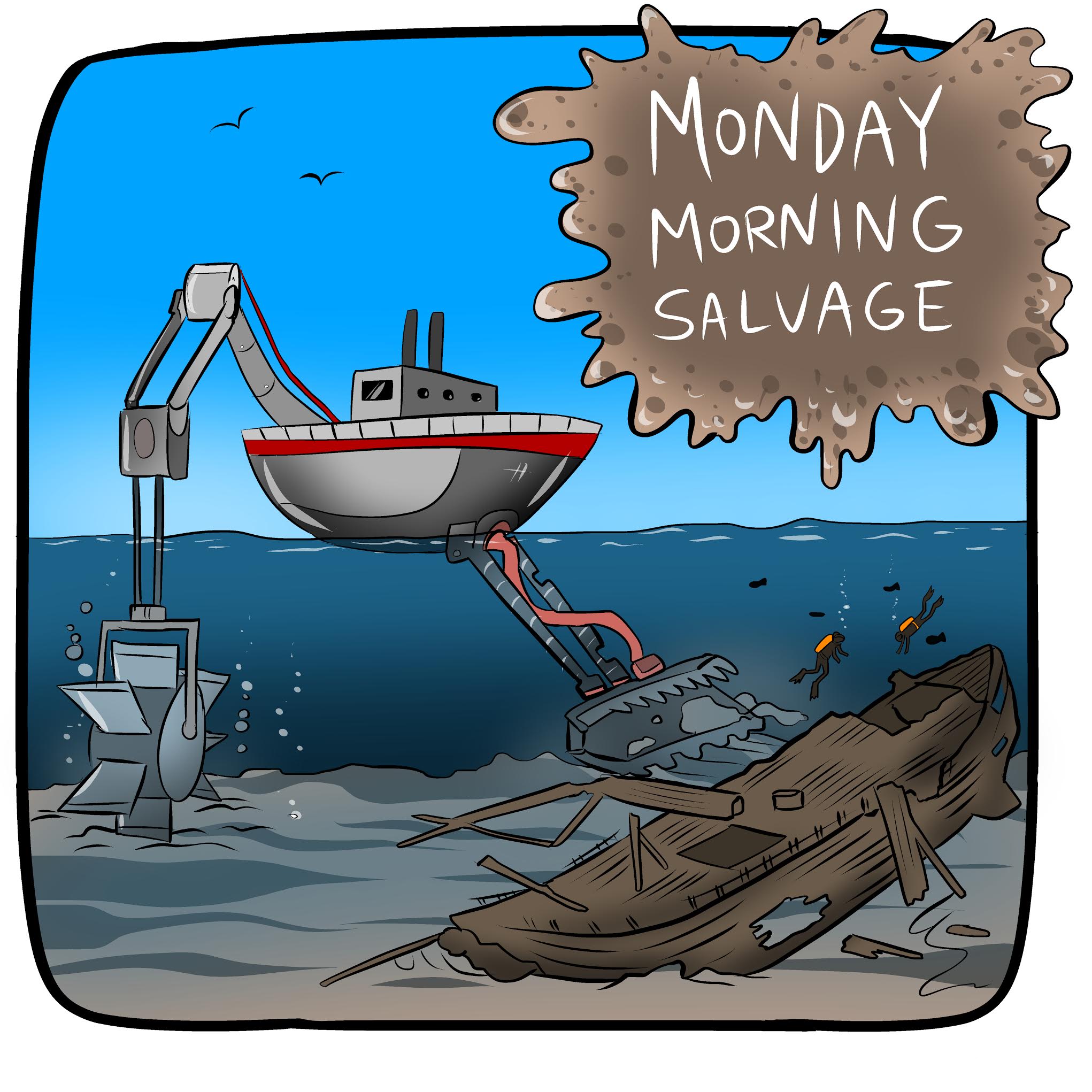
Twitter Ocean Chess, lessons from the Vaquita, awe of the deep, and more! Monday Morning Salvage: November 13, 2017

Posted on November 13, 2017November 13, 2017 By Andrew Thaler
Weekly Salvage

Fog Horn (A Call to Action)

  • Ocean policy news breaking this week. We’ll have a comment template ready to go when it does. Please check back. We can’t announce until we know exactly what we’re dealing with.
  • Still time to register for OceanDotComm! Science Communication folks! Are you ready for OceanDotComm? Register now!

Flotsam (what we’re obsessed with right now)

  • This is an amazing piece about the importance of awe in deep-sea conservation. Unless we regain our historic awe of the deep ocean, it will be plundered.

Wine bottle found in the deep North Atlantic. Laura Robinson, University of Bristol, and the Natural Environment Research Council. Expedition JC094 was funded by the European Research Council.

  • The Vaquita are going extinct and with them comes an importance lesson on the value of social science to conservation research:

My wife, on the other hand, is a social scientist who works on development here in Mexico. When we first started dating, I used to tease her for being a soft little scientist in her soft little science. I now understand that helping a community pull itself out of poverty is more complex than brain surgery or quantum physics.

There is no magic equation for community organizing but she begins by understanding that “the community” isn’t some monolithic creature that thinks as a unit. There are complex politics and power dynamics at work that can either aid or destroy all her efforts.

I now understand why the vaquita is going extinct. They sent too many people like me into the region and not enough like her.

source.

  • Would you like to play a game? Last week David and I unleashed Twitter Ocean Chess upon the internet and the results are in: it’s the only valid use of 280 characters.
    • Marine biology nerd chess is the only decent justification for 280-character tweets
    • Here’s what happened when two marine scientists played emoji chess on Twitter
    • Emojis + Marine biology triva = OCEAN CHESS 🐬🦀♞

Read More “Twitter Ocean Chess, lessons from the Vaquita, awe of the deep, and more! Monday Morning Salvage: November 13, 2017” »

What is a Sand Shark?

Posted on November 12, 2017November 12, 2017 By Chuck Bangley 1 Comment on What is a Sand Shark?
Conservation

I’d like to take a moment rant about a particular pet peeve of mine, which involves the seemingly-dull subject of species common names.  As you may have learned in biology class, all identified and described species are assigned a Latin scientific name, which is intended to be a universal identifier of that species regardless of where it’s coming up in conversation.  However, scientific names are not typically very familiar to non-scientists, so common names remain the most, well, common way to refer to a species.

Read More “What is a Sand Shark?” »

Ocean Noise, Parasite Extinction, and Jellyfish Blooms: Thursday Afternoon Dredging: November 9th, 2017

Posted on November 9, 2017 By David Shiffman
Uncategorized

Cuttings (short and sweet): 

  • Watch this manta ray (or should I say mobula ray) at the Georgia Aquarium

    Video by Georgia Aquarium
  • Follow Serena Wong, a graduate student at SFU studying shark and ray respiratory physiology, on twitter!
  • 9 reasons you can’t help but love manatees. By Katie Hogge, for the Ocean Conservancy blog


Read More “Ocean Noise, Parasite Extinction, and Jellyfish Blooms: Thursday Afternoon Dredging: November 9th, 2017” »

Shark protections, shark careers, and sharky grammar: Dear Shark Man, Volume 1

Posted on November 8, 2017November 8, 2017 By David Shiffman
Uncategorized

Welcome to volume #1 of Dear Shark Man, an advice column inspired by a ridiculous e-mail I received. You can send your questions to me via twitter (@WhySharksMatter) or e-mail (WhySharksMatter at gmail).


Dear Shark Man,

Have you seen this New Scientist article (“Sharks now protected no matter whose waters they swim in?)
Is this good news? It seems too good to be true.

Sincerely,
Skeptical in Seattle

Dear Skeptical,

You are correct to be, um, skeptical. At best, this article is an oversimplification of a very complex problem. Many shark species migrate through the territorial waters of multiple nations, which complicates any conservation and management plans for these species. The Convention on Migratory Species, which is what the New Scientist article is about, is an attempt to help. However, a CMS listing is only the first step, and it does not inherently require any legal protections. Thus far, CMS listings for sharks have not resulted in any concrete legal protections for these species. The World Wildlife Fund’s shark expert, Ian Campbell, has written a great summary of why this CMS news is not the be-all end-all solution that many seem to believe, check it out here:

Read More “Shark protections, shark careers, and sharky grammar: Dear Shark Man, Volume 1” »

One weird trick for improving the outcome of your PhD defense.

Posted on November 6, 2017November 6, 2017 By Andrew Thaler 1 Comment on One weird trick for improving the outcome of your PhD defense.
Academic life

Feed your committee.

At the very least, make sure your committee is fed. A hungry committee is a grumpy committee. A grumpy committee is just a little bit less likely to let you pass your defense. Sure, you can prep, polish your thesis to perfection, run through a half-dozen practice defenses. You can even invest in some serious snake-fighting lessons. But all of those solutions are practical, pragmatic, and belie a commitment to success that suggests a work ethic, expertise, and discipline. All of which you need, but don’t ignore the obvious, easy stuff, either.

Wait, Andrew, you’re serious?

If you’ve learned anything from reading this blog for the last 9 years, it’s that I am always serious. Humor is anathema to me. Let’s talk about the science.

In a 2011 paper, Danziger and friends looked at extraneous factors in judicial decisions. In short, they looked at how often judges granted parole to inmates as a function of when the decision was made. Parole judges often hear dozens of cases in a day with few breaks. What Danziger and friends found was that, immediately after a judge had eaten, favorable parole outcomes were much more frequent and that, as parolees got further and further from mealtime, their chance of getting out plummeted. Those whose hearings fell right before a meal break had a 0% chance of parole. The pattern was clear: never appear before a hungry judge.

Proportion of rulings in favor of the prisoners by ordinal position. Circled points indicate the first decision in each of the three decision sessions; tick marks on x axis denote every third case; dotted line denotes food break. Because unequal session lengths resulted in a low number of cases for some of the later ordinal positions, the graph is based on the first 95% of the data from each session. Danziger and friends, 2011.

Simple.

Well, not quite.

Read More “One weird trick for improving the outcome of your PhD defense.” »

Surviving a Double Hurricane (a first person report of the Puerto Rico disaster by Heather Cooke)

Posted on November 6, 2017November 6, 2017 By Guest Writer
Uncategorized

Heather Cooke graduated with an environmental science degree from George Mason University and studied marine biology. She is now a dive instructor and runs Culebra Divers on Culebra Island. This article was written during brief moments of power on Culebra Island.


As General Manager of Culebra Divers in Culebra, Puerto Rico for the last 2.5 years, I have enjoyed our semi-arid island with its brief storms. Known for one of the safer harbors in the Caribbean, my husband and I watched tropical storm after tropical storm and hurricane after hurricane pass us by. What I am writing is based on our experiences and what others around me have experienced or shared from their families on our sister islands.

Culebra the smallest of 3 islands that make up what you know as Puerto Rico (the “mainland”, Vieques, and us) and we’re 17 miles from the mainland itself.  To get here you fly from San Juan or take a ferry from the mainland’s east coast. We get all our food and fuel via that same ferry system. Our water and power travel under the ocean from the mainland through Vieques and then to us so if anything happens to either of those islands, we are screwed.  The island has a rag tag rental generator and no desalination plant.

As I write this, it has been 34 days since Maria and 48 since Irma and we still lack non-generator power, reliable daily water, and cell service not provided by some other island.

Read More “Surviving a Double Hurricane (a first person report of the Puerto Rico disaster by Heather Cooke)” »

Posts pagination

Previous 1 … 54 55 56 … 274 Next

Popular Posts

What Ocean Ramsey does is not shark science or conservation: some brief thoughts on "the Shark Whisperer" documentaryWhat Ocean Ramsey does is not shark science or conservation: some brief thoughts on "the Shark Whisperer" documentaryJuly 2, 2025David Shiffman
What is a Sand Shark?What is a Sand Shark?November 12, 2017Chuck Bangley
Zombie ideas in conservation: trophy hunting and conservationZombie ideas in conservation: trophy hunting and conservationAugust 6, 2026Ali Gaster
Jumping the shark: New study reviews the breaching behavior of sharks and raysJumping the shark: New study reviews the breaching behavior of sharks and raysSeptember 19, 2024David Shiffman
Shark of Darkness: Wrath of Submarine is a fake documentaryShark of Darkness: Wrath of Submarine is a fake documentaryAugust 10, 2014Michelle Jewell
That's not a blobfish: Deep Sea Social Media is Flooded by AI SlopThat's not a blobfish: Deep Sea Social Media is Flooded by AI SlopDecember 19, 2025Andrew Thaler
Is Academic Publishing is breaking conservation science?Is Academic Publishing is breaking conservation science?August 10, 2026Chris Parsons
Considering writing a popular science book? Here's my adviceConsidering writing a popular science book? Here's my adviceJuly 7, 2025David Shiffman
How the Bluespotted Ribbontail Stingray got its SpotsHow the Bluespotted Ribbontail Stingray got its SpotsMarch 28, 2024David Shiffman
Emergency room conservation: why waiting for the Endangered Species Act to save a species is a fiscal disasterEmergency room conservation: why waiting for the Endangered Species Act to save a species is a fiscal disasterAugust 11, 2026Ali Gaster

squishy

Subscribe to our RSS Feed for updates whenever new articles are published.

We recommend Feedly for RSS management. It's like Google Reader, except it still exists.

Southern Fried Science

  • Home
  • About SFS
  • Authors
  • Support SFS


If you enjoy Southern Fried Science, consider contributing to our Patreon campaign.

Copyright © 2026 Southern Fried Science.

Theme: Oceanly Premium by ScriptsTown