
Skip to content

Southern Fried Science

Over 15 years of ocean science and conservation online

  • Home
  • About SFS
  • Authors
  • Support SFS

Recent Posts

Here’s how to join my IMCC8 symposium, “Ocean Science Communication: What’s New and What’s Next?”
April 22, 2026
Deep Sea Mining Symposium Announcement
April 21, 2026
Join Me at Upwell: A Wave of Ocean Justice — Our Fourth Year!
March 24, 2026
How close did the world’s first deep-sea mining come to the dredging the world’s largest cold-water coral reef?
March 17, 2026
Here are some ocean conservation technologies that I’m excited about
February 19, 2026
Walking Backwards Into the Future: Applying Indigenous Knowledge to Deep Sea Mining
February 5, 2026

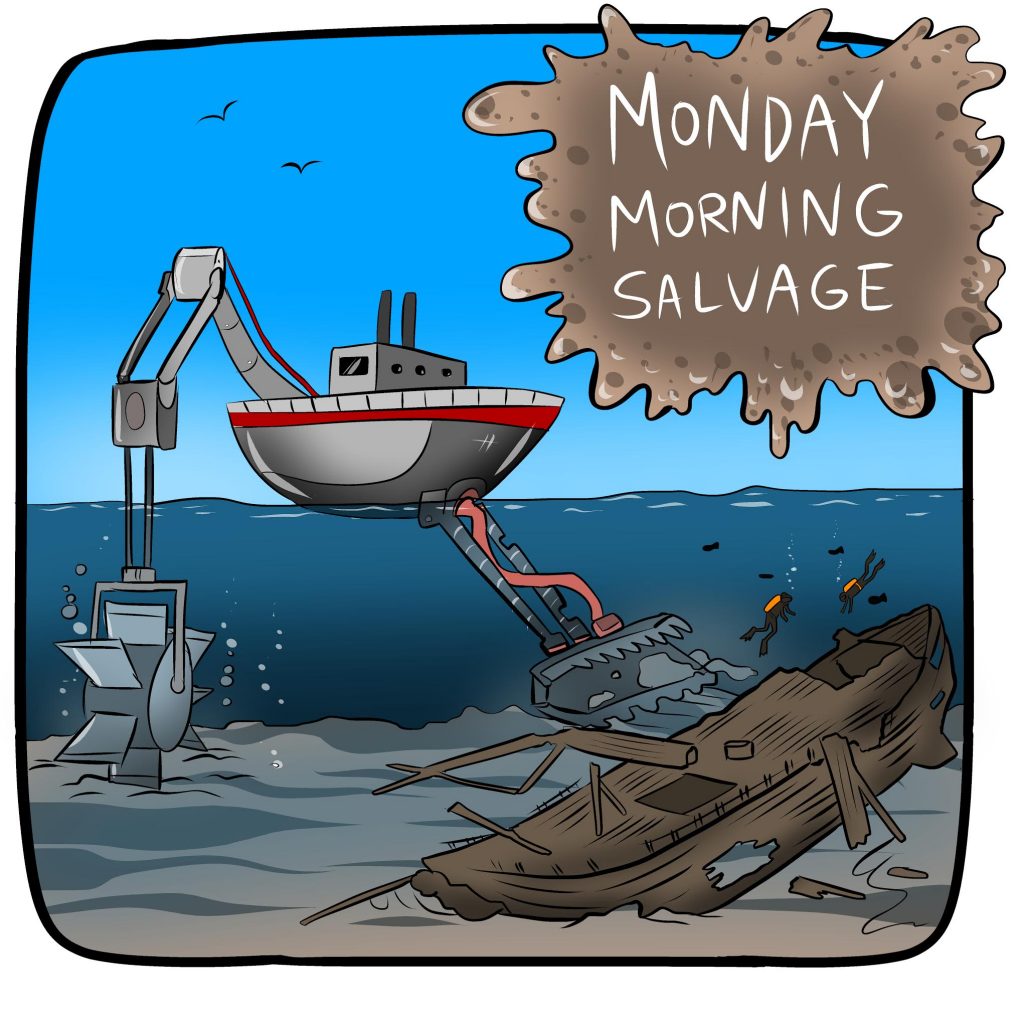
Climate change denial, open-science hardware, some missing pink dolphins, and more! Monday Morning Salvage: May 1, 2017

Posted on May 1, 2017April 30, 2017 By Andrew Thaler
Weekly Salvage

Fog Horn (A Call to Action)

  • Are you represented by a climate change denier? Motherboard has put together this amazing guide to every climate change denier in congress. Check your state and give your congressperson a piece of your mind. Congressman Andy Harris may be sick of hearing from me, but I guarantee he’ll be gone from my district long before I am.

Flotsam (what we’re obsessed with right now)

Read More “Climate change denial, open-science hardware, some missing pink dolphins, and more! Monday Morning Salvage: May 1, 2017” »

Fun Science FRIEDay – Immune System Amnesia

Posted on April 28, 2017May 8, 2017 By Kersey Sturdivant 2 Comments on Fun Science FRIEDay – Immune System Amnesia
Uncategorized

Ah the measles, a childhood illness that most of my generation has never experienced; due in large part to the success of measles vaccination. A lot of people think the measles isn’t that big of a deal, its just some combination of a rash and fever that goes away in due time. While this is true in most people, in about 1 in 1,000 cases the infection becomes systemic and moves to the brain resulting in death, in what is known as  measles encephalitis.  The measles vaccination resolved this issue but also had an unexpected secondary effect.

16th-century Aztec drawing of someone with measles (Photo credit: Unknown – (2009) Viruses, Plagues, and History: Past, Present and Future, Oxford University Press, USA, p. 144)

When the measles vaccine was first introduced in America in the 1960s, scientists were perplexed why childhood deaths from all infectious diseases plummeted along w/ the measles; even deaths from diseases like pneumonia and diarrhea were cut in half.  An obvious assumption was the drop in childhood deaths was just a result of our advances in modern medicine. While there is undoubtedly truth in the assertion that modern medicine was advancing rapidly in the mid-20th century, whenever the measles vaccine was introduced to Europe a few years later, and even now as its being introduced to third world countries, the same phenomena has been observed. Places that have the measles vaccine see a steep decline in deaths from all other childhood diseases. So whats going on?

Read More “Fun Science FRIEDay – Immune System Amnesia” »

The Holy Grail of the portable hardware-hacking lab: A cordless soldering iron that actually works.

Posted on April 25, 2017April 25, 2017 By Andrew Thaler
Reviews and Interviews

This is a mess. This isn’t even everything I brought for Make for the Planet.

All electronics kits are not created equal. Between the OpenROV, Oceanography for Everyone, and hack-a-thons around the world, my work has taken me out of the lab and into the field, fantail, and classroom to build instruments, hack oceanographic equipment, and train next generation of open-science oceanographers. This has placed a huge new demand on my standard kit, a collection of electronics and hardware tools and components that allow a creative maker to build anything, anywhere. Portability is key, but portability comes with it’s own challenges, especially for that most vital of electronics tools, the humble, powerful soldering iron.

A good soldering iron is absolutely critical to the kinds of projects and workshops I run. Without it, we can to the delicate electronics work necessary for getting a piece of equipment working in the field. But traveling with soldering irons is a nightmare. These high-wattage devices don’t always play nice with local electrical infrastructure. Even using the *right* power converters we’ve blown fuses and burned out power supplies. In the best case scenarios, the irons just don’t produce enough heat to get the job done. In remote regions, local options are often non-existent. When we go, we bring everything with us.

There are portable soldering irons, but they have their own problems. Gas-powered irons require a fuel source that may not be easily obtained and are not always welcome on flights. They also lack the fine control we need. Electric options tend to be of the “cold heat” variety, which is a poor tool for circuit board work and can generate a current that burns out components and shorts your project. Heat-based electric soldering irons are weak, short-lived, and often utterly ineffective. I resigned myself to lugging large soldering stations around the world, hoping for the best when it comes to finding an adequate power supply.

And then I discovered the Hakko FX-901. 

Read More “The Holy Grail of the portable hardware-hacking lab: A cordless soldering iron that actually works.” »

The impact of the March for Science

Posted on April 24, 2017April 25, 2017 By Chris Parsons 1 Comment on The impact of the March for Science
Science

Along with an estimated forty thousand other scientists, I braved the rains to attend the March for science in Washington DC. I went with a bit of trepidation, as I was wondering if anyone would attend, but the staging post at the based of the Washington Monument was absolutely packed.

Donald Trump blamed rain (a brief smattering of drizzle) for poor numbers at his inauguration, but pouring rain and cold did not deter the masses of scientists who attended the March. Although we be derided as “snowflakes” for protesting the current administration, clearly scientists are snowflakes made of Titanium.

Read More “The impact of the March for Science” »

Deep-sea Disco, Giant Icebergs, Pokémon Go, and more! Monday Morning Salvage: April 24, 2017

Posted on April 24, 2017 By Andrew Thaler
Weekly Salvage

Fog Horn (A Call to Action)

  • Still time! The EPA is seeking public input on the new administrations approach to environmental regulations. They are required to seek public input. They are required to respond to public input. Go tell them how you feel. Public comments close May 15. Here’s the docket with instructions on how to comment: Evaluation of Existing Regulations.

Flotsam (what we’re obsessed with right now)

  • This deep-sea mining Disco video is something.

Jetsam (what we’re enjoying from around the web)

Read More “Deep-sea Disco, Giant Icebergs, Pokémon Go, and more! Monday Morning Salvage: April 24, 2017” »

March for the Science that uplifts humanity.

Posted on April 22, 2017April 22, 2017 By Andrew Thaler
Blogging

The March for Science has a diversity problem.

Ok, to be clear, the committee organizing the march is the one with the problem. As they’re about to find out, a movement like this will resist, among other things, the efforts of a few to take ownership over a much grander view of life. The Science March on Washington (and the marches in your home state) is bigger than one organization.

Five months ago, we issued a mandate for Southern Fried Science, that we would strive to tear down barriers, to breach the dam, because Diversity is Resilience. Seeing the March for Science struggle and seemingly succumb to the same weathered barricades reinforced, for me, exactly why we need that mandate.

“Science isn’t political” is a lovely Platonic platitude that we whisper reassuringly into comfortable ears.

It is not so.

Read More “March for the Science that uplifts humanity.” »

Titanic tourists, nodule mining, right whales, and more! The Monday Morning Salvage: April 17, 2017

Posted on April 17, 2017April 16, 2017 By Andrew Thaler
Weekly Salvage

Fog Horn (A Call to Action)

  • The EPA is seeking public input on the new administrations approach to environmental regulations. They are required to seek public input. They are required to respond to public input. Go tell them how you feel. Public comments close May 15. Here’s the docket with instructions on how to comment: Evaluation of Existing Regulations.

Flotsam (what we’re obsessed with right now)

  • Titanic Tourism. Like this article: To Visit Titanic Firsthand, New York Banker Dives Deep Into Wallet. I have thoughts. Oh so many thoughts.

Jetsam (what we’re enjoying from around the web)

  • Deep-sea mining meets alternative energy: Renewables’ deep-sea mining conundrum. I once calculated that all the copper in Solwara 1 could make 800 1-megawatt wind turbines [note: I am not good at math].
  • Two really cool expeditions coming out of Louisiana this year: Exploring Changes on the Gulf Coast and Ecology of Shallow Wood Falls.  Neat!
  • Begun, the crab wars have. Svalbard’s Snow Crabs: a Pincered Proxy for Arctic Oil.
  • A wonderful piece on field notes and what they mean to past a future fisheries biologists from our friends at the Fisheries Blog.
  • A tiny Iowa paper just won a Pulitzer Prize for tackling farm pollution. This mouse roars.
  • Farm-raised superbugs find their way into kids’ noses somehow. This is fine. Every thing is fine.

Read More “Titanic tourists, nodule mining, right whales, and more! The Monday Morning Salvage: April 17, 2017” »

Hone your social media #SciComm skills with ocean science pros.

Posted on April 14, 2017 By Andrew Thaler
Blogging

Looking to boost your ocean outreach skills in a more formal setting? We’ve got two opportunities for social media training with ocean science and ocean communications experts from Southern Fried Science: LUMCON Summer Course: Join me at the Louisiana Universities Marine Consortium on the Gulf Coast for a week-long workshop on Science Communication Using Social Media led by … Read More “Hone your social media #SciComm skills with ocean science pros.” »

Make for the Planet with Conservation X Labs and the Earth Optimism Summit!

Posted on April 11, 2017 By Andrew Thaler 2 Comments on Make for the Planet with Conservation X Labs and the Earth Optimism Summit!
Conservation

Invasive species, overfishing, ocean plastics, wildlife tracking, and measuring ecosystem services, are some of the most daunting challenges in conservation.While these challenges require a combination of social, commercial, and regulatory cooperation to address, they can also be tackled through technological innovation, which can bypass some of the largest hurdles to implementing practical, timely solutions.

On April 21, 2017, 18 teams of conservationists, technologists, makers, and hardware hackers will gather in Washington DC and tackle five conservation challenges selected by a panel of experts at the Make for the Planet, part of the Smithsonian’s Earth Optimism Summit. Over three days, teams will work to develop prototypes, strategic frameworks, and model systems that address specific issues within the broader challenge prompt of terrestrial species invasion, overfishing, ocean plastics, wildlife tracking, and ecosystem services.

Read More “Make for the Planet with Conservation X Labs and the Earth Optimism Summit!” »

Octopus Genes, Decolonization, and a mega-dose of Citizen Science! Monday Morning Salvage: April 10, 2017

Posted on April 10, 2017April 10, 2017 By Andrew Thaler
Weekly Salvage

Flotsam (what we’re obsessed with right now)

  • Octopuses are weird. Really, really weird. Ed Yong covers yet another weird octopus thing in the Atlantic: Octopuses Do Something Really Strange to Their Genes. And check out the original paper, below.

Jetsam (what we’re enjoying from around the web)

  • This interview with Shay Akil McLean is one of the best introductions to the concept of decolonizing science: Hood Biologist Explains How to Decolonize All The Science. See also: We Need Decolonial Scientists.
  • Free Radicals is one of the best new(ish) science blogs on the net: Zapatistas Reimagine Science as Tool of Resistance.
  • Incidentally, the March for Science does not have a diversity problem.

Instead, I believe that this march needs to be completely apolitical and nonpartisan. I think that we should protest the current administration, which wants to repeal laws guaranteeing clean air and water, claim that climate change is a hoax, and remove scientists’ access to quality healthcare, but in a way that doesn’t alienate members of the current administration. We should demand change, but vaguely, and from no one in particular.

Source.

  • If you love geophysical fluid dynamics, then you will love these foamy streaks in a lagoon. Deep Sea News, natch.
  • With the legendary Erika Bergman at the helm, the Aquatica Submarine crew put eyes on a new glass sponge bioherm off the coast of Vancouver.

https://www.youtube.com/watch?v=V6stLjJ5lAo

  • Another article about the GOSH meeting where I rep-ed OpenROV and Oceanography for Everyone: Santiago de Chile, capital of the Global network for Open Science Hardware.
  • As a card-carrying population geneticist, I second this piece: Getting your genetic disease risks from 23andme is probably a terrible idea.

Read More “Octopus Genes, Decolonization, and a mega-dose of Citizen Science! Monday Morning Salvage: April 10, 2017” »

Posts pagination

Previous 1 … 61 62 63 … 272 Next

Popular Posts

What Ocean Ramsey does is not shark science or conservation: some brief thoughts on "the Shark Whisperer" documentaryWhat Ocean Ramsey does is not shark science or conservation: some brief thoughts on "the Shark Whisperer" documentaryJuly 2, 2025David Shiffman
What is a Sand Shark?What is a Sand Shark?November 12, 2017Chuck Bangley
That's not a blobfish: Deep Sea Social Media is Flooded by AI SlopThat's not a blobfish: Deep Sea Social Media is Flooded by AI SlopDecember 19, 2025Andrew Thaler
Fun facts and FAQs about Megalodon, Maryland's new (and definitely extinct) official state sharkFun facts and FAQs about Megalodon, Maryland's new (and definitely extinct) official state sharkApril 15, 2026David Shiffman
Considering writing a popular science book? Here's my adviceConsidering writing a popular science book? Here's my adviceJuly 7, 2025David Shiffman
This is not an article about epoxy river tables.This is not an article about epoxy river tables.June 4, 2024Andrew Thaler
Here's what I teach my students about finding jobs in marine biology and conservationHere's what I teach my students about finding jobs in marine biology and conservationApril 10, 2024David Shiffman
Shark of Darkness: Wrath of Submarine is a fake documentaryShark of Darkness: Wrath of Submarine is a fake documentaryAugust 10, 2014Michelle Jewell
Join Me at Upwell: A Wave of Ocean Justice — Our Fourth Year!Join Me at Upwell: A Wave of Ocean Justice — Our Fourth Year!March 24, 2026Angelo Villagomez
What can the funniest shark memes on the internetz teach us about ocean science and conservation?What can the funniest shark memes on the internetz teach us about ocean science and conservation?November 8, 2013David Shiffman

squishy

Subscribe to our RSS Feed for updates whenever new articles are published.

We recommend Feedly for RSS management. It's like Google Reader, except it still exists.

Southern Fried Science

  • Home
  • About SFS
  • Authors
  • Support SFS


If you enjoy Southern Fried Science, consider contributing to our Patreon campaign.

Copyright © 2026 Southern Fried Science.

Theme: Oceanly Premium by ScriptsTown