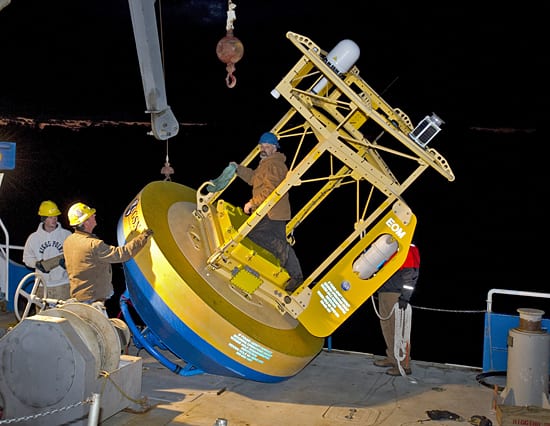

The Louisiana Universities Marine Consortium (LUMCON), located at the very tip of Louisiana’s boot, is a special place. The only marine lab in Louisiana, LUMCON serves public universities and supports marine science for the entire state. I had the pleasure of visiting LUMCON late last year to lead an underwater robotics workshop for local high … Read More “Help an ocean student catch a break!” »
This weekend, the Washington Post reported on a leaked proposed budget from the Administration which includes drastic, agency-breaking cuts to the National Oceanic and Atmospheric Administration. This comes in the wake of new Commerce Secretary Wilbur Ross pledging to protect peer-reviewed researchers and shield NOAA climate scientists from partisan attacks and that the Department of … Read More “Monday Morning Salvage: NOAA Special Edition (call your representatives!)” »
Cuttings (short and sweet):
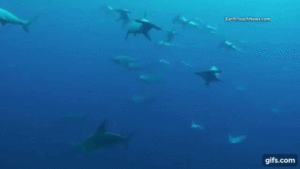
- Watch this school of hammerheads swim! Video by Earth Touch.

- Follow seahorse conservation biologist Lindsay Aylesworth on twitter!
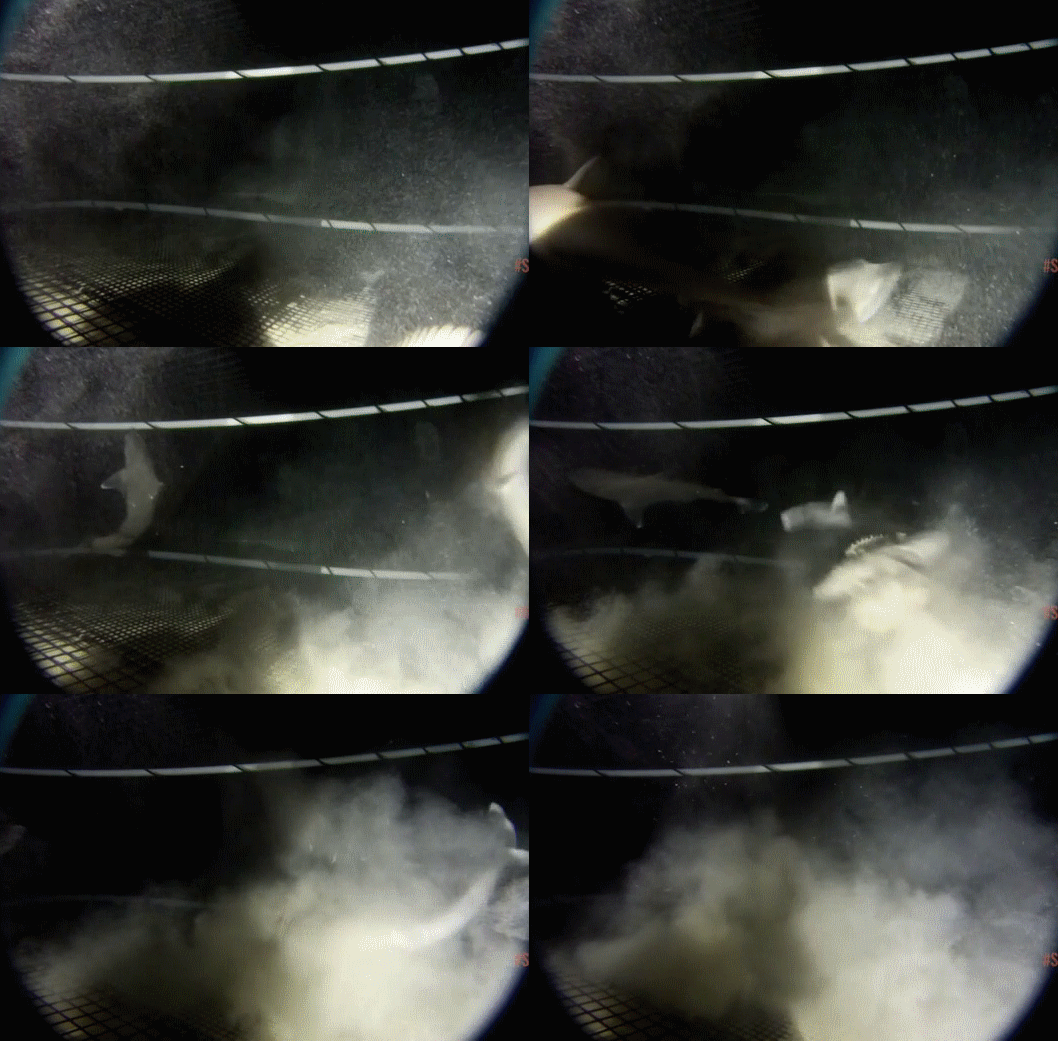
- 147 individual great white sharks were spotted off Cape Cod last year. By Steve Annear, for the Boston Globe.
- Tips for planning an environmentally-friendly vacation. By Shivani Vora, for the New York Times.
Something that has been bothering me for a while, is why do wizards go adventuring?
Source: ClipArtLord.com
Now if you are a big geek like me, you’ll know that practically every adventuring party has a wizard. But these wizards are incredibly unprepared for exploring dungeons and have a shockingly high mortality rate. In the dungeons and dragons* of my youth, a starting wizard had a mere 1 to 4 hit points and was equipped with dagger (or is they were luck a staff). Did these budding Gandalfs get armor? Of course not, they faced ogres and basilisks in the fantasy equivalent of sweat pants.
The statistics of a starting wizard meant that they could easily be killed by a house cat. Also they had just one spell. Cast “light” so that your party could see in a cave, and you were done for the day. If you had the most destructive spell of the first level wizard, you would fire a “magic missile” that always hit, but did a miserable 2 to 5 (1d4+1) points of damage. So if jumped by above mentioned angry house cat, you literally had a 50/50 chance of killing it before it killed you**.
So why do all these highly educated, highly intelligent wizards leave their ivory (or mithril) towers and trudge through cold, dank dungeons with groups of characters that generally make the knights in Monty Python and the Holy Grail look like Seal Team 6 in comparison?
Why does every early career academic pursue elusive gold and put their common sense and lives on the line? Why…? To get tenure of course…

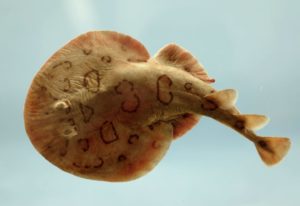
The lesser electric ray, a small sand-dwelling ray that lives from North Carolina to Brazil, has been considered one of the most endangered marine fish on Earth. A 2005 paper reported that 98% of these rays had been wiped out, a decline attributed to shrimp trawling bycatch. This paper resulted in these animals getting classified as IUCN Red List “Critically Endangered,” the highest risk category for any species that is still found in the wild.
A new paper published today in the journal Endangered Species Research shows that these rays are in much better shape than previously believed. “There is no evidence of a decline in the relative abundance of lesser electric rays,” said Dr. John Carlson, a NOAA Fisheries Service Research Biologist and lead author of the new paper.
Read More “Rumors of the lesser electric ray’s demise have been greatly exaggerated” »
Cuttings (short and sweet):
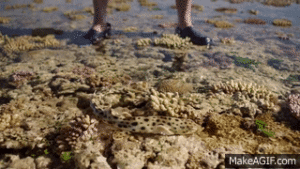
- Watch this shark walk across a reef during low tide, from the BBC Shark special!

- Follow the JCU Seagrass Ecology Lab on twitter!
- Bring out your dead: donation of fish carcasses helps the community. By Henry Hershey, for the Fisheries Blog
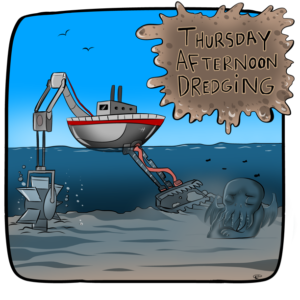
Read More “Thursday Afternoon Dredging: February 23rd, 2017” »

For all our US-based Readers: Happy President’s Day! For everyone else, this is the reason none of you USian colleagues are answering e-mails. Unless they are, in which case, *grumble grumble grumble* *something about work-life balance*
Flotsam (what we’re obsessed with right now)
- The ocean is full of garbage and even the deepest trenches aren’t safe. Here’s an interview I did with KSPN Saipan where I talked about the garbage the precedes us everywhere we go.
- Also: Banned chemicals persist in deep ocean. This seems important.
Cuttings (short and sweet):
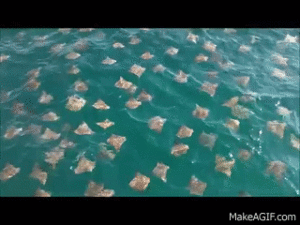
- Watch cownose rays migrate past Destin, Florida, filmed by a parasailer
- Follow Abby Lawson, a Ph.D. candidate researching alligators, on twitter!
- Debunking myths about ocean garbage patches. From the NOAA restoration blog
- What does BREXIT mean for UK fishing rights? By Daniel Boffey, for the Guardian
Read More “Thursday Afternoon Dredging: February 16th, 2017” »
If you are at a university that has graduate students, you have probably heard about whether your university is an R1 or R2 or R-whatever research institution. Universities tout their position in this ranking system, awarded by the Carnegie Foundation, to denote how “prestigious” they are in terms of research. From 1994, the ranking used to be given according to how much federal research funding they were awarded.
Source: clipart panda
Because of this, all the ranking told you was how much federal money a particular university received. This system is incredibly flawed. For example, if you have faculty more dedicated to writing grants and less dedicated to teaching, mentoring graduate students, publishing articles or doing other activities that are supposed to be the mainstay of academia, then certainly you will get more money. However, this will be at the expense of teaching, mentoring, publishing, etc.
Read More “R1 research universities – is a biased, flawed ranking system crippling academia?” »

Bringing you the best of marine science and conservation from the last week.
Flotsam (what we’re obsessed with right now)

- More.
Jetsam (what we’re enjoying from around the web)