
Skip to content

Southern Fried Science

Over 15 years of ocean science and conservation online

  • Home
  • About SFS
  • Authors
  • Support SFS

Recent Posts

Here’s how to join my IMCC8 symposium, “Ocean Science Communication: What’s New and What’s Next?”
April 22, 2026
Deep Sea Mining Symposium Announcement
April 21, 2026
Join Me at Upwell: A Wave of Ocean Justice — Our Fourth Year!
March 24, 2026
How close did the world’s first deep-sea mining come to the dredging the world’s largest cold-water coral reef?
March 17, 2026
Here are some ocean conservation technologies that I’m excited about
February 19, 2026
Walking Backwards Into the Future: Applying Indigenous Knowledge to Deep Sea Mining
February 5, 2026

Fun Science FRIEDay – Drug Resistant Bacteria, The Movie

Posted on September 9, 2016September 9, 2016 By Kersey Sturdivant
Uncategorized

In today’s FSF we bring you both a jaw dropping, and somewhat terrifying cinematic visualization of how bacteria evolve resistance to antibiotics, and overtime can become super bugs immune to any antibiotic treatment.  A concise and detailed description is presented below:

This stunning video of evolution in action captures how bacteria with no resistance to an antibiotic can in a very short time become resistant to concentrations of more than a thousand times the initial concentration. Other scientists have documented this phenomenon before, but never with such vivid clarity as that provided by Michael Bay and Roy Kishony of Harvard University.

Read More “Fun Science FRIEDay – Drug Resistant Bacteria, The Movie” »

Fun Science FRIEDay – Shark Daycare

Posted on September 2, 2016September 2, 2016 By Kersey Sturdivant 3 Comments on Fun Science FRIEDay – Shark Daycare
Conservation, Uncategorized

A great white shark nursery in the North Atlantic that was discovered in 1985 south of Cape Cod in the waters off Montauk, New York  has received renewed attention due to the increased activity of white sharks off cape cod in recent years. The nursery was first documented in 1985 by Casey and Pratt who deduced the presence of a nursery based on the number of juvenile sightings and landings in the area. This work was followed up recently  by OCEARCH (an organization dedicated to generating scientific data related to tracking/telemetry and biological studies of keystone marine species such as great white sharks), which tagged and tracked nine infant great whites to the nursery, located a few miles off Montauk.

Great White Shark. Image courtesy animals.NationalGeographic.com

Photo of a great white shark in Mexico by Terry Goss, WikiMedia Commons. http://commons.wikimedia.org/wiki/File:White_shark.jpg


Read More “Fun Science FRIEDay – Shark Daycare” »

Look at your sharks: how close observation leads to new scientific discoveries

Posted on August 31, 2016 By Guest Writer
Science

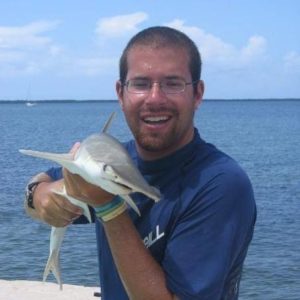
Josh Moyer Head ShotJoshua Moyer is an ichthyologist specializing in the evolution, biodiversity, and morphology of sharks and their relatives, collectively known as elasmobranchs. He is a member of the American Society of Ichthyologists and Herpetologists (ASIH) and the American Elasmobranch Society (AES). He has co-authored multiple scientific articles about shark teeth and their roles in understanding elasmobranch evolution. Joshua earned his Masters of Science in Ecology and Evolutionary Biology at Cornell University and teaches evolutionary biology at Ithaca College. Joshua also routinely lectures in courses on marine biology, vertebrate biology, and elasmobranchs. He has co-taught courses in shark biology in the field, laboratory, classroom, and most recently the online edX.org course “Sharks! Global Biodiversity, Biology, and Conservation.”

Whenever I tell someone that I study sharks I can see their imagination shift into high gear. Their eyebrows go up, their mouths make an intrigued smile, and I’m usually asked whether I’ve gone swimming with sharks or if I’ve ever been bitten by one. Yes, I’ve been in the water with sharks. No, a shark has never bitten me (although I did drop the jaw of a Mako shark on my arm once – that left an interesting scar). I’ve also gone on shark tagging trips and many spent days as an undergraduate documenting the social behaviors of sharks in aquaria. Those are what I call my “dinner party stories.” They’re the anecdotes people expect to hear from a shark biologist. I’m frequently happy to oblige. However, I’d be remiss if I didn’t acknowledge that oceanic adventures are not essential to being a shark biologist, and they’re no substitute for curiosity and educated observation. In other words, you may see a shark, but you need to know how to really look at it – how to study it.

Read More “Look at your sharks: how close observation leads to new scientific discoveries” »

Death by Renaissance Faire

Posted on August 30, 2016September 2, 2016 By Chris Parsons 1 Comment on Death by Renaissance Faire
Climate change

I am a big fan of Renaissance Faires and Festivals – I have a sizeable collection of pirate hats, doublets and billowy shirts and even a pair of thigh-length boots that would make Blackbeard envious. But whenever I go to a Renn Faire at this time of year and see the clientele dressed up in full Tudor formal dress, I worry about their immediate expiration from massive heat stroke.

Renn Fest

Read More “Death by Renaissance Faire” »

Scientific literature needs discipline – an example from a killer whale life expectancy study

Posted on August 23, 2016August 23, 2016 By Chris Parsons 1 Comment on Scientific literature needs discipline – an example from a killer whale life expectancy study
Uncategorized

If you let a puppy piddle on the carpet without discipline, it will keep doing it. It will grow into a big dog that destroys your carpeting and rugs and makes your whole house stink.

So it is with scientific literature.

puppy-pees

We all know bad papers are out there. When you read them, you’re left scratching your head and wondering, “How on earth did these pass peer-review?” Worse still, there are “ugly” science articles, where the scientific method goes by the wayside and data are cherry-picked, misinterpreted or manipulated to justify a political or ideological agenda or to undermine science that interferes with that agenda.

Read More “Scientific literature needs discipline – an example from a killer whale life expectancy study” »

Book review: the marine mammal observer’s handbook

Posted on August 22, 2016August 23, 2016 By Chris Parsons
Reviews and Interviews

I agree with Dr Phil Clapham, who provided the forward for the “Marine mammal observer and passive acoustic monitoring handbook” (by V. Todd, I. Todd, J. Gardner & E. Morin): the title is a bit of a mouthful. Therefore, I will refer to the book by the abbreviated title above. That said, this is a really useful book that I’ve found myself reaching for on several occasions when needing to look something up.

Read More “Book review: the marine mammal observer’s handbook” »

What can be done to protect the incredibly long-lived Greenland shark?

Posted on August 16, 2016August 17, 2016 By Guest Writer 1 Comment on What can be done to protect the incredibly long-lived Greenland shark?
Science

Sonja Fordham President, Shark Advocates International
Sonja Fordham
President, Shark Advocates International

Sonja Fordham founded Shark Advocates International as a project of The Ocean Foundation in 2010 based on her two decades of shark conservation experience at  Ocean Conservancy.  She is Deputy Chair of the IUCN Shark Specialist Group and Conservation Committee Chair for the American Elasmobranch Society, has co-authored numerous publications on shark fisheries management, and serves on most of the U.S. federal and state government advisory panels relevant to sharks and rays.  Her awards include the U.S. Department of Commerce Environmental Hero Award, the Peter Benchley Shark Conservation Award, and the IUCN Harry Messel Award for Conservation Leadership.

1A new study confirming the mysterious deepsea Greenland Shark as the world’s longest lived vertebrate has made huge news in the last few days – from Science News and BBC to People magazine and the Wall Street Journal. While some scientists are questioning whether these sharks live quite as long as estimated (392 years ± 120), most agree they could well live for a century or two and – as a result —  are particularly vulnerable to overfishing. Experts also warn that risks to Greenland sharks may be increasing as melting sea ice changes Arctic ecosystems and makes fishing in the region more feasible. Study authors are among those urging a precautionary approach to the species’ conservation. In other words, an incomplete picture of status and threats should not be used as an excuse for inaction. So what might be threatening Greenland sharks today, and which upcoming policy opportunities might warrant consideration, given worldwide interest in these jaw-dropping findings?  To come up with some ideas, I first took a look back.

Read More “What can be done to protect the incredibly long-lived Greenland shark?” »

Ocean Outreach in an Evolving Online Ecosystem: Exploration wants to be shared

Posted on August 11, 2016 By Andrew Thaler
Blogging, Conservation, Oceanography for Everyone, Open Science

This is the transcript of the keynote I delivered at the Fourth International Marine Conservation Congress in St. John’s, Newfoundland. It has been lightly modified for flow.

Read Act II: Transforming the Narrative.

Picture38

Now I want to shift gears and look towards the future, where we’re going, and what tools are available to help us get there. Because the future of ocean outreach, and really the future of ocean conservation, comes down to this one concept: “Exploration wants to be shared”.

Picture2
Sealand courtesy the Daily Beast

The online ocean ecosystem is full of platforms–preexisting tools that allow us to produce, share, broadcast, enhance, and manage our outreach campaigns. Not just the obvious ones like Twitter and Facebook, but more niche tools like Slack, github, Ushahidi, medium, and yes, even PokemonGo, or if you want something a bit more serious, consider R as something that’s not just a statistics package, but a way to share your own software and data with the scientific community.

Read More “Ocean Outreach in an Evolving Online Ecosystem: Exploration wants to be shared” »

Dying for Reason in the Rational Utopia

Posted on August 10, 2016August 10, 2016 By Andrew Thaler
Conservation, Popular Culture

When Neil deGrasse Tyson proposed his “Rationalia” thought experiment several months ago, I thought is was cute but misguided. Now that he’s doubled down on the concept, I can see exactly why it is such a naively flawed idea. Rationalia would be a disaster for conservation. This short science fiction story illustrates why.


ration

“Oyez, oyez, oyez!  This, the 107th session of the 16th Superior District Court, is hereby gavelled to order. Please be seated.”

Cope Johns remained standing. He surveyed the crowd, an odd assortment of bystanders, tourists, and his few supporters. Chief Justice Carlsson entered the hall, climbed onto his podium, and looked down on the assembled masses. Somewhere amid the crush of bodies, an elderly lawyer took his seat. All eyes turned to him. He timidly rose to his feet.

“Today we hear Dr. Cope Johns, on behalf of the Vaquita (Phocoena sinus), versus the Free Republic of Rationalia. Make note that, as evidence suggests that timeliness is required in this decision, we have elected to expedite deliberations. The court has been briefed extensively on this case and requires no additional background. Dr. Johns, your opening statement?”

Cope approached the stand. The bailiff placed his left hand on the near-field ID scanner, confirming his identity. Cope raised his right hand to nothing and swore under his breath.

“Thank you, your honor. The Vaquita is a tiny porpoise that has been on the verge of extinction for the better part of a century. Its only remaining habitat is in the Gulf of Reason, where the Free Republic of Rationalia intends to establish the Lost Lobos tidal energy farm. This farm will displace the Vaquita breeding grounds and will likely drive the species over the brink to extinction.”

Read More “Dying for Reason in the Rational Utopia” »

Ocean Outreach in an Evolving Online Ecosystem: Transforming the Narrative

Posted on August 10, 2016August 11, 2016 By Andrew Thaler
Blogging, Conservation

This is the transcript of the keynote I delivered at the Fourth International Marine Conservation Congress in St. John’s, Newfoundland. It has been lightly modified for flow.

Read Act I: Science is Storytelling. 

Picture17

In Act I I discussed the underlying structure that frames narrative storytelling, but now I want to talk about how we can use the tools available to us on the internet to transform that narrative into something even more potent.

But before we can do that I have to tilt at some windmills.

Picture18

When we talk about good outreach, we often look to people like Neil deGrasse Tyson, like Bill Nye, like David Attenborough, and like Carl Sagan. These are the paragons of scientific outreach, the icons that we often hold up as examples for what constitutes good outreach. We talk about things like Cosmos, both Sagan’s and deGrasse Tyson’s, Bill Nye the Science Guy and his more recent work combating climate change, or David Attenborough and his astounding Nature Documentaries.

Read More “Ocean Outreach in an Evolving Online Ecosystem: Transforming the Narrative” »

Posts pagination

Previous 1 … 71 72 73 … 272 Next

Popular Posts

What Ocean Ramsey does is not shark science or conservation: some brief thoughts on "the Shark Whisperer" documentaryWhat Ocean Ramsey does is not shark science or conservation: some brief thoughts on "the Shark Whisperer" documentaryJuly 2, 2025David Shiffman
What is a Sand Shark?What is a Sand Shark?November 12, 2017Chuck Bangley
That's not a blobfish: Deep Sea Social Media is Flooded by AI SlopThat's not a blobfish: Deep Sea Social Media is Flooded by AI SlopDecember 19, 2025Andrew Thaler
Fun facts and FAQs about Megalodon, Maryland's new (and definitely extinct) official state sharkFun facts and FAQs about Megalodon, Maryland's new (and definitely extinct) official state sharkApril 15, 2026David Shiffman
Join Me at Upwell: A Wave of Ocean Justice — Our Fourth Year!Join Me at Upwell: A Wave of Ocean Justice — Our Fourth Year!March 24, 2026Angelo Villagomez
Considering writing a popular science book? Here's my adviceConsidering writing a popular science book? Here's my adviceJuly 7, 2025David Shiffman
This is not an article about epoxy river tables.This is not an article about epoxy river tables.June 4, 2024Andrew Thaler
Shark of Darkness: Wrath of Submarine is a fake documentaryShark of Darkness: Wrath of Submarine is a fake documentaryAugust 10, 2014Michelle Jewell
Here's what I teach my students about finding jobs in marine biology and conservationHere's what I teach my students about finding jobs in marine biology and conservationApril 10, 2024David Shiffman
What can the funniest shark memes on the internetz teach us about ocean science and conservation?What can the funniest shark memes on the internetz teach us about ocean science and conservation?November 8, 2013David Shiffman

squishy

Subscribe to our RSS Feed for updates whenever new articles are published.

We recommend Feedly for RSS management. It's like Google Reader, except it still exists.

Southern Fried Science

  • Home
  • About SFS
  • Authors
  • Support SFS


If you enjoy Southern Fried Science, consider contributing to our Patreon campaign.

Copyright © 2026 Southern Fried Science.

Theme: Oceanly Premium by ScriptsTown