

Skip to content

Southern Fried Science

Over 15 years of ocean science and conservation online

  • Home
  • About SFS
  • Authors
  • Support SFS

Recent Posts

Here’s how to join my IMCC8 symposium, “Ocean Science Communication: What’s New and What’s Next?”
April 22, 2026
Deep Sea Mining Symposium Announcement
April 21, 2026
Join Me at Upwell: A Wave of Ocean Justice — Our Fourth Year!
March 24, 2026
How close did the world’s first deep-sea mining come to the dredging the world’s largest cold-water coral reef?
March 17, 2026
Here are some ocean conservation technologies that I’m excited about
February 19, 2026
Walking Backwards Into the Future: Applying Indigenous Knowledge to Deep Sea Mining
February 5, 2026

28 quotes, facts and graphs from the new UN global use of shark products report

Posted on August 2, 2015August 27, 2015 By David Shiffman
Conservation, Science

AThe United Nations Food and Agriculture organization just released fisheries and agriculture technical paper number 590, “the state of the global market for shark products.” Coauthored by legendary shark conservation researcher Shelley Clarke, this 196 page document is a comprehensive look at, um, the state of the global market for shark products.

It includes an updated review of threats to sharks and the conservation and management mechanisms that governments are used to protect them. If you’re interested in shark conservation, you should read it. If you’re interested in shark conservation but don’t want to read a 196 page technical document, I’ve selected 28 important quotes, facts, and graphs from the report. These are organized into the following four categories (categories which can be used as a TL;DR summary of the entire report):

A) The global trade in shark meat is growing and is significantly different from the fin trade (despite not getting anywhere near the same attention from conservation activists and the media as the fin trade).

B) Many, many countries other than China are involved in the global trade in shark and ray products (despite not getting anywhere near the same attention from conservation activists and the media as China).

C) Many species and populations of skates, rays, and smaller sharks are highly traded (despite not getting anywhere near the same attention from conservation activists and the media as larger, charismatic species).

D) Global trade is complex, and we need a lot more data from governments of shark fishing and trading nations to effectively track trends in shark product use (i.e. science and record-keeping are critical for conservation, and not all important conservation work is glamorous or exciting).

Read More “28 quotes, facts and graphs from the new UN global use of shark products report” »

11 thoughts about Cecil the lion

Posted on July 30, 2015July 31, 2015 By David Shiffman 6 Comments on 11 thoughts about Cecil the lion
Blogging

This is not Cecil the lion. I shot this lioness in 2000 in Tanzania... with a digital camera.
This is not Cecil the lion. I shot this lioness in 2000 in Tanzania… with a digital camera.

1) The manner in which Cecil the lion was killed (he slowly bled to death over nearly 2 days after being shot with an arrow before eventually being shot with a rifle) is strikingly inhumane and atypical of hunting. Lots of people seem to be fixating on the fact that he was skinned and beheaded after he was killed, but that’s pretty typical for hunting.

2) If the hunter who shot and killed Cecil the lion broke the law in doing so (this seems to be not entirely resolved, he had a permit to kill a lion but seems to have lured Cecil out of a protected area) he should absolutely be held responsible for it. In a court.

3) The hunter’s excuse of “I should not be responsible for anything that happened during the hunt because I hired guides to plan everything” is complete bullshit, both legally and morally.

Read More “11 thoughts about Cecil the lion” »

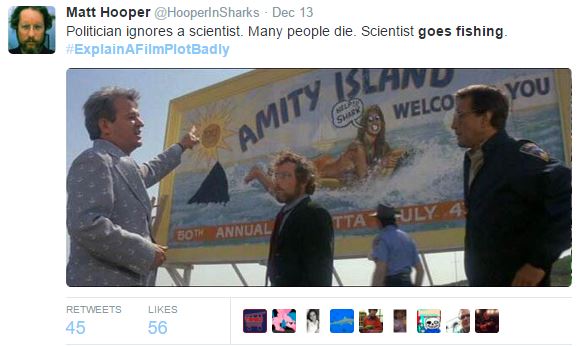
In an Adventure …. with Scientists ! (…or why does America hate science so much?)

Posted on July 30, 2015August 12, 2015 By Chris Parsons
Science

In the UK “The pirates ! In an adventure with scientists” an animated movie by Aardman Animations (the studio behind Wallace & Gromit) saw some success at the movie box office. The film was based by on the popular book by the same name by Gideon Defoe, which features, as the name suggests, pirates, Charles Darwin and scientists of the Royal Society. When the movie was screened in the US however, the title was changed to “The Pirates! Band of Misfits” because it was thought that American children would avoid a movie with scientists in. All reference to Darwin, who was one of the main characters, was also removed from US trailers, presumably because evolution is viewed as ‘controversial’ in the US.

Why is it science is such seen this way in the US?

Read More “In an Adventure …. with Scientists ! (…or why does America hate science so much?)” »

Graduate minions vs masterminds

Posted on July 30, 2015 By Chris Parsons 2 Comments on Graduate minions vs masterminds
Uncategorized

The other day I overheard an academic tell an upcoming graduate student that they should pick a PhD project by finding an advisor who already had a project set up and who had funding and that they should do research where the funding was rather than where their interests lay. This was so totally contrary to my PhD experience it left me reeling.

Read More “Graduate minions vs masterminds” »

Geese, snakeheads, and the ones that got away: Southern Fried Science Book Club, week 5

Posted on July 27, 2015 By Andrew Thaler 1 Comment on Geese, snakeheads, and the ones that got away: Southern Fried Science Book Club, week 5
Blogging

Fortunately, it turns out last week’s chapter was a fluke, and we come down the home stretch of Eating Aliens with some of the strongest sections since the beginning. Canadian Geese was particularly fascinating, as it’s clear this is the species Landers has the most experience talking about. Te chapter is rich with the details, backstory, and information that I was hoping to find throughout the book, with less cynicism about the role of local and national government than we’ve seen previous. If you haven’t caught up yet, I recommend just skipping Nutria and going straight to Canadian Geese.

Then we’re back in the water with numerous marine and freshwater invasives, many from the aquarium trade. Plecos and armored catfish, released by amateur aquarists, are booming in Florida’s warm, protected waters, while tilapia is a holdover from the aquaculture industry. Frankly, there wasn’t much new in these chapters, other than the species–at this point introduced fish are old news, and while the details of each animal are slightly different, the causes and consequences are often the same. Personally, I don’t think I’d eat a pleco, but it doesn’t sound particularly unpalatable. Even though the story is pretty much the same–Landers struggles to catch anything, hijinks ensues, they finally eat it–this was a fun part of the book.

Read More “Geese, snakeheads, and the ones that got away: Southern Fried Science Book Club, week 5” »

Is peer-review best left to academic journals?

Posted on July 21, 2015 By Bluegrass Blue Crab
Science

If you have ever dealt with scientific data, you’ve probably encountered one of the shadier sides of science: academic publishing. While they’ve stood, in some cases, for centuries, as the official record of scientific advancement safeguarded under the watchful eye of peers, modern journals live in a modern world. Millions of words have already been spilled on the subject, so that’s not what this article is about. Instead, I’m left asking whether academic publishing is the only means of getting the stamp of peer-review these days?

The reasons leading me to ask this question are many, but primarily through working in a management arena lately. One example, in particular, highlighted many of the disconnects between the need for verified scientific data and the incentives of journals. This moment was at a Chesapeake Bay Program Sustainable Fisheries Goal Implementation Team meeting (for those of you not in the Chesapeake region, that’s a consortium of regional fisheries managers), where a room full of decision-makers needed a verified stock assessment of blue crabs to move forward with their management planning. Peer-review is the time-tested, well-understood, and arguably easiest means of verifying data.

Read More “Is peer-review best left to academic journals?” »

Build a dirt cheap, tough-as-nails field computer in a Pelican case

Posted on July 21, 2015June 25, 2016 By Andrew Thaler
Science

IMG_20150720_233502091For and updated version of the BeagleBox, please go here: The BeagleBox 2: a dirt-cheap, tough-as-nails, 3D-printed, versatile field laptop.

Fieldwork is tough. You’re in the elements, facing wind, rain, and salt spray, sometime on an open boat far out in the Atlantic. You and your gear takes a beating. But you’re out there because there’s science that need to get done.

But your equipment is controlled via computer, and your data entry mandates a computer, which means your precious laptop needs to come with you. For graduate students and early career scientists, this can be a dilemma. I’ve see the calculations happen as my colleagues prepare for the field–do I take my one and only computer out into the field and risk damaging it, or do I leave it brute-force my way through sampling without it. That is, if they’re lucky enough to have alternative methods they can employ. For some gear, there’s no choice but to take the computer.

This equation is, counter-intuitively, getting worse. Our sensors, sampling devices, and scanners are getting cheaper and lighter. Rather than buying a $20,000 piece of equipment, you can get a $20 chip, but there’s a trade off, and the trade off is that chip based systems rely on external processing power, they need a general computer, and that means your laptop is coming with you.

I don’t like going out on the water with my laptop. Losing it would be frustrating and time consuming. It’s tough, but it’s not tough-as-nails. And it’s definitely not cheap.

So I tapped into the wealth of Maker experience I’ve accumulated over the last few years and build a new one, using a single board computer, some extra peripherals, and a 3D printer. And I shoved the whole thing into a Pelican case. Say hello to the BeagleBox, a dirt cheap, tough-as-nails field computer for about $200.

Read More “Build a dirt cheap, tough-as-nails field computer in a Pelican case” »

Hacking the Tractor: what the future of farming means for open science

Posted on July 20, 2015July 21, 2015 By Andrew Thaler
Science

I took a gamble when I bought the tractor mower. It was old, but well-cared for and ran well, but it was wearing out. Still, I couldn’t get a quarter as much machine for twice the price. Two months later, the mower deck cracked, rusted out from ten years of hard use. A replacement deck would run into the thousands of dollars, there were no options for just the shell, a cheaper, but still pricey option, and there were no off-brand decks to be found. Those three facts alone should tell you that we’re dealing with a John Deere, here.

John Deere made headlines earlier this year when Wired ran an impressive (and rare) expose on farm tech: New High Tech Farm Equipment is a Nightmare for Farmer. Deere followed up with a rebuttal letter, declaring that farmers did, in fact, own their equipment, while simultaneously outlining all the ways in which they didn’t: John Deere: of course you “own” your tractor, but only if you agree to let us rip you off.

Here’s the short version: Tractors are complicated and increasingly controlled by onboard computers. These computers use proprietary software, and that software is protected by the Digital Millennium Copyright Act (DMCA). The software itself is encrypted to prevent copying or modding. Those encryption are also protected by the DMCA. Breaking that encryption is illegal, regardless of the state of the software. If you have to decrypt the software to remove it, you’re breaking the law.

Read More “Hacking the Tractor: what the future of farming means for open science” »

Tweets from the American Elasmobranch Society 2015

Posted on July 20, 2015 By David Shiffman
Uncategorized

This year, there were 3,680 tweets with the American Elasmobranch Society meeting hashtag #AES15, approximately 1,000 of these from me and the rest from another approximately 20 members who attended the conference. In contrast, the Joint Meeting of Ichthyologists and Herpetologists, of which AES is a small part (approximately 1/6th of the talks), had a … Read More “Tweets from the American Elasmobranch Society 2015” »

American Elasmobranch Society announces new initiative to promote diversity in marine science

Posted on July 16, 2015 By David Shiffman 1 Comment on American Elasmobranch Society announces new initiative to promote diversity in marine science
Blogging

The American Elasmobranch Society, the world’s largest and oldest professional society focusing on shark and ray research, announced a new diversity initiative today. The new Young Professional Recruitment Fund will identify and contact students, postdocs and early career professional from historically underrepresented minority groups and from developing countries whose research focuses on elasmobranchs. Additionally, if you are … Read More “American Elasmobranch Society announces new initiative to promote diversity in marine science” »

Posts pagination

Previous 1 … 88 89 90 … 272 Next

Popular Posts

You probably don't want to work for me: What you read on Southern Fried Science in AprilYou probably don't want to work for me: What you read on Southern Fried Science in AprilApril 30, 2024Andrew Thaler
What you read on Southern Fried Science in JanuaryWhat you read on Southern Fried Science in JanuaryJanuary 31, 2024Andrew Thaler
What Ocean Ramsey does is not shark science or conservation: some brief thoughts on "the Shark Whisperer" documentaryWhat Ocean Ramsey does is not shark science or conservation: some brief thoughts on "the Shark Whisperer" documentaryJuly 2, 2025David Shiffman
That's not a blobfish: Deep Sea Social Media is Flooded by AI SlopThat's not a blobfish: Deep Sea Social Media is Flooded by AI SlopDecember 19, 2025Andrew Thaler
What is a Sand Shark?What is a Sand Shark?November 12, 2017Chuck Bangley
Marine Biology Career AdviceMarine Biology Career AdviceMay 30, 2025David Shiffman
Shark scientists want their research to help save threatened species, but don’t know how. Our new paper can help.Shark scientists want their research to help save threatened species, but don’t know how. Our new paper can help.December 1, 2025David Shiffman
Shark of Darkness: Wrath of Submarine is a fake documentaryShark of Darkness: Wrath of Submarine is a fake documentaryAugust 10, 2014Michelle Jewell
Join Me at Upwell: A Wave of Ocean Justice — Our Fourth Year!Join Me at Upwell: A Wave of Ocean Justice — Our Fourth Year!March 24, 2026Angelo Villagomez
What can the funniest shark memes on the internetz teach us about ocean science and conservation?What can the funniest shark memes on the internetz teach us about ocean science and conservation?November 8, 2013David Shiffman

squishy

Subscribe to our RSS Feed for updates whenever new articles are published.

We recommend Feedly for RSS management. It's like Google Reader, except it still exists.

Southern Fried Science

  • Home
  • About SFS
  • Authors
  • Support SFS


If you enjoy Southern Fried Science, consider contributing to our Patreon campaign.

Copyright © 2026 Southern Fried Science.

Theme: Oceanly Premium by ScriptsTown