


Yesterday, after months of waiting, David and my magnum opus on our efforts to stem the tide of fake documentaries was, at last, made available online: Fish tales: Combating fake science in popular media. What role should scientist play in correcting bad science, fake science, and pseudoscience presented in popular media? Here, we present a case … Read More “Fish tales: Combating fake science in popular media” »
Warning: The following blog post contains some language that is NSWF.
You are sat at a table of professionals within your field and they are discussing a topic you are very experienced with. The group keeps mentioning common beginner errors that you could easily correct, but you don’t. You sit quietly and sip your coffee.

Whales, those magnificent leviathans of the deep, have an uncanny knack for ending up in space. Science fiction is flooded with stories of starwhales–sometimes entirely new creatures that happen to resemble terran cetaceans in either behavior or appearance, sometimes evolved leviathans from our own world, and occasionally hapless, confused, ordinary whales. This is no fluke. Space is big, whales are big, so why shouldn’t there be whales in space?
Science fiction loves its tropes, and particularly loves comparing space to the golden age of maritime exploration, to the point where starships sometimes have sails. And then, of course, there’s The Narrative. You know, the one where a captain is consumed by obsession and revenge to hunt some semi-mythical mcguffin. If you’re going to do Moby-Dick-in-Space, you better have a starwhale. SciFi loves the Moby Schtick.
So what is a starwhale, and why is it different from other giant space creatures like the exogorth of Empire Strikes Back? Like terran whales, star whales are intelligent creatures that often exhibit some form of emotion. Unlike other space monsters, they often act with a purpose that goes beyond “eat space people, wreck ship”. Nowhere is this more clearly highlighted than in the Doctor Who episode The Beast Below, in which the Doctor encounters the last living starwhale, now supporting the remnants of the British Empire on its back. In the story, the whale endures tremendous suffering in order to protect ‘the children’, and chooses to stay even after being freed from its captors.
Giant whales providing the backbone for mysterious islands traces its roots back to the ancient Greeks, at least in the Western canon. Aspidochelon was a sea monster said to resemble either a turtle or a whale, with a craggy back the carried sandy beaches and sometimes even trees and jungles. Sailors who wandered ashore would find their ships crushed as they were pulled down into the deep. Later incarnations of the whale-as-island made explicit its connection to Satan, the ultimate deceiver. And, of course, Herman Melville makes explicit the modern civilization rests on the back, or, more accurately, the oil, of the whale.
Interestingly, starwhales are, at worst chaotic neutral, but more often lawful good. Their connection to the devil abandoned back on Earth.
The Star Trek universe is resplendent with starwhales, from numerous Enterprises have encountered numerous starwhales, from benign travelers passing through to confused infants looking to the ship for survival, to aggressive bulls threatened by incursion into their territory. Bull sperm whales were documented by early Earth whalers as solitary, especially aggressive male whales, some of which had tasted the bite of many harpoons and continued to charge. It was a bull sperm whale the sunk the Essex, the inspiration for Moby Dick.
The Society for Conservation Biology Marine Section (SCB Marine) has just initiated their Conservation Small Grants Program (CSGP) to fund worthy conservation projects around the globe. The grants will vary from $500-$700 and priority is being given to individuals from developing countries and those working in developing countries, where projects a small amount of money could make a big difference. … Read More “Got grants? New small grants for marine conservation launched by SCB Marine” »

The American Elasmobranch Society, the world’s oldest and largest professional society focusing on the scientific study and management of sharks and their relatives, is now welcoming applications for the Young Professional Recruitment Fund, our new diversity initiative. Awardees will be given one year of Society membership, in addition to specialized professional development training, mentorship, and networking opportunities specific to their needs as international or historically underrepresented minority scientists and professionals.
To be eligible for the Young Professional Recruitment Fund, applicants must fill out the application below and demonstrate that they:
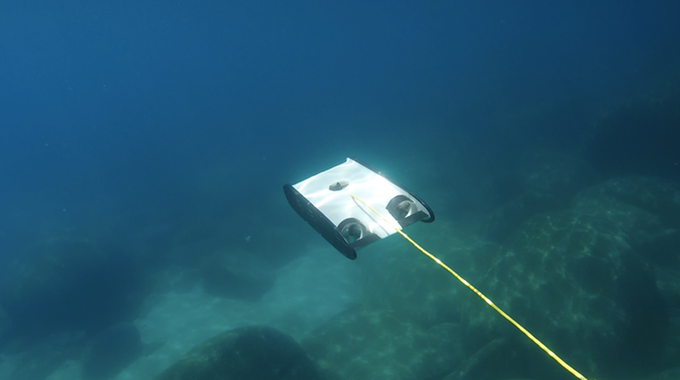
The future of ocean exploration is here.
OpenROV Trident – An Underwater Drone for Everyone by OpenROV
I’ve been watching, exploring, and working with the folks at OpenROV since their last Kickstarter, way back in 2012. Today they announce the launch of Trident, the next generation underwater vehicle, and one of the most capable microROVs that I’ve ever seen. I had the rare pleasure to join them in Lake Tahoe this May to test fly one of the earliest prototypes, and it surpassed all of my expectations.
You don’t need to hear me sing the praises of one of the most important emergent technologies in marine science and conservation. The rise of affordable, capable, portable underwater robots will fundamentally change the way we think about exploring the ocean and monitoring ocean health.
Onward to the Ocean Kickstarter criteria!
1. Is it sound, reasonable, and informed by science? You bet. OpenROV have been building underwater vehicles for upwards of four years. I use their robots in my research and education programs. The first peer-reviewed publication using OpenROV as a research platform will be coming out at the end of the month.
Read More “Ocean Kickstarter of the Month: The OpenROV Trident” »
A couple of days ago I was at a big meeting to welcome environmental scientists into our university. The catering supplied by the university came on non-recyclable plastic, with non-recyclable plastic glasses cups for drinks and some food items that were from infamously unsustainable sources. Instead of going away saying what a great program, half of those going out of the door were talking about the catering faux pas. To be fair, the organizers didn’t expect catering was going to bring the environmental equivalent of platters of grilled panda marinated in dolphin tears, but then again this is something that perhaps they might have anticipated – after all the University administrators have put the Environmental Science Department in one of the most energy inefficient, environmentally unfriendly buildings on campus. In winter, you can see plumes of heat and asbestos leaking from the faculty’s office windows from miles away.
Read More “When conservation scientists talk the talk but don’t walk the walk” »
Last month, I had the great privilege of attending the 100th Ecological Society of America meeting. This meant there were many opportunities to reflect upon the last century of ecological science and think about what worked, what didn’t, and where we go from here. As with many of the sciences, this involved a lot of … Read More “What kind of scientist do you want to – and should you – be?” »
Every year, Southern Fried Science and our related outreach campaigns churn out hundreds of articles about marine science and conservation, coordinate innovative, multimedia outreach campaigns, and produce both educational tools and actual open-source hardware to help protect the ocean. These efforts aren’t free and our authors volunteer their time and expertise to help make Southern Fried Science one of the most visited marine science and conservation websites on the internet. Server costs run in excess of $3,000 per year, and that not including tech support and website development, all of which are voluntary and occasionally offset by funding campaigns. We don’t run ads. We don’t charge for access to our content.
So how can you help support Southern Fried Science?
- Read, discuss, and share our blog posts, videos, articles, tweets, and other projects. That’s why we do this.
- Contribute to Andrew’s Patreon. Website Overlord Andrew David Thaler runs a Patreon page to help offset the bulk of the cost of running Southern Fried Science, cover his tech support time, and fund new and interesting projects. The big stuff – keeping the website running, developing open-source hardware, buying capital equipment – all happens through support from his Patrons. This year, two peer-reviewed publications are slated to come out acknowledging financial support from Patreon.
- Use our Amazon Affiliate links. On some projects that involve buying hardware (or book reviews), we provide links to the parts we use. These links are Amazon Affiliate links, a small percentage of you purchase through that link goes back to us. It’s a simple, no fuss way to show you support.
You could also buy one of Andrew’s books – which are outreach efforts in their own rights, but those profits aren’t directly earmarked for Southern Fried Science.
Read More “Three ways to support Southern Fried Science and Ocean Outreach” »
In April, Andrew introduced the “Buy David Shiffman less ugly sunglasses” crowdfunding campaign, a campaign which included several amazing donor perks like 3D printed megalodon teeth. All funds raised in excess of the cost of a new pair of prescription sunglasses would go towards ongoing shark conservation research and outreach projects. After a month of campaigning, we raised $2,440 from 92 donors!
Once the funds had been transferred, I spent an extremely amusing afternoon at my neighborhood LensCrafters asking the staff and customers (along with my Facebook fans and twitter followers) to vote on which pair of sunglasses I should get. A few days later…. my new, improved, less ugly sunglasses arrived in the mail:
Read More “Thanks for buying David Shiffman (A.K.A. me) a less ugly pair of sunglasses!” »