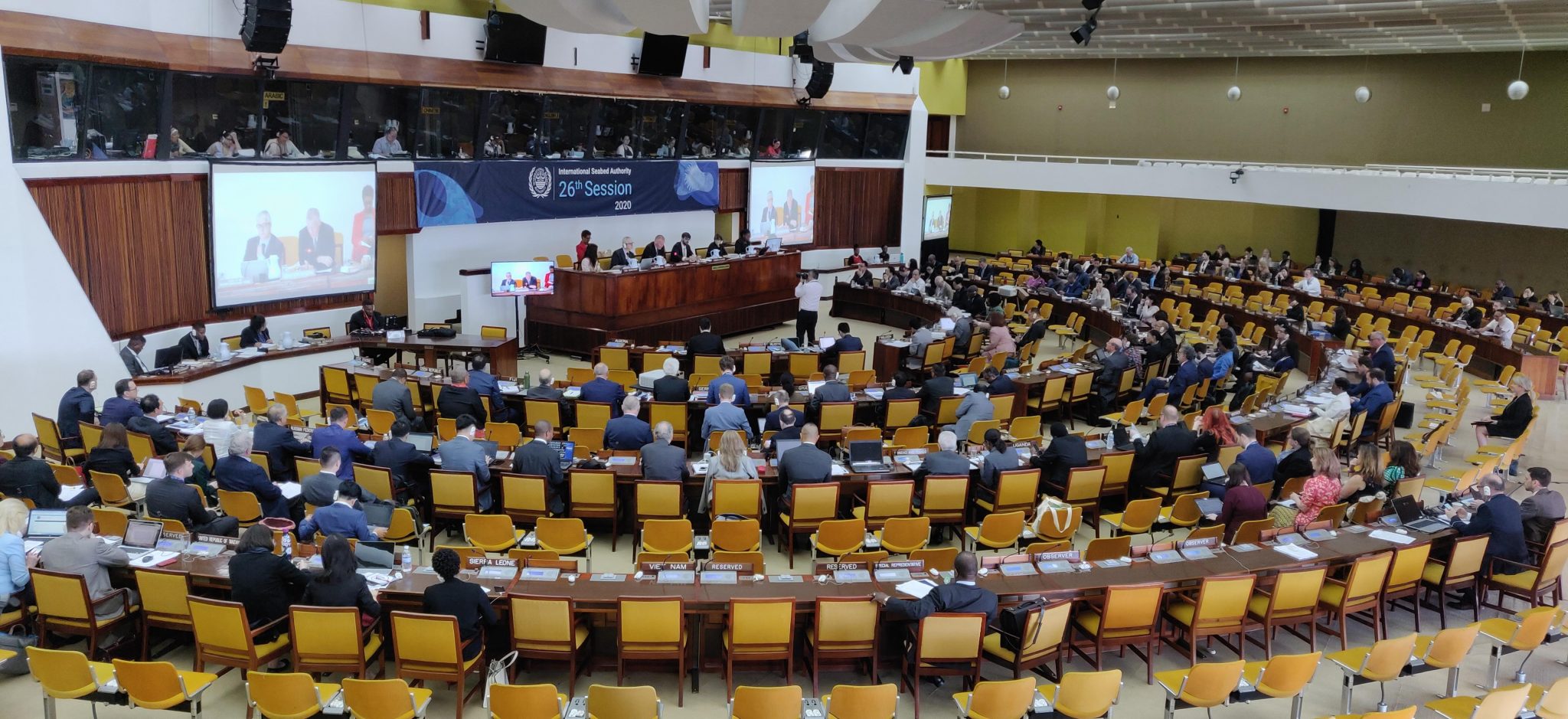
As in-person negotiations on the future of exploitation in the deep ocean resume this week in Kingston Jamaica, we reflect back on the last two years of development as reported on our sister site, the Deep-sea Mining Observer. This article first appeared two years ago, on March 19, 2020.
The 26th Session of the International Seabed Authority convened this February to continue the long and complex negotiations over the draft Mining Code and work towards consensus among the various stakeholders. 2020 was set as the target year to get the Mining Code finalized, but many delegates left Jamaica feeling frustrated with the pace of deliberations and a growing sense that the 2020 deadline was far too optimistic. Chief among the challenges was a recognition that the Council is now further from reaching agreement on the financial model than it was at the end of the 25th Session and a lack of clarity over the composition of the Legal and Technical Commission as it pertains to the representation of both geographic distribution and technical expertise.
Procedural Gridlock slows negotiations
The overwhelming sentiment of member state delegates, NGO’s, and even contractors was a sense of dysfunction and confusion, best highlighted by the fact that over a 5-day meeting, the Council went through three new presidents. First, as outgoing Council President Lumka Yengeni was absent from the meeting, outgoing regional Vice-president Luis del Solar assumed the chair to preside over the selection of a new council president. Usually, a Regional Group arrives at the ISA with a nominee for council president already prepared. Not this time. A three hour delay to select the president of the 26th Session of the ISA on the morning of the first day set the tone for the week.
Finally, the Council meeting resumed, with Tongan representative Taaniela Kula elected as Council President. This was an unusual choice, as Kula represents Tonga’s Geological Services, rather than its state department. This situation would not last, as President Kula was recalled to his home country mid-way through the third day and Jamaican representative Kathy-Ann Brown stepped in to oversee the remainder of the meeting.
The extent of closed-door politicking cut into the time needed for the Council to deliberate upon issues related to the Mining Code. Many representatives expressed frustration that the meeting was being overwhelmed with process discussion, to the detriment of the substantive discussion of the Code. More than one representative confidentially expressed the concern that the meeting was being intentionally slowed through procedural filibuster.
Upon assuming the chair, Council President Kathy-Ann Brown acknowledged that frustration, noting that it was almost the end of day 3 and “all we have done is REMPs.”
Waiting for the BBNJ
Throughout the week, many member states expressed a desire to see the outcomes of the current Biodiversity Beyond National Jurisdiction treaty under negotiation. With an environmental treaty that could impact activities in the Area, several countries were concerned that if the Mining Code was not in agreement with the still unfinished BBNJ treaty, this could set up an internal conflict within the UN that could further stall the timely operationalizing of the Enterprise. Both Costa Rica and the Federated States of Micronesia intervened to express their desire to see the BBNJ negotiations play out before committing to a Mining Code.
Outside of deliberations, other delegates expressed concern that the push to wait for the BBNJ Treaty was itself a stalling tactic.
Big moves in private and public worlds
Though ISA deliberations were slowed, developments outside of the Council chamber are moving at a blistering pace. During the same week, DeepGreen announced a $600 million partnership with AllSeas to acquire and customize a support vessel for their mining operations in the Clarion-Clipperton Zone. While public attention tends to focus on novel seafloor equipment, having a vessel that can actually handle that hardware is one of the biggest technical barriers to commercialization. Nautilus Minerals, famously, had seafloor production tools in hand, but it was the loss of their vessel contract that sent the company into a tailspin.
Brazil continues to move forward with its continental shelf claim over the Rio Grande Rise, which is working its way through the Commission on the Limits of the Continental Shelf. Ambassador Carlos Alberto Michaelsen den Hartog or Brazil expressed optimism that the CLCS would rule in Brazil’s favor.
Though many delegates left this meeting frustrated and feeling that the Council was further from consensus than it was at the beginning of the week, there was one bright spot. “At least, no one can accuse this of being a gold-rush,” opined one council member on their way to the airport.
Featured Photo: A noticeably less well-attended ISA Council Meeting. Photo by author.