Skip to content

Southern Fried Science

Over 15 years of ocean science and conservation online

  • Home
  • About SFS
  • Authors
  • Support SFS

Category: Blogging

A year of 3D printing in the home: does it live up to the hype?

Posted on March 2, 2016March 18, 2016 By Andrew Thaler
Blogging

3D Printing. No new technology in the last decade has been heralded with as much hope and hyperbole as the promise of desktop replicators fabricating whatever object you need at the push of a button. 3D printing has made huge steps forward, with more sophisticated machines at lower prices, new materials that vastly expand the printer’s capabilities, and the breathless optimism that foresees a printer in every home, as mundane and easy to operate as a conventional printer*.

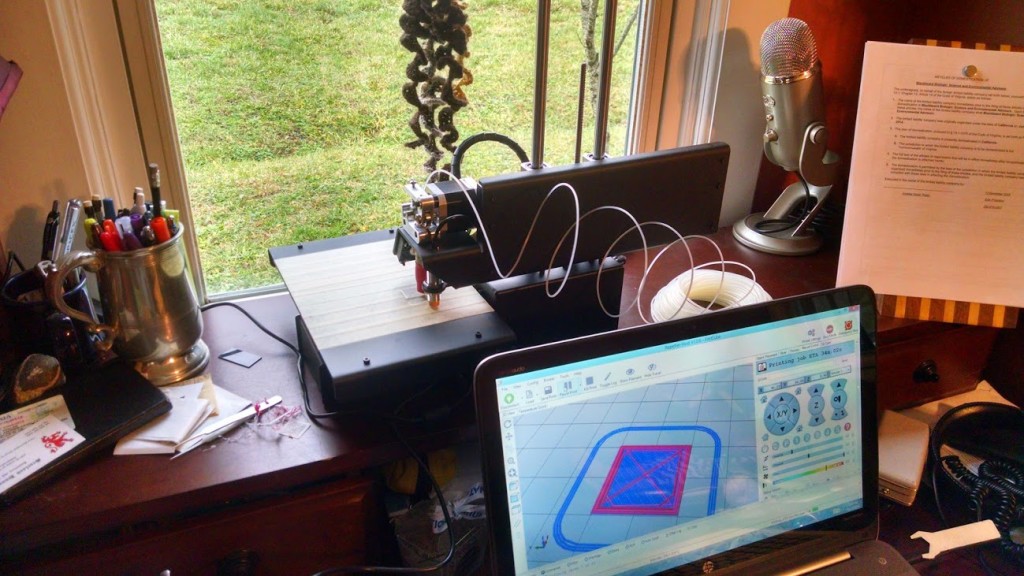
A Printrbot in the home.

And yet, for all the hype, most personal 3D printers are pressed into service fabricating plastic tschotskes — low quality, low function items of little to no utility. While the raw potential of 3D printing continues to expand, the promise of personal printers seems mired in the sandbox: an expensive toy for grownups. A toy that produces heaps of plastic detritus that will eventually find it’s way into the environment.

I posit here that, while it is true the the vast majority of people currently have no practical need for a 3D printer, under the right circumstances, a personal 3D printer can be an incredibly useful tool in the modern home.

A little over a year ago, we bought a personal 3D printer. It’s a Printrbot Simple Metal, a tough, no nonsense machine that works as well in my home office as it does at sea. Its footprint is small, and it can handle object up to 150 mm by 150 mm by 150 mm. Not huge, but big enough to be useful. And yes, this printer has primarily been used to fabricate parts for Oceanography for Everyone and other scientific endeavors. You can read more about that here: A 3D-printable, drone and ROV-mountable, water sampler and Oceanography for Everyone: Empowering researchers, educators, and citizen scientists through open-source hardware. I’m not talking about the scientific utility of the printer, but rather, how it fits into our homestead.

Read More “A year of 3D printing in the home: does it live up to the hype?” »

New book by Doc Gruber raises money for shark research

Posted on February 16, 2016February 16, 2016 By David Shiffman
Blogging

After a week of teasers, the Bimini Biological Field Station (“Shark Lab”) has finally unveiled the secret of #SharkDocSharkLab. It’s a book written by Sonny “Doc” Gruber, the founder of Shark Lab (and the first President of the American Elasmobranch Society, and an overall legendary figure in the world of shark research)! “Shark Doc, Shark Lab” … Read More “New book by Doc Gruber raises money for shark research” »

Playing against the slaughter rule

Posted on February 8, 2016August 11, 2016 By Andrew Thaler 1 Comment on Playing against the slaughter rule
Blogging

My middle school baseball team was bad. Really bad. Ball droppingly, bat throwingly, pitch ditchingly bad. It was a good inning if four of our batters made it to the plate. A great inning if the other team didn’t rotate through it’s entire line-up, twice. Our MVP was the kid who caught a ball. And if you think this is going to be one of those articles about how one tough player (me?) turned a bunch of scrappy underdogs into winners, it is not. I played right field, and not particularly well. We lost, often.

In peewee sports, at least in the US, there’s something called a “slaughter rule”. The slaughter rule ends the game if a team is losing by more than a certain number of points. In our case, it took something like a 20 run difference to trigger a slaughter. The slaughter rule exists so that outmatched teams don’t have to slog through 7 innings of a brutal losing streak, racking up demoralizing 112 to zero defeats. Once, we got slaughtered in the first inning.

Were it not for the slaughter rule, I would probably still be out somewhere in right field, wondering if maybe I should sign up for the Latin team next year.

Read More “Playing against the slaughter rule” »

On spending a month publishing science fiction from our Ocean Future.

Posted on February 2, 2016February 2, 2016 By Andrew Thaler 1 Comment on On spending a month publishing science fiction from our Ocean Future.
Blogging

January 2016 was different.

We blocked off an entire month, primed it with some of the best speculative fiction from our ocean’s future, wrapped it in a narrative to connect seemingly disparate topics, and launched Field Notes from the Future, 41 blog post imagining the issues we would face in 2041, 25 years in the future. This was the first time in the blog’s almost 8-year run that we dedicated an entire month to a single concept. It was also the first time that the authors collaborated and coordinated our content.

I am incredibly happy with the results. Field Notes from the Future gave us a chance to flex our creative muscles in new and exciting ways. It gave us an outlet to express our hopes and fears, to expand on our concerns, and to look beyond the horizon and imagine the conflicts that have yet to emerge.

Science and Science Fiction have always been deeply connected. For all the great work of the “heroes of science communication”, the STEM-advocates, the science outreach professionals, it was Clarke, Verne, Shelley, Wells, and Le Guin who inspired me to pursue a career in science. Science shows us the world as it is, Science Fiction imagines the world as it could be.

Read More “On spending a month publishing science fiction from our Ocean Future.” »

Frequently asked questions about sharks (and about me)

Posted on October 27, 2015 By David Shiffman
Blogging

Every week on twitter (and every few weeks on my Facebook fan page,) I host a one hour “ask me anything” session. I also give lots of interviews to the press, and occasionally answer high school students’ questions about what my job is like for class projects. Some of the same questions tend to come up over and over. Here are some frequently asked questions and my answers to them.  Feel free to quote anything on this page for a class project or media article and attribute it to me. 

1. What is your job?

A:  I am a Ph.D. candidate and research assistant at the University of Miami. “Candidate” vs. “student” means that I passed my qualifying exams, an important test for graduate students. Research assistant means that my funding comes from doing research and not teaching. Depending on my audience, I’ve also described myself as a marine biologist, a shark researcher, an ecologist, a conservation biologist, a science communicator, or simply a scientist.

Read More “Frequently asked questions about sharks (and about me)” »

What the Farm?! A podcast about agriculture by two wanna-be farmers who have no idea what they’re doing.

Posted on October 21, 2015 By Andrew Thaler 1 Comment on What the Farm?! A podcast about agriculture by two wanna-be farmers who have no idea what they’re doing.
Blogging

What the Farm?! is a completely unrelated side-project that I’ve been developing with Andrew Middleton (@EcoAndrewTRC). It has nothing to do with Marine Science and Conservation, so if you want further updates, subscribe to our SoundCloud stream. RSS feed is here. Enjoy the first two episodes, right here: [soundcloud url=”https://api.soundcloud.com/tracks/229414322″ params=”auto_play=false&hide_related=false&show_comments=true&show_user=true&show_reposts=false&visual=true” width=”100%” height=”450″ iframe=”true” /] … Read More “What the Farm?! A podcast about agriculture by two wanna-be farmers who have no idea what they’re doing.” »

OceansOnline: How can internet tools help marine scientists and conservationists?

Posted on October 20, 2015 By David Shiffman
Blogging

IMCCNext summer’s 4th International Marine Conservation Congress will include an optional full day add-on called OceansOnline. This add-on day, inspired by 2013’s successful ScienceOnline Oceans, will focus on how social media and other internet tools can help ocean scientists and conservation professionals with research, collaboration, and public outreach.

OceansOnline is suitable for total beginners who want to learn how to use these tools as well as advanced users who want to learn much more about their applications.  Scientists and professionals who are advanced users of internet tools are encouraged to attend this meeting even if ocean conservation biology is not your primary research specialty.

OceansOnline will consist of three types of events: workshops, presentations, and facilitated discussions:

Read More “OceansOnline: How can internet tools help marine scientists and conservationists?” »

Politely optimistic: What do the Canadian election results mean for ocean science and conservation?

Posted on October 20, 2015October 20, 2015 By Guest Writer 2 Comments on Politely optimistic: What do the Canadian election results mean for ocean science and conservation?
Blogging

Julia skate trawlJulia Whidden completed her Masters in Biology with a focus on marine conservation from Acadia University in Nova Scotia, Canada, in 2015. Her project evaluated population demographics and species identification of two at-risk species of skate in the inner Bay of Fundy. She joins Dr. Neil Hammerschlag’s lab at the University of Miami for the year as a Fulbright Student and shark research intern. Follow her on twitter! 

DCIM101GOPRORachel Skubel graduated with an M.Sc. in Environmental Science from McMaster University where she studied climate impacts on water cycling in temperate forests, and a B.Sc. from the University of Western Ontario. Her current research interests revolve around how oceanic predators will be impacted by anthropogenic environmental changes. She is a currently a shark research intern with Dr. Neil Hammerschlag’s lab at the University of Miami. Follow her on twitter! 

Up until this past year, the thought of Canadian politics had probably never crossed your mind. For some of you, your introduction to the topic may have been via the astute criticisms of John Oliver published this past weekend. His YouTube video currently skyrocketing at just under 3 million views in less than 48 hours, may have even been the introduction to Canadian politics for some Canadians. Let’s face it: in comparison to the flashy and sometimes trashy race of our neighbors to the south (ahem, you Americans), Canadian politics are usually tame, boring, and dry. In 2011, our last major election, 61.1% of Canadians voted (14.8 million), but up until the election last night, at least 68.5% have actively contributed to changing the dire political and environmental landscape formed by Prime Minister Stephen Harper and his Conservative cronies over the past 10 years. This voter turnout is the highest since 1993, and certainly demonstrates that – not unlike your defeat of Republicans following the Bush years – Canadians were ready for change.

To our newly elected Prime Minister Justin Trudeau, we say welcome and we’re ready for action.

Read More “Politely optimistic: What do the Canadian election results mean for ocean science and conservation?” »

How to pitch an Ocean Kickstarter for us to review

Posted on October 12, 2015October 12, 2015 By Andrew Thaler
Blogging

I put this up as a closer on our last Ocean Kickstarter selection, and am posting here as a standalone for anyone who may have missed it.

Email me at southernfriedscientist@gmail.com with the subject heading: Ocean Kickstarter: Your Project. This isn’t limited to Kickstarter, projects on IndieGoGo, RocketHub, GoFundMe, or any other site are eligible for an Ocean Kickstarter of the month. We will review based on three criteria:

1. Is it sound, reasonable, and informed by science?

2. Is there a clear goal, timeline, and budget; and are they partnering with the people who have experience hitting those marks?

3. Do some of the parties involved have a successful record with other crowdfunding projects and experience delivering on rewards.

Read More “How to pitch an Ocean Kickstarter for us to review” »

Three ways to support Southern Fried Science and Ocean Outreach

Posted on August 24, 2015August 23, 2015 By Administrator
Blogging

Every year, Southern Fried Science and our related outreach campaigns churn out hundreds of articles about marine science and conservation, coordinate innovative, multimedia outreach campaigns, and produce both educational tools and actual open-source hardware to help protect the ocean. These efforts aren’t free and our authors volunteer their time and expertise to help make Southern Fried Science one of the most visited marine science and conservation websites on the internet. Server costs run in excess of $3,000 per year, and that not including tech support and website development, all of which are voluntary and occasionally offset by funding campaigns. We don’t run ads. We don’t charge for access to our content.

So how can you help support Southern Fried Science?

  1. Read, discuss, and share our blog posts, videos, articles, tweets, and other projects. That’s why we do this.
  2. Contribute to Andrew’s Patreon. Website Overlord Andrew David Thaler runs a Patreon page to help offset the bulk of the cost of running Southern Fried Science, cover his tech support time, and fund new and interesting projects. The big stuff – keeping the website running, developing open-source hardware, buying capital equipment – all happens through support from his Patrons. This year, two peer-reviewed publications are slated to come out acknowledging financial support from Patreon.
  3. Use our Amazon Affiliate links. On some projects that involve buying hardware (or book reviews), we provide links to the parts we use. These links are Amazon Affiliate links, a small percentage of you purchase through that link goes back to us. It’s a simple, no fuss way to show you support.

You could also buy one of Andrew’s books – which are outreach efforts in their own rights, but those profits aren’t directly earmarked for Southern Fried Science.

Read More “Three ways to support Southern Fried Science and Ocean Outreach” »

Posts pagination

Previous 1 … 7 8 9 … 19 Next

Popular Posts

What Ocean Ramsey does is not shark science or conservation: some brief thoughts on "the Shark Whisperer" documentaryWhat Ocean Ramsey does is not shark science or conservation: some brief thoughts on "the Shark Whisperer" documentaryJuly 2, 2025David Shiffman
Here's how to join my IMCC8 symposium, "Ocean Science Communication: What's New and What's Next?"Here's how to join my IMCC8 symposium, "Ocean Science Communication: What's New and What's Next?"April 22, 2026David Shiffman
That's not a blobfish: Deep Sea Social Media is Flooded by AI SlopThat's not a blobfish: Deep Sea Social Media is Flooded by AI SlopDecember 19, 2025Andrew Thaler
What is a Sand Shark?What is a Sand Shark?November 12, 2017Chuck Bangley
Here are some ocean conservation technologies that I'm excited aboutHere are some ocean conservation technologies that I'm excited aboutFebruary 19, 2026David Shiffman
Fun facts and FAQs about Megalodon, Maryland's new (and definitely extinct) official state sharkFun facts and FAQs about Megalodon, Maryland's new (and definitely extinct) official state sharkApril 15, 2026David Shiffman
Reflections on science and my role in it, ten years since my Ph.D. defenseReflections on science and my role in it, ten years since my Ph.D. defenseApril 1, 2026David Shiffman
Join Me at Upwell: A Wave of Ocean Justice — Our Fourth Year!Join Me at Upwell: A Wave of Ocean Justice — Our Fourth Year!March 24, 2026Angelo Villagomez
Here's what I teach my students about finding jobs in marine biology and conservationHere's what I teach my students about finding jobs in marine biology and conservationApril 10, 2024David Shiffman
Urea and Shark OsmoregulationUrea and Shark OsmoregulationNovember 15, 2010David Shiffman
Subscribe to our RSS Feed for updates whenever new articles are published.

We recommend Feedly for RSS management. It's like Google Reader, except it still exists.

Southern Fried Science

  • Home
  • About SFS
  • Authors
  • Support SFS


If you enjoy Southern Fried Science, consider contributing to our Patreon campaign.

Copyright © 2026 Southern Fried Science.

Theme: Oceanly Premium by ScriptsTown