Skip to content

Southern Fried Science

Over 15 years of ocean science and conservation online

  • Home
  • About SFS
  • Authors
  • Support SFS

Category: Popular Culture

It’s not about the Mermaids: Animal Planet’s track record of fabricated reality

Posted on July 19, 2013March 24, 2014 By Andrew Thaler 24 Comments on It’s not about the Mermaids: Animal Planet’s track record of fabricated reality
Popular Culture, Science
The Little Mermaid statue in Copenhagen, of which this post is not about. Photo by ADT.

I have fond memories of Animal Planet. I grew up with Steve Irwin and Jeff Corwin. On the rare occasions when I have caught their recent programming, I’ve enjoyed shows like River Monsters and Monsters Inside Me. These are certainly not high-minded nature documentaries like Planet Earth and Blue Planet, but they manage to be both entertaining and informative. Then came the ghost hunters, pet psychics, bigfoot hunters, and mermaids. I started watching with a cynical eye*, started noticing things that seemed out of place: a catfish that looked already dead before being caught, a multitude of pets that looked surprisingly healthy considering their life in a hoarders house, conversations that seemed awkward, forced, and disjointed. And then there was Mermaids.

I’m not naive to the realities of reality shows**, but I do believe that channels like Animal Planet, channels that bill themselves as educational programming, have a responsibility to present fact-based programming. I also believe the public has a reasonable expectation that Animal Planet’s programming is at least honest in the events it portrays. Whale Wars is not Storage Wars. I’m also not a reality TV hater, and believe that it is possible to create compelling, educational programming in that format. After all, had it aired today, the Underwater World of Jacques Cousteau would have been classified as a reality show.

I’m not even talking about intentionally fake shows, like Lost Tapes or Mermaids: the Body Found, nor am I talking about shows with supernatural premises, like Pet Psychics or The Haunted, although I do have problems with the ways those shows portray the supernatural credulously while marketing them as science-based. I’m talking specifically about shows where Animal Planet stages, distorts, or manufactures scenes and then presents them as being actual events captured by their film crew. I’m talking about outright deception with the intention of misleading the audience.

I’m also talking about evidence. Over the years, I have had hundreds of head-scratching moments while watching Animal Planet shows that I strongly suspect were staged. For some the evidence is there, but, unless someone involved in the production comes forward, most will remain unconfirmed. Instead of wallowing in hearsay, I present to you four cases in which we have convincing evidence–statements from members of the cast, discordance with widely reported events, or witness and expert testimony–that an Animal Planet show is staged.

Read More “It’s not about the Mermaids: Animal Planet’s track record of fabricated reality” »

Was Aquaman quietly saving the world during Man of Steel?

Posted on June 17, 2013October 27, 2013 By Andrew Thaler 2 Comments on Was Aquaman quietly saving the world during Man of Steel?
Popular Culture

Man of Steel was a thoroughly entertaining superhero movie and a serviceable Superman movie. Fortunately, the last son of Krypton was not the only super-powered being saving the world, as the king of Atlantis was hanging out, cleaning up ol’ Kal-El’s mess.

It has been 98 days since our last Aquaman is Awesome post. We’re due.

Arthur Curry’s presence is first felt near the beginning, while a scruffy Clark is trying his best impression of Jack Kerouac auditioning for Deadliest Catch. Pre-Supes can’t help but hurl himself at a burning oil rig, rescue the roughnecks, and then keep derrick from collapsing on a hapless helicopter. Explosion. We cut to some Kansas flashbacks. Mr. Soupy floats in the water. Pan up and, inexplicably, there’s a couple of humpback whales just chilling, amidst the carnage of a collapsing oil rig,  having a casual sing-in. No doubt those whales are having a chat with a rogue Atlantean, swimming somewhere off screen. He’s probably making sure that the Caped Clam Chowder doesn’t ruin his handy work.

Because, obviously, Aquaman was the one who knocked out that oil rig. I said he was saving the world, not saving humanity. That’s Crab Bisque’s gig.

Read More “Was Aquaman quietly saving the world during Man of Steel?” »

The great #Mermaids Storify

Posted on May 30, 2013May 29, 2013 By David Shiffman 4 Comments on The great #Mermaids Storify
Popular Culture, Science

davesquare

This week, Animal Planet aired “Mermaids: The New Evidence”  the second fake documentary in their series about mermaids.  After complaining about the ridiculous show and the associated devastating effects on science literacy*, we decided to watch the re-air together and live-tweet it. The goal was to get real scientific information into the twitter conversation associated with the show. The Storify of our contributions to the discussion is below.

* Lots of people think that the admittedly fake documentary is real. Search the twitter hashtag #Mermaids and you’ll see literally hundreds of examples of this. These are not included in the Storify in the interest of not being cruel to strangers.

Read More “The great #Mermaids Storify” »

Mock the Doc: Watch both fake Mermaids documentaries tonight and mock them on twitter with us!

Posted on May 29, 2013 By David Shiffman 4 Comments on Mock the Doc: Watch both fake Mermaids documentaries tonight and mock them on twitter with us!
Popular Culture, Science

Tonight from 8-11 P.M. EST, Animal Planet is re-airing both fake mermaid documentaries, “Mermaids: The Body Found” and “Mermaids: the New Evidence”. We’re going to watch them. We’re going to live-tweet our thoughts using the show’s existing hashtag, #Mermaids. We’re going to systematically point out everything factually incorrect about mermaids (or anything having to do … Read More “Mock the Doc: Watch both fake Mermaids documentaries tonight and mock them on twitter with us!” »

Five more marine organisms that put their superhero counterparts to shame

Posted on April 17, 2013January 27, 2015 By Andrew Thaler
Popular Culture, Science

Evolution is the most creative force on the planet. Everywhere we look, we find species with novel and phenomenal adaptations that put their comic book brethren to shame. In no ecosystem is this more apparent than in the vast and unfathomable ocean. Marine species, especially those in the deep sea, have evolved to survive in a environment that is completely alien to us. Several months ago, I unveiled “Five organisms with real super powers that rival their comic book counterparts“, but that was just the beginning. Without further adieu, I give you 5 more marine organisms that put their superhero counterparts to shame (and one bonus critter).

The blind shrimp with super senses

Rimicaris exoculata – http://eol.org/data_objects/13231836

In the deep sea, eyes are not among the most useful sense organs. While many deep-sea species have extremely reduced eyes, some have abandoned these organs entirely. Rimicaris exoculata is a shrimp endemic to deep-sea hydrothermal vents in the mid-Atlantic that is completely eyeless. Its carapace is smooth, without even a hint of reduced, vestigial eyes. This, unfortunately, is a problem because Rimicaris exoculata is a farmer. The blind shrimp grows bacteria in its gill chamber, bacteria that can convert the chemical-rich hydrothermal vent fluid into food for the shrimp.

For lack of a more descriptive adjective, hydrothermal vents are hot. Some can exceed 400°C. Rimicaris exoculata needs to get close to this hot vent fluid to feed its crop of bacteria, but not so close as to become a hydrothermal hors d’oeuvre. And so, the blind shrimp evolved a completely new light-sensitive organ mounted on the top of its carapace–the rhodopsin-rich dorsal eyespot.

The dorsal eyespot of Rimicaris exoculata doesn’t “see” in the normal sense, there is still almost no light in the deep sea. Rather, this shrimp is adapted to detect the black body radiation emitted by the hydrothermal vent. For Rimicaris exoculata, the deep sea glows with the light of super-heated hydrothermal fluid, allowing it to both find food for its bacterial crop and avoid getting cooked itself.

It should be no surprise that Rimicaris exoculata is undoubtedly the favorite deep sea organism of another blind champion with super senses–Daredevil.

Read More “Five more marine organisms that put their superhero counterparts to shame” »

15 important shark conservation and management terms explained with memes

Posted on April 1, 2013April 2, 2013 By David Shiffman 9 Comments on 15 important shark conservation and management terms explained with memes
Conservation, Popular Culture, Science

davesquare

inigo-montoya-you-keep-using-that-word-i-dont-think-it-means-what-you-th-3b4b2920-sz625x625-animateIf interested citizens want to get involved in conservation and management policy, it’s absolutely vital to use proper terminology. The policy world can be full of confusing jargon, but there are few ways to discredit yourself in the eyes of decision makers as quickly as using a critical term incorrectly. In fact, it isn’t uncommon for a decision maker’s response to a petition or public comment to consist entirely of correcting  inaccurate terminology, if a response is issued at all. There are well over 100 acronyms and terms that I’ve seen regularly used, but in the interest of brevity, I’ve selected what I believe to be the 15 most important terms that I’ve seen people repeatedly use incorrectly.

For each term, I’ve provided a definition from a scientific paper or technical report whenever possible.  I have also  provided some additional explanation in my own words, and some assistance from familiar memes. Whenever possible, I’ve linked to blog posts, articles, or websites that provide even more information. Most of these terms are broadly applicable to fisheries management policy, but some are specific to shark fisheries. It is not my intention with this post to strongly advocate for or against any specific policy (I do plenty of that with other posts), but to make sure everyone is speaking the same language.

Read More “15 important shark conservation and management terms explained with memes” »

Who are “The Lucky Ones”?

Posted on March 13, 2013 By Andrew Thaler
Popular Culture

We interrupt our regularly scheduled marine science and conservation discussions and frequent Aquaman adulation to bring you this important announcement: “My legs creak as I climb the stairs to our meeting room. I lean against the wall to steady myself. I could have taken the elevator, saved myself the pain, but I need to heal. … Read More “Who are “The Lucky Ones”?” »

Aquaman is back!

Posted on March 12, 2013March 12, 2013 By Andrew Thaler 2 Comments on Aquaman is back!
Popular Culture

headshot-thalerSMALLLong-time readers know that I am a dedicated fan of the one true king of Atlantis, Arthur Curry–Aquaman. Since his reboot in DC Comic’s New 52 series, Aquaman has risen above the Justice League pantheon, casually crushing his critics with humor, style, and pure, aquatic power. My original plan was to review the marine science in Aquaman, but, since the Trench, our hero has spent relatively little time in the sea. We can forgive that. Between protecting his old gang, the Others, from arch-nemesis Black Manta, and saving the surface dwellers while reclaiming his crown in Throne of Atlantis, Mr. Curry has been quite busy.

Now, with Aquaman #17, it looks like things are about to change.

littleaqua
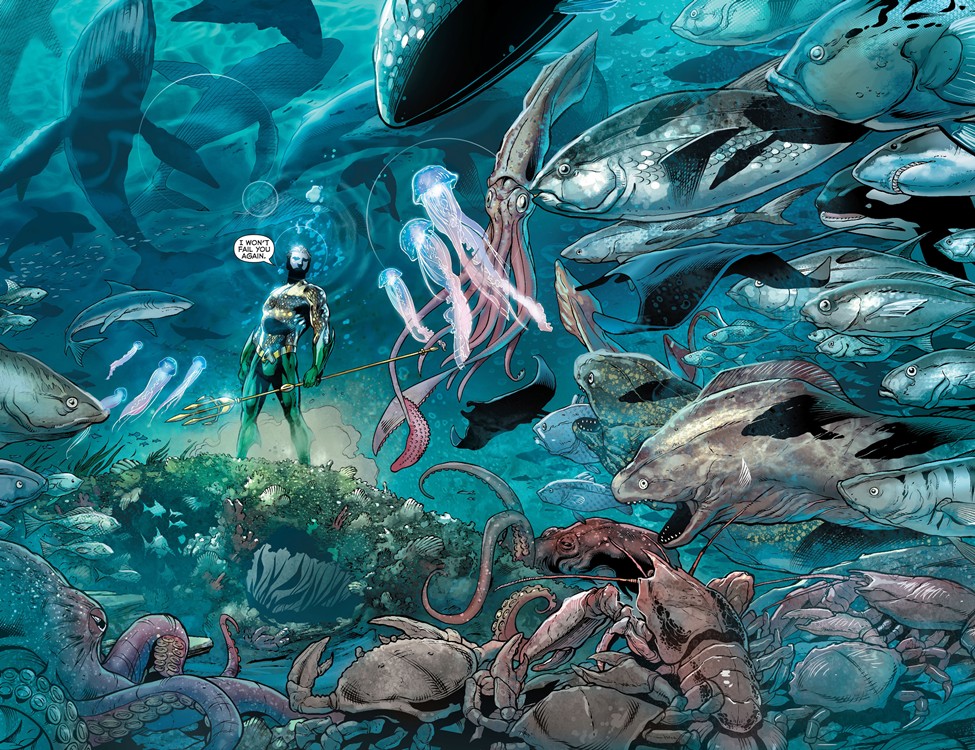
“I won’t fail you again.” Aquaman #17. DC Comics.

So, this is pretty much my all time favorite piece of comic book art. I love that so many invertebrates get starring roles–colossal squid, octopuses, crustaceans of all sorts. I love that whales are relegated to the background, dolphins are barely more than shadows, and elasmobranchs other than sharks are prominently featured. Artists Paul Pelletier and Art Thebert did a fantastic job creating an ocean biodiversity tableau that shuns the Wyland-esque tropes characteristic of the genre. This is a tough, gritty Aquaman. His ocean is not all sunsets and dolphins.

This also settles the longstanding debate about Aquaman’s telepathy. Aquaman talks to fish. Whether they talk back is a different story.

Read More “Aquaman is back!” »

How to tell if a “shark in flooded city streets after a storm” photo is a fake in 5 easy steps

Posted on January 23, 2013August 28, 2017 By David Shiffman 3 Comments on How to tell if a “shark in flooded city streets after a storm” photo is a fake in 5 easy steps
Popular Culture, Science


The combination of increasing extreme weather and social media has created, if you’ll pardon the pun, a perfect storm for sharing photos that show post-hurricane devastation (both real and fake). Many of them take the form of of a shark swimming through flooded city streets. For better or for worse, I’m known as “the shark guy” among my friends and family, which means that every time one of these pictures pops up, I get it e-mailed to me on the order of 50-100 times.

With the hopes of lightening my inbox and edu-ma-cating our loyal readers, presented below is a simple guide to determine if any given “shark after the storm” photo is fake.

1) Use your vast knowledge of shark biology to determine if a shark that size of that species could possibly be in water that deep.

puertorico

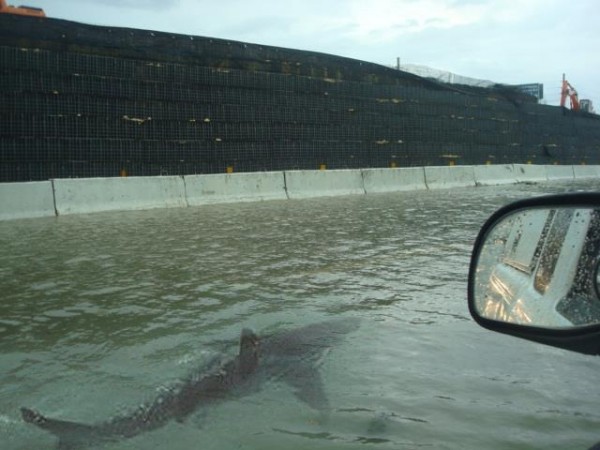
The image above was one of the first “shark after a storm” pictures to go viral. It claimed to show a great white shark swimming through the flooded streets of Puerto Rico after Hurricane Irene in 2011. Take a look at how high the car’s side view mirror is above the water. That means the water level, while more than high enough to be destructive to cars and buildings, is not nearly high enough for a shark of that size to be comfortably swimming in. Also, great white sharks are not typically found in the Caribbean in August.

Read More “How to tell if a “shark in flooded city streets after a storm” photo is a fake in 5 easy steps” »

Five organisms with real super powers that rival their comic book counterparts

Posted on January 2, 2013September 19, 2013 By Andrew Thaler 6 Comments on Five organisms with real super powers that rival their comic book counterparts
Popular Culture, Science

Andrew ThumbThere is no force more creative than the painstakingly slow process of evolution. Ever wanted to walk through walls? Naked mole rats can physically bore through concrete. How about fly? There are a couple dozen different ways to accomplish that goal, even if you’re a squid. Incredible power of regeneration? Flatworms, roundworms, and echinoderms have us beat. Among the vertebrates, species like the axolotl can regrow limbs, organs, and parts of their brain. For practically every super power we can imagine, something on the tree of life has come up with a real-world analog.

Some real super power are more super than others:

1. The immortal rotifer that absorbs the abilities of anything it touches.

Bdelloid Rotifers. photo by Diego Fontaneto

Around 80 million years ago, a small, unassuming group of metazoa decided that sex just wasn’t for them. Instead of going through the effort of recombining their genetic material with a mate every generation to produce a viable offspring with a roughly 50% contribution from each parent, Bdelloid Rotifers started reproducing asexually. Males completely disappeared from class bdelloidea, leaving females to generate genetic duplicates through parthenogenesis. This is not their super power.

Bdelloid rotifers are incredibly tough. When environmental conditions are less than favorable, they can enter a dormant state. In this dormant state,they can survive the worst unscathed. Dehydrated, they can endure extreme temperatures, drought, even ionizing radiation. A bdelloid rotifer in its dormant state can even survive in space. If that isn’t enough, while dormant, these rotifers continue to produce offspring, which also remain  dormant. This is not their super power.

Bdelloid rotifers’ super power appears when they recover from their dormant state. As they rehydrate and repair whatever damage their cells incurred, they incorporate DNA fragments from their environment. This includes partially digested food and any DNA in close proximity to them, even bacterial and archael DNA. It is this ability that allows bdelloid rotifers to overcome the limitations of asexual reproduction and survive for 80 million years without mates. They can literally absorb the attributes of those around them.

Their incredible toughness, celibate lifestyle, and ability to absorb the powers of anything they touch, put Bdelloid Rotifers firmly on par with X-Men perennial favorite: Rogue.

Read More “Five organisms with real super powers that rival their comic book counterparts” »

Posts pagination

Previous 1 … 10 11 12 … 19 Next

Popular Posts

Shark scientists want their research to help save threatened species, but don’t know how. Our new paper can help.Shark scientists want their research to help save threatened species, but don’t know how. Our new paper can help.December 1, 2025David Shiffman
What Ocean Ramsey does is not shark science or conservation: some brief thoughts on "the Shark Whisperer" documentaryWhat Ocean Ramsey does is not shark science or conservation: some brief thoughts on "the Shark Whisperer" documentaryJuly 2, 2025David Shiffman
Norway and Cook Islands put their deep-sea mining plans on pause.Norway and Cook Islands put their deep-sea mining plans on pause.December 3, 2025Andrew Thaler
What is a Sand Shark?What is a Sand Shark?November 12, 2017Chuck Bangley
Mermaids: The New Evidence is a Fake DocumentaryMermaids: The New Evidence is a Fake DocumentaryMay 28, 2013Andrew Thaler
What we know we don't know: impacts of deep-sea mining on whales, dolphins, sharks, turtles, and other migratory species.What we know we don't know: impacts of deep-sea mining on whales, dolphins, sharks, turtles, and other migratory species.November 20, 2025Andrew Thaler
What can the funniest shark memes on the internetz teach us about ocean science and conservation?What can the funniest shark memes on the internetz teach us about ocean science and conservation?November 8, 2013David Shiffman
10 fish weirder than the fish in the 10 weirdest fish in the world list10 fish weirder than the fish in the 10 weirdest fish in the world listDecember 18, 2013Guest Writer
Build a dirt cheap, tough-as-nails field computer in a Pelican caseBuild a dirt cheap, tough-as-nails field computer in a Pelican caseJuly 21, 2015Andrew Thaler
Breaking News! "Most Comprehensive Estimate of Mortality": Between 63 and 273 Million Sharks Killed Each YearBreaking News! "Most Comprehensive Estimate of Mortality": Between 63 and 273 Million Sharks Killed Each YearMarch 1, 2013David Shiffman
Subscribe to our RSS Feed for updates whenever new articles are published.

We recommend Feedly for RSS management. It's like Google Reader, except it still exists.

Southern Fried Science

  • Home
  • About SFS
  • Authors
  • Support SFS


If you enjoy Southern Fried Science, consider contributing to our Patreon campaign.

Copyright © 2025 Southern Fried Science.

Theme: Oceanly Premium by ScriptsTown