Skip to content

Southern Fried Science

Over 15 years of ocean science and conservation online

  • Home
  • About SFS
  • Authors
  • Support SFS

Category: Popular Culture

5 best baby books to launch your child’s ocean education.

Posted on September 15, 2016September 15, 2016 By Andrew Thaler
Education, Popular Culture, Reviews and Interviews

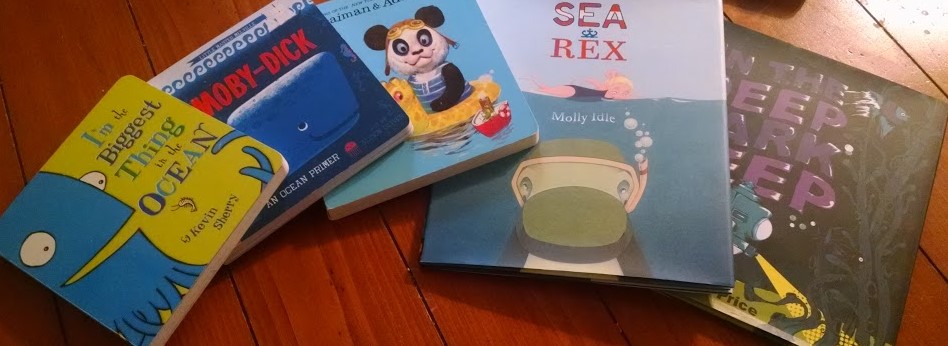
img_20160915_110450570

As a few of you have noticed, we recently added a tiny new member to our little ocean outreach empire. A new baby opens up a chance for us to explore a whole new world of ocean-themed content tailored to our newest explorers. As a family of marine biologists, we very quickly accumulated a massive library of ocean-themed baby books, some amazing, some not-so-amazing.

After critical review by two PhDs in Marine Science and Conservation, for both scientific accuracy and pure delightfulness, here are my top 5 baby books to get your ocean education started off right.
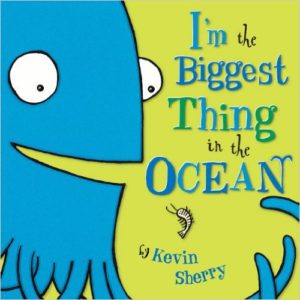
biggestI’m the Biggest Thing in the Ocean by Kevin Sherry.

Sherry must have written this book specifically for me, since Sizing ocean giants: patterns of intraspecific size variation in marine megafauna is already my most widely distributed paper. I know a few things about giant squids. I really love this book. The art is colorful and engaging. The story has a hilarious twist. It’s grounded in real ocean critters (though there’s something funky going on with that jellyfish). And there’s an important lesson about hubris and trophic position in marine food webs. 

Read More “5 best baby books to launch your child’s ocean education.” »
Dying for Reason in the Rational Utopia

Posted on August 10, 2016August 10, 2016 By Andrew Thaler
Conservation, Popular Culture

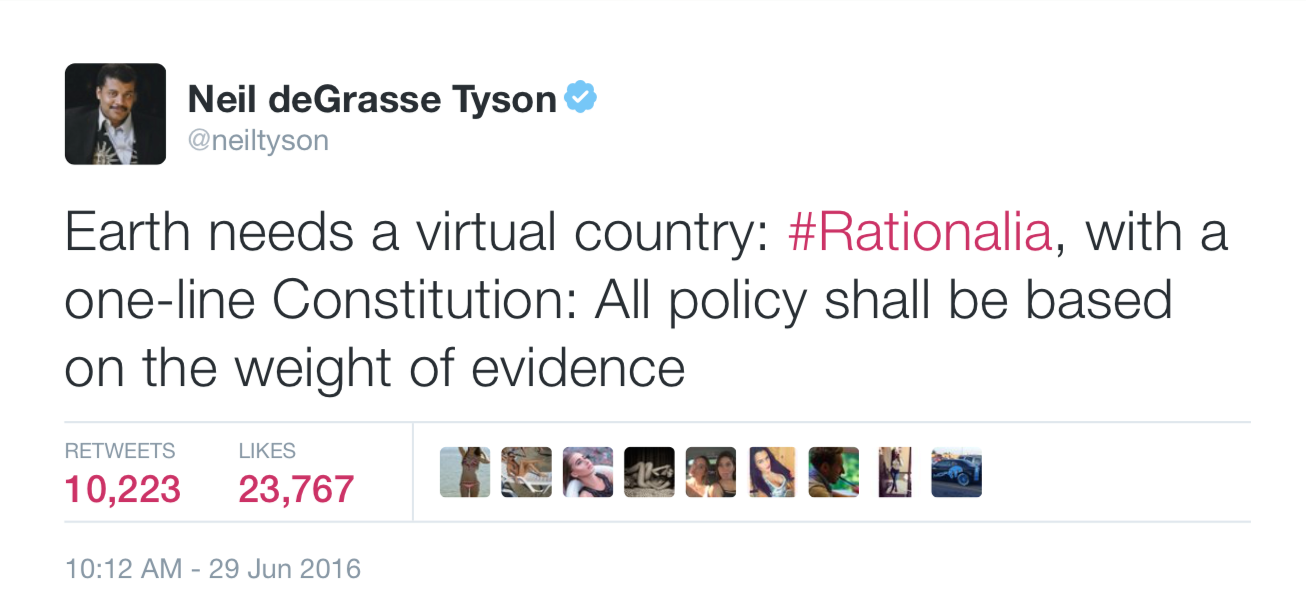
When Neil deGrasse Tyson proposed his “Rationalia” thought experiment several months ago, I thought is was cute but misguided. Now that he’s doubled down on the concept, I can see exactly why it is such a naively flawed idea. Rationalia would be a disaster for conservation. This short science fiction story illustrates why.


ration

“Oyez, oyez, oyez!  This, the 107th session of the 16th Superior District Court, is hereby gavelled to order. Please be seated.”

Cope Johns remained standing. He surveyed the crowd, an odd assortment of bystanders, tourists, and his few supporters. Chief Justice Carlsson entered the hall, climbed onto his podium, and looked down on the assembled masses. Somewhere amid the crush of bodies, an elderly lawyer took his seat. All eyes turned to him. He timidly rose to his feet.

“Today we hear Dr. Cope Johns, on behalf of the Vaquita (Phocoena sinus), versus the Free Republic of Rationalia. Make note that, as evidence suggests that timeliness is required in this decision, we have elected to expedite deliberations. The court has been briefed extensively on this case and requires no additional background. Dr. Johns, your opening statement?”

Cope approached the stand. The bailiff placed his left hand on the near-field ID scanner, confirming his identity. Cope raised his right hand to nothing and swore under his breath.

“Thank you, your honor. The Vaquita is a tiny porpoise that has been on the verge of extinction for the better part of a century. Its only remaining habitat is in the Gulf of Reason, where the Free Republic of Rationalia intends to establish the Lost Lobos tidal energy farm. This farm will displace the Vaquita breeding grounds and will likely drive the species over the brink to extinction.”

Read More “Dying for Reason in the Rational Utopia” »

The Science of Aquaman: Understanding Dead Water

Posted on April 22, 2016April 23, 2016 By Andrew Thaler
Popular Culture, Science

Update: legendary oceanographer Dr. Kim Martini stops by to set the record straight on the challenging subject of internal waves. Her comments in bold. 

It has been a long time since I’ve made an entry into our long-running, world-famous, Science of Aquaman series. The last few runs have been heavy on high adventure, but light on ocean tidbits for me to nerd out on. I don’t like to force ocean fact into comic fiction unless the opportunity presents itself.

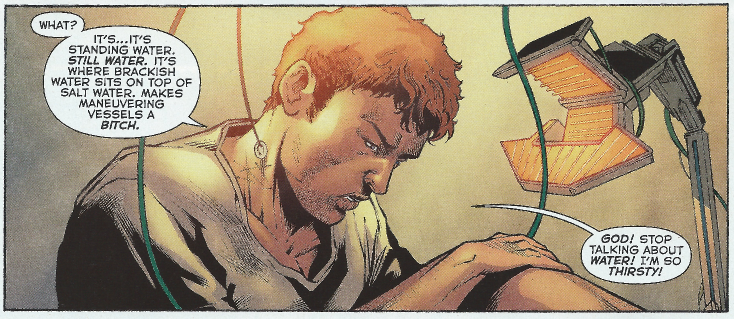
So, with the newest run of Aquaman, starting with issue #50, focusing around a villain named Dead Water, I thought it was the perfect moment to talk about some physical oceanography. And then…

Dead Water. From Aquaman #51.

My hat’s off to Dan Abnett, who beat me to the science punchline. If I had to explain the phenomenon of dead water in a single tweet, it would have been pretty close to this. Well played, sir. Well played.

So what is dead water and why does it make maneuvering a vessel so challenging?

Read More “The Science of Aquaman: Understanding Dead Water” »

A journey across Titan’s largest methane sea.

Posted on March 28, 2016March 28, 2016 By Andrew Thaler
Popular Culture

You asked for a map the clarify the journey of Calliope, the Salvager, and others as they sail, fly, and walk across Kraken Mare, Titan’s largest methane sea. Here, for your pleasure, is a map of the journey across Kraken Mare from A Crack in the Sky above Titan. Read A Crack in the Sky … Read More “A journey across Titan’s largest methane sea.” »

The 8 Most Ridiculous Shark Moments in Comics

Posted on March 28, 2016March 28, 2016 By Andrew Thaler
Popular Culture

It’s a very special week. No, not that week. It’s David Shiffman defends his PhD thesis week! In honor of this auspicious event, here are the 8 most ridiculous shark moments in comic books.

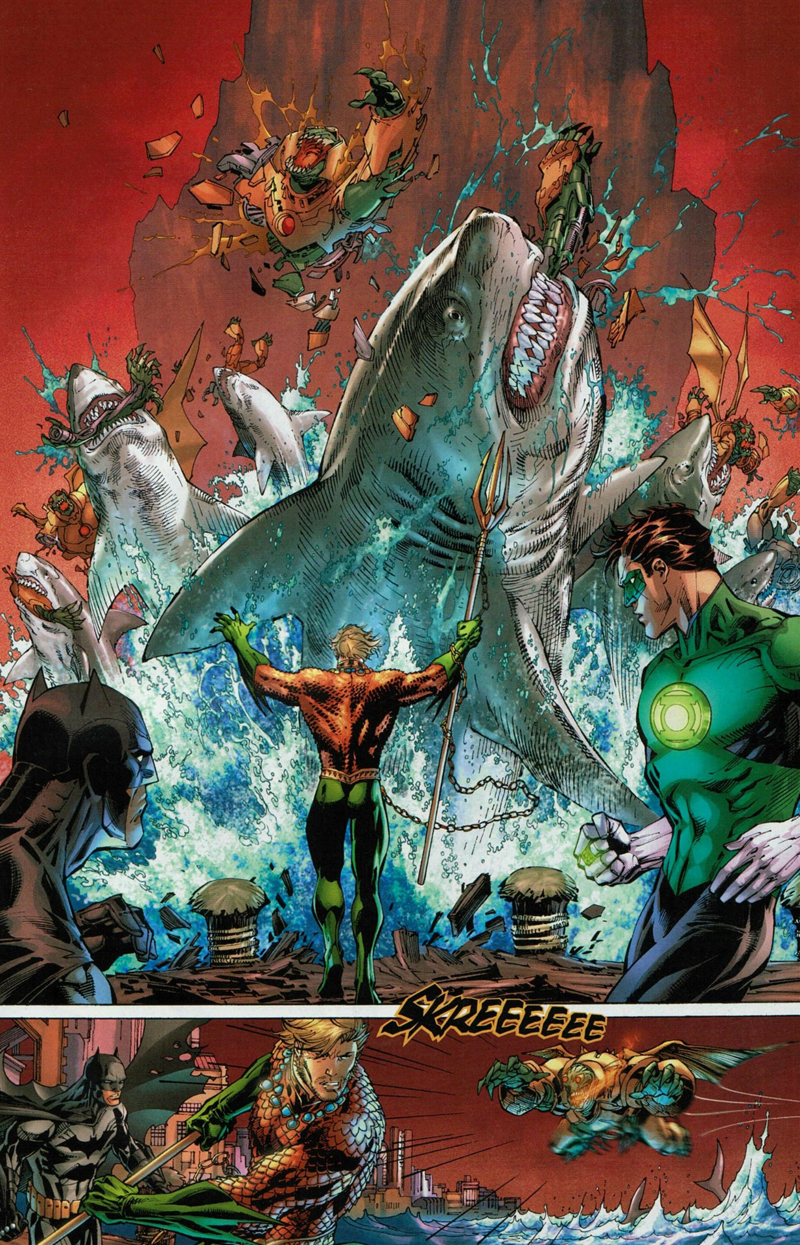
Aquaman talks to fish.

Justice League #4
Justice League #4

Reason 652 that “can talk to fish” is still the best super power ever. 

Read More “The 8 Most Ridiculous Shark Moments in Comics” »

A selection of space nerdery from your favorite ocean blog.

Posted on March 25, 2016March 25, 2016 By Andrew Thaler
Blogging, Popular Culture

coverTitanThis Monday I launched A Crack in the Sky above Titan, a science fiction adventure framed around the seemingly simple question: What is it like to sail across the methane seas of Titan?

While Southern Fried Science is all about ocean science and conservation, we do make the occasional foray into space. From celestial navigation on Mars, do diving robots on Europa, to exploring other (fictional) worlds to learn something about our own, we haven’t shied away from the ‘other’ final frontier. So, in honor of A Crack in the Sky above Titan (available now on Amazon*) here is a selection of our favorite space nerdery from Southern Fried Science.

(Note: Some of these are from our month of ocean science fiction. While the framing for these pieces is fictional, the science itself is sound)

The Extraterrestrial Ocean: Could OpenROV Trident explore the seas of Europa?

Our planet is an ocean, and it is almost entirely unexplored. OpenROV, and their new Trident underwater drone is one of many tools that will help change that by democratizing exploration, conservation, and ocean science. We are poised atop the crest of a wave that may change how humans interact with the ocean as profoundly as the invention of the aqualung.

Earth is not the only body in our solar system that hosts an ocean. As we (slowly) venture out into the stars, could OpenROV Trident dive in extraterrestrial seas?

Read More “A selection of space nerdery from your favorite ocean blog.” »

What is it like to sail across Titan’s methane seas?

Posted on March 21, 2016March 20, 2016 By Andrew Thaler
Blogging, Popular Culture

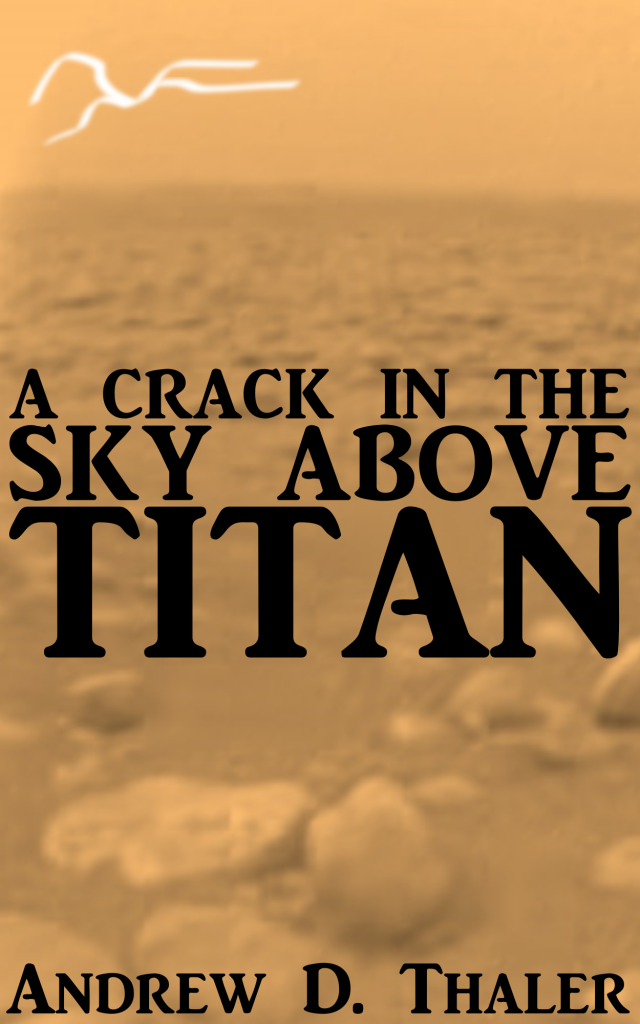
coverTitanA simple writing prompt–what would it be like to sail across Titan?–has taken me on a 20,000-word journey through the intricacies of life on Saturn’s largest moon. Join the Salvager on a journey across Kraken Mare to land the score of a lifetime, if the rest of the universe doesn’t get in their way. Discover the weird, wonderful world of Titan and her coastal colonies and confront the challenges of sailing across an alien world.
A Crack in the Sky above Titan takes a lot of the ideas developed during Field Notes from the Future and extends them out into the extremely distant future. At what point do humans, heavily augmented with hardware and software, stop being human? What rights are retained when a person contains no human parts? How does art evolve in a future obsessed with technology? And how exactly do you sail via celestial navigation with no polar star and an atmosphere of dense haze.

In honor of this new launch, my other novella, Prepared, an adventure in doomsday prepping, seasteading, and catastrophic sea level rise, is free to download all week long.

A Crack in the Sky above Titan.


Read an excerpt from my latest novella, below:

Read More “What is it like to sail across Titan’s methane seas?” »

A Natural History of the Starwhale

Posted on September 21, 2015September 20, 2015 By Andrew Thaler 1 Comment on A Natural History of the Starwhale
Popular Culture, Science
space_whale_by_ovitan-d8cc9en
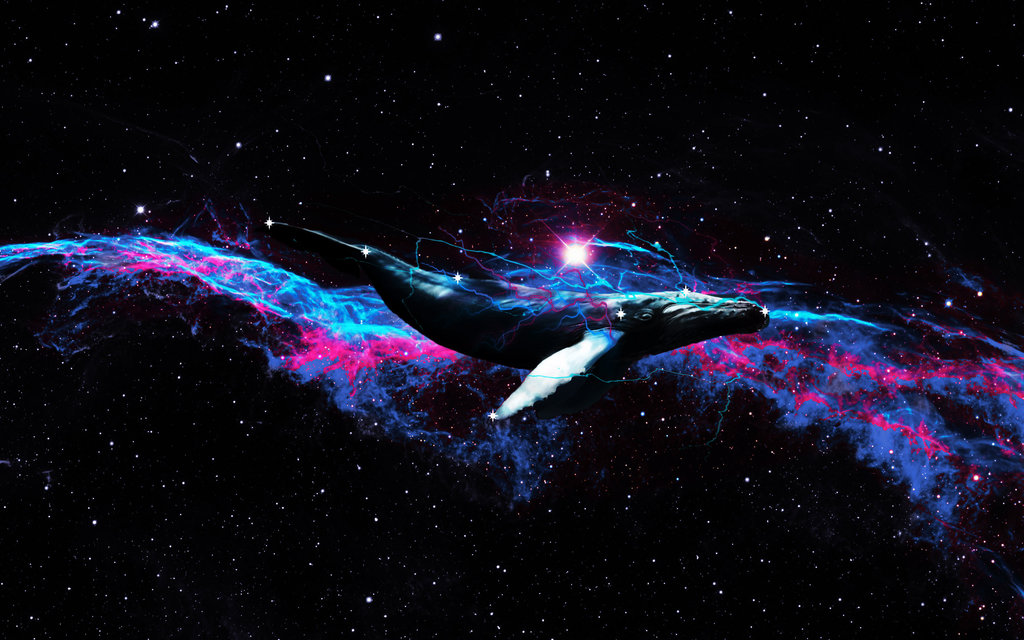
Space Whale, by OvitaN – http://ovitan.deviantart.com/art/Space-Whale-504456863

Whales, those magnificent leviathans of the deep, have an uncanny knack for ending up in space. Science fiction is flooded with stories of starwhales–sometimes entirely new creatures that happen to resemble terran cetaceans in either behavior or appearance, sometimes evolved leviathans from our own world, and occasionally hapless, confused, ordinary whales. This is no fluke. Space is big, whales are big, so why shouldn’t there be whales in space?

Science fiction loves its tropes, and particularly loves comparing space to the golden age of maritime exploration, to the point where starships sometimes have sails. And then, of course, there’s The Narrative. You know, the one where a captain is consumed by obsession and revenge to hunt some semi-mythical mcguffin. If you’re going to do Moby-Dick-in-Space, you better have a starwhale. SciFi loves the Moby Schtick.

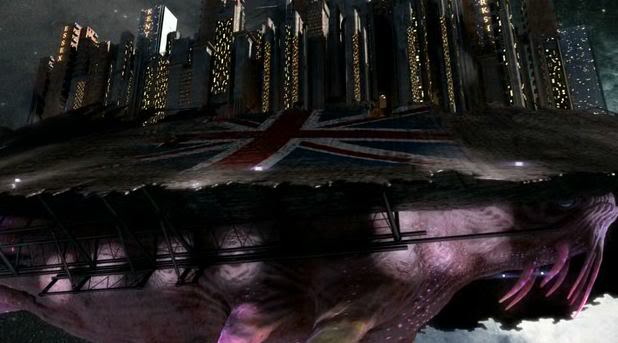
Starship UK, from Doctor Who.

So what is a starwhale, and why is it different from other giant space creatures like the exogorth of Empire Strikes Back? Like terran whales, star whales are intelligent creatures that often exhibit some form of emotion. Unlike other space monsters, they often act with a purpose that goes beyond “eat space people, wreck ship”. Nowhere is this more clearly highlighted than in the Doctor Who episode The Beast Below, in which the Doctor encounters the last living starwhale, now supporting the remnants of the British Empire on its back. In the story, the whale endures tremendous suffering in order to protect ‘the children’, and chooses to stay even after being freed from its captors.

Giant whales providing the backbone for mysterious islands traces its roots back to the ancient Greeks, at least in the Western canon. Aspidochelon was a sea monster said to resemble either a turtle or a whale, with a craggy back the carried sandy beaches and sometimes even trees and jungles. Sailors who wandered ashore would find their ships crushed as they were pulled down into the deep. Later incarnations of the whale-as-island made explicit its connection to Satan, the ultimate deceiver. And, of course, Herman Melville makes explicit the modern civilization rests on the back, or, more accurately, the oil, of the whale.

Interestingly, starwhales are, at worst chaotic neutral, but more often lawful good. Their connection to the devil abandoned back on Earth.

The Star Trek universe is resplendent with starwhales, from numerous Enterprises have encountered numerous starwhales, from benign travelers passing through to confused infants looking to the ship for survival, to aggressive bulls threatened by incursion into their territory. Bull sperm whales were documented by early Earth whalers as solitary, especially aggressive male whales, some of which had tasted the bite of many harpoons and continued to charge. It was a bull sperm whale the sunk the Essex, the inspiration for Moby Dick.

Read More “A Natural History of the Starwhale” »

Does Shark Week portrayal of sharks matter?

Posted on June 29, 2015July 3, 2015 By David Shiffman 6 Comments on Does Shark Week portrayal of sharks matter?
Blogging, Popular Culture, Science

sharkI’ve been critical of factual inaccuracy and fearmongering on Shark Week documentaries for years. But how big of a problem is this, and how do we know? I asked some of the authors of three recent scientific studies*  to summarize the evidence.

Many species of sharks are in desperate need of conservation. Twenty-four percent of all known species of sharks, skates and rays are considered Threatened with extinction by the IUCN Red List. Using a variety of different methods, scientists have documented rapid and severe population declines in many species of sharks all over the world.

Conservation requires public support. In a participatory democracy, new policies and regulations require some public support to pass. It’s easy to get public support to conserve cute and cuddly animals, but ugly animals need protection too. So do animals that scare people, like sharks.

Read More “Does Shark Week portrayal of sharks matter?” »

How a 10 Million Year old fossil, a smart phone, and a 3D printer recharged my #OceanOptimism.

Posted on April 10, 2015 By Andrew Thaler
Popular Culture, Science

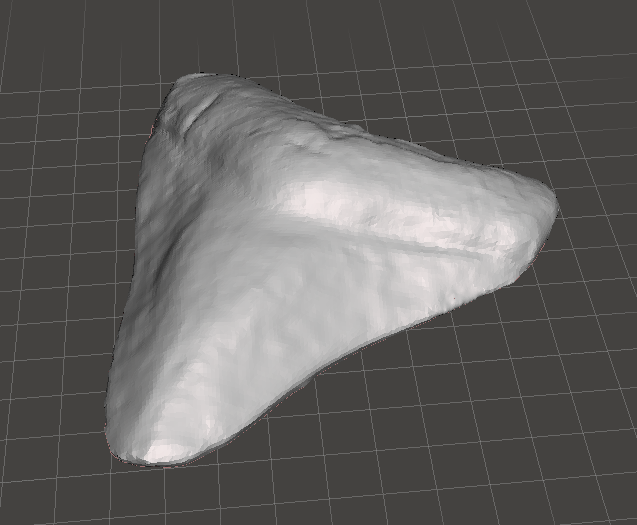
3dtootLast week, we launched a novel little experiment in crowdfunding marine science and conservation – Buy David Shiffman a Less Ugly Pair of Sunglasses – ostensibly about replacing David’s legendarily hideous sunglasses with something a bit more aesthetic. Of course, anyone digging into the stretch goals quickly realized that this was less about sunglasses and more about funding some cool research and outreach projects we’re currently working on; projects like a hammerhead conservation genetics analysis, building a marine ecology drone, and sending students from underserved schools of a shark tagging trip. This was made more explicit when we hit our first goal in the first 36 hours of funding.

With the first funding goal achieved, I decided we needed a cool perk, something not particularly expensive to produce but completely novel and cool enough to justify making a heftier donation. And, of course, it needed to be thematically related to the spirit of the project.

Enter the Megalodon.

Read More “How a 10 Million Year old fossil, a smart phone, and a 3D printer recharged my #OceanOptimism.” »

Posts pagination

Previous 1 … 4 5 6 … 20 Next

Popular Posts

Florida angler catches (and likely kills) Endangered great hammerhead sharkFlorida angler catches (and likely kills) Endangered great hammerhead sharkFebruary 13, 2012David Shiffman
10 misrepresentations about climate change10 misrepresentations about climate changeOctober 3, 2011David Shiffman
At least 74 practicing shark researchers: How a silly thing I said online raised thousands for conservationAt least 74 practicing shark researchers: How a silly thing I said online raised thousands for conservationFebruary 26, 2025David Shiffman
What shark finning means (and doesn't mean): a primer and quizWhat shark finning means (and doesn't mean): a primer and quizJune 18, 2012David Shiffman
Why the new Trump order to shoot wolves is both illegal and a dreadful precedent for endangered speciesWhy the new Trump order to shoot wolves is both illegal and a dreadful precedent for endangered speciesSeptember 5, 2026Ali Gaster
That's not a blobfish: Deep Sea Social Media is Flooded by AI SlopThat's not a blobfish: Deep Sea Social Media is Flooded by AI SlopDecember 19, 2025Andrew Thaler
Is Sea Shepherd really saving whales?Is Sea Shepherd really saving whales?June 7, 2010Andrew Thaler
Have we found the city of Atlantis?Have we found the city of Atlantis?September 1, 2026Chris Parsons
When is a take not a take? Yet another attack on Endangered Species by the Trump AdministrationWhen is a take not a take? Yet another attack on Endangered Species by the Trump AdministrationSeptember 22, 2026Ali Gaster
The Trump Administration’s latest attack on endangered speciesThe Trump Administration’s latest attack on endangered speciesSeptember 17, 2026Ali Gaster
Subscribe to our RSS Feed for updates whenever new articles are published.

We recommend Feedly for RSS management. It's like Google Reader, except it still exists.

Southern Fried Science

  • Home
  • About SFS
  • Authors
  • Support SFS


If you enjoy Southern Fried Science, consider contributing to our Patreon campaign.

Copyright © 2026 Southern Fried Science.

Theme: Oceanly Premium by ScriptsTown