Skip to content

Southern Fried Science

Over 15 years of ocean science and conservation online

  • Home
  • About SFS
  • Authors
  • Support SFS

Category: Science

Better Conservation through Cloning: this cock doesn’t crow

Posted on December 7, 2011December 7, 2011 By Andrew Thaler 7 Comments on Better Conservation through Cloning: this cock doesn’t crow
Conservation, Science

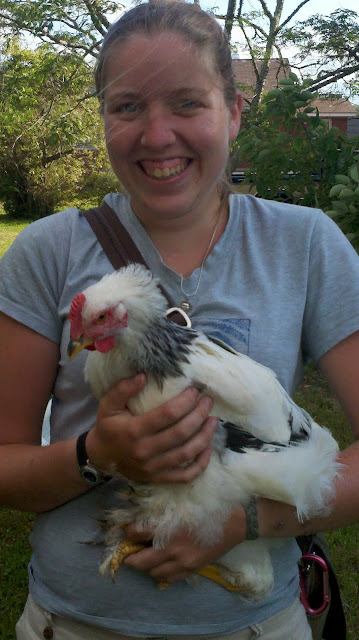
Poor Vindaloo never learned to crow.
Poor Vindaloo never learned to crow. Photo by Andrew David Thaler.

I awoke one morning early last spring to a noise I has been dreading for weeks, the first crow of a chicken that was not supposed to be a rooster. It took me several minutes to fully register what I was hearing. Rather that the classic cock-a-doodle-do we often associate with the rooster’s crow, the sound emanating from my hen house was an awkward, unstable noise not unlike a turkey squawking through a vat of molasses while being vigorously shaken. Over the next several months, two more cocks arrived crowing, in my flock. All three roosters, different breeds from different parents, made noises resembling nothing like a rooster’s crow. There was no pattern; some mornings they would crow off-and-on for a few hours, other mornings they would, for lack of a better word, gargle for half-an-hour straight.

I raise my chickens from day-old hatchlings. Those three roosters, from my very first flock, had never met an adult chicken. They imprinted on Amy and me and looked to us for guidance. When we introduced them to new food, new water dispensers, even small changes to their habitat (like a particularly terrifying log), we had to teach them. Instinctively, they would scratch for food, and if left to their own devices, they would attempt to eat everything, but for the most part, we had to show them how to eat, how to drink, how to roost. But we could not teach them how to crow.

Which is why Casey B. Mulligan’s Economix article in the New York Times – Species Protection and Technology – which argues that cloning could be an effective tool to restore extinct species (a topic I’ve been thinking about quite a bit in terms of population dynamics), is fatally flawed.

Read More “Better Conservation through Cloning: this cock doesn’t crow” »

Bluefin Tuna, Big Game Hunters, and the Conservation Vortex

Posted on November 29, 2011December 9, 2011 By Andrew Thaler 4 Comments on Bluefin Tuna, Big Game Hunters, and the Conservation Vortex
Conservation, Science

Bluefin Tuna. Public Domain NOAA

Why are we still killing Bluefin Tuna? This question has resonated through the ocean blogosphere recently, as various experts weigh the issues surrounding overfishing and wonder why, when we know how limited the Bluefin Tuna populations are, and how precipitously they’ve declined in the last decade, do they demand record-breaking prices able to support an industry that must range further afield to chase that last, lonely fish? Other conservation writers discuss the recent extinction of not one, but two, rhinoceros species and ponder the fate of large terrestrial mammals. Knowing how rare these rhinoceroses were, why did they continue to be poached? Where does this demand come from?

Read More “Bluefin Tuna, Big Game Hunters, and the Conservation Vortex” »

Are Neutrinos really faster than light? Irish folk rock parody band weighs in.

Posted on November 27, 2011December 9, 2011 By Andrew Thaler
Popular Culture, Science

From the same people who brought us the eminently catchy “There’s no one as Irish as Barack O’Bama.” Quoth Ger Corrigan “for the moment we are backing Albert and his theory, I’m no Einstein but he was.” The Neutrino Song: httpv://www.youtube.com/watch?v=vpMY84T8WY0

Giant manta rays protected by Convention on Migratory Species

Posted on November 25, 2011December 9, 2011 By David Shiffman 6 Comments on Giant manta rays protected by Convention on Migratory Species
Conservation, Science

A few weeks after they were listed as Vulnerable on the IUCN Red List, giant manta rays (Manta birostris) have received major international legal protection. The Parties to the Convention on Migratory Species of Wild Animals (CMS) just agreed to list giant mantas on Appendix 1 and II of CMS at their tri-annual meeting in … Read More “Giant manta rays protected by Convention on Migratory Species” »

Check out Shark Attack Experiment Live, Friday on National Geographic Wild

Posted on November 23, 2011December 9, 2011 By David Shiffman
Popular Culture, Science

This Friday, tune in to National Geographic Wild for a day of sharks! Starting at noon, they will air a series of shark documentaries culminating at 9 p.m. with “Shark Attack Experiment: Live“. This show, aired live from the shark hotspot of South Africa, aims to test some common myths about shark attacks and to “to … Read More “Check out Shark Attack Experiment Live, Friday on National Geographic Wild” »

America’s lust for gigantic breasts leads to impotence: the population genetics of captive-reared turkeys

Posted on November 23, 2011November 27, 2013 By Andrew Thaler 2 Comments on America’s lust for gigantic breasts leads to impotence: the population genetics of captive-reared turkeys
Conservation, Science
Gobble? image from http://www.public-domain-image.com

The noble turkey, a centerpiece of the American Thanksgiving supper. It looms large from its prominent position on the dining room table. The master of ceremonies – or, in my case, the guy who keeps slicing himself open with various sharp objects yet is inexplicably the one people call on when there’s knife-work needs doing – draws a set of fine, honed knives, set aside for this particular task, and carves, delicately yet firmly, into the hefty white meat of the turkey’s breast. Sure, some favor the dark, rich meat around the legs, but this white meat, soaked in gravy and topped with cranberry sauce or stuffing, that is what we crave.

“We give thanks,” the benediction may begin, “to Charles Darwin, for determining the underlying mechanism by which a theropod may, over the course of 65 million years, through a process of gradual change by means of the retention of beneficial traits through successive generations, evolve into this delicious, delicious bird.” And then, perhaps, that surly teenager, the one determined to point out the social inequalities inherent in the holiday and the colonialist attitudes which led to the wholesale extermination of America’s native peoples – every family has at least one – will chime in to quip “you know, evolution didn’t shape the turkey. The modern Thanksgiving turkey is the product of an extensive selective breeding program that began in the 1940’s. Commercial turkeys can’t even reproduce naturally, they have to be artificially inseminated.” At which point the older members of your family may blush and/or faint at such an unseemly turn of phrase.

Read More “America’s lust for gigantic breasts leads to impotence: the population genetics of captive-reared turkeys” »

European Union officials propose stronger finning ban, sign UN migratory shark initiative

Posted on November 22, 2011December 9, 2011 By David Shiffman
Science

Two pieces of good news for European sharks were announced yesterday.  The European Union signed the UN Convention on Migratory Species (CMS) Memorandum of Understanding for sharks. This MOU was established last year to support the conservation of seven shark species which regularly migrate between national boundaries, a list which includes great whites and whale sharks. … Read More “European Union officials propose stronger finning ban, sign UN migratory shark initiative” »

Guest Post: A review of the Field Guide for Sharks of the Genus Carcharhinus

Posted on November 21, 2011December 9, 2011 By Guest Writer
Science

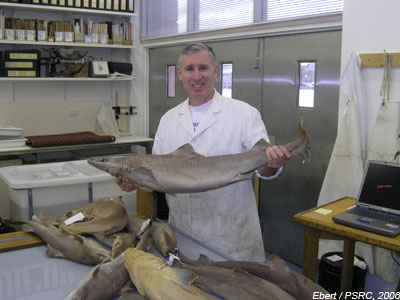
Dr. David Ebert is the Director of the Pacific Shark Research Center at Moss Landing Marine Laboratories. He is one of the world’s leading experts on shark taxonomy, and has described new species of sharks, skates, rays, and chimaeras. Dr. Ebert has written over 100 publications, five books, and dozens of IUCN Red List assessments. He generously agreed to review a new taxonomy guide, Field Guide for Sharks of the Genus Carcharhinus, for Southern Fried Science. He has provided a thorough list of citations backing up his points, but all opinions are his own. 

The shark genus Carcharhinus is one of the largest and perhaps most important genera of sharks, with many common and wide-ranging species. These sharks are mostly marine occurring from close inshore to the outer continental shelf and upper slope, but a few species inhabit estuaries and freshwater rivers and lakes. This group is by far one of the most important shark genera for fisheries globally, with various species being taken in commercial and sport fisheries, and in artisanal fisheries. Given the high profile and importance of this genus and the associated problems in identifying them to individual species in the field, an identification guide to the group would be most welcomed.

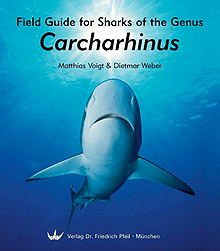
The book, “Field Guide for Sharks of the Genus Carcharhinus” by Matthias Voigt and Dietmar Weber, could have been that guide, with an exceptionally nice layout, beautiful illustrations, and tooth plates, but unfortunately the text does not stand up to the same high quality of the illustrations. The book cover is quite attractive and eye-catching, and upon initially thumbing through the illustrations and layout of the individual species accounts, I thought wow this looks to be an interesting and possibly useful guide to this shark group, even though I was unfamiliar with the authors, whom to be candid I had never heard of before.

Read More “Guest Post: A review of the Field Guide for Sharks of the Genus Carcharhinus” »

Cull canceled: victory for the sharks of Western Australia!

Posted on November 15, 2011December 9, 2011 By David Shiffman 1 Comment on Cull canceled: victory for the sharks of Western Australia!
Conservation, Science

A few weeks ago, I wrote about a proposed shark cull in Western Australia and asked for your help to oppose it. By the end of the Support Our Sharks anti-cull campaign, the petition had almost 19,000 signatures from dedicated shark conservationists from around the world, including many of our readers. After some initial anti-shark … Read More “Cull canceled: victory for the sharks of Western Australia!” »

Threatened gentle giants: both species of manta ray added to the IUCN Red List

Posted on November 14, 2011December 9, 2011 By David Shiffman 14 Comments on Threatened gentle giants: both species of manta ray added to the IUCN Red List
Conservation, Science

Manta rays are true gentle giants; though they can grow more than 20 feet wide from wingtip to wingtip, they eat only plankton. Swimming with these animals is a rare thrill for SCUBA divers, and manta-viewing ecotourism is worth over $100 million each year. Like many species of sharks, manta rays grow slowly and reproduce … Read More “Threatened gentle giants: both species of manta ray added to the IUCN Red List” »

Posts pagination

Previous 1 … 50 51 52 … 83 Next

Popular Posts

How many of these shark Jeopardy clues can you get correct?How many of these shark Jeopardy clues can you get correct?November 5, 2026David Shiffman
What Ocean Ramsey does is not shark science or conservation: some brief thoughts on "the Shark Whisperer" documentaryWhat Ocean Ramsey does is not shark science or conservation: some brief thoughts on "the Shark Whisperer" documentaryJuly 2, 2025David Shiffman
What sharks would Odysseus have encountered during his journey?What sharks would Odysseus have encountered during his journey?October 9, 2026David Shiffman
We Asked IMCC7 Attendees What Ocean Conservation Needs. Here's What They Said.We Asked IMCC7 Attendees What Ocean Conservation Needs. Here's What They Said.November 5, 2026Angelo Villagomez
Why the new Trump order to shoot wolves is both illegal and a dreadful precedent for endangered speciesWhy the new Trump order to shoot wolves is both illegal and a dreadful precedent for endangered speciesSeptember 5, 2026Ali Gaster
For when the madness ends: a 5-point plan for getting conservation back on track in the USFor when the madness ends: a 5-point plan for getting conservation back on track in the USJuly 9, 2026Ali Gaster
That's not a blobfish: Deep Sea Social Media is Flooded by AI SlopThat's not a blobfish: Deep Sea Social Media is Flooded by AI SlopDecember 19, 2025Andrew Thaler
REPORT: The Trump Administration’s War in Iran Is Harming Fishermen in Hawaii and Across the CountryREPORT: The Trump Administration’s War in Iran Is Harming Fishermen in Hawaii and Across the CountryOctober 28, 2026Angelo Villagomez
Our favorite sea monsters – Ningen (#4)Our favorite sea monsters – Ningen (#4)September 7, 2010Andrew Thaler
Why ocean science is still one of the worst-funded scientific fields worldwideWhy ocean science is still one of the worst-funded scientific fields worldwideJune 3, 2026Chris Parsons
Subscribe to our RSS Feed for updates whenever new articles are published.

We recommend Feedly for RSS management. It's like Google Reader, except it still exists.

Southern Fried Science

  • Home
  • About SFS
  • Authors
  • Support SFS


If you enjoy Southern Fried Science, consider contributing to our Patreon campaign.

Copyright © 2026 Southern Fried Science.

Theme: Oceanly Premium by ScriptsTown