Inception, a clever movie starring Leonardo DiCaprio where the premise of the story is to sneak into a person’s subconscious and implant an idea or a memory whilst they sleep. When the person awakes from their slumber they cannot distinguish the implanted memory from their own. It makes for blockbuster cinematography, but the practical concept is quite frightening to think about: the ability to artificially implant memories inches closer to the prospect of reality distortion.
Read the full, open access paper “262 Voyages Beneath the Sea: A global assessment of macro- and megafaunal biodiversity and research effort at deep-sea hydrothermal vents” at PeerJ!
I am in Saba in the Dutch Caribbean with the Dutch Elasmobranch Society, St. Maarten Nature Foundation, and the Saba Conservation Foundation serving as a research assistant to an international team of shark scientists participating in the Save Our Sharks Expedition 2019. Today was our first day out on the water and our objective was … Read More “Small Shark Tagging Day” »
I’m in the Dutch Caribbean this week with a team of international researchers for an expedition to the Saba Bank to study sharks. This endeavor has been pulled together under the leadership of the Dutch Elasmobranch Society, the Saba Conservation Foundation, and the Nature Foundation Sint Maarten. I’m only here for five days, but the … Read More “Studying Sharks in the Dutch Caribbean” »
Can you remember how young you were when you were first taught stop, drop, and roll? How about turn around, don’t drown? Slogans are abridged stories that fulfill our human need to convey information quickly and memorably. Their uses range from social connection, cooperation, and informing cohorts of risk. Sayings like the above are effective … Read More “Worldwide SciComm Challenge: #SharkSafetySlogan” »
I have had the pleasure of working communications roles in several industries over the years. During this time, I’ve seen the rise of a dubious campaign metric commonly referred to as “Stop the Scroll” (or “Swipe”). This metric has conscientious roots. Online communications strategists have less than a second to grab a potential donor, stakeholder, or client’s attention. Good strategists have read Craig McClain’s paper, as a great visual will make your thumb quiver before scrolling on to a video of dogs doing literally anything. In this light, stop the scroll seems like a pretty good metric for individual post efficacy. Time is the currency of experience, after all.
Can we count the seconds people spend learning untrue facts as progress towards our campaign? Or change the campaign goals to justify a resource-heavy shit post?
Editors: Jeffrey C. Carrier, Michael R. Heithaus, Colin A. Simpfendorfer. CRC Press, available here.
I can’t imagine a more useful introductory reference guide for new or prospective graduate students starting their career in marine biology than “Shark Research: Emerging Technologies and Applications for the Field And Laboratory”. This book is designed for people who have little to no familiarity with a research discipline but are about to start working in that discipline, a large and important audience that is often ignored by books and review papers geared towards people who are already experts. So many graduate students are told to learn a new research method by reading technical literature that assumes they already know this stuff, resulting in stress and frustration.
For the last several years, I’ve been working off the weight gained and fitness lost from a decade of grad school, post-doctoral research, job hunting, and, ultimately, launching my own company. The gym, to put it mildly, had not been a priority. Running and weight training went a long way towards getting me back to where I wanted to be, but I had hit a plateau. Every spring and summer I’d make incremental improvements, every winter, I’d fall back into old habits. It was a sustainable situation, but not fantastic.
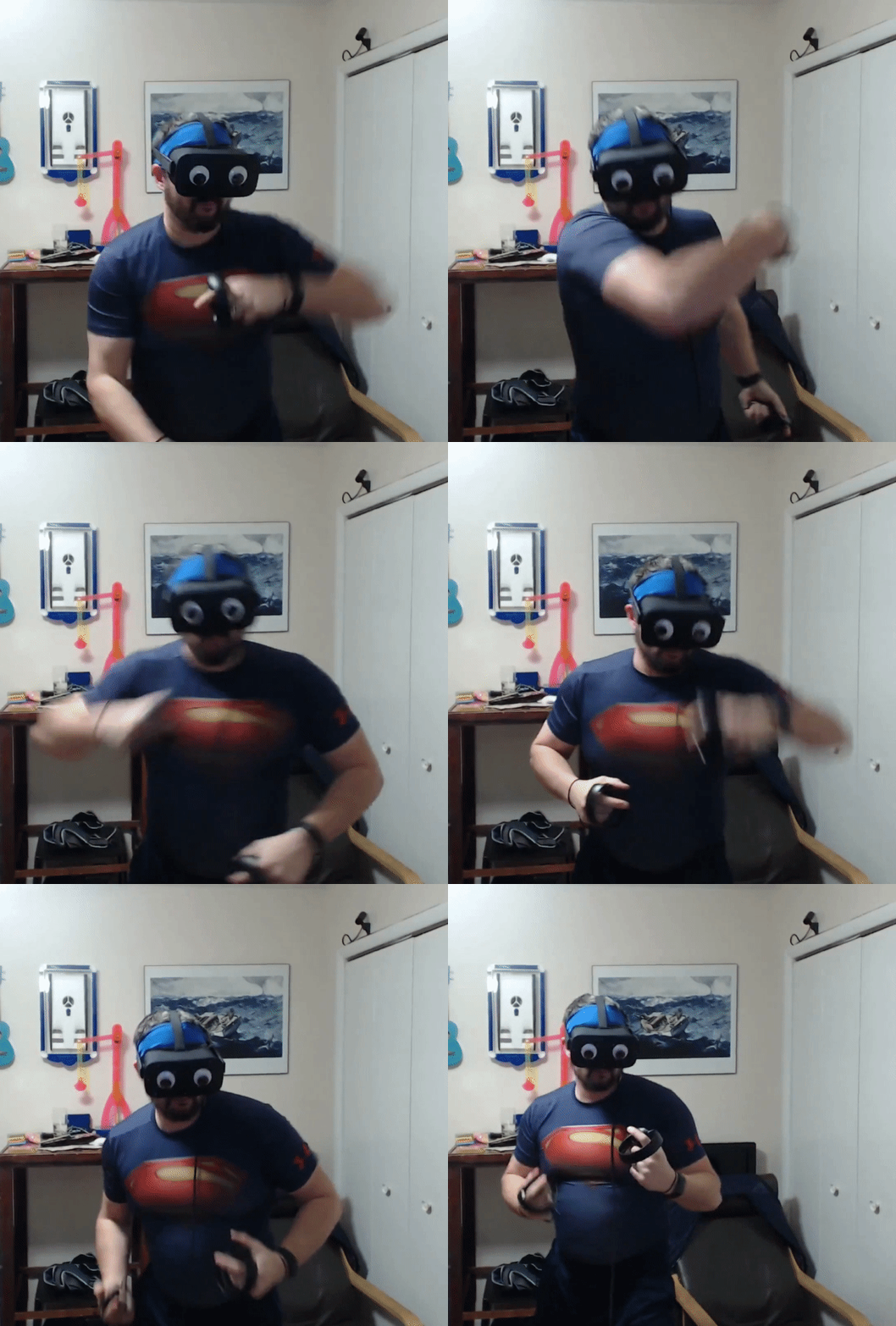
Last summer, I set a goal for myself. While the weather was just on the wrong side of that threshold that makes running something I’m willing to do first thing in the morning, I would instead swap out my sneakers for an Oculus Rift, and spend an hour, four or five days a week, playing fitness-oriented virtual reality games, for fifty sessions. That schedule would get me through the winter and hopefully keep me more active than I otherwise would.
To better illustrate this plan, I made a GIF, just for you:
Yes, it’s me. Yes, we put googly eyes on the Oculus.
Unsurprisingly, the science behind Virtual Reality and exercise is still in its infancy.
We have a new paper out today in the journal Aquatic Ecology! Read it here, open access copy here. This is the last paper from my Ph.D. dissertation, and coauthors include my Ph.D. advisor Dr. Neil Hammerschlag, Ph.D. committee member Dr. Mike Heithaus, and colleague Dr. Les Kaufman. It’s called “Intraspecific Differences in Relative Isotopic Niche Area and Overlap of Co-occurring Sharks,” which I think rolls right off the tongue and would make a pretty sweet band name. This research was crowdfunded by the SciFund challenge a few years ago, so thanks again for your support! I want to tell you a little bit about what we did and what we found!