

Uncategorized
httpv://www.youtube.com/watch?v=yBbrBg-ji08
Over 15 years of ocean science and conservation online
httpv://www.youtube.com/watch?v=yBbrBg-ji08
A lot of debate among conservationists centers on the conflict between the desire to see a species totally protected from human exploitation and the reality that market forces will continue to exist (see the latest on shark fin bans for a very good example). Ideally, a conservation plan should strike a balance, ensuring the continued existence of the species while still allowing people to profit from it in some way. This also requires a clear idea of the limitations of conservation policies. For example, US policies (even the mighty Endangered Species Act) only directly affect populations within the territorial waters of the United States, while international agreements like CITES restrict trade of the species without telling any particular country what to do domestically. However, there are ways to track the interaction between conservation policies and the market, making it possible to make some predictions on how things like fishery management plans and CITES listings might affect trade. Then it gets interesting. Armed with this knowledge, can the market be pushed towards species conservation?
Read More “Good Conservation Policies Can Push Markets Towards Conservation” »
Today, Pew unleashed a mini-media blitz on the importance of predation in fisheries management. This got my attention because the interaction between marine predators and fisheries is one of my major research interests. They do a great (and slickly-designed) job explaining the basics of why paying attention to predation matters in fisheries management, and bonus … Read More “Predation Matters” »
httpv://www.youtube.com/watch?v=Cix8PkDpag4
When you work on the water long enough, you encounter some unique situations. Whether it’s getting stranded during field work, surviving massive seasickness, having your equipment attacked by hostile sea life, or just seeing something unusual, these anecdotes are an important part of what makes marine science fun (sometimes moreso in hindsight). That’s why I’m creating a new category for posts here called “Fish Tales,” where we can share these stories. To start with, here is a literal fishing story.
While I was down in Morehead City for some field work (post on that coming soon), I got the chance to do a little fishing with fellow Southern Fried writers Andrew and Amy and check on potential sites for shark sampling this summer. I’d wanted to test out a new fishing rod set up for sharks and large fish, and had rigged up a wire leader with a size 12/0 circle hook. While casting, it became very clear that I hadn’t properly attached the leader to the swivel when I pulled back an empty swivel where the leader had been. Frustrating, but I’m practically required to lose gear every time I fish, so I rigged up a second wire leader with a J-hook that was on hand.
Circle hooks are used by recreational and commercial hook-and-line fisheries (and many longliners) to reduce hooking mortality in large fishes, sharks, and bycatch animals like sea turtles. The idea is that the hook more or less works by itself without being set like a J-hook. The shape of the hook prevents swallowing and encourages hooking in the corner of the mouth, where it’s less likely to do serious damage.


I’ve written in the past about why shark fin bans might not be the best tool for the conservation and management of sharks. Though specific details vary, these so-called “blanket bans” typically make it illegal for anyone to buy, sell, or possess shark fins regardless of the source *. Additionally, to date most of these fin bans have taken place in a few U.S. states and Canadian towns. If the goal of these state-level fin bans is to reduce the supply of fins to the global market, proponents should consider that according to TRAFFIC, more than 95% of the supply of shark products comes from countries outside of the U.S. and Canada. Even if every U.S. state passed a fin ban, it would have a negligible direct impact on global supply. Additionally, the United States has some of the most sustainably managed shark fisheries in the world (hammerhead sharks and a few others are an exception). We want other countries to emulate out management practices, not to remove our management practices from the global marketplace.
If the goal of these local fin bans is to reduce global demand, proponents should consider that the overwhelming majority of the demand for shark fin soup is in China and Southeast Asia, where passing such bans will pose a significant challenge. Some proponents of fin bans say (after the negligible impact on supply and demand is pointed out) that fin bans help with “raising awareness of the problem of overfishing of sharks”. While these fin bans do result in (relatively) positive media coverage for shark conservation, “raising awareness” is not the publicly stated goal of these bans. If your goal is to educate people about a problem, educate people about the problem.
Instead of inflexible and ineffective fin bans that penalize fishermen who have adopted best practices * without impacting the global market, I’ve advocated for a science-based approach to sustainable shark management following the 10 basic principles in line with what has been laid out in the United Nations Fisheries and Aquaculture Organization’s International Plan of Action for Sharks and IUCN Shark Specialist Group guidance. These principles include banning finning of sharks by requiring that carcasses be landed whole (recall that finning is a specific fishing practice not synonymous with the fin trade), using science-based quotas to manage the fisheries of sharks whose populations can support a fishery, and restricting the harvest of species whose populations cannot.
Recently, the United States National Marine Fisheries Service (which, once again, manages some of the most sustainable shark fisheries on Earth) has started to officially speak out against state level fin bans.
 No doubt you’ve seen the recent news reports of a Florida high school student, by all accounts a model student with a clean disciplinary record, who was not only expelled, but arrested on felony charges, for conducting a relatively innocuous scientific experiment. I don’ t need to rehash the details, Danielle Lee has a good summary, with relevant links, over at Scientific American–Florida teen charged with felony for trying science.
Without a doubt this story is about race as well as the egregious over-reaction of the school administrators. Zero tolerance policies, like the one that forced Kiera Wilmot’s expulsion from Bartow High School, disproportionately affect students of color and Florida has the largest School-to-Prison Pipeline in the country. The punishment is consistent with systemic marginalization of minority students in American public schools. This is not the case of a student willfully endangering her classmates or school. This is a case of an intelligent, curious student performing a perfectly mundane act of independent inquiry, an inquiry that happens in innumerable variations in schools throughout the country. Educators know how to respond to inquisitive (even recklessly inquisitive) students, and that response is never prison.
Science is messy. Science in messiest when we just start learning how to turn our curiosity into something testable. For many people, high school is the time when we learn to harness that curiosity. Many young scientists have a brush with danger due to a combination of curiosity and experimentation. High school programs should be nurturing that curiosity and fostering responsible experimentation, not punishing it. I asked my twitter followers, many of whom are practicing scientists, whether they, during high school, had accidentally caused an explosion in the course of scientific curiosity:
Read More “On stifling scientific curiosity, in the most egregious way possible.” »
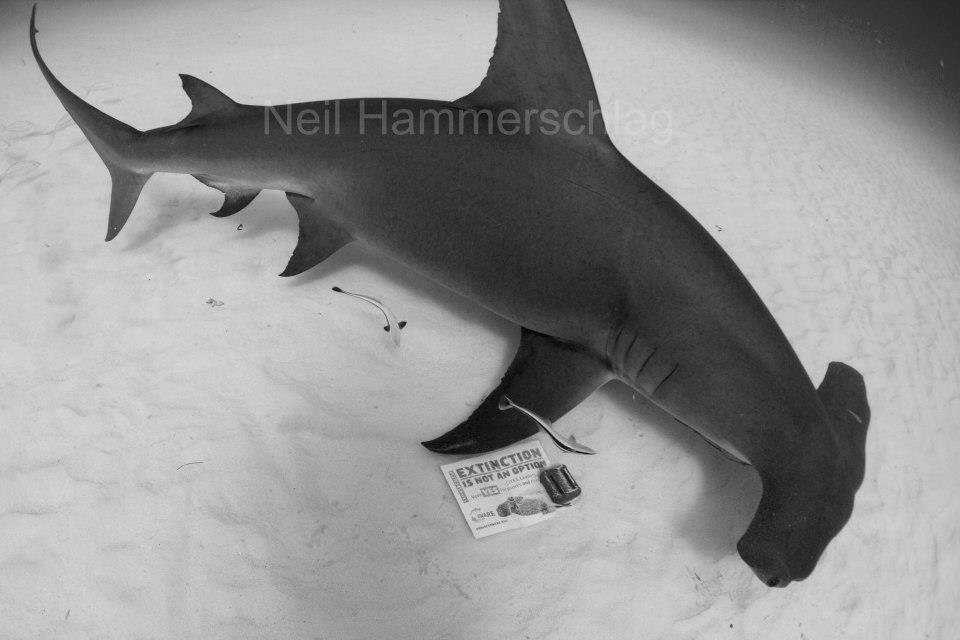
The Endangered Species Act is one of the strongest conservation laws on the planet, and to date, no shark has ever been given ESA protections. In recent weeks, however, the National Marine Fisheries Service has responded to a series of NGO petitions requesting ESA protections for two species of hammerhead sharks. NMFS proposes to list 2 “distinct” population segments” (DPS) of scalloped hammerhead sharks as endangered and 2 as threatened, with 2 DPS’s listed as “not warranted”. The response to the great hammerhead petition is not as developed (the petition itself is more recent), but notes that “the petitioned action may be warranted”.
I strongly believe that both of these species of hammerhead sharks need and qualify for Endangered Species Act protections. If you agree, I encourage you to submit an official public comment in support of listing both under the ESA following the instructions below. Failure to follow all instructions to the letter will result in your comment not being considered. Commenting on this blog post does not count as submitting a public comment, and neither does commenting on a Facebook post about this blog post. Online petitions will not be considered. This process is open to the public, but requires that we follow basic instructions.
To submit a public comment in support of great hammerhead ESA listings, click on the “comment now” button on this page and fill in the required information. To submit a public comment in support of scalloped hammerhead ESA listings, click on the “comment now” button on this page and fill in all the required information. You can also submit written comments via the mail to “Office of Protected Resources,NMFS, 1315 East-West Highway, Silver Spring, MD 20910 or by fax to 301-713-4060 attn: Maggie Miller. Please note that if you submit a comment by mail or fax, you need to include code NOAA-NMFS-2013-0046 for great hammerheads and code NOAA-NMFS-2011-0261 for scalloped hammerheads.
To help craft your public comment, I’ve written a list of 10 reasons why these sharks qualify for Endangered Species Act protections. Please do not just quote this post word-for-word, if you do then your comment will be considered a “form letter” and not an individual comment.
httpv://www.youtube.com/watch?v=QByplUnSNLY
It’s the final cup in our series. Posting these images has been a fun way to reminisce about our adventures in the Cayman Abyss and hopefully give you a small glimpse into the more whimsical side of deep-sea research. To finish of the series, here is my favorite cup: That’ll do, pig, that’ll do.