I’m pleased to announce that Southern Fried Science has once again joined the DonorsChoose Science Bloggers for Students Challenge! For those of you unfamiliar with DonorsChoose, they are an online charity that allows public school teachers to describe projects, and allows anyone to donate to these projects. In the past, the Science Bloggers Challenge has … Read More “Help students in need with the DonorsChoose Science Bloggers Challenge!” »

I adore Here Comes Honey Boo Boo. That’s right, I said it. There’s a soft spot in my brittle old heart for that whole family, Sugar Bear, Mamma June, and all. Especially Glitzy.

Glitzy, for those of you who don’t know, is a “Teacup” Pig (as you can tell from the video, pigs don’t like to be held). Pigs are cute. Piglets are super cute. Pigs are very intelligent, highly social, and make surprisingly good, house-trainable pets. Unfortunately, 800-lb hogs are not cute. Over the years, various breeders have tried to create pigs that retain all of the adorableness of a piglet without reaching the potential half ton plus mass of a full grown adult hog. Among the most popular “miniature” is the Vietnamese pot-bellied pig, a delightfully spry porcine that tops the scales at a manageable 300 pounds. When legitimate breeders talk about miniature pigs, they’re talking about these 300-lb cuties. Pot-bellied pigs are surprisingly diverse, and, although extremely rare, adults have been reported as small as 20 pounds (most breeders would regard an adult pig that size to be extremely malnourished). This huge size range prompted many breeders to attempt to create even smaller pig breeds, selecting from only the smallest stock. Enter the teacup pig.
A teacup pig (or a micro pig, nano pig, or any of a half dozen variations of “small”) is supposedly a tiny pig breed. Some breeders claim that their pigs only reach up to 30 pounds in weight. Combined with the intelligence and sociability that pigs possess, it would seem that teacup pigs should make a perfect pet. There is only one problem: there’s no such thing as a teacup pig.
We’ve updated the ever-evolving, often changing comments policy and added a link to John Scalzi’s excellent “How to be a good commenter” article. As an experiment, I cleared the moderation queue giving previously banned commenters a second chance. Here is the current policy in its entirety: Commenters (including blog authors) are asked to adhere to the philosophy … Read More “Brief Blog Notice: Changes to the Comment Policy” »
A newly-released list of proposed amendments for the upcoming CITES Conference of the Parties includes proposals to protect ten species of sharks and rays, a record-breaking number. These include three species of hammerheads, oceanic whitetip sharks, porbeagle sharks, three species of freshwater stingray, and both species of manta ray. In total, 37 countries are involved in … Read More “Breaking news: CITES protections for hammerheads, manta rays, and oceanic whitetips proposed” »

The government of Western Australia recently announced a plan to kill great white sharks that come close to popular swimming beaches, resulting in justifiable outrage from the scientific and conservation communities. I’ve written before (here and here) about why this is a bad idea that will harm a species in need of protection without making the ocean significantly safer for humans, and won’t rehash the details here. Instead, I want to focus on a claim recently made in support of this plan by Paul Mulshine, best known for taunting environmentalists by stating that shark fin dumplings would taste better if only more sharks were killed.
In a recent blog post on the subject, provocatively titled “Aussie’s common-sense approach to great white sharks has shark huggers’ jaws flapping” , Mulshine makes a lot of wildly inaccurate claims about great whites, shark attacks, and shark conservation.
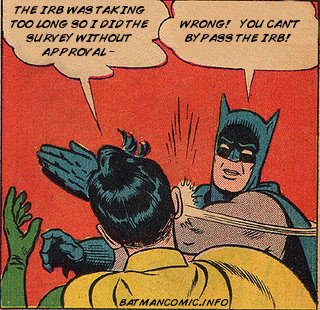
Say your local Lions Club wants to hold a focus group to determine what the community thinks would be the best way to direct community service efforts? What if you, as a blog writer, want to survey your readership about their demographics? What if the local food group wants to stand in front of a grocery store surveying people where they get their food from? What if an independent scholar wants to interview people for their next book? These are all real-world applications of social science that may have significant positive impacts to the community involved. But are they responsible to anyone for ethical behavior? Should they be? If they were University scholars, they’d be subject Institutional Review Board oversight. No IRB approval means no publishing and no funding.
Even in the university setting, what if a scholar decides to cross disciplines and use some social science methods? Are they subject ot IRB review? Say fisheries biologists want to interview fishers about their knowledge of fish stocks and aggregations or an agricultural extension agent wants to survey local farmers where they get their seed? The what-if’s could go on forever. And they are all in the ethical grey area.
Read More “Ethics, Interdisciplinarity, and the Institutional Review Board” »
Welcome to the world. I know it must feel like a very small world right now–just big enough to keep you safe and sheltered and loved–but trust me, as you keep growing, so will the world. Even after you stop growing, it will keep getting bigger. This big, old world that you have suddenly appeared in is huge and strange and beautiful and mysterious. There is more to discover in this world than all of us who have ever lived, working together, can ever know. Even before you can speak, you will think things and know things that no one has ever thought or known before. That is wonderful.
We are explorers. Not just your aunt and uncle, or your family, but all of us: this whole, gigantic group of people that call ourselves “humanity”. Today, there are over 7 billion of us and every last one, every person you will ever meet, can trace their heritage back, through thousands of millennia, to a small tribe of primates somewhere on the African savannah We were explorers then, too. This tribe made its way across Europe and Asia. They sailed across the Pacific to Australia and a thousand tiny islands. They marched across the Bering Sea–land once connected Alaska to Russia–and traveled all the way down to the tip of South America. And, no matter how far they traveled, no matter how much they explored, the world just kept getting bigger.
We’re still exploring, today. We’ve built an enormous machine called the Large Hadron Collider–some say it’s the most complicated machine humanity has ever built—that allows us to explore the tiniest things in the universe: the sub-atomic particles that hold our world (and every world) together. We’ve even begun to explore beyond our own world. We have massive telescopes that allow us to explore distant galaxies. We’ve built probes that have left our own solar system. We have satellites orbiting Jupiter and Saturn. This summer, we landed a robot on Mars. It has already discovered that Mars was once more like our own world than we previously believed. We named that robot “Curiosity”.
Last Wednesday morning, the Fisheries Committee of the European Parliament voted on proposed amendments that would, if passed, form their response to the European Commission’s 2011 proposal to end all removal of shark fins at sea (and thereby close loopholes in the EU finning ban). As the EU is the single largest supplier of shark fins to … Read More “What the $&!* happened? A summary of the “contradictory, confusing, and inconsistent” EU finning ban votes” »


All eyes in the shark world are focused on Belgium, where the European Parliament’s Fisheries Committee votes Wednesday on one of the most significant conservation policies in years: a stronger EU-wide ban on shark finning via a prohibition on removing sharks at sea, with no more exceptions. Since some of the details are quite technical, emotions are running high, and a lot of misinformation is spreading, I’ve prepared a quick guide to help our readers understand the proposed policy. For much more detailed updates, follow the Shark Alliance’s blog.
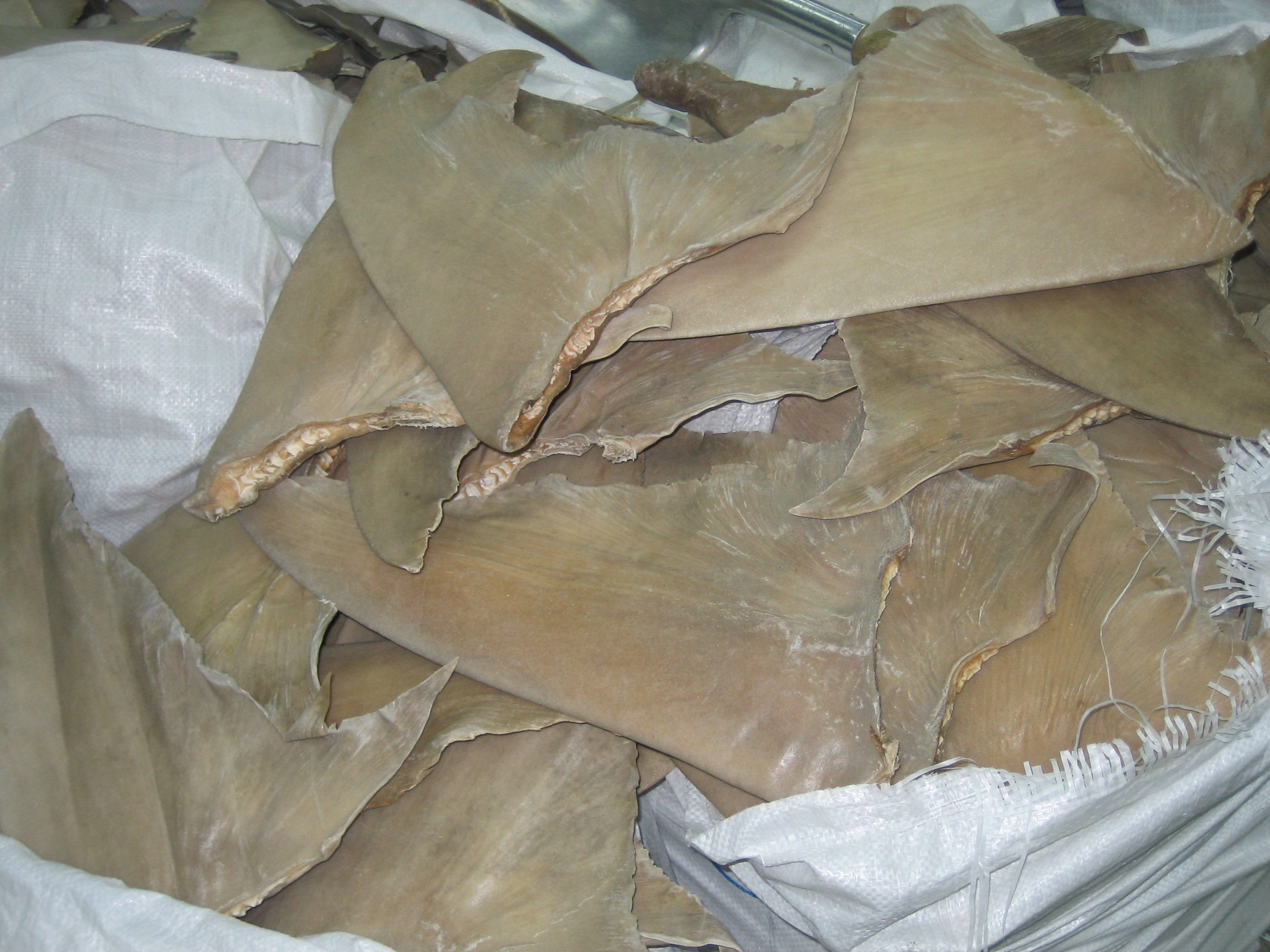
1) The proposed policy would strengthen the current EU finning ban, not ban fins. As has previously been discussed, some of the language surrounding shark conservation policy can be confusing. As a reminder, shark finning is the act of removing fins from a shark at sea and dumping the body overboard. Finning of live sharks is incredibly inhumane (the “finned” shark will bleed to death or drown when dumped overboard), and incredibly wasteful whether the shark is alive or dead (less than 5% of the shark is used). Scientists are almost universally opposed to shark finning because it is often associated with unsustainable fishing and the practice makes it difficult for managers to know what species of shark the fin came from. The policy that the European Parliament is voting on is an amendment to the current EU “finning ban”,” which relies on a complicated and lenient fin to carcass ratio for enforcement. The European Commission has proposed requiring that sharks be landed with fins still attached, which would strengthen enforcement and data collection capabilities. This is not a “fin ban” that would make it illegal to buy, sell, or possess fins.
In response to yesterday’s review of Aquaman Volume 1: The Trench, Al Dove made a simple request via twitter:

This question is more complex than it first appears, and needs a little unpacking. Water is denser than air. When light passes through, the water acts as a filter, absorbing visible light in a predictable pattern from longest wavelengths (infrareds and reds) to shortest wavelengths (purples and ultraviolets). As Aquaman dives deeper, the brilliant colors of his orange and green costume will begin to fade.
Read More “Epilogue to the Return of the Science of Aquaman: Costume Palettes at Depth” »