News broke yesterday that NC-20, a lobbying group for coastal development that, among other things, thinks property owners should be allowed to dump chemical waste directly into our watersheds, is sponsoring legislation that would outlaw outlaw sea level rise. Ignoring the fact that you can’t actually sue the ocean, what they’re actually promoting is a law that would prevent the state from using any sea surface model that extrapolates future ocean trends using anything but a linear regression. Essentially, they’re making it illegal for the state to anticipate future changes to the coastline, plan and prepare for potential flooding, or restrict development on transient barrier islands.
We traveled to Cape Lookout Bight aboard the R/V Susan Hudson to sample sediment and test our homemade ROV. Along the way, we asked the research team to talk about their favorite marine ecosystems. httpv://www.youtube.com/watch?v=_vpX4XGNjf8 Let us know what your favorite marine ecosystems are in the comments below.
As part of my ongoing community-based research on water quality in coastal North Carolina, I ended up tasked with answering what I thought would be a very basic question: what is the predominant pesticide used in my county? The largest farm and by far the largest amount of cropland is occupied by a traditional corn/soy rotation with the occasional cotton thrown in. Given the multitude of American acres donated to corn/soy, I figured I could easily find out the basics of that crop’s chemistry. Not so. My little information adventure has made me realize why there are so many rumors surrounding farming’s impact on water quality in the region. Rumors are easier to find than facts.
Read More “Chemistry of the Great Big Blue: A Pesticide Mystery” »
#SciFund, a month long initiative to raise funds for a variety of scientific research projects, is once again upon us. Project leaders post a project description and an appeal for funds, and members of the public are invited to make small donations to projects that they deem worthy. Donations come with rewards such as access to … Read More “#SciFund Returns: Where have all the coral reef fish gone?” »

Food is a tricky. For some people, food choice is an essential component of cultural heritage and national identity. For others, food choice is a statement of philosophical or moral principles. For many, being able to reject food is an unobtainable luxury. One thing is certain: food is so central to the human experience that when we question our food choices, when we are forced (or force others) to change them, when we discover that the choices we make are not what we think they are, it is impossible to separate our food ethics from our social structure. Which is why seemingly trivial revelations–bugs in your coffee, meat made slime, or a fish by any other name–often result in major outrage and structural changes. Eating is simultaneously a deeply personal experience and one in which, for much of the developed world, we are completely detached from the source.


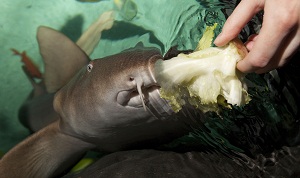
Between my well-documented love for sharks and my famously vegetable-less diet, a recent story about a “vegetarian shark” was destined to be e-mailed to me by friends and family. For those of you unfamiliar with the story, a captive nurse shark at an aquarium in the United Kingdom has been eating lettuce and celery, and refusing to eat normal nurse shark food (crustaceans and fish). As a result of this…no, wait, that’s pretty much the whole story. This animal has been dubbed “the world’s first vegetarian shark”, and my twitter and Facebook feeds have been full of people misinterpreting what this means even worse than the original media coverage did.
This is not a case of an animal “changing the reputation of sharks worldwide, and in the greenest way possible”, as reported on EcoRazzi. This is not a case of “even sharks realizing that vegetarianism is the most environmentally friendly diet”, as some have claimed. The reality is much more troubling. Following an incredibly traumatic experience (a 2009 surgical procedure to remove a rusty hook lodged in the digestive tract), an animal has radically changed its natural behavior in a way that isn’t healthy.
Yes, unhealthy- regardless of your views on the health benefits of a vegetarian diet, I’ve been assured by friends who do eat vegetables that lettuce and celery don’t have a lot of nutritional content. Fortunately, the aquarium staff at the Birmingham Sea Life Centre is aware of this and is working hard to get this animal the nutrition it needs. According to the press release (available online here), aquarium curator Graham Burrows said “we’re having to hide pieces of fish inside celery sticks, hollowed out cucumbers and between the leaves of lettuces to get her to eat them”. One could argue that the fact that the shark is still eating fish (although hidden among veggies) means that it isn’t a vegetarian at all, but that isn’t really the most important point here.
To y’all’er’um it may concern, I really appreciate what you do. Checking the RSS feeds for my favorite scientific journals is the first thing I do, every morning; it’s how I find out about the latest publications in my various interests. That being said, when I come back from lunch and you do this: I’m … Read More “An open letter to anyone who manages the RSS feed for a scientific journal” »
Shannon is a student who participated in my blogging workshop as part of her Science and Nature Writing class earlier this semester. He she recounts her experience conducting independent research at the Duke University Marine Lab.
This past semester I was simply enjoying my life and doing what college students do when it happened: I got crabs. Sixty-four of them, to be exact. Never before had I experienced such prolonged irritation; before long I was just itching to get rid of them. For weeks I was sure that I had made a foolish mistake, vowing to be more careful in the future. Now, I’m not talking about Pthirus pubis, the sexually transmitted disease—get your mind out of the gutter! The crabs I’m referring to are Clibanarius vitattus, the striped hermit crabs that haunted my dreams and terrorized my every waking moment for the duration of my first ever independent study experiment.
#SciFund, a month long initiative to raise funds for a variety of scientific research projects, is once again upon us. Project leaders post a project description and an appeal for funds, and members of the public are invited to make small donations to projects that they deem worthy. Donations come with rewards such as access to … Read More “#SciFund Returns: Can an abalone in a bag save two on the reef?” »
#SciFund, a month long initiative to raise funds for a variety of scientific research projects, is once again upon us. Project leaders post a project description and an appeal for funds, and members of the public are invited to make small donations to projects that they deem worthy. Donations come with rewards such as access to … Read More “#SciFund Returns – A Climate for Castrators?” »