


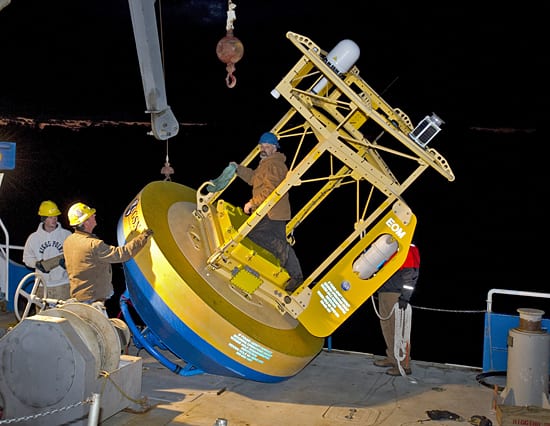

Every year high school students from across the country come together to compete against each other and test their knowledge of marine systems and processes. The National Ocean Science Bowl is soliciting applications for question writers to contribute their knowledge to the competition. If you think your ocean skills are up the task, head on … Read More “Become a question writer for the National Ocean Science Bowl” »

The sustainability movement has gained some ground in recent years, evidenced by recycling education in elementary schools, green marketing efforts, and green jobs to support new economies. Sometimes this might seem like we’re in a brave new world, but at the same time we are fighting the exact same battles citizens have been pushing along for decades – for better or worse. A recent reading of First Along the River: A Brief History of the US Environmental Movement I had a much better appreciation of where the modern environmental movement has come from and perhaps where we are going.
Divya Karnad is a wildlife biologist in India focusing on marine issues. She began her career working with olive ridley sea turtles, studying hatchling responses to beach lighting and temperature-dependent sex determination. Lately, she has been focusing on marine fisheries issues on both coasts of India, including shark fishing and the fin trade. She met WhySharksMatter at the International Marine Conservation Congress, and agreed to write a guest post for Southern Fried Science.
A soupy end to Indian Sharks
Thomas and Arulsingh, fishermen who hail from Kanyakumari, hauled up their nets and fishing lines on a beach in southern India. The catch was special and I was privileged, as an outsider, to be invited to watch as this enormous fish was sliced, its fin, the most valuable part, handled with extreme care. The shark fin, I was told, would fetch a lot of money, despite the fact that it was not a hammerhead, which fetches the best price. Nevertheless, the fishermen revealed, there were several more where this one came from, and they could be caught easily using specialized hooks and lines. Altogether estimated to host about 70 species of shark, 18, including two species of hammerheads, spadenose, requiem and milk sharks, are often landed for fins or meat from Indian waters. Different parts of the Indian coast have different species compositions of sharks, with the northwest reporting large proportions of spadenose sharks, hammerheads along the south west coast, and requiem, hammerheads and milk sharks along the east coast. Sharks are usually brought to shore before finning and the flesh is consumed locally while the fins are exported to South-east Asian markets.
Read More “Shark Science Monday: The Sharks and Shark Fisheries of India” »
Happy World Ocean Day. In lieu of an actually post, take a look at this graph, courtesy of Information is Beautiful. I think this is one of those rare items that needs no additional commentary.
The 3QuarksDaily science writing contest, a prestigious online writing competition, has entered the public voting phase. One Southern Fried Science post has been nominated- Back from the Brink: Victories in Conservation (which can be viewed here) . That post, co-written by Andrew and I, tells the story of an important scientific paper that showed both … Read More “Vote for us in the 3QuarksDaily science writing contest!” »
Earlier this week, several New York state beaches were closed due to shark sightings. Fox News’ Rick Leventhal, speaking as part of Bill Hemmer’s “America’s Newsroom” show, reported on this story, claiming that “some onlookers ID’ed them as thresher sharks, they’re estimated to be about 18 feet long”. A half-eaten seal also washed up on shore nearby.
To his credit, Mr. Leventhal attempted to play down fears about these animals, saying that “Let’s not forget that sharks live in the ocean…as long as there’s food, they’re likely to keep hanging around”. However, I was immediately skeptical of the claim that a group of 18 foot long thresher sharks were swimming slowly just a few yards offshore. A cursory review of the known biology and ecology of thresher sharks will explain my skepticism.
Read More “Were 18 foot long thresher sharks responsible for closing a New York beach?” »
The world of fisheries management is so full of laws and regulations that it’s no wonder many fishermen feel persecuted by the government. That’s why I was pleasantly surprised to see the National Marine Fisheries Service trying something new.
Read More “Dear Fishermen, Please release mako sharks alive. Thanks, The Management” »
Oceanic whitetip sharks are considered by many to be a poster-child for shark conservation. Once one of the most abundant species of pelagic sharks on Earth, unregulated overfishing throughout their global range had led to a precipitous decline in their population. In some parts of their range, the species has declined in population by more than 70% in the last few decades. Scientists haven’t been able to find them in significant numbers for many years. One of the few remaining known aggregation sites is Cat Island in the Bahamas, and that’s where an international team of researchers just went to find these animals.

Read More “International research team tracks threatened oceanic whitetip sharks” »
In this week’s edition of Shark Science Monday, Rima Jabado of UAE University discusses the sharks and shark fisheries of the Persian Gulf. If you have a question for Rima, leave it as a comment below and I”ll make sure she gets it.
At the International Marine Conservation Congress, I attended a workshop focusing on resolution of human-wildlife conflict that was put on by Francine Madden of the Human-Wildlife Conflict Collaboration. Francine explained her strategies for bringing both sides (wolf conservationists and ranchers, fishermen and government managers, etc) to the table for productive negotiations that benefit everyone.
Read More “Resolving human-wildlife conflicts through trust, respect, and… humor?” »