



[Editor’s Notice – Comments have been suspended on this post. Please visit “Full video of injured shark shows numerous natural injuries” for an update on this controversy]

Last summer, I reviewed National Geographic’s “Expedition Great White” and interviewed the lead scientist. Several researchers and conservationists were concerned about the methods that Dr. Michael Domeier uses to study great white sharks, particularly after one shark was “foul hooked” through the gills. These methods (removing captured great white sharks from the water to study them using a forklift-like structure) make for excellent television, but may be harmful to the sharks. As I reported last year:
Read More “Severely injured great white shark found, are scientists responsible?” »



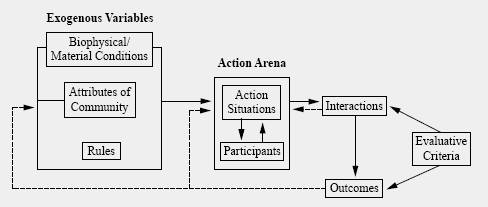 Ostrom’s Institutional Analysis and Design (IAD) Framework is not specific for natural resources or even commons problems, but serves as a place to begin policy analysis for all sorts of policy problems, including education, gender relations, crime, and natural resources. A short description here does not fully describe the IAD framework – for that, refer to Ostrom’s 2005 book. To highlight a few pertinent features, the framework is centered around a decision-making arena called the action arena rather than on the formation of a particular policy. Inputs to the action arena include exogenous variables describing the biophysical characteristics, community factors, and existing rules relating the action arena in play. This action arena then interacts with action arenas at other levels of governance (operational, collective choice, constitutional, and super-constitutional) to form an outcome. The outcome is evaluated by some defined set of criteria and the process feeds back to become iterative. The main benefit of the framework is to allow for comparative studies between empirical studies by scholars around the world in many disciplines.