In this week’s edition of Shark Science Monday, Barry Bruce of CSIRO (the Australian government science agency) discusses great white shark behavior. If you have a question for Barry, please post it as a comment below and I’ll make sure that he gets it.
As Science Online kicks into high gear, I’d like to give a shout out to the three new blogs that have joined the Gam this week! First up is the long-awaited People, Policy, Planet by Lyndell. The blogs focuses on environmental policy, science research, and ecology. Read her introductory posts Politics and Policy. Next up … Read More “Welcome three new blogs to our network!” »
I had the pleasure of seeing Roz Savage speak at the Nicholas School of the Environment last year. That talk was a slightly longer version of the one above, with the addition that she had finished her Pacific voyage in Papua New Guinea. The question I pose to our readers is, what effect do these … Read More “Weekly dose of TED – Roz Savage: Why I’m rowing across the Pacific” »
Any good field scientist needs a good camera. At the very least you have to document your sampling sites, record samples, and get good photographs of your methods for the inevitable presentations. A field camera needs to be compact, flexible, easy to use, light on batteries, and durable. Of course, the more advanced photographer may scale up to a robust Digital SLR, but at that point, you already know what you need. For the rest of us, a smaller point-and-shoot will suffice.
I shoot with both a heavy duty DSLR and a light-weight point-and-shoot, depending on the conditions, how much space I have available, and how much gear I have to lug around. When it came time to replace my 6-year-old point-and-shoot with something a little more modern, I wanted something that had more flexibility than the run-of-the-mill pointers while still being small enough to carry around in a pocket. I also put a priority on optical zoom (which is definately not the same as digital zoom). I chose the Cannon Power Shot SX130 IS.
Thanks to everyone who stuck around during our blog vacation. Our adventure into Moby Dick continues with chapters 37 and 38 – Sunset and Dusk. These two chapters have been consolidated from two soliloquies to a dialog between Ahab and Starbuck. Read along with us and discuss this chapter or the book as a whole … Read More “Finding Melville’s Whale: Sunset and Dusk (Chapters 37 and 38)” »

Science Online, the annual science bloggers conference, is this weekend! This will be my third Science Online, and Amy and David’s second, and this year’s is the biggest conference ever. You can follow me, Amy, and David on twitter or track the #scio11 hashtag. Talks will be recorded and made available online after the conference.
If you’re going to be there, you can find me at the following session:
At last count (which was last summer), the number of conservation/science/ocean listservs I subscribe to was over 100. It’s kind of a problem. Every once in a while, though, a real gem comes through.
Yesterday, the award-winning eco-friendly Banana Slug String Band released their 11th album. It’s called Only One Ocean, and the goal is “outrageously good music that inspires youngsters and their families to learn about and take better care of our precious oceans.”
Read More ““Only One Ocean”- ocean literacy through music” »

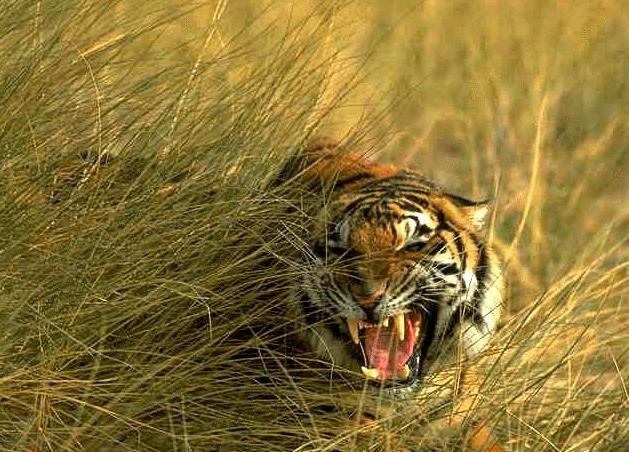
This week for Biodiversity Wednesday, we bring you to the Sundarbans of Bangladesh and eastern India. They’re wild, wet, and full of mangroves and tigers. In fact, it’s the world’s largest mangrove forest at 140,000 hectares and is a UNESCO World Heritage Site for cultural and ecological value. The area is perhaps most famous for housing the charismatic Bengal tiger, estuarine crocodile and Indian python among a habitat of endangered flora and fauna.
The Sundarbans are protected primarily for their unique ecological processes, making it on our list for their special kind of biodiversity. These processes include monsoon rains, flooding, delta formation, tidal influence, and plant colonization that are all part of the life of a dynamic mangrove forest.
Thanks to everyone who stuck around during our blog vacation. Our adventure into Moby Dick continues with chapter 36 – The Quarter-deck. Read along with us and discuss this chapter or the book as a whole in the comments. Visit this page for the complete collection to date: Finding Melville’s Whale. The Quarter-deck Ahab, standing upon … Read More “Finding Melville’s Whale: The Quarter-deck (Chapter 36)” »
Hybridity refers to any object that crosses a conceptual divide. The term is remarkably general and used to investigate the nature of the divide as well as the form of linkages that make the cross. One of the most famous (and relevant to me) is the separation between nature and culture. While there are many scholars that argue that no such divide exists, modern society still likes to separate the human from the habitat. Examples of important hybrid objects to nature-society relations are elk, water, forests, particular mountains, and really anything natural that has importance to society.
Perhaps the most important reason to know about hybrid objects is to be able to recognize them. Some scholars say that investigation of hybrids is the only way to understand the complicated relation between binaries such as nature and society – an understanding necessary for goals such as conservation. Another distinct benefit is that recognizing the hybrid nature of and object provides the ability to also recognize the many aspects of said object. Reversing this logic, understanding how hybrid objects are constructed and function may allow creation of new, interesting and important objects, often from the deepest parts of the imagination.