
Uncategorized
Charlie hangs out on the roof of out home for the next several days.
Over 15 years of ocean science and conservation online
Charlie hangs out on the roof of out home for the next several days.

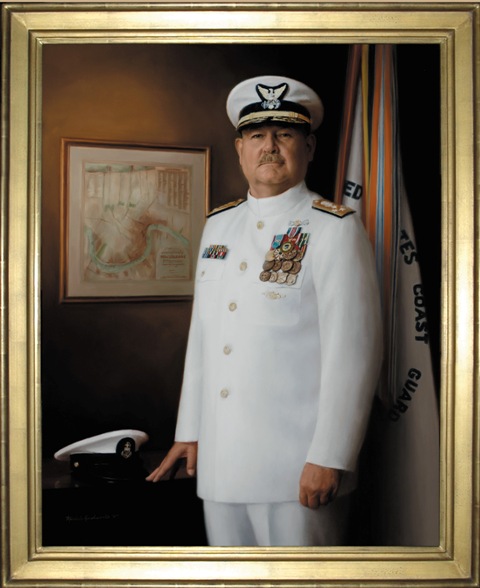 I’ve been a fan of Coast Guard Commandant Thad Allen for a while now. His blog, iCommandant, provided a window into a world few of us glimpse. His openness, honesty, and no nonsense attitude made the iCommandant blog one of the best blogs on the internet. Which is why I began today disheartened to see that he was relieved as Commandant of the U.S. Coast Guard by Admiral Robert Papp. But that sadness was short lived when it was announced the Admiral Thad Allen will continue serve as National Incident Commander for the Gulf of Mexico.
Read More “Real Leadership for the Deepwater Horizon Disaster” »
 85 years ago today John Scopes was indicted for violating the Butler Law – a law that made it illegal to teach evolution in Tennessee. The Scopes Trial, engineered by several parties to bring attention to both Dayton, Tennessee and the controversial anti-evolution laws, left a lasting mark on America’s legal system and the public perception of science. It was the bombastic firebrand H. L. Menken, one of the architects of the trial, that summerised best the spirit of the Monkey Trail:
The way to deal with superstition is not to be polite to it, but to tackle it with all arms, and so rout it, cripple it, and make it forever infamous and ridiculous. Is it, perchance, cherished by persons who should know better? Then their folly should be brought out into the light of day, and exhibited there in all its hideousness until they flee from it, hiding their heads in shame.
Read More “And sense achieved a great victory – 85 years after Scopes” »
Packed up and ready to go, an artist’s facsimile of Charlie, ready for adventure Six months ago we made a declaration. It was the end of the Year of Darwin – his 200th birthday and the 150th anniversary of the publication of Origin. The science blogosphere had been abuz all year with Darwin themed events, … Read More “Charlie and the Adventure – 365 days of Darwin” »
We’re getting a huge surge in pageviews from reddit, stumble, and neatorama today. If you’re new here check out some of our classic Southern Fried Science Posts: How to brew beer in a coffee maker, using only materials commonly found on a modestly sized oceanographic research vessel. The Cove, Dolphins, and Mercury Ethical Debate: Captive … Read More “Welcome stumblers, reddit-ers, and neatorama readers” »


At first glance, the question posed in the title seems silly. Both cod and sandbar sharks are fish, therefore they must be more similar to each other than either are to bowhead whales (which are mammals). However, a recent conservation genetics paper has demonstrated that one aspect of a sandbar shark’s life history is more similar to that of bowhead whales: both sandbar sharks and bowhead whales have an effective size that is very similar to their census size.
Read More “Are sandbar sharks more like bowhead whales or cod?” »
 We’d all been staring at the weather forecast in disbelief for the last couple of days. We had plenty of warning it was coming, but even in the midst of a storm, I don’t believe it’s happening. Why? Because it’s sunny out. However, there are gale force winds outside causing 12-14 foot swells and rocking the boat every which way.
Today marks the official halfway point for our year long adventure traveling the world with Charles Darwin. his first 3 months are summarized here – 365 days of Darwin: the first 3 months. Charlie has had an exciting 3 months, traveling across the country, diving into the Deep Sea Lab, and even testing out his green thumb in the garden. He kicked off these three months with a celebration of Mardi Gras:
This Sunday on NPR I heard the following paraphrased comment: “The ROV pilots have never had to deal with anything like this before, no one has trained for the kinds of maneuvers needed to close to well.” I’ve known many ROV pilots. They are all incredibly skilled, know how to handle their robots, and generally have many years of experience working in industrial settings.
But commercial ROV work tends to be monotonous. Many pilots I know spend the vast majority of their time inspecting pipelines and oil rigs, flying over long tracks of seafloor with little to no variation, looking for any signs of damage. When their skills are put to the test, it’s often the same repetitive motion, over and over. Even training simulations to prepare them for catastrophes cannot predict the infinite variations that could occur as an oil-rig collapses. It’s impossible to train for everything.
Until you throw a biologist into the mix.
Read More “Unguided deep-sea research is essential for national and global security” »
.