
Skip to content

Southern Fried Science

Over 15 years of ocean science and conservation online

  • Home
  • About SFS
  • Authors
  • Support SFS

Recent Posts

small boy holding Miss Abyss Dumbo Octopus
Please Help This Little Dumbo Octopus Travel Across America
August 3, 2026
Isn’t ironic, don’t you think: dismantling the Ocean Observatories Initiative on World Oceans Day
June 9, 2026
My Journey Into Researching Historical Erasure on Public Lands
July 31, 2026
The next OpenCTD is here!
June 22, 2026
humpback whale in Antarctica
The evolution of the International Whaling Commission – from  whaling quotas to whale conservation
June 10, 2026
“Why Sustainable Seafood Matters” is now available for preorder! Here’s what it’s about, and why I decided to write it.
June 8, 2026

Two Years of Deep-sea Mining in Review: The Precarious Partnership Between Deep-sea Mining Contractors and Environmental NGOs

Posted on March 18, 2022March 17, 2022 By Andrew Thaler
Two Years of Deep-sea Mining in Review: The Precarious Partnership Between Deep-sea Mining Contractors and Environmental NGOs
Science

As in-person negotiations on the future of exploitation in the deep ocean resume this week in Kingston Jamaica, we reflect back on the last two years of development as reported on our sister site, the Deep-sea Mining Observer. This editorial first appeared on June 25, 2021.


Opinion by Andrew Thaler, DSMO Editor-in-Chief

Deep-sea mining occupies a unique niche in the annals of extractive exploration. Its modern manifestation owes as much to the surging demand of critical minerals as it does to the work of environmental organizations shining a light on the vast environmental and ethical catastrophes of terrestrial mining. In its current form, deep-sea mining is an industry motivated by the need to rapidly wean ourselves from fossil fuels. It is, in short, an industrial response to an environmental crisis. 

Whether or not it is the right response, for whatever “right” means in the midst of a global crisis while the clock is ticking, remains to be proven. No plans of work have been approved and no mining licenses have been issued by the International Seabed Authority for Areas Beyond National Jurisdiction. What few attempts have been made in territorial waters have not reached production or have collapsed under the complexity of the operation. Deep-sea mining is an industry that has been perpetually just over the horizon. That horizon creeps closer every year.

There is an precarious partnership between deep-sea mining contractors and environmental NGOs, two entities with wildly differing views of what the world needs to reach sustainable development, but a recognition, at least in principle, that negotiation and compromise are possible. Even the calls for moratoria leave room for the possibility that deep-sea mining can be shown to be sustainable.

Read More “Two Years of Deep-sea Mining in Review: The Precarious Partnership Between Deep-sea Mining Contractors and Environmental NGOs” »

Two Years of Deep-sea Mining in Review: A 3-decade-long disturbance study on the deep abyssal plain.

Posted on March 17, 2022March 17, 2022 By Andrew Thaler
Two Years of Deep-sea Mining in Review: A 3-decade-long disturbance study on the deep abyssal plain.
Science

As in-person negotiations on the future of exploitation in the deep ocean resume this week in Kingston Jamaica, we reflect back on the last two years of development as reported on our sister site, the Deep-sea Mining Observer. This article first appeared on May 22, 2020.


In the late 1980s, as the first wave of deep-sea mining exploration approached a decade of hibernation, researchers launched an ambitious experiment to understand the long-term environmental impact of harvesting polymetallic nodules from the abyssal plain. The Disturbance and recolonization experiment in a manganese nodule area of the deep South Pacific (DISCOL) remains the most ambitious attempt to understand how nodule extraction affects deep ocean ecosystems. Though interest (and funding) waxed and waned with the prevailing interest in deep-sea mining, now, more than 30 years later, DISCOL provides the only large, multi-decade impact study from which contractors, regulators, and environmental advocacy groups can draw inferences about the recovery and resilience of deep-sea ecosystems following mining-induced disturbances throughout the lifetime of an ISA-issued mining exploration or exploitation lease. 

The 1980s saw a surge in interest for deep-sea mining. The successful early campaigns of the late 1970s, bolstered by CIA funding for Project Azorian, presented a future of seemingly limitless profit scattered across the seafloor. That the early financial projections were supported by covert government funding was not yet widely known, and, even for those who were privy to the operation, regardless of initial funding the value had been established, the ship built, the technology sea-trialed. The profit potential was there. What was still tabula rasa was the environmental consequences of extraction on an almost completely unknown ecosystem.

Read More “Two Years of Deep-sea Mining in Review: A 3-decade-long disturbance study on the deep abyssal plain.” »

Two Years of Deep-sea Mining in Review: Confusion and Gridlock at the 26th Session of the International Seabed Authority

Posted on March 17, 2022March 17, 2022 By Andrew Thaler
Two Years of Deep-sea Mining in Review: Confusion and Gridlock at the 26th Session of the International Seabed Authority
Science

As in-person negotiations on the future of exploitation in the deep ocean resume this week in Kingston Jamaica, we reflect back on the last two years of development as reported on our sister site, the Deep-sea Mining Observer. This article first appeared two years ago, on March 19, 2020.


The 26th Session of the International Seabed Authority convened this February to continue the long and complex negotiations over the draft Mining Code and work towards consensus among the various stakeholders. 2020 was set as the target year to get the Mining Code finalized, but many delegates left Jamaica feeling frustrated with the pace of deliberations and a growing sense that the 2020 deadline was far too optimistic. Chief among the challenges was a recognition that the Council is now further from reaching agreement on the financial model than it was at the end of the 25th Session and a lack of clarity over the composition of the Legal and Technical Commission as it pertains to the representation of both geographic distribution and technical expertise.

Procedural Gridlock slows negotiations

The overwhelming sentiment of member state delegates, NGO’s, and even contractors was a sense of dysfunction and confusion, best highlighted by the fact that over a 5-day meeting, the Council went through three new presidents. First, as outgoing Council President Lumka Yengeni was absent from the meeting, outgoing regional Vice-president Luis del Solar assumed the chair to preside over the selection of a new council president. Usually, a Regional Group arrives at the ISA with a nominee for council president already prepared. Not this time. A three hour delay to select the president of the 26th Session of the ISA on the morning of the first day set the tone for the week. 

Read More “Two Years of Deep-sea Mining in Review: Confusion and Gridlock at the 26th Session of the International Seabed Authority” »

Two Years of Deep-sea Mining in Review: As deep-sea mining inches towards production, a global pandemic brings negotiations to a halt.

Posted on March 17, 2022 By Andrew Thaler
Two Years of Deep-sea Mining in Review: As deep-sea mining inches towards production, a global pandemic brings negotiations to a halt.
Science

As in-person negotiations on the future of exploitation in the deep ocean resume this week in Kingston Jamaica, we reflect back on the last two years of development as reported on our sister site, the Deep-sea Mining Observer. This article first appeared two years ago, on March 18, 2020.


When the first part of 26th Session of the International Seabed Authority convened last month, there was a new stakeholder impacting the pace of deliberations. COVID-19 had just begun to spread beyond China and nations across the world were limiting travel in the hopes of containing the outbreak. With Jamaica imposing a 14-day quarantine on any traveler coming from China, the Chinese delegation was notably absent, with a delegation from the New York mission standing in for their colleagues. But they weren’t the only delegation affected. Multiple delegates whose travel was supported by the Commonwealth we’re also unable to attend. 

Though those absences did slow down deliberations and cast a pallor over the proceedings, they were nothing compared with what happened next. 

Earlier this week, Forbes published a contributor article entitled “Will Ocean Seabed Mining Delay The Discovery Of Potential Coronavirus Vaccines?” Though hyperbolic in its reaction to an industry which has yet to even begin production, ironically Forbes may have gotten the situation reversed: long before deep-sea mining has even the remote potential to delay the development of novel pharmaceuticals, the COVID-19 pandemic will almost certainly delay the development of deep-sea mining. 

Read More “Two Years of Deep-sea Mining in Review: As deep-sea mining inches towards production, a global pandemic brings negotiations to a halt.” »

Getting your kids started in conservation technology: a quick guide for parents who have no idea where to begin.

Posted on March 16, 2022 By Andrew Thaler
Getting your kids started in conservation technology: a quick guide for parents who have no idea where to begin.
Education

Southern Fried Science has been a bit dormant for the last year, so first, a re-introduction:

I’m Andrew Thaler, I’m an ocean scientist, and I make weird tech things.

Ten years ago I inherited an old mechanical tide gauge from a lab cleanout. For some bizarre reason, I thought: what if, instead of tracking the rising and falling tides in the Beaufort Inlet, it tracked the waxing and waning of conversations about sea level rise on Twitter. And thus, the Sea Leveler was born. 

Meet Sea Leveler: the open source water level gauge that wants you to talk about #sealevelrise

In a lot of ways, the Sea Leveler was the precursor of things to come. It was exhaustively documented and released as an open-source project on GitHub. It merged the digital with the physical, creating an object that allowed you to connect an online conversation to the real-world environment through repurposed technology. It was weird. And it was fun. 

The Sea Leveler itself was passed on to a good friend and champion of ocean outreach, but its legacy lives on in the plethora of projects to follow: Drown Your Town, Dolphin Vision, the reStepper, Turtle Borg, and, of course, the OpenCTD. 

Read More “Getting your kids started in conservation technology: a quick guide for parents who have no idea where to begin.” »

A Call to Prioritize Social Equity in Ocean Conservation

Posted on August 16, 2021January 9, 2022 By Angelo Villagomez
Conservation

A Q&A with Nathan Bennett, Laure Katz, and Angelo Villagomez

This piece was originally published on the Blue Nature Alliance website.

Modern conservation practices were largely developed without considering justice, equity, diversity, and inclusion. Humans have been viewed as separate from nature. Indigenous and local knowledge has been mostly dismissed. And communities have been left out of decisions that directly impact their ocean, land, and heritage.

Even though many efforts have aimed at correcting these and other failings for decades, the worldwide pandemic and highly visible human rights atrocities have spotlighted the need and opportunity to address longstanding social, economic, political, and environmental inequities. While these issues and conversations extend far beyond the conservation community, they are relevant, timely, important, and deserving of urgent attention and action.

New research, “Advancing social equity in and through marine conservation,” recently published in Frontiers in Marine Science explores these issues and calls for steps for improving social equity in ocean conservation efforts. In this Q&A, three of the 21 co-authors, Nathan Bennett, Laure Katz, and Angelo Villagomez, discuss their work and its implications. The Blue Nature Alliance provided financial support for this research and used the research as the basis for our Code of Conduct.

Why is it important to address social equity through ocean conservation?

Angelo: There is strong scientific evidence that we need to protect at least 30% of the ocean by 2030. But in our urgency to protect the ocean, we can exacerbate social inequities if we do not address how decisions are made and who is part of the decision-making process. Generally, marine conservation has not been able to reach its full potential of ideas, knowledge, and action because it has historically been dominated by people, institutions, and organizations that exclude entire communities, knowledge systems, and cultures. Focusing on social equity is not only the right thing to do, but equitable approaches lead to better and longer-lasting outcomes.

Nathan: There are too many examples of conservation initiatives that resulted in disenfranchisement, abrupt displacement, and outright exclusion of local and Indigenous communities. Understandably, this action – or inaction – resulted in hard feelings and opposition to marine conservation. We need more allies, not fewer, to achieve global marine conservation targets. While there has been progress, the marine conservation community needs to continue to learn and incorporate equitable and inclusive approaches.

Read More “A Call to Prioritize Social Equity in Ocean Conservation” »

Discovery of a Great Hammerhead Nursery

Posted on July 12, 2021January 9, 2022 By Catherine Macdonald
Conservation, Exploration, Uncategorized

Happy Shark Week (if you celebrate), and I’m so excited to share our newly published open access paper about our research on juvenile great hammerheads (Sphyrna mokarran) with you! (It’s been hard to keep this one to ourselves).

Great hammerheads are an iconic shark species which have undergone significant population declines globally. In 2019, they were assessed as Critically Endangered by the IUCN Red List, which reported overfishing as the greatest threat to their survival. Great hammerheads are known to make incredible long-range migrations and cross state and international boundaries, making them challenging to protect as adults. Little is known about where they are born or where they spend their early years of their life, although there have been scattered reports of juveniles from the Gulf of Mexico, the Florida Keys, and one report from Georgia.

Identifying habitats that are important to juvenile sharks matters because young sharks are often the most vulnerable individuals in a population, and their survival is vital to the future of their species. Many juvenile sharks spend time in “nursery areas”—places where they are less likely to be eaten by predators, or where food resources are abundant. They then expand their ranges as they age, covering more distance as they grow larger. Identifying nurseries has long been a conservation priority for managers and scientists. After several years of research, our team has collected the first scientific evidence of a nursery area for great hammerhead sharks on the Atlantic coast of the United States—within sight of the skyline of Miami, Florida.

There’s a three-part established test for an area to be identified as a shark nursery: 1) Juvenile sharks are more commonly encountered in that habitat than elsewhere; 2) they remain in the area for extended periods; and 3) The area is used repeatedly over years. Our results demonstrate that this area definitely meets two of these criteria, with preliminary evidence that it also meets the third. We’ve found the same habitat may be a nursery area for several other shark species too, including scalloped hammerheads, another Critically Endangered species!

Read More “Discovery of a Great Hammerhead Nursery” »

Furniture as Revolution.

Posted on July 6, 2021January 8, 2024 By Andrew Thaler
Furniture as Revolution.
Built to Last

This is Part 3 of Built to Last: A Reflection on Environmentally Conscientious Woodworking.

  • Built to Last: A Reflection on Environmentally Conscientious Woodworking
  • Part 1: I turned my woodshop into a personal solar farm.
  • Part 2: Getting a handle on workworking chemicals, or sometimes we all need to vent.
  • Part 3: Furniture as Revolution.
  • Part 4: The best tool for the job is you
  • A good joint is built to last: archaeologists uncover evidence for the earliest structural use of wood.

Small-scale DIY solar arrays are neat. Vigilance in chemical exposure risk is a valuable habit to develop. Selecting local materials and responsibly-sourced wood can ease your environmental burden while bolstering creativity. But these are not particularly paradigm-breaking expressions of an environmental ethic. It is the furniture itself that is the most profound manifestation of that ethic.

Creating a piece of functional, practical art that can last for generations is a radical departure from the current trend of disposable fast furniture made of particle board and held together with camming nuts, cheap dowels, and that one textbook that you can never read lest your bookcase collapses under its own precarious weight. Stores like Ikea have done an impressive job making attractive, modern furniture accessible and affordable, but it has done so at significant environmental costs.

Although fast furniture stores, and especially Ikea, have made huge strides in environmental compliance and sustainable production, their core business model is centered on the idea that furniture is disposable, that people want to “refresh” their living spaces every few years, and that the transience of fast furniture is part of its appeal. People want to go furniture shopping. Ikea gives you a reason to. 

The life-cycle of fast furniture is grim. By design. 

Read More “Furniture as Revolution.” »

Getting a handle on workworking chemicals, or sometimes we all need to vent.

Posted on June 22, 2021January 8, 2024 By Andrew Thaler
Getting a handle on workworking chemicals, or sometimes we all need to vent.
Built to Last, Conservation

This is Part 2 of Built to Last: A Reflection on Environmentally Conscientious Woodworking.

  • Built to Last: A Reflection on Environmentally Conscientious Woodworking
  • Part 1: I turned my woodshop into a personal solar farm.
  • Part 2: Getting a handle on workworking chemicals, or sometimes we all need to vent.
  • Part 3: Furniture as Revolution.
  • Part 4: The best tool for the job is you
  • A good joint is built to last: archaeologists uncover evidence for the earliest structural use of wood.

Walk into any woodshop and you find a shelf full of chemicals. Solvents, paints, varnishes, lacquers, oils, glues, and a host of other exotic and not so exotic solutions are a staple of the craft. These compounds are used to join, clean, prepare, and finish most woodworking projects, as well as maintain your tools. Do any amount of woodworking, and you’ll almost certainly accumulate a shelf of assorted, half-used, chemicals of your own. 

What’s almost certainly not present in most woodshops, especially hobbyist woodshops, are the Material Safety Data Sheets (MSDSs) for these chemicals. MSDSs tell you everything you could possibly want to know about the hazards associated with commercial chemical compounds. For many common woodworking products, the MSDSs are pretty intense. 

I’ll be completely honest here. I have never had MSDSs in my workshop. It was only while doing the background research for this article that I realized I needed to pay more attention to the assorted chemicals involved in the craft, and started compiling all the potential hazards. I suspect that the vast majority of hobbyist woodworkers are the same. 

Woodworking chemicals contain irritants, release volatile organic compounds (VOCs), are cut with heavy metals, and are often just plastic. They can be bad for your skin, bad for your lungs, and bad for your brain. When produced, disposed of, accidentally discharged, or as they break down through regular wear, they can release harmful compounds into the environment. If not disposed of correctly, some of these products will spontaneously burst into flames.

Read More “Getting a handle on workworking chemicals, or sometimes we all need to vent.” »

I turned my woodshop into a personal solar farm.

Posted on June 21, 2021January 8, 2024 By Andrew Thaler
I turned my woodshop into a personal solar farm.
Built to Last, Conservation

This is Part 1 of Built to Last: A Reflection on Environmentally Conscientious Woodworking.

  • Built to Last: A Reflection on Environmentally Conscientious Woodworking
  • Part 1: I turned my woodshop into a personal solar farm.
  • Part 2: Getting a handle on workworking chemicals, or sometimes we all need to vent.
  • Part 3: Furniture as Revolution.
  • Part 4: The best tool for the job is you
  • A good joint is built to last: archaeologists uncover evidence for the earliest structural use of wood.

Note: there is an update to this project, here: Woodworking off the grid: upgrades to my DIY solar workshop.


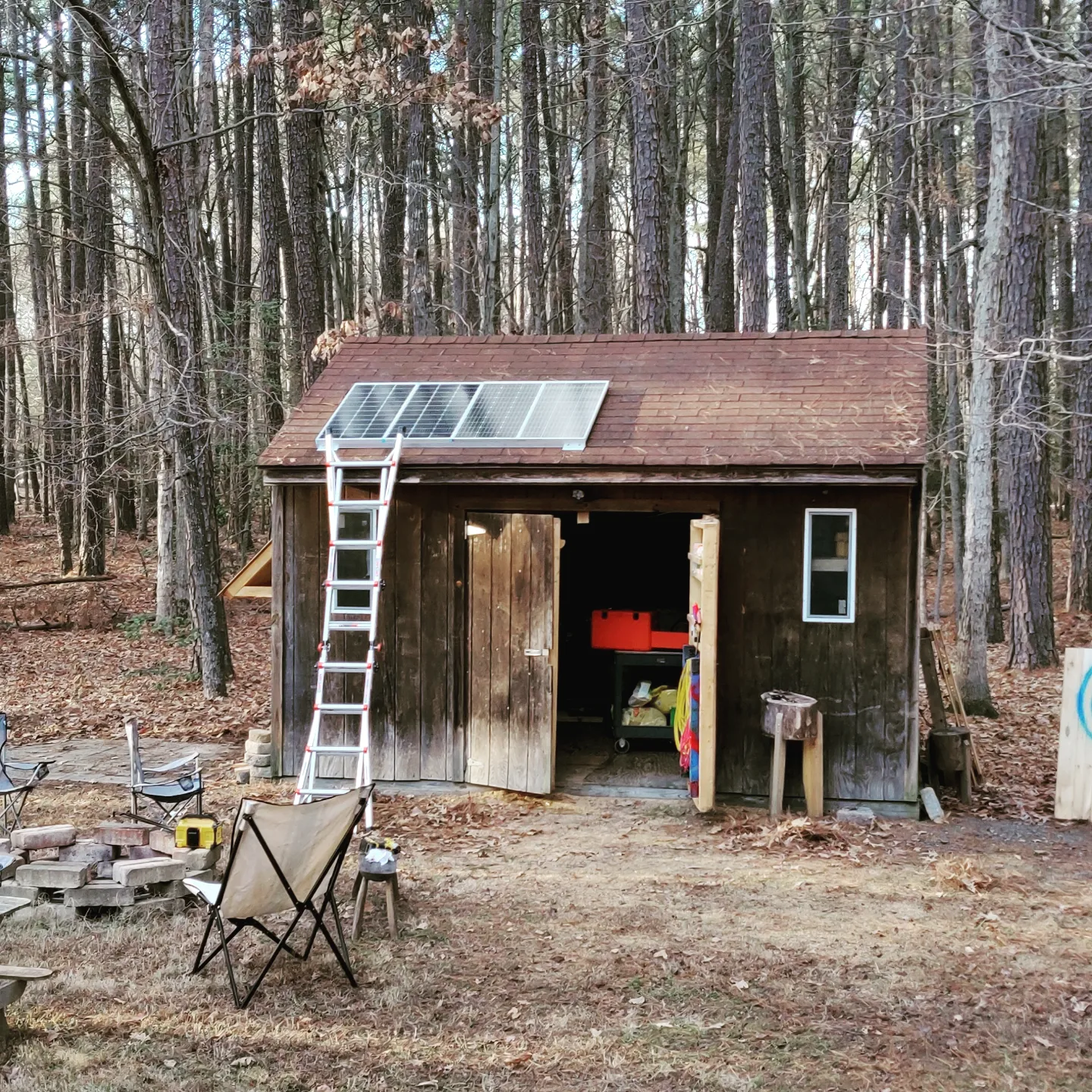
For almost a decade, I’ve dreamed of building an off-grid solar system to power my woodworking, provide reliable back-up power for my home, and reduce the number of 2-stroke engines in my life. This was finally the year where I had the time and resources to do it. 

My workshop isn’t big. The 12-foot by 16-foot shed houses not just my tools and workbenches, but also all our yard and gardening supplies, storage for assorted seasonal gear and decorations, and a pile of robot parts. So I needed a compact system that still delivered the amps. 

Building a small off-grid solar system is simpler than you might think. Building a small off-grid solar system that can run power tools is a bit more complicated. 

Read More “I turned my woodshop into a personal solar farm.” »

Posts pagination

Previous 1 … 25 26 27 … 274 Next

Popular Posts

What Ocean Ramsey does is not shark science or conservation: some brief thoughts on "the Shark Whisperer" documentaryWhat Ocean Ramsey does is not shark science or conservation: some brief thoughts on "the Shark Whisperer" documentaryJuly 2, 2025David Shiffman
What is a Sand Shark?What is a Sand Shark?November 12, 2017Chuck Bangley
Zombie ideas in conservation: trophy hunting and conservationZombie ideas in conservation: trophy hunting and conservationAugust 6, 2026Ali Gaster
Jumping the shark: New study reviews the breaching behavior of sharks and raysJumping the shark: New study reviews the breaching behavior of sharks and raysSeptember 19, 2024David Shiffman
Shark of Darkness: Wrath of Submarine is a fake documentaryShark of Darkness: Wrath of Submarine is a fake documentaryAugust 10, 2014Michelle Jewell
That's not a blobfish: Deep Sea Social Media is Flooded by AI SlopThat's not a blobfish: Deep Sea Social Media is Flooded by AI SlopDecember 19, 2025Andrew Thaler
Please Help This Little Dumbo Octopus Travel Across AmericaPlease Help This Little Dumbo Octopus Travel Across AmericaAugust 3, 2026Angelo Villagomez
Is Academic Publishing is breaking conservation science?Is Academic Publishing is breaking conservation science?August 10, 2026Chris Parsons
Considering writing a popular science book? Here's my adviceConsidering writing a popular science book? Here's my adviceJuly 7, 2025David Shiffman
Fun facts and FAQs about Megalodon, Maryland's new (and definitely extinct) official state sharkFun facts and FAQs about Megalodon, Maryland's new (and definitely extinct) official state sharkApril 15, 2026David Shiffman

squishy

Subscribe to our RSS Feed for updates whenever new articles are published.

We recommend Feedly for RSS management. It's like Google Reader, except it still exists.

Southern Fried Science

  • Home
  • About SFS
  • Authors
  • Support SFS


If you enjoy Southern Fried Science, consider contributing to our Patreon campaign.

Copyright © 2026 Southern Fried Science.

Theme: Oceanly Premium by ScriptsTown