
Bringing you the best of marine science and conservation from the last week.
Flotsam (what we’re obsessed with right now)

- More.
Jetsam (what we’re enjoying from around the web)
Over 15 years of ocean science and conservation online

Bringing you the best of marine science and conservation from the last week.
Flotsam (what we’re obsessed with right now)

Jetsam (what we’re enjoying from around the web)
Cuttings (short and sweet):

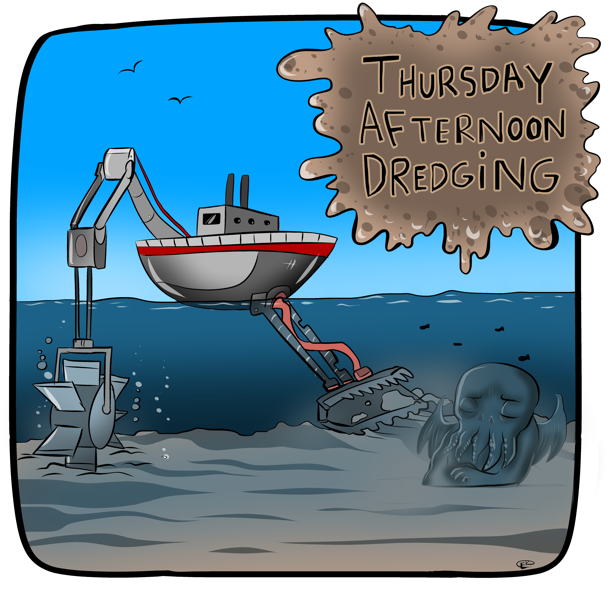
Read More “Thursday Afternoon Dredging: February 9th, 2017” »

Credit: Gordon Hides (used with permission)
On Sunday, February 5, 2017, Granddad the Australian Lungfish, the oldest fish in any aquarium or zoo, was euthanized due to health complications. Although his exact age is unknown, he arrived at Shedd Aquarium in Chicago as an adult in 1933. Australian Lungfish (Neoceratodus forsteri) take over a decade to mature, so we can estimate he was over 90 years old when he passed.
The Australian Lungfish is a unique species, considered a “living fossil”, resembling its ancestors whose lineage dates back over 380 million years. The Australian Lungfish genus (Neoceratodus) itself has been around for about 100 million years. When first described, they were believed to be amphibians; one look at their elongate body and flipper-like fins, and you can imagine the classification conundrum. The fish even possesses a primitive lung, allowing it to breathe air in low-oxygen environments (although they usually breathe with their gills).
We have entered a challenging new era for conservation and the environmental movement. Some of us feel as if we are hanging from the edge of a cliff. Others are preparing for the battles ahead. And many of us are still reeling from the whirlwind of changes taking place seemingly overnight.
We can’t tell you how to feel or how to act. We can’t really offer any comfort either, at least none that feels sincere. What we can provide are resources culled from a lifetime working in conservation science to provide, if not a map, than at least a scattered set of guideposts to remind us of where we’ve been and direct us to where we need to be going.
Over the last few weeks, I’ve been collecting and curating a reading list for the conservation professionals, managers, and activists. I’ve culled from a diverse groups of writers to both focus and expand my vision of what conservation could become in the coming years.
This is, of course, not a comprehensive list of writings, but rather those which I have turned to, or turned back to, in the last few months, for inspiration and understanding. Some of them may seem a little out of place, but they have all offered guidance and insight as we move forward into this brave new world.
Bringing you the best of marine science and conservation from the last week.
Flotsam (what we’re obsessed with right now)

Jetsam (what we’re enjoying from around the web)
Overall job satisfaction in academia has been steadily declining for many independent reasons I won’t get into here (see Nature 1 and 2). However, we do need to accept some ownership for this dissatisfaction. Our expectations and goal posts are understandable set very high. Indeed for many of us, our impossible standards and stubborn determination are the only reasons we got this far, so it can be painful – nigh impossible – for those who are hardwired to overachieve to step back and be happy with the big picture. We need to, because the stakes are as high as health, sanity, and relationships.
This inspired me to develop a new set of milestones to measure our academic careers by. Not only for our sanity, but especially for those younger scientists and students still fighting their way up the ladder.
Here are 12 new milestones of achievement I recommend we measure our career success by:
Cuttings (short and sweet):
Read More “Thursday Afternoon Dredging: February 2nd, 2017” »
One of my favorite things to do is browse through google maps looking for weird formations and places of historical curiosity. Apparently I’m not alone, as there are hordes of map hunters searching for the bizarre on this increasingly bizarre world. That’s right! It’s time for yet another installment of “this thing on Google maps is not a sea-monster/alien/UFO/ancient pyramid”.

This newest discovery comes from Antarctica, where monster hunters have found what looks like a perfect disc sitting on the ice. Could it be a UFO? The image is surprisingly compelling.
It’s very round for one, and it looks like it’s sitting on top of a glacier, partially covered by rock. The 60-foot-wide object looks remarkably like a classic flying saucer.
SPOILERS: It’s not a UFO.
We have a problem in conservation biology (ok, to be fair, we have a lot of problems, but this is one of them). The biggest environmental challenges–climate change, ocean acidification, over-fishing, agricultural runoff, species invasion, and myriad other emergent issues–are global challenges. They respect no borders and require a cohesive, multinational response. Researchers, stakeholders, and conservation managers, on the other hand, are increasingly impeded in their work by more and more restrictive barriers to travel.
This isn’t new. The Global South has often been excluded from major international conferences hosted in European and American cities, which are expensive and hard to get to. Onerous visa restrictions from and to a multitude of countries have been in place for decades, but the events of this week have made it clear that scientific societies need to plan for and provide alternatives to a membership that may not be able to travel to a conference yet still need to participate.
Flotsam (what we’re obsessed with right now)
Jetsam (what we’re enjoying from around the web)