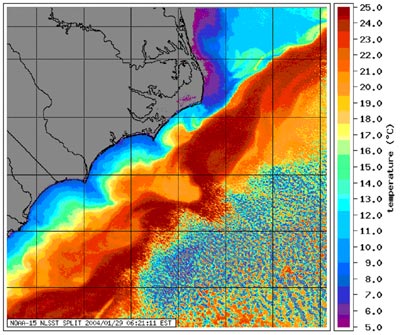

In 2012, North Carolina outlawed climate change, receiving major press as the face of conservative climate policy. The intent of the law was to stop planning processes from basing their decisions on modeled climate change scenarios of the future, which would halt large investments in coastal development. But the letter of the law actually outlawed … Read More “The words we use matter in climate change adaptation” »
Today, Craig McClain, along with a massive team of ocean scientists (including me!) published our monumental paper: Sizing ocean giants: patterns of intraspecific size variation in marine megafauna. This massive monograph investigates patterns of size among 25 ocean giants, the biggest, most massive members of their respective taxa. You can probably guess which species I had a hand in reviewing.
httpv://www.youtube.com/watch?v=xtk5t7sSb3s
Along the way, I learned quite a few cool things about the magnificent giants of the deep sea.
1. Giant deep-sea isopods are sexually dimorphic.
Read More “Six things I learned about Giant Isopods while Sizing Ocean Giants” »
Dear Rich Ross, new President of the Discovery Channel,
I was excited to learn about your commitment to no longer show fake documentaries on the Discovery Channel. These shows have been incredibly damaging not only to Discovery’s goals of being the “number one non-fiction media company in the world” by”telling compelling and accurate stories,” but to public understanding of science and conservation. In recent years, the Discovery Channel has tried hard to actively muddle the fact that these documentaries were fake, including hiding vague disclaimers at the very end. I’ve spoken to hundreds of schoolchildren about sharks, and every time someone asks me about megalodon or mermaids. Viewers believed that they were real, and your channel actively bragged about the fact that people believed that they were real.
By claiming that megalodon isn’t extinct and mermaids are real but the government is covering this up, these shows resulted in scientists receiving threats and harassment, and resulted in important government agencies getting so many angry phone calls that they had to issue public statements. Producers for some of these shows intentionally lied to scientists to convince them to appear onscreen, intentionally lied to journalists about the facts behind them, and intentionally caused a real-life public panic. They actually showed a documentary about a legendary (read as “fake”) shark called Hitler. In short, I will be glad to see Shark Week and the Discovery Channel return to your roots of fact-based programming.
However, while “we won’t actively lie to viewers anymore” is an important step that I applaud, Shark Week and other Discovery Communications programs have many other problems that should be addressed. Shark Week 2014’s “Zombie Sharks” glorified wildlife harassment for no reason, as the entire stated goal of the show was for a non-scientist with a history of wildlife harassment to try to answer a question that scientists have known the answer to for decades. This problem is not limited to Zombie Sharks, but pervades Discovery Communications shows.
Read More “An open letter to new Discovery Channel President Rich Ross from a shark scientist” »
In both my professional and private life, I am a man who wears many hats. I am a deep-sea ecologist, a science writer, a goatherd, a geneticist, a conservation advocate, a grill master, and many others. When David asked me to join him in co-authoring “Trophy fishing for species threatened with extinction: A way forward building on a history of conservation” I did so not in my capacity as a marine science Ph.D., but as a recreational fisherman who cares deeply about the survival of his sport. Without fish, there is no fishing.
I was, at first, skeptical, but over the course of a summer, I came to appreciate what David was trying to accomplish.

Before I talk about fish, I need to talk about birds.
For the last several years, we’ve been following the first-of-the-year Tsukiji Tuna Auction. In the past, this auction has served as a (often questionable) benchmark for the demand for Bluefin Tuna. At its peak, the price of Bluefin Tuna broke the scales at nearly $1,800,000. As the price continued to inflate, last year we even released an early warning to journalists covering the auction, cautioning them against drawing too many conclusions about the expectedly massive auction price. We we’re all caught off guard when the price of the first fish barely topped $70,000 dollars, kilo-for-kilo not even the most expensive fish sold that day.
Today, the numbers are in, and the first Bluefin of the year sold for a measly $37,500, barely enough to cover the cost to fuel for a fishing boat.
The era of the million-dollar tuna is over.
“It is a barren wasteland, riddled with fire and ash and dust, the very air you breathe is a poisonous fume.” Boromir, The Lord of the Rings Mordor, the seat of the Dark Lord’s power, a barren wasteland crawling with orcs, dry and desolate. Or at least, that’s what we’re led to believe thanks to … Read More “Southern California is basically Mordor: Climate forcing effects in Middle Earth” »
“Eagles! The eagles are coming!” Pippin, Return of the King “I came from the end of bag, but no bag went over me. I am the friend of bears and the guest of eagles. I am Ring-winner and Luckwearer; and I am Barrel-rider.” Bilbo Bagins, The Hobbit Truly, in this late age, is there anything … Read More “Warg extirpation and the destabilization of eagle colonies in Middle Earth” »

In a cave in the Lonely Mountain there lived a dragon. Not a gnarly, goblin-stuffed, slimy cave, filled with the bowels of orcs and fishy creepers, nor yet an empty, granite, echo-less cave with nothing in it to lie down on or horde: it was a dragon-cave, and that meant gold. At least it did, until a nasty band of poachers found Lonesome Smaug, the last of his species, alone, asleep, threatening none, and smote his genus from the red ledger, stripping Middle Earth of critical biodiversity.
The ecologists of Carsondell would say, of the age of war that followed, that the men and dwarves and elves and hobbits brought the darkness upon themselves. Indeed, as the Dark Lord raised his army, denuded the forests, and belched carbon from the factories of Mordor, Gandalf the Grey, one of the more powerful, though among the least conservation-minded, of the wizards would remark: “It has been said that dragon-fire could melt and consume the Rings of Power, but there is not now any dragon left on earth in which the old fire is hot enough.”
The Grey Wizard failed to mention that, were it not for his callousness, there would be*.
Read More “Middle Earth could have been saved by the Endangered Species Act” »
My family loves to watch movies, which presents a problem during the few times we’re all together: there are very few good movies that none of us have already seen. This past Thanksgiving, we resolved that dilemma by watching some “based on a true story” garbage starring Nicholas Cage and the star of High School Musical, a plot-less but action packed shoot ’em up starring the governator and Sawyer from Lost, and “Cloudy with a Chance of Meatballs.”
Based on a popular children’s book, Cloudy with a Chance of Meatballs tells the story of Flint Lockwood, a young inventor who keeps trying to make life better for people in his small island town of Swallow Falls. His inventions always backfire, including the titular invention that makes the sky rain food. In the sequel, which I watched this past weekend because shut up I enjoyed the first one leave me alone, we learn that some of the food has become sentient. Swallow Falls is now home to a unique ecosystem that includes watermel-ephants, taco-diles, fla-mangos, and many other hybrids called foodimals. In addition to featuring some of the best puns I’ve ever seen, these movies also raise some interesting questions about ecology, sustainability and conservation.

Ocean plastics is one of the most pernicious problems facing the ocean. One-time use plastics, which, ironically, can persist for thousands of years, often find themselves carried downstream, settling on our beaches, our coastlines, and in large aggregations within oceanic gyres. We’re still trying to cope with the extent to which plastics, and particularly microplastics–tiny photodegraded plastic particles, impact marine ecosystems. Earlier this year, ocean plastics made major waves when it was reported that not only do we not know how much damage they really cause, but we don’t even know where most of them go: 99% of the plastic that should be in the ocean is missing.
It looks like we found the missing plastic.
Read More “There is 10,000 times more plastic in the deep sea than in surface waters.” »