Skip to content

Southern Fried Science

Over 15 years of ocean science and conservation online

  • Home
  • About SFS
  • Authors
  • Support SFS

Tag: bats

I built a head-mounted LiDAR array that lets you see the world like a dolphin via vibrations sent through your jaw.

Posted on July 24, 2018July 24, 2018 By Andrew Thaler 5 Comments on I built a head-mounted LiDAR array that lets you see the world like a dolphin via vibrations sent through your jaw.
Education, Open Science, Science

I’m Andrew Thaler and I build weird things.

Last month, while traveling to Kuching for Make for the Planet Borneo, I had an idea for the next strange ocean education project: what if we could use bone-conducting headphones to “see” the world like a dolphin might through echolocation?
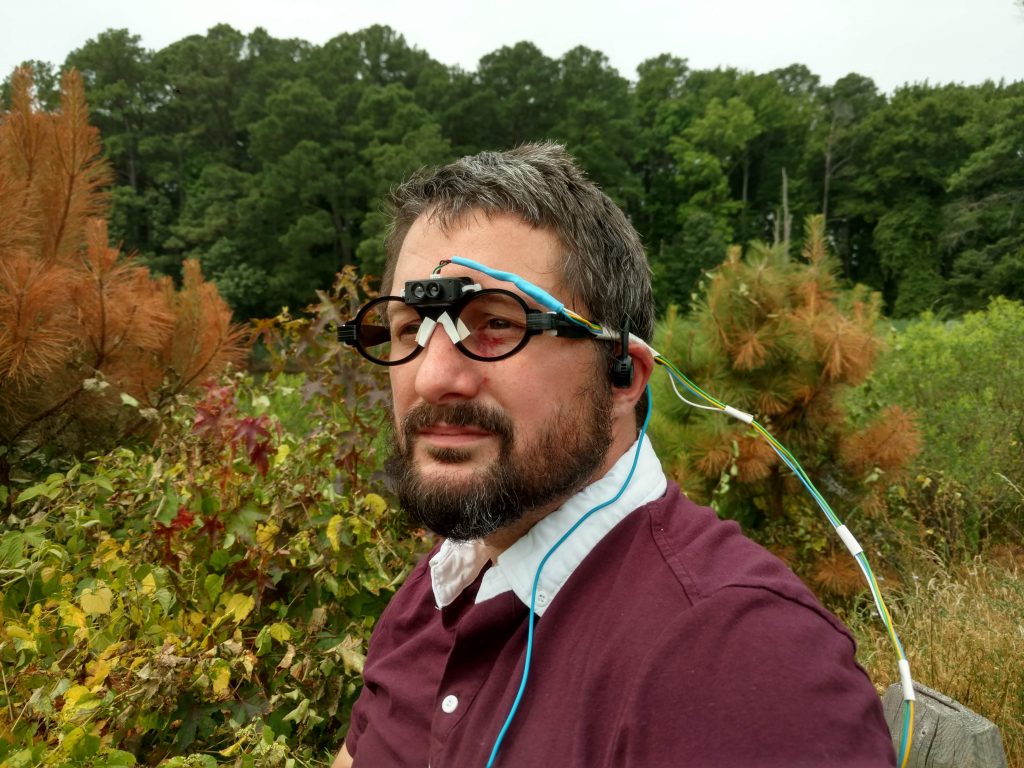
The author wearing a head mounted LiDAR array, looking very pensive.
Spoilers: You can. Photo by A. Freitag.

Bone-conducting headphones use speakers or tiny motors to send vibrations directly into the bone of you skull. This works surprisingly well for listening to music or amplifying voices without obstructing the ear. The first time you try it, it’s an odd experience. Though you hear the sound just fine, it doesn’t feel like it’s coming through your ears. Bone conduction has been used for a while now in hearing aids as well as military- and industrial-grade communications systems, but the tech has recently cropped up in sports headphones for people who want to listen to music and podcasts on a run without tuning out the rest of the world. Rather than anchoring to the skull, the sports headphones sit just in front of the ear, where your lower jaw meets your skull.

This is not entirely unlike how dolphins (and at least 65 species of toothed whales) detect sound. 
Read More “I built a head-mounted LiDAR array that lets you see the world like a dolphin via vibrations sent through your jaw.” »

Chasing Genius, aquatic brain blobs, hurricanes, bats, and more! Monday Morning Salvage: September 4, 2017

Posted on September 4, 2017September 3, 2017 By Andrew Thaler
Weekly Salvage

Fog Horn (A Call to Action)

  • Hurricane Harvey has passed, but its impacts will continue to be felt for years to come. There’s lots of great organizations to donate to, but in the immediate aftermath,it’s often best to donate to local relief programs that already have a ground team in place, rather than national groups that will take weeks to build up their infrastructure. I’m a fan of the Texas Diaper Bank and Portlight Inclusive Disaster Strategies, both of which serve communities that tend to be particularly vulnerable during natural disasters.
  • Gratuitous self promotion! The OpenCTD and Oceanography for Everyone has been selected as a finalist in National Geographic’s Chasing Genius Challenge! Please help me win the People’s Choice award by voting for the OpenCTD. Visit http://www.natgeochasinggenius.com/video/776, create or sign into your Chasing Genius account, and click the yellow star to vote on my video. Thank you!

Flotsam (what we’re obsessed with right now)

  • It will take months, if not years, to fully understand the impacts of Hurricane Harvey, which already looks to be the costliest storm in US history. These drone videos give you some idea of the sheer scale of the damage. The Washington Post has an interactive map to help visualize what the equivalent deluge would look like around the world: What the Harvey deluge would look like where you live.

Read More “Chasing Genius, aquatic brain blobs, hurricanes, bats, and more! Monday Morning Salvage: September 4, 2017” »

Popular Posts

Shark scientists want their research to help save threatened species, but don’t know how. Our new paper can help.Shark scientists want their research to help save threatened species, but don’t know how. Our new paper can help.December 1, 2025David Shiffman
Norway and Cook Islands put their deep-sea mining plans on pause.Norway and Cook Islands put their deep-sea mining plans on pause.December 3, 2025Andrew Thaler
What Ocean Ramsey does is not shark science or conservation: some brief thoughts on "the Shark Whisperer" documentaryWhat Ocean Ramsey does is not shark science or conservation: some brief thoughts on "the Shark Whisperer" documentaryJuly 2, 2025David Shiffman
What we know we don't know: impacts of deep-sea mining on whales, dolphins, sharks, turtles, and other migratory species.What we know we don't know: impacts of deep-sea mining on whales, dolphins, sharks, turtles, and other migratory species.November 20, 2025Andrew Thaler
2025: My year in writing, public speaking, and media interviews2025: My year in writing, public speaking, and media interviewsDecember 3, 2025David Shiffman
The Trouble with Teacup PigsThe Trouble with Teacup PigsOctober 14, 2012Andrew Thaler
Urea and Shark OsmoregulationUrea and Shark OsmoregulationNovember 15, 2010David Shiffman
How tiny satellites are tracking marine wildlifeDecember 1, 2025Andrew Thaler
Shark of Darkness: Wrath of Submarine is a fake documentaryShark of Darkness: Wrath of Submarine is a fake documentaryAugust 10, 2014Michelle Jewell
Quick Tips for Graduate Student Life - Write a Book ReviewJanuary 23, 2014Andrew Thaler
Subscribe to our RSS Feed for updates whenever new articles are published.

We recommend Feedly for RSS management. It's like Google Reader, except it still exists.

Southern Fried Science

  • Home
  • About SFS
  • Authors
  • Support SFS


If you enjoy Southern Fried Science, consider contributing to our Patreon campaign.

Copyright © 2025 Southern Fried Science.

Theme: Oceanly Premium by ScriptsTown