Skip to content

Southern Fried Science

Over 15 years of ocean science and conservation online

  • Home
  • About SFS
  • Authors
  • Support SFS

Tag: sea level rise

Science in the Fleet: What would your hometown look like with 80 meters Sea Level Rise

Posted on October 16, 2013April 29, 2014 By Andrew Thaler 33 Comments on Science in the Fleet: What would your hometown look like with 80 meters Sea Level Rise
#DrownYourTown, Popular Culture

UPDATE: These posts, and the hashtag are getting a lot of attention, so I’d like to reiterate, Caveat Tweetor (twitter beware) — these models are being generated on the fly as request come in. They are not validated and there are many variables that influence sea level rise which are not taken into account. This is a fun way to visualize potential sea level rise but it would be inadvisable to use it for real estate speculation. 

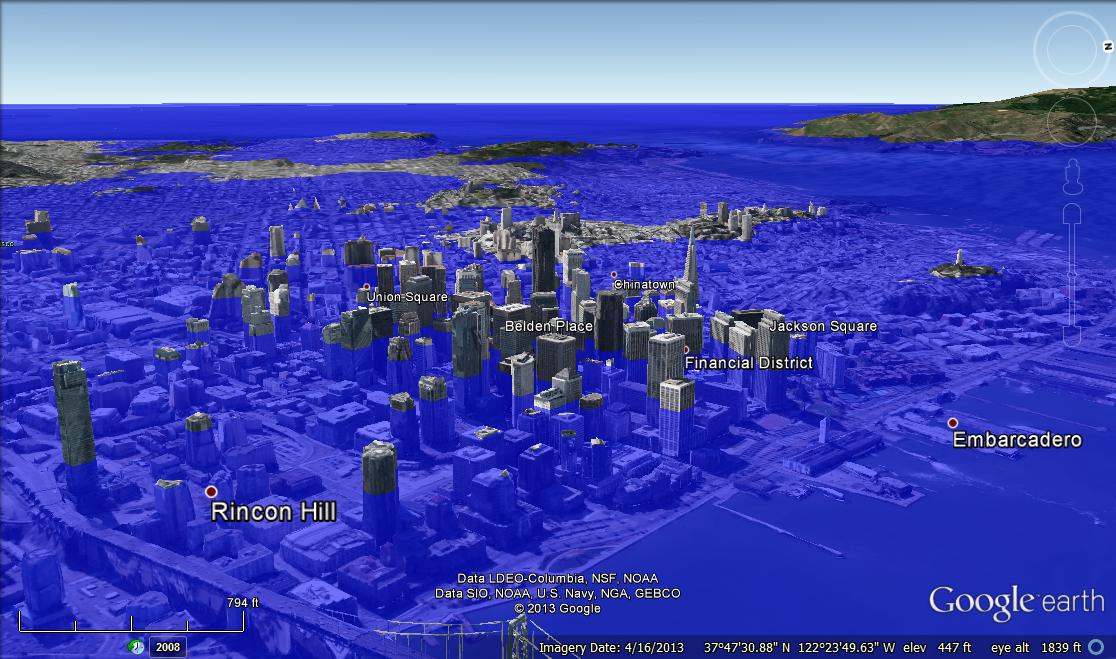
The central conceit in the world of Fleet–my dystopian maritime science fiction serial adventure–is that sea level has risen 80 meters, an extreme maximum projection under global climate change prediction (INSERT LINK TO USGS DATA HERE AFTER SHUTDOWN ENDS – UPDATE: Oh, neat, we have a federal government again. Here’s the source). Since 80 meters is pretty hard to visualize, I turned to Google Earth to help me simulate what our world would look like under those conditions, starting with my new residence in San Francisco:
FleetSanFran
San Francisco, 80 meters

Oh, but we’re not done yet.

Read More “Science in the Fleet: What would your hometown look like with 80 meters Sea Level Rise” »


Sick of fictional mermaid documentaries? Try some dystopian maritime science fiction, instead!

Posted on September 2, 2013October 27, 2013 By Andrew Thaler 4 Comments on Sick of fictional mermaid documentaries? Try some dystopian maritime science fiction, instead!
Popular Culture

Welcome to the Fleet! It’s the near future, the rising tides have swallowed much of the world’s coastlines, and the last survivors of a deadly plague are scattered across a new and vastly different ocean. But all is not well in the Reach. The fish are dwindling, the currents are shifting, and secrets long thought … Read More “Sick of fictional mermaid documentaries? Try some dystopian maritime science fiction, instead!” »

Sea Leveler Update: one week of #sealevelrise

Posted on April 13, 2013October 28, 2013 By Andrew Thaler

Now that most of the bugs are out of the system, here is what a one week readout looks like on the Sea Leveler. A few observations: The Sea Leveler is driven by twitter’s own search API, which is not perfect. The rapid dramatic drops are due to twitter updating its search parameters to exclude … Read More “Sea Leveler Update: one week of #sealevelrise” »

Sea Leveler Update

Posted on March 29, 2013October 28, 2013 By Andrew Thaler

Earlier this week I launched the Sea Leveler, and open-source, arduino-powered, water level meter that measure the activity of tweets about #sealevelrise on twitter. Not surprisingly, the first full week of trial revealed a few bugs in the machine. The first thing you’ll notice is that, in addition to recording tweets about sea level rise, … Read More “Sea Leveler Update” »

Watch Blue Pints Episode 2: Sea Level Rise, Seafood Fraud, Shipwrecked Aliens, and more!

Posted on June 28, 2012October 27, 2013 By Andrew Thaler
Uncategorized

Watch Episode 2 here:

httpv://www.youtube.com/watch?v=ijPEW7x93N0

Read More “Watch Blue Pints Episode 2: Sea Level Rise, Seafood Fraud, Shipwrecked Aliens, and more!” »

Understanding Sea Level Rise: Why a linear extrapolation is the least reasonable predictor of future changes

Posted on June 14, 2012June 18, 2012 By Andrew Thaler 2 Comments on Understanding Sea Level Rise: Why a linear extrapolation is the least reasonable predictor of future changes
Conservation, Science

The Division of Coastal Management shall be the only State agency authorized to develop rates of sea-level rise and shall do so only at the request of the Commission. These rates shall only be determined using historical data, and these data shall be limited to the time period following the year 1900. Rates of sea-level rise may be extrapolated linearly to estimate future rates of rise but shall not include scenarios of accelerated rates of sea-level rise.

source (emphasis mine)

This is the text of the notorious, anti-science, anti-coastal community bill that was originally floated in the North Carolina state senate. A revised version of that bill is now under review, with new language that now mandates that:

The Commission and the Division of Coastal Management may collaborate with other State agencies, boards, commissions, other public entities, or institutions when defining sea-level rise or developing rates of sea-level rise. These rates shall be determined using statistically significant, peer-reviewed historical data generated using generally accepted scientific and statistical techniques. Historic rates of sea-level rise  may be extrapolated to estimate future rates of rise but shall not include scenarios of accelerated rates of sea-level rise unless such rates are from statistically significant, peer-reviewed data and are consistent with historic trends.

source (emphasis mine)

While this new language is almost certainly an improvement over the old bill, which was heavily supported by a lobbying group for coastal developers and heavily opposed by organizations that actually care what happens to the Carolina coastline and its historic communities, it is still problematic. By problematic, I mean wrong. And by wrong I mean that by refusing to allow accelerated estimates of sea level rise, it explicitly ignores all the best available science and contradicts 130 millenia of historic precedent.

Read More “Understanding Sea Level Rise: Why a linear extrapolation is the least reasonable predictor of future changes” »

North Carolina’s attempted ban on sea level rise is a boon for Global Draining researchers

Posted on May 31, 2012May 31, 2012 By Andrew Thaler 4 Comments on North Carolina’s attempted ban on sea level rise is a boon for Global Draining researchers
Science

News broke yesterday that NC-20, a lobbying group for coastal development that, among other things, thinks property owners should be allowed to dump chemical waste directly into our watersheds, is sponsoring legislation that would outlaw outlaw sea level rise. Ignoring the fact that you can’t actually sue the ocean, what they’re actually promoting is a law that would prevent the state from using any sea surface model that extrapolates future ocean trends using anything but a linear regression. Essentially, they’re making it illegal for the state to anticipate future changes to the coastline, plan and prepare for potential flooding, or restrict development on transient barrier islands.

Read More “North Carolina’s attempted ban on sea level rise is a boon for Global Draining researchers” »

10 misrepresentations about climate change

Posted on October 3, 2011October 2, 2011 By David Shiffman 146 Comments on 10 misrepresentations about climate change
Science

Few scientific fields generate as much controversy as climate change. Misunderstandings, misrepresentations, and outright lies are common. While environmentalists rightly criticize anti-global warming activists for not being truthful, neither side is innocent. Presented here are five common misrepresentations from both sides and the truth about those issues.

Read More “10 misrepresentations about climate change” »

A primer for climate change

Posted on July 24, 2011July 24, 2011 By Andrew Thaler 69 Comments on A primer for climate change
Conservation, Science

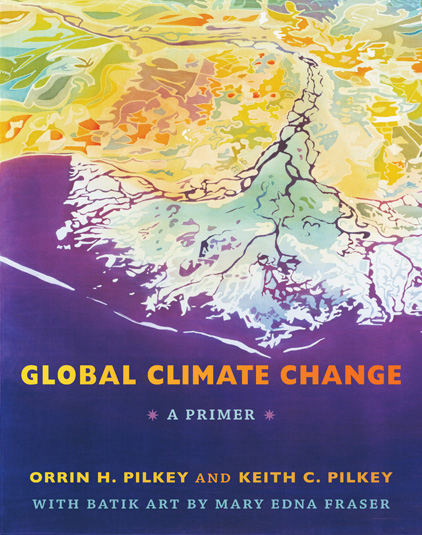
Sea level rise. Desertification. Ocean acidification. Climategate. Permafrost. Greenland ice sheet. Hockey stick. The language of global climate change can be overwhelming. Every year, as we learn more about the ways that human activity fundamentally alter global processes, the subject becomes even broader and more complicated. Fortunately, world renowned oceanographer Orrin Pilkey and his son, Keith Pilkey, have produced a comprehensive and readable primer on global climate change. The strength of Global Climate Change: A Primer can be broken into three sections – the content, the conflict, and the illustrations.

Read More “A primer for climate change” »

Weekly dose of TED – Greg Stone: Saving the ocean one island at a time

Posted on February 25, 2011 By Andrew Thaler
Uncategorized

Kiribati is perhaps one of the most remote countries in the world. Despite its distance from the sources of environmental degradation, it will probably be the very first country to be destroyed by climate change. Most of the country, a collection of small islands spanning an area almost as large as the United States, lies … Read More “Weekly dose of TED – Greg Stone: Saving the ocean one island at a time” »

Posts pagination

Previous 1 2 3 4 Next

Popular Posts

Screaming into the void - Why your scientific paper doesn’t matterScreaming into the void - Why your scientific paper doesn’t matterJune 18, 2026Chris Parsons
What Ocean Ramsey does is not shark science or conservation: some brief thoughts on "the Shark Whisperer" documentaryWhat Ocean Ramsey does is not shark science or conservation: some brief thoughts on "the Shark Whisperer" documentaryJuly 2, 2025David Shiffman
Ageism in the conservation job marketAgeism in the conservation job marketJune 19, 2026Chris Parsons
The next OpenCTD is here!The next OpenCTD is here!June 22, 2026Andrew Thaler
Undermining the Law of the Sea. Some additional thoughts following my OpEd in the Hill.Undermining the Law of the Sea. Some additional thoughts following my OpEd in the Hill.June 22, 2026Andrew Thaler
What is a Sand Shark?What is a Sand Shark?November 12, 2017Chuck Bangley
The story of the pride flag made from NASA imagery: Bluesky's most-liked imageThe story of the pride flag made from NASA imagery: Bluesky's most-liked imageSeptember 27, 2024David Shiffman
That's not a blobfish: Deep Sea Social Media is Flooded by AI SlopThat's not a blobfish: Deep Sea Social Media is Flooded by AI SlopDecember 19, 2025Andrew Thaler
Our favorite sea monsters – Ningen (#4)Our favorite sea monsters – Ningen (#4)September 7, 2010Andrew Thaler
I can serve on your graduate thesis committee. Here’s what you can expect of me, and what I expect in return.I can serve on your graduate thesis committee. Here’s what you can expect of me, and what I expect in return.October 16, 2025David Shiffman
Subscribe to our RSS Feed for updates whenever new articles are published.

We recommend Feedly for RSS management. It's like Google Reader, except it still exists.

Southern Fried Science

  • Home
  • About SFS
  • Authors
  • Support SFS


If you enjoy Southern Fried Science, consider contributing to our Patreon campaign.

Copyright © 2026 Southern Fried Science.

Theme: Oceanly Premium by ScriptsTown