Skip to content

Southern Fried Science

Over 15 years of ocean science and conservation online

  • Home
  • About SFS
  • Authors
  • Support SFS

A tongue-eating isopod takes a 5-million+ year journey through fossilized feces

Posted on February 4, 2025February 4, 2025 By Andrew Thaler
Featured, Science

One day, 5 to 20 million years ago, a tongue-eating isopod parasitized some unknown Miocene fish, embedding itself in the fish’s mouth where wit would grow and consume scraps as its host feed. That partnership lasted until the fish, itself, became food, likely eaten by an ancestral sea turtle.

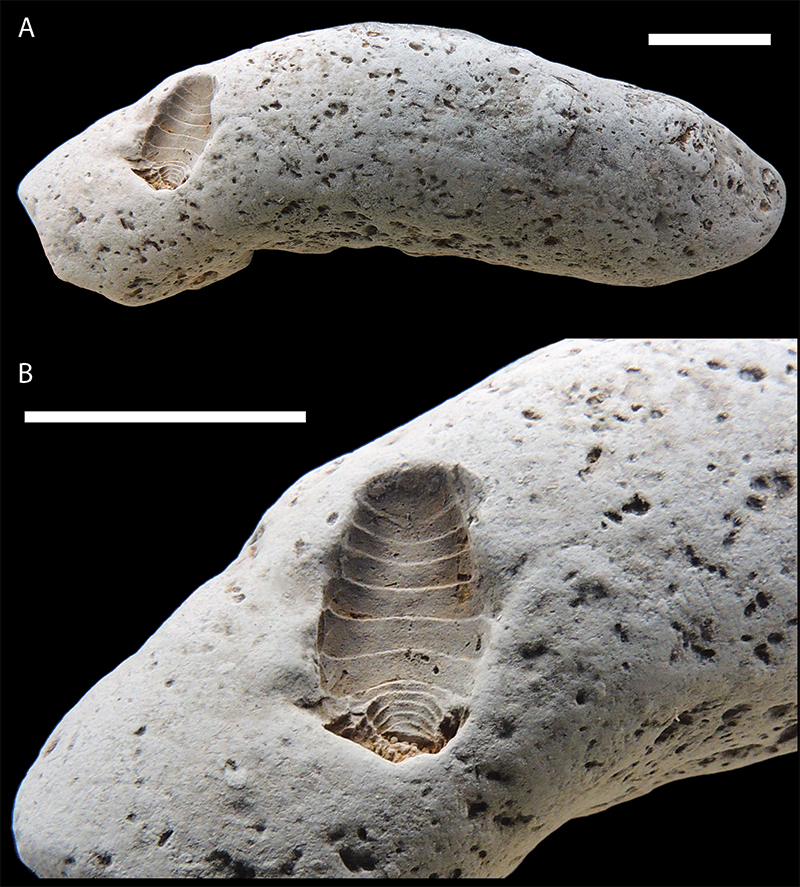
And that’s where a million-year old story should end. But in 2023, a diver surveying the bed of the Pamunkey River in Virginia came across a coprolite, the fossilized feces of a long dead animal. And within that coprolite, perfectly preserved in negative, was a near-perfect impression of that tongue-eating isopod.

To give you an idea of just how rare this discovery is, impressions of organisms preserved in coprolites have been found exactly two other times. A fragment of a sea turtle hatchling’s shell was found in 2017. An ammonite impression was found in a coprolite in 2022. Not other arthropod and no other isopod has ever been found preserved in fossil feces.

Cymothoid isopods are still extremely common throughout the world. They gained notoriety as the tongue-eating isopod from viral images of sinister sea creatures clinging to the inside the fish mouths. You might also find them clinging to the flesh of fish or in their gills or eyes. Buccal-dwelling cymothoids do destroy the tongue when they parasitize their host, replacing the organ with their own body. The fish almost certainly are not thrilled with this turn of events.
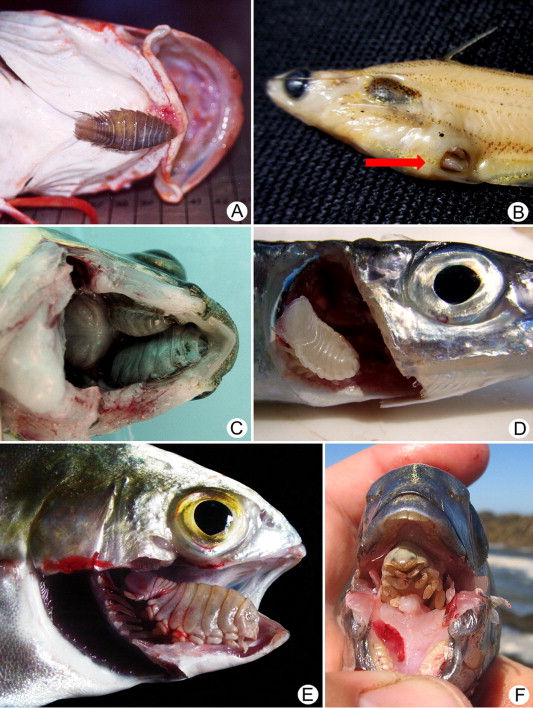
Different attachment sites of cymothoids. External or scale attaching (A), flesh-burrowing (B) buccal dwelling (C, E, F) and gill attaching (D). From Global diversity of fish parasitic isopod crustaceans of the family Cymothoidae

This particular cymothoid isopod was so well preserved that the researchers were able to describe the species. They named it Calverteca osbornei and it is now housed at the Calvert Marine Museum in Solomons Island, Maryland. While the story above is a reasonable hypothesis for how the isopod came to leave an impression in fossilized feces, the authors note that they do not know whether the isopod itself was consumed and excreted or if the isopod and potential fish host were consumed by other large common predators, like sea turtles, crocodiles, or marine mammals.
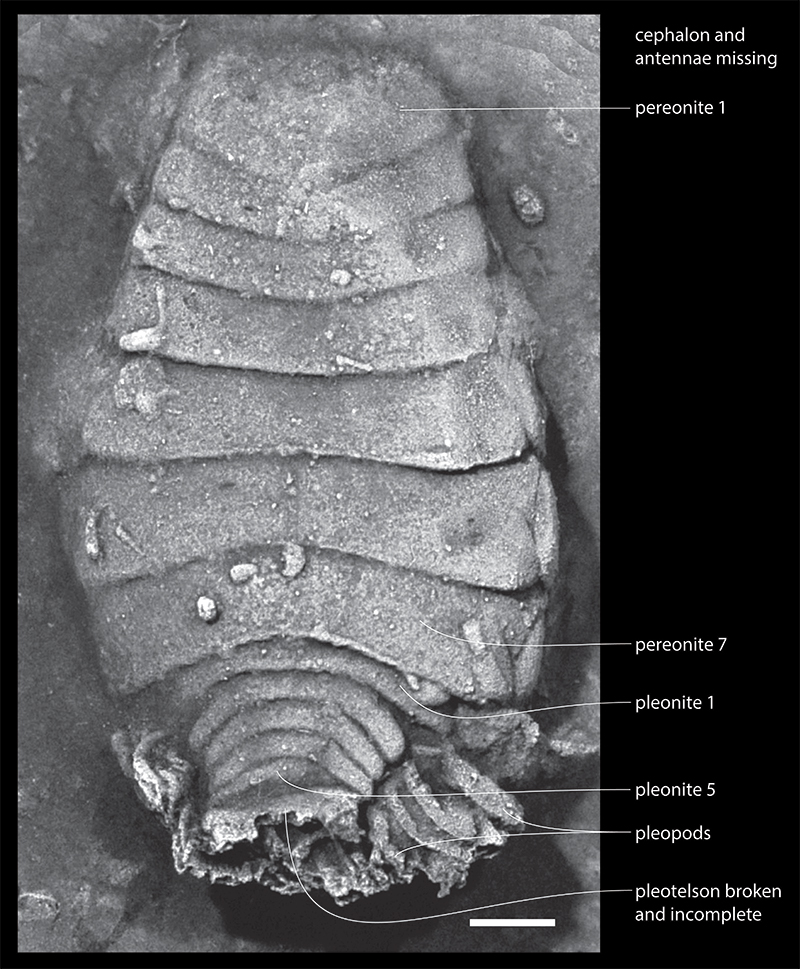
Enlarged view of a latex cast of the natural mold of the cymothoid isopod, Calverteca osbornei gen. et sp. nov., preserved in CMM-V-11695 (a Miocene vertebrate coprolite). White scale bar equals 1 mm. From The body impression of a new genus and species of cymothoid isopod (Cymothoidae, Crustacea) preserved in a vertebrate coprolite from the Atlantic Coastal Plain (Miocene, Chesapeake Group) of Virginia, USA.

The body impression of a new genus and species of cymothoid isopod (Cymothoidae, Crustacea) preserved in a vertebrate coprolite from the Atlantic Coastal Plain (Miocene, Chesapeake Group) of Virginia, USA by Stephen J. Godfrey, Rodney M. Feldmann, and Carrie E. Schweitzer is available Open-Access in the journal Paleaontologia Electronica: https://palaeo-electronica.org/content/2024/5363-isopod-impression-in-a-coprolite


Feature Image: FIGURE 2. CMM-V-11695, a Miocene vertebrate coprolite preserving an impression of the dorsal surface of a cymothoid isopod, Calverteca osbornei gen. et sp. nov. A. View of the length of the coprolite and the body impression of the cymothoid isopod. B. Enlarged view of the end of the coprolite and the isopod body impression. The anterior end of the isopod is oriented upward. The coprolite was dusted with sublimed ammonium chloride to highlight detail and improve contrast. White scale bars equal 10 mm. From The body impression of a new genus and species of cymothoid isopod (Cymothoidae, Crustacea) preserved in a vertebrate coprolite from the Atlantic Coastal Plain (Miocene, Chesapeake Group) of Virginia, USA.

Southern Fried Science is free and ad-free. Southern Fried Science and the OpenCTD project are supported by funding from our Patreon Subscribers. If you value these resources, please consider contributing a few dollars to help keep the servers running and the coffee flowing. We have stickers.

Share this:

  • Share on Bluesky (Opens in new window) Bluesky
  • Share on Facebook (Opens in new window) Facebook
  • Share on Reddit (Opens in new window) Reddit
  • Share on Threads (Opens in new window) Threads
  • Share on WhatsApp (Opens in new window) WhatsApp
  • Share on Mastodon (Opens in new window) Mastodon

Related

Post navigation

❮ Previous Post: FOR IMMEDIATE RELEASE: Experts respond to Executive Order renaming a subsection of the Gulf of Mexico
Next Post: We’re making a new marine conservation science and policy textbook. What do you want to be in it? ❯

Popular Posts

How close did the world's first deep-sea mining come to the dredging the world's largest cold-water coral reef?How close did the world's first deep-sea mining come to the dredging the world's largest cold-water coral reef?March 17, 2026Andrew Thaler
At least 74 practicing shark researchers: How a silly thing I said online raised thousands for conservationAt least 74 practicing shark researchers: How a silly thing I said online raised thousands for conservationFebruary 26, 2025David Shiffman
What Ocean Ramsey does is not shark science or conservation: some brief thoughts on "the Shark Whisperer" documentaryWhat Ocean Ramsey does is not shark science or conservation: some brief thoughts on "the Shark Whisperer" documentaryJuly 2, 2025David Shiffman
That's not a blobfish: Deep Sea Social Media is Flooded by AI SlopThat's not a blobfish: Deep Sea Social Media is Flooded by AI SlopDecember 19, 2025Andrew Thaler
Urea and Shark OsmoregulationUrea and Shark OsmoregulationNovember 15, 2010David Shiffman
Here's what I teach my students about finding jobs in marine biology and conservationHere's what I teach my students about finding jobs in marine biology and conservationApril 10, 2024David Shiffman
Here are some ocean conservation technologies that I'm excited aboutHere are some ocean conservation technologies that I'm excited aboutFebruary 19, 2026David Shiffman
I turned my woodshop into a personal solar farm.I turned my woodshop into a personal solar farm.June 21, 2021Andrew Thaler
Alberta, Canada is the proud owner of the largest man-made pyramid on the planetAlberta, Canada is the proud owner of the largest man-made pyramid on the planetOctober 16, 2012Andrew Thaler
My "Follow ocean science and conservation experts on Bluesky and Instagram" assignmentMy "Follow ocean science and conservation experts on Bluesky and Instagram" assignmentNovember 19, 2024David Shiffman
Subscribe to our RSS Feed for updates whenever new articles are published.

We recommend Feedly for RSS management. It's like Google Reader, except it still exists.

Southern Fried Science

  • Home
  • About SFS
  • Authors
  • Support SFS


If you enjoy Southern Fried Science, consider contributing to our Patreon campaign.

Copyright © 2026 Southern Fried Science.

Theme: Oceanly Premium by ScriptsTown