Skip to content

Southern Fried Science

Over 15 years of ocean science and conservation online

  • Home
  • About SFS
  • Authors
  • Support SFS

Author: Andrew Thaler

Marine science and conservation. Deep-sea ecology. Population genetics. Underwater robots. Open-source instrumentation. The deep sea is Earth's last great wilderness.

Six thoughts about Greenpeace’s attack on Ray Hilborn.

Posted on May 13, 2016June 2, 2016 By Andrew Thaler 6 Comments on Six thoughts about Greenpeace’s attack on Ray Hilborn.
Conservation, Science

Update: Both the University of Washington and the Proceedings of the National Academy of Sciences have reviewed Greenpeace’s claims and concluded that Hilborn did not violate their disclosure policy.

First, some background:

  • Fisheries Scientist Under Fire For Undisclosed Seafood Industry Funding
  • Ray Hilborn: Overfishing Denier
  • Hilborn’s Response to Greenpeace

Or, just read Trevor Branch’s timeline.

1. The idea that scientists should declare every source of funding over the history of their career on every scientific paper is impractical and wholly unnecessary in a connected world where anyone can effortlessly access a researcher’s CV. Non-profit NGOs only need to file one financial disclosure statement every year, not attach it to every press release, and that is also perfectly adequate.

2. Transparency in funding is important. Claiming that a researcher is failing to disclose funding information when that information clearly is available and accessible erodes public trust in science and makes everyone’s job harder. Greenpeace didn’t send a team of stealth lawyers on an o’dark thirty raid of the UW mainframe, they asked for the information and were given it.

Read More “Six thoughts about Greenpeace’s attack on Ray Hilborn.” »

Build your own BeagleBox 2!

Posted on May 9, 2016May 12, 2016 By Andrew Thaler
Uncategorized

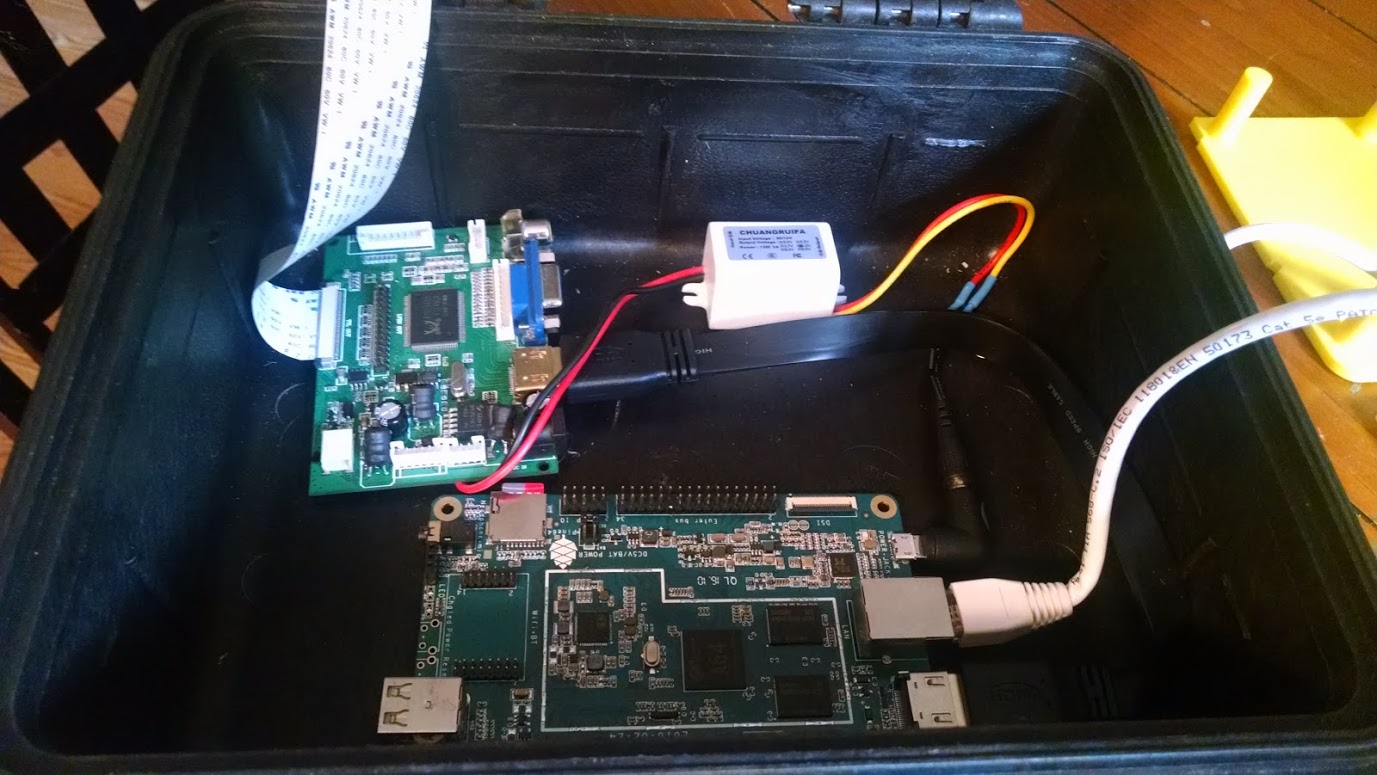
A more comprehensive build guide, along with the 3D printer files, can be found in the BeagleBox GitHub Repository. 


The BeagleBox 2 is a dirt-cheat, tough, versatile field computer built from 3D-printed parts, off-the-shelf hardware, and a single board computer. You can read all about it here: The BeagleBox 2: a dirt-cheap, tough-as-nails, 3D-printed, versatile field laptop.

Let’s build one!

The Brain of the BeagleBox 2

Read More “Build your own BeagleBox 2!” »

The BeagleBox 2: a dirt-cheap, tough-as-nails, 3D-printed, versatile field laptop.

Posted on May 9, 2016May 12, 2016 By Andrew Thaler
Science
The BeagleBox 2
The BeagleBox 2

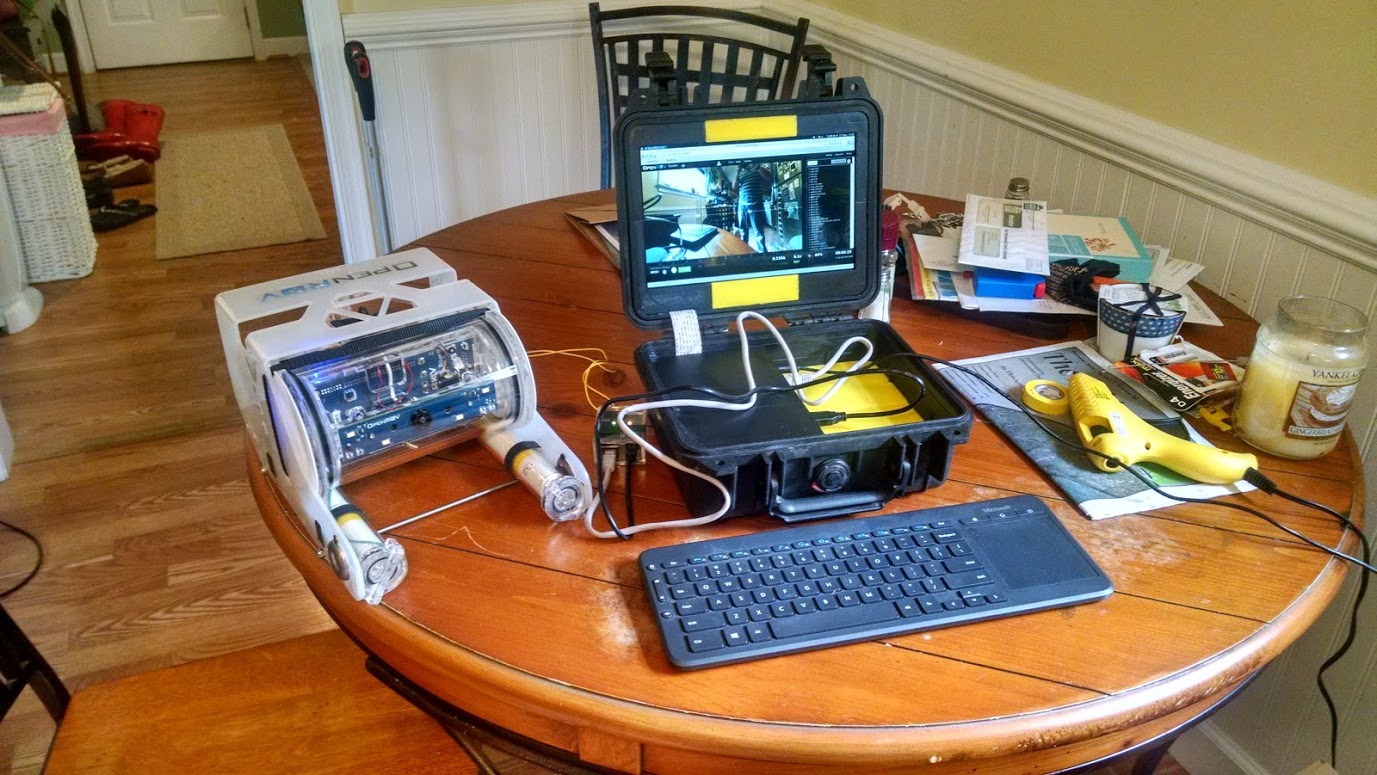
Last year, as part of Oceanography for Everyone, we debuted the BeagleBox, a small, cheap, tough, basic field computer powered by a BeagleBone Black. The first BeagleBox didn’t promise much, it was designed for basic field work and, most importantly, to be cheap enough that researchers (particularly grad students) wouldn’t be too worried about damaging it. It wasn’t designed to be your only computer but to replace your more valuable computer when participating in fieldwork.

In the last year, the single board computer landscape has changed, with new systems running off tiny, powerful 64bit ARM chips. One of the first of this new breed of SCB to hit the market was the massively Kickstarted, and rocky-launching Pine64. I received my 1GB Pine64 late last week, and immediately set to work redesigning the BeagleBox to house this larger board (and correct for some other annoyances in the original design). So here it is, an even beefier, cheaper, tougher field machine.

Yes, it will run an OpenROV. It will not run it well.

Read More “The BeagleBox 2: a dirt-cheap, tough-as-nails, 3D-printed, versatile field laptop.” »

The Science of Aquaman: Understanding Dead Water

Posted on April 22, 2016April 23, 2016 By Andrew Thaler
Popular Culture, Science

Update: legendary oceanographer Dr. Kim Martini stops by to set the record straight on the challenging subject of internal waves. Her comments in bold. 

It has been a long time since I’ve made an entry into our long-running, world-famous, Science of Aquaman series. The last few runs have been heavy on high adventure, but light on ocean tidbits for me to nerd out on. I don’t like to force ocean fact into comic fiction unless the opportunity presents itself.

So, with the newest run of Aquaman, starting with issue #50, focusing around a villain named Dead Water, I thought it was the perfect moment to talk about some physical oceanography. And then…

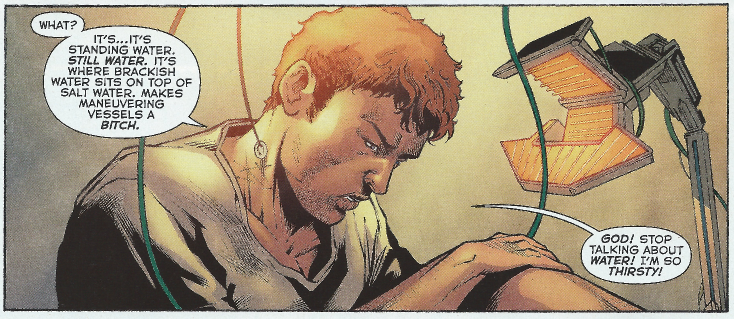
Dead Water. From Aquaman #51.

My hat’s off to Dan Abnett, who beat me to the science punchline. If I had to explain the phenomenon of dead water in a single tweet, it would have been pretty close to this. Well played, sir. Well played.

So what is dead water and why does it make maneuvering a vessel so challenging?

Read More “The Science of Aquaman: Understanding Dead Water” »

Ocean Kickstarter of the Month: New Robot to Explore the Depths of Yellowstone Lake

Posted on April 14, 2016 By Andrew Thaler
Uncategorized

We are engineers and explorers who plan to help Yellowstone scientists make what could be tomorrow’s greatest discoveries.

New Robot to Explore the Depths of Yellowstone Lake

The Global Foundation for Ocean Exploration is a non-profit engineering group that designs and builds robots to explore the world’s oceans and large lakes. They are trying to build Yogi, a small research ROV to explore the depths of Yellowstone Lake in Yellowstone National Park. Yellowstone Lake is a fascinating water body, with hydrothermal vents similar to the deep-sea vents that my primary research focuses on.

I’ll let them explain why this project is so cool:

Why explore Yellowstone Lake?

Yellowstone started a proud tradition of protecting our planet’s most unique environments when it became the world’s first National Park more than a century ago. However, there is a part of Yellowstone that very few people have visited. An entire ecosystem that is hidden from us at the surface. A place that scientists are eager to study and may harbor unknown life; the depths of Yellowstone Lake.

We now know that the bottom of the Lake is far from barren, hosting species of crustaceans, sponges, and even small creatures that feed off of the Earth’s heat and chemistry rather than the Sun. ‘Thermophilic’ (or hot water-loving) microbes thrive in the relatively high-temperatures immediately surrounding active thermal features at the bottom of the Lake and scattered throughout Yellowstone Park. These creatures may be microscopic but they have the potential to profoundly influence the medical and biological sciences.

New Robot to Explore the Depths of Yellowstone Lake

Onward to the Ocean Kickstarter Criteria!

Read More “Ocean Kickstarter of the Month: New Robot to Explore the Depths of Yellowstone Lake” »

My favorite story about Craig McClain

Posted on April 13, 2016 By Andrew Thaler
Blogging
Sasquatch?
Sasquatch?

Today marks the last day of Craig McClain week for our friends over at Deep Sea News. We’ve celebrated his science, his outreach, and his tremendous spirit. Over the last decade, I’ve been lucky enough to co-author two papers with Craig: Digital environmentalism: tools and strategies for the evolving online ecosystem and Sizing ocean giants: patterns of intraspecific size variation in marine megafauna, both of which have quickly become seminal in their related fields. Craig is a titan, and my one regret is that I didn’t try hard enough to convince him to determine the author order for Sizing Ocean Giants by our respective sizes.

One time, in New Zealand, he tried to impersonate a Sasquatch. 

Read More “My favorite story about Craig McClain” »

Robots! Artificial Gills! Goats! Craig! A series of unrelated ocean updates

Posted on April 8, 2016 By Andrew Thaler
Blogging

There’s been some amazing things happening around the oceanosphere, none of which are particularly related. All of which are pretty awesome (or super bogus). Here we go! 1. Robots to save the ocean. Last weekend I was in Miami at We Robot 2016, a meeting about the future of robotics and the law, repping for … Read More “Robots! Artificial Gills! Goats! Craig! A series of unrelated ocean updates” »

April 1 on Southern Fried Science

Posted on April 1, 2016March 31, 2016 By Andrew Thaler
Blogging

For the last several years, we’ve made an effort to produce a silly, though not particularly pranky (because pranks are a whack way to be mean to people who ostensibly trust you), article for April 1. Today, our own David Shiffman defends his thesis. Make of that what you will. Good luck David! And may … Read More “April 1 on Southern Fried Science” »

A funny thing happens when you point out ocean scams.

Posted on March 29, 2016March 29, 2016 By Andrew Thaler
Blogging

Last Friday I pointed out that, based on the science presented and the behavior of the team involved, Triton Gills is almost certainly a scam. You can read that post and the linked articles for more details.

We do a bit of ocean debunking here at Southern Fried Science, though less and less every year, in part for the reasons listed below. While I find it vital for the ocean community that we push back, especially, about outright fraud, there are a few things that happen which make the entire process enormously frustrating. So much so that you come away disinclined to bother doing anything the next time a fraudulent project comes around.

1. Everyone expects you to be as outraged as they are. I get it, people don’t like being defrauded, people don’t like seeing others defrauded, and everyone feels a sense of self-righteous justice when they find something to rail against in real time. But I’m not the ShittyCrowdfunding Avenger. I saw a bad project, I wrote about the bad project, I gave some interviews to journalists about the bad project. I’m not in the business of doggedly pursuing one crowfunding campaign to extinction. I also don’t assume people are idiots. Whenever you back any crowdfunding campaign, you have to do your due diligence. We make an effort here to make our due diligence public and easy to find so that other can benefit from it. 

Read More “A funny thing happens when you point out ocean scams.” »

A journey across Titan’s largest methane sea.

Posted on March 28, 2016March 28, 2016 By Andrew Thaler
Popular Culture

You asked for a map the clarify the journey of Calliope, the Salvager, and others as they sail, fly, and walk across Kraken Mare, Titan’s largest methane sea. Here, for your pleasure, is a map of the journey across Kraken Mare from A Crack in the Sky above Titan. Read A Crack in the Sky … Read More “A journey across Titan’s largest methane sea.” »

Posts pagination

Previous 1 … 42 43 44 … 149 Next

Popular Posts

What Ocean Ramsey does is not shark science or conservation: some brief thoughts on "the Shark Whisperer" documentaryWhat Ocean Ramsey does is not shark science or conservation: some brief thoughts on "the Shark Whisperer" documentaryJuly 2, 2025David Shiffman
What is a Sand Shark?What is a Sand Shark?November 12, 2017Chuck Bangley
Zombie ideas in conservation: trophy hunting and conservationZombie ideas in conservation: trophy hunting and conservationAugust 6, 2026Ali Gaster
Jumping the shark: New study reviews the breaching behavior of sharks and raysJumping the shark: New study reviews the breaching behavior of sharks and raysSeptember 19, 2024David Shiffman
Shark of Darkness: Wrath of Submarine is a fake documentaryShark of Darkness: Wrath of Submarine is a fake documentaryAugust 10, 2014Michelle Jewell
That's not a blobfish: Deep Sea Social Media is Flooded by AI SlopThat's not a blobfish: Deep Sea Social Media is Flooded by AI SlopDecember 19, 2025Andrew Thaler
Please Help This Little Dumbo Octopus Travel Across AmericaPlease Help This Little Dumbo Octopus Travel Across AmericaAugust 3, 2026Angelo Villagomez
Is Academic Publishing is breaking conservation science?Is Academic Publishing is breaking conservation science?August 10, 2026Chris Parsons
Considering writing a popular science book? Here's my adviceConsidering writing a popular science book? Here's my adviceJuly 7, 2025David Shiffman
Fun facts and FAQs about Megalodon, Maryland's new (and definitely extinct) official state sharkFun facts and FAQs about Megalodon, Maryland's new (and definitely extinct) official state sharkApril 15, 2026David Shiffman
Subscribe to our RSS Feed for updates whenever new articles are published.

We recommend Feedly for RSS management. It's like Google Reader, except it still exists.

Southern Fried Science

  • Home
  • About SFS
  • Authors
  • Support SFS


If you enjoy Southern Fried Science, consider contributing to our Patreon campaign.

Copyright © 2026 Southern Fried Science.

Theme: Oceanly Premium by ScriptsTown