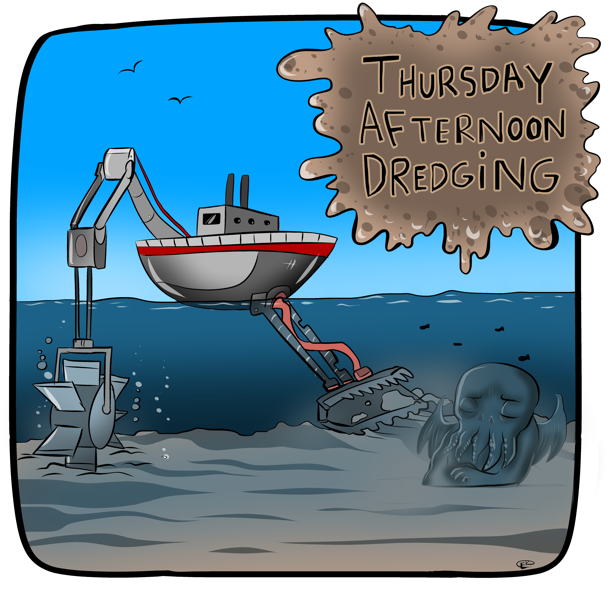
Cuttings (short and sweet):
- Follow Dr. Toby Daly-Engel’s shark research lab on twitter!
- Cod catch at an all-time low, but a rebound could be near. By Patrick Whittle, for the Associated Press.
- Right whale died from fishing gear. From CBC News
Over 15 years of ocean science and conservation online
Cuttings (short and sweet): Follow Kelsey James, a graduate student studying the age and growth of batoid fishes, on twitter! Ancient maps show islands that don’t really exist. By Greg Miller, for National Geographic. Global registry of invasive species is a milestone for conservation. By Jonathan Watts, for the Guardian. Want to buy a tshirt, mug, … Read More “Imaginary islands, lobster pain, porgs and puffins: Thursday Afternoon Dredging, January 25th, 2018” »
Cuttings (short and sweet):
 Welcome to Dear Shark Man, an advice column inspired by a ridiculous e-mail I received. You can send your questions to me via twitter (@WhySharksMatter) or e-mail (WhySharksMatter at gmail).
Dear Shark Man,
Someone I follow on Instagram posted this earlier this week. In this post, she claims that a shark became blind in one eye because SCUBA divers were regularly rubbing it’s snout. Is that a thing? It doesn’t seem like a thing.
Sincerely,
Frustrated in Fort Lauderdale
Read More “Dear Shark Man, can rubbing a shark’s snout cause blindness?” »
Cuttings (short and sweet):
Welcome to Dear Shark Man, an advice column inspired by a ridiculous e-mail I received. You can send your questions to me via twitter (@WhySharksMatter) or e-mail (WhySharksMatter at gmail).
Dear Shark Man,
Do sharks fart?
Sincerely,
Restless in Raleigh
 OceansOnline is now accepting abstracts! OceansOnline is an optional one-day add-on to the International Marine Conservation Congress (IMCC5).This year’s IMCC (including OceansOnline) will take place in Kuching, Malaysia. IMCC5 is June 22-29th, 2018 with OceansOnline on the 2018.
OceansOnline focuses on using online tools for marine science and conservation, including advocacy, public education, research, and collaboration! Anyone is welcome, including scientists, conservation advocates, educators, natural resource managers, journalists, and communicators. OceansOnline content is suitable for beginners or professionals.
Be sure to follow #SharkScienceMonday on twitter every Monday morning of 2018 (starting January 8th)! Each week, a team of researchers* will be discussing a different scientific paper related to shark and ray biology, behavior, ecology, or management.
Some papers will be new and cutting edge, while others will be classics. They’ll all have one thing in common: a member of the Dulvy lab thought that they had an interesting or important result that significantly contributed to our various areas of expertise. Whenever possible, we will share a link to an open access copy of the paper so everyone can read along.
After we summarize the key takeaways from each paper, we’ll take questions. We’ll also start a discussion about that specific paper and the discipline that it is a part of, including suggesting various experts you can follow on twitter.
We hope that you’ll follow along with us, and that you’ll learn some interesting and important things about elasmobranch research and management!
2017 was… yeah. Of all the years I’ve lived through, 2017 was definitely one of them. Anyway, some interesting things happened in the world of shark research. Here, in no particular order, are 17 amazing and important things that scientists discovered about sharks and rays over the last year.
1 Sharks can switch between sexual and asexual reproduction. We’ve known that several shark species can reproduce asexually for over a decade now, but this year, Dudgeon and friends showed an individual shark switching between sexual and asexual reproduction for the first time!
Noteworthy media coverage: CNN, National Geographic, Gizmodo
Cuttings (short and sweet):
Read More “Narwhal stress and coral disease: Thursday Afternoon Dredging, December 14th, 2017” »
Welcome to Volume #5 of Dear Shark Man, an advice column inspired by a ridiculous e-mail I received. You can send your questions to me via twitter (@WhySharksMatter) or e-mail (WhySharksMatter at gmail).
Dear Shark Man,
What’s the history of the shark’s cultural image as a sneaky aggressive predator? Do other cultures see it differently?
Sincerely,
Imaginative in Irvine
Dear imaginative,
Much of the large-scale public fear of sharks we see today can be traced to the movie “Jaws” (read my Gizmodo article about this here). Shark conservation biologists actually use the term “the Jaws effect” in peer reviewed scientific literature. Terror of sharks resulting from that movie is fairly common even among people you wouldn’t expect; for example, both of my parents are outdoorsy and have post-graduate degrees, and yet both reported being afraid to go swimming in pools or lakes the summer after Jaws came out. Personally, I don’t think that modern shark b-movies like “SharkNado” or “Two-Headed Shark Attack” inspire the same level of public misunderstanding because they’re obviously silly, but others disagree.
Media coverage of shark bites also plays a major role. If someone gets bitten by a shark anywhere in the world, it’s headline news everywhere even if the bite isn’t severe enough to require more than a band-aid. In Australia, 38% of reported “shark attacks” didn’t even involve any injury at all. This is part of why I, along with many other shark scientists, have called on the popular press to avoid the inflammatory and inaccurate term “shark attack” in favor of a typology of other terms (shark sighting, shark encounter, shark bite, fatal shark bite).
Other cultures absolutely see sharks differently. Where I now live in western Canada, coastal First Nations have stories about a supernatural being called the Dogfish Woman. In some South Pacific cultures, sharks are seen as spirits of ancestors called aumakua (briefly referenced in Moana, see below), and there are even shark gods like Dakuwaqa.

Read More “Galeophobia, Shark Teeth, and Non-Expert Awareness Campaigns: Dear Shark Man, Volume 5” »