Skip to content

Southern Fried Science

Over 15 years of ocean science and conservation online

  • Home
  • About SFS
  • Authors
  • Support SFS

Category: Science

Keeping your robot invasions under control.

Posted on September 28, 2015 By Andrew Thaler
Conservation, Education, Science

It’s been a big week for papers here at Southern Fried Science. This morning, Amy, myself, William (of Bomai Cruz fame), and Dominik and Erika of OpenROV published our guidelines on minimizing the potential for microROVs to act as invasive species vectors in Tropical Conservation Science. The abstract: Remotely operated vehicles (ROVs) present a potential risk … Read More “Keeping your robot invasions under control.” »

A Natural History of the Starwhale

Posted on September 21, 2015September 20, 2015 By Andrew Thaler 1 Comment on A Natural History of the Starwhale
Popular Culture, Science
space_whale_by_ovitan-d8cc9en
Space Whale, by OvitaN – http://ovitan.deviantart.com/art/Space-Whale-504456863

Whales, those magnificent leviathans of the deep, have an uncanny knack for ending up in space. Science fiction is flooded with stories of starwhales–sometimes entirely new creatures that happen to resemble terran cetaceans in either behavior or appearance, sometimes evolved leviathans from our own world, and occasionally hapless, confused, ordinary whales. This is no fluke. Space is big, whales are big, so why shouldn’t there be whales in space?

Science fiction loves its tropes, and particularly loves comparing space to the golden age of maritime exploration, to the point where starships sometimes have sails. And then, of course, there’s The Narrative. You know, the one where a captain is consumed by obsession and revenge to hunt some semi-mythical mcguffin. If you’re going to do Moby-Dick-in-Space, you better have a starwhale. SciFi loves the Moby Schtick.

Starship UK, from Doctor Who.

So what is a starwhale, and why is it different from other giant space creatures like the exogorth of Empire Strikes Back? Like terran whales, star whales are intelligent creatures that often exhibit some form of emotion. Unlike other space monsters, they often act with a purpose that goes beyond “eat space people, wreck ship”. Nowhere is this more clearly highlighted than in the Doctor Who episode The Beast Below, in which the Doctor encounters the last living starwhale, now supporting the remnants of the British Empire on its back. In the story, the whale endures tremendous suffering in order to protect ‘the children’, and chooses to stay even after being freed from its captors.

Giant whales providing the backbone for mysterious islands traces its roots back to the ancient Greeks, at least in the Western canon. Aspidochelon was a sea monster said to resemble either a turtle or a whale, with a craggy back the carried sandy beaches and sometimes even trees and jungles. Sailors who wandered ashore would find their ships crushed as they were pulled down into the deep. Later incarnations of the whale-as-island made explicit its connection to Satan, the ultimate deceiver. And, of course, Herman Melville makes explicit the modern civilization rests on the back, or, more accurately, the oil, of the whale.

Interestingly, starwhales are, at worst chaotic neutral, but more often lawful good. Their connection to the devil abandoned back on Earth.

The Star Trek universe is resplendent with starwhales, from numerous Enterprises have encountered numerous starwhales, from benign travelers passing through to confused infants looking to the ship for survival, to aggressive bulls threatened by incursion into their territory. Bull sperm whales were documented by early Earth whalers as solitary, especially aggressive male whales, some of which had tasted the bite of many harpoons and continued to charge. It was a bull sperm whale the sunk the Essex, the inspiration for Moby Dick.

Read More “A Natural History of the Starwhale” »

Applications now open for the Elasmobranch Society’s new diversity in marine science initiative

Posted on September 16, 2015September 16, 2015 By David Shiffman
Science
The American Elasmobranch Society is the world's oldest and largest professional association of shark and ray scientists
The American Elasmobranch Society is the world’s oldest and largest professional association of shark and ray scientists

The American Elasmobranch Society, the world’s oldest and largest professional society focusing on the scientific study and management of sharks and their relatives, is now welcoming applications for the Young Professional Recruitment Fund, our new diversity initiative. Awardees will be given one year of Society membership, in addition to specialized professional development training, mentorship, and networking opportunities specific to their needs as international or historically underrepresented minority scientists and professionals.

To be eligible for the Young Professional Recruitment Fund, applicants must fill out the application below and demonstrate that they:

Read More “Applications now open for the Elasmobranch Society’s new diversity in marine science initiative” »

Ocean Kickstarter of the Month: The OpenROV Trident

Posted on September 14, 2015October 6, 2015 By Andrew Thaler
Education, Science

The future of ocean exploration is here.

OpenROV Trident – An Underwater Drone for Everyone by OpenROV

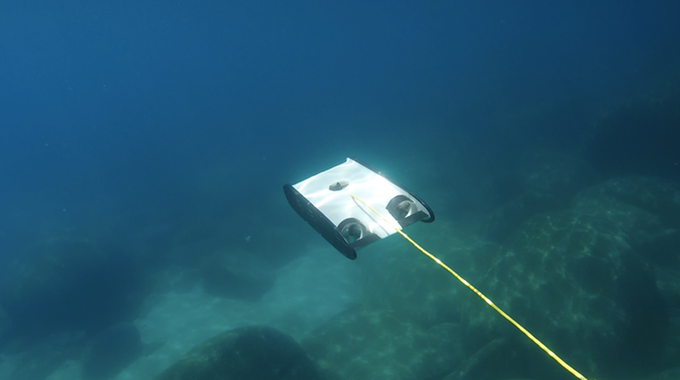
I’ve been watching, exploring, and working with the folks at OpenROV since their last Kickstarter, way back in 2012. Today they announce the launch of Trident, the next generation underwater vehicle, and one of the most capable microROVs that I’ve ever seen. I had the rare pleasure to join them in Lake Tahoe this May to test fly one of the earliest prototypes, and it surpassed all of my expectations.

You don’t need to hear me sing the praises of one of the most important emergent technologies in marine science and conservation. The rise of affordable, capable, portable underwater robots will fundamentally change the way we think about exploring the ocean and monitoring ocean health.

Onward to the Ocean Kickstarter criteria!

1. Is it sound, reasonable, and informed by science? You bet. OpenROV have been building underwater vehicles for upwards of four years. I use their robots in my research and education programs. The first peer-reviewed publication using OpenROV as a research platform will be coming out at the end of the month. 

Read More “Ocean Kickstarter of the Month: The OpenROV Trident” »

A 3D-printable, drone and ROV-mountable, water sampler

Posted on August 10, 2015August 11, 2015 By Andrew Thaler 2 Comments on A 3D-printable, drone and ROV-mountable, water sampler
Education, Open Science, Science

IMG_20150809_160734584_HDRThe Niskin bottle, a seemingly simple tube designed to take water samples at discrete depths, is one of the most important tools of oceanography. Coupled with a CTD, an array of Niskin bottles fit into the rosette, a Voltron-esque amalgamation of everything an oceanographer needs to profile the ocean. Niskin bottles are neither cheap nor particularly easy to use. A commercial rosette requires a decent-sized winch to launch and recover, which means you need a vessel and a crew to deploy. For Rogue Ecologist and citizen scientists, getting a high-quality, discrete water sample is a perpetual challenge. With tools like the OpenROV and the soon-to-be-completed EcoDrone, I wanted a Niskin bottle that was light weight and capable of being mounted on both underwater robots and quadcopters with ease.

Until now. 

After a few months of brainstorming and planning, I sat down this Friday and began building a 3D printable Niskin bottle that could be hand deployed or mounted on an OpenROV or drone. While this version is designed around a 1.25 inch acrylic tube, the trigger mechanism can be expanded to fit any size pipe. The trigger is driven by a waterproof servo developed by the good folks over at OpenROV. Everything else can either be purchased off-the-shelf or printed on you home 3D printer. Later this month, I’ll be taking my prototypes out on the RV Blue Heron for field testing in Lake Superior.

Bill of Materials

Read More “A 3D-printable, drone and ROV-mountable, water sampler” »

28 quotes, facts and graphs from the new UN global use of shark products report

Posted on August 2, 2015August 27, 2015 By David Shiffman
Conservation, Science

AThe United Nations Food and Agriculture organization just released fisheries and agriculture technical paper number 590, “the state of the global market for shark products.” Coauthored by legendary shark conservation researcher Shelley Clarke, this 196 page document is a comprehensive look at, um, the state of the global market for shark products.

It includes an updated review of threats to sharks and the conservation and management mechanisms that governments are used to protect them. If you’re interested in shark conservation, you should read it. If you’re interested in shark conservation but don’t want to read a 196 page technical document, I’ve selected 28 important quotes, facts, and graphs from the report. These are organized into the following four categories (categories which can be used as a TL;DR summary of the entire report):

A) The global trade in shark meat is growing and is significantly different from the fin trade (despite not getting anywhere near the same attention from conservation activists and the media as the fin trade).

B) Many, many countries other than China are involved in the global trade in shark and ray products (despite not getting anywhere near the same attention from conservation activists and the media as China).

C) Many species and populations of skates, rays, and smaller sharks are highly traded (despite not getting anywhere near the same attention from conservation activists and the media as larger, charismatic species).

D) Global trade is complex, and we need a lot more data from governments of shark fishing and trading nations to effectively track trends in shark product use (i.e. science and record-keeping are critical for conservation, and not all important conservation work is glamorous or exciting).

Read More “28 quotes, facts and graphs from the new UN global use of shark products report” »

In an Adventure …. with Scientists ! (…or why does America hate science so much?)

Posted on July 30, 2015August 12, 2015 By Chris Parsons
Science

In the UK “The pirates ! In an adventure with scientists” an animated movie by Aardman Animations (the studio behind Wallace & Gromit) saw some success at the movie box office. The film was based by on the popular book by the same name by Gideon Defoe, which features, as the name suggests, pirates, Charles Darwin and scientists of the Royal Society. When the movie was screened in the US however, the title was changed to “The Pirates! Band of Misfits” because it was thought that American children would avoid a movie with scientists in. All reference to Darwin, who was one of the main characters, was also removed from US trailers, presumably because evolution is viewed as ‘controversial’ in the US.

Why is it science is such seen this way in the US?

Read More “In an Adventure …. with Scientists ! (…or why does America hate science so much?)” »

Is peer-review best left to academic journals?

Posted on July 21, 2015 By Bluegrass Blue Crab
Science

If you have ever dealt with scientific data, you’ve probably encountered one of the shadier sides of science: academic publishing. While they’ve stood, in some cases, for centuries, as the official record of scientific advancement safeguarded under the watchful eye of peers, modern journals live in a modern world. Millions of words have already been spilled on the subject, so that’s not what this article is about. Instead, I’m left asking whether academic publishing is the only means of getting the stamp of peer-review these days?

The reasons leading me to ask this question are many, but primarily through working in a management arena lately. One example, in particular, highlighted many of the disconnects between the need for verified scientific data and the incentives of journals. This moment was at a Chesapeake Bay Program Sustainable Fisheries Goal Implementation Team meeting (for those of you not in the Chesapeake region, that’s a consortium of regional fisheries managers), where a room full of decision-makers needed a verified stock assessment of blue crabs to move forward with their management planning. Peer-review is the time-tested, well-understood, and arguably easiest means of verifying data.

Read More “Is peer-review best left to academic journals?” »

Build a dirt cheap, tough-as-nails field computer in a Pelican case

Posted on July 21, 2015June 25, 2016 By Andrew Thaler
Science

IMG_20150720_233502091For and updated version of the BeagleBox, please go here: The BeagleBox 2: a dirt-cheap, tough-as-nails, 3D-printed, versatile field laptop.

Fieldwork is tough. You’re in the elements, facing wind, rain, and salt spray, sometime on an open boat far out in the Atlantic. You and your gear takes a beating. But you’re out there because there’s science that need to get done.

But your equipment is controlled via computer, and your data entry mandates a computer, which means your precious laptop needs to come with you. For graduate students and early career scientists, this can be a dilemma. I’ve see the calculations happen as my colleagues prepare for the field–do I take my one and only computer out into the field and risk damaging it, or do I leave it brute-force my way through sampling without it. That is, if they’re lucky enough to have alternative methods they can employ. For some gear, there’s no choice but to take the computer.

This equation is, counter-intuitively, getting worse. Our sensors, sampling devices, and scanners are getting cheaper and lighter. Rather than buying a $20,000 piece of equipment, you can get a $20 chip, but there’s a trade off, and the trade off is that chip based systems rely on external processing power, they need a general computer, and that means your laptop is coming with you.

I don’t like going out on the water with my laptop. Losing it would be frustrating and time consuming. It’s tough, but it’s not tough-as-nails. And it’s definitely not cheap.

So I tapped into the wealth of Maker experience I’ve accumulated over the last few years and build a new one, using a single board computer, some extra peripherals, and a 3D printer. And I shoved the whole thing into a Pelican case. Say hello to the BeagleBox, a dirt cheap, tough-as-nails field computer for about $200.

Read More “Build a dirt cheap, tough-as-nails field computer in a Pelican case” »

Hacking the Tractor: what the future of farming means for open science

Posted on July 20, 2015July 21, 2015 By Andrew Thaler
Science

I took a gamble when I bought the tractor mower. It was old, but well-cared for and ran well, but it was wearing out. Still, I couldn’t get a quarter as much machine for twice the price. Two months later, the mower deck cracked, rusted out from ten years of hard use. A replacement deck would run into the thousands of dollars, there were no options for just the shell, a cheaper, but still pricey option, and there were no off-brand decks to be found. Those three facts alone should tell you that we’re dealing with a John Deere, here.

John Deere made headlines earlier this year when Wired ran an impressive (and rare) expose on farm tech: New High Tech Farm Equipment is a Nightmare for Farmer. Deere followed up with a rebuttal letter, declaring that farmers did, in fact, own their equipment, while simultaneously outlining all the ways in which they didn’t: John Deere: of course you “own” your tractor, but only if you agree to let us rip you off.

Here’s the short version: Tractors are complicated and increasingly controlled by onboard computers. These computers use proprietary software, and that software is protected by the Digital Millennium Copyright Act (DMCA). The software itself is encrypted to prevent copying or modding. Those encryption are also protected by the DMCA. Breaking that encryption is illegal, regardless of the state of the software. If you have to decrypt the software to remove it, you’re breaking the law.

Read More “Hacking the Tractor: what the future of farming means for open science” »

Posts pagination

Previous 1 … 19 20 21 … 82 Next

Popular Posts

The story of the pride flag made from NASA imagery: Bluesky's most-liked imageThe story of the pride flag made from NASA imagery: Bluesky's most-liked imageSeptember 27, 2024David Shiffman
The evolution of the International Whaling Commission – from  whaling quotas to whale conservationThe evolution of the International Whaling Commission – from  whaling quotas to whale conservationJune 10, 2026Chris Parsons
Tackling the least important debate in deep-sea mining: the desultory hyphenTackling the least important debate in deep-sea mining: the desultory hyphenJune 8, 2026Andrew Thaler
What Ocean Ramsey does is not shark science or conservation: some brief thoughts on "the Shark Whisperer" documentaryWhat Ocean Ramsey does is not shark science or conservation: some brief thoughts on "the Shark Whisperer" documentaryJuly 2, 2025David Shiffman
"Why Sustainable Seafood Matters" is now available for preorder! Here's what it's about, and why I decided to write it."Why Sustainable Seafood Matters" is now available for preorder! Here's what it's about, and why I decided to write it.June 8, 2026David Shiffman
Isn’t ironic, don’t you think: dismantling the Ocean Observatories Initiative on World Oceans DayIsn’t ironic, don’t you think: dismantling the Ocean Observatories Initiative on World Oceans DayJune 9, 2026Southern Fried Science
That's not a blobfish: Deep Sea Social Media is Flooded by AI SlopThat's not a blobfish: Deep Sea Social Media is Flooded by AI SlopDecember 19, 2025Andrew Thaler
Shark of Darkness: Wrath of Submarine is a fake documentaryShark of Darkness: Wrath of Submarine is a fake documentaryAugust 10, 2014Michelle Jewell
What is a Sand Shark?What is a Sand Shark?November 12, 2017Chuck Bangley
Our favorite sea monsters – Ningen (#4)Our favorite sea monsters – Ningen (#4)September 7, 2010Andrew Thaler
Subscribe to our RSS Feed for updates whenever new articles are published.

We recommend Feedly for RSS management. It's like Google Reader, except it still exists.

Southern Fried Science

  • Home
  • About SFS
  • Authors
  • Support SFS


If you enjoy Southern Fried Science, consider contributing to our Patreon campaign.

Copyright © 2026 Southern Fried Science.

Theme: Oceanly Premium by ScriptsTown