Skip to content

Southern Fried Science

Over 15 years of ocean science and conservation online

  • Home
  • About SFS
  • Authors
  • Support SFS

Category: Science

Help crowdfund shark research: Jaws, lost sharks, and the legacy of Peter Benchley

Posted on June 22, 2016June 22, 2016 By Guest Writer
Science

1-Head shot for bio_Dave SFS Article pic_Photo by DA EbertDavid Ebert has been researching sharks and their relatives (the rays, skates, and ghost sharks) around the world for more than three decades focusing his research on the biology, ecology and systematics of this enigmatic fish group. His current research efforts are focused on finding, documenting, and bring awareness to the world’s “lost sharks”. If you would like to learn more please see our crowd funding project “Looking for Lost Sharks: An Exploration of Discovery through the Western Indian Ocean” and consider making a donation. The more we raise, the more sharks we can name and the more schools we will be able to reach.

Jaws, the mere mention of the movie conjures up images of a large triangular fin cutting through the water, beneath it a large fearsome-looking toothy shark swimming with a sense of authority, a purpose. One of the movie’s trailers at the time hyped the fact that this was a mindless eating machine!

I recall seeing the movie Jaws in the theater for the first time during my high school days in the summer of 1975.  It was the first big summer blockbuster film, it was something new to audiences, and certainly new to me. Prior to the film’s release people generally did not anticipate such great summertime entertainment from movies like Jaws and subsequently Star Wars (released in 1977).  These were fun movies to see with your friends and spend an afternoon or evening afterwards talking about certain scenes or dialog from the movie, “You’re gonna need a bigger boat”; remember this was back in the pre-iPhone, Facebook, Twitter, social media era when kids actually spent time together talking with each other, without the aid of electronic devices and no texting!

The movie as an ancillary and an unintended consequence brought a lot of attention to sharks, both good and not so good. Shark attacks that were of minimal media attention became big news stories, catching big sharks became a sport and shark diving became popular; all of this after the movie’s release. A few high profile shark attacks, one in particular in Monterey that made international news, only further fueled the public’s fascination and fear of sharks. Just going into the water suddenly became an adventure, with the prospects (however unlikely) that one may see a shark. It certainly put the public’s awareness of sharks in their conscience.

Read More “Help crowdfund shark research: Jaws, lost sharks, and the legacy of Peter Benchley” »

Help crowdfund shark research: bycatch reduction with the loopy leader

Posted on June 15, 2016June 15, 2016 By Guest Writer
Science

GlennDr. Glenn R. Parsons is a 30 year veteran in the battle against University Administrators, bean-counting bureaucrats, and disinterested students (i.e. he is a Professor at Ole Miss). In his spare time he conducts research work on fish physiology and ecology and has published many papers on shark biology, primarily Gulf of Mexico species. He is author of the seminal book on sharks of the Gulf of Mexico entitled “Sharks, Skates and Rays of the Gulf of Mexico” and a popular novel entitled “Cherokee Summer” that could have been on the New York Times best seller list (if only it was better written and was backed by a high-powered agent like John Grisham’s). He received his PhD from the University of South Florida, School of Marine Science, MS from the University of South Alabama and BS from the University of Alabama. He was a DISL Marine Research Fellow, a Gulf Research Council Research Fellow, and a winner of a World Wildlife Fund, Smartgear Competition (for his bycatch research).

Folks, The world has witnessed an unparalleled decline in sharks that began about 30 years ago and has continued to the present. While the explanations for this decline are varied, scientists are in agreement that “bycatch” during fishing is one of the problems. Bycatch is the un-intended capture of non-target species during fishing. For example, commercial fishing for tuna and swordfish results in the capture of many sharks. The World Wildlife Fund estimates that 50,000,000 sharks are taken as bycatch during commercial fishing. Unfortunately, many of these sharks do not survive the stress of capture (a topic that my lab has researched for many years). Fishers do not want these sharks (they are dangerous to handle and they damage fishing gear) and they would welcome new developments that would reduce or eliminate shark capture.

Read More “Help crowdfund shark research: bycatch reduction with the loopy leader” »

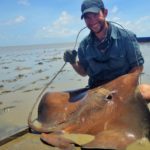
Help crowdfund shark research! Always chew your food – how freshwater stingrays gnaw on prey.

Posted on June 14, 2016June 14, 2016 By Guest Writer
Science

MattMatt Kolmann is a PhD candidate whose research program is at the interface of evolution, comparative anatomy, and biomechanics. He completed his Master’s degree at Florida State University with Dr. Dean Grubbs on the feeding biomechanics and fisheries ecology of cownose rays, a purported pest on commercial shellfish. During this process he developed a love of field work, and since then has collected rays and other fishes on expeditions across South and Central America with the Royal Ontario Museum. His PhD research investigates the evolution of biodiversity using South American freshwater stingrays as a model system. The number of different feeding niches these stingrays occupy is astounding, and Matt is using gene-sequencing, comparative phylogenetic methods, and biomechanical modeling to characterize the evolutionary processes underlying this biodiversity. From June 8th through the end of Shark Week, he will be raising funds to delve more deeply into the evolution of feeding behavior in freshwater rays – specifically investigating whether freshwater rays ‘chew’ tough prey like insects in a manner comparable to mammals. Follow him on twitter! 

What role does our food have in explaining where we live, what we look like, and how we behave?  I study how properties of prey – material, structural, and ecological – shape the evolution of predators.  Specifically, I am interested in how animals adapt to novel foods and diets that pose unique challenges: prey that are tough, stiff, hard, or just generally robust.  I approach these questions at the macroevolutionary (how species are related) level; biodiversity lends insight into engineering and synthetic design based on an understanding of how animals evolve using similar organic principles.

Read More “Help crowdfund shark research! Always chew your food – how freshwater stingrays gnaw on prey.” »

Help crowdfund shark research: Quick(silver?) stingrays

Posted on June 10, 2016June 10, 2016 By Guest Writer
Science

KadyKady Lyons is a Ph.D. candidate whose research focuses on the intersection of physiology, ecology and toxicology.  Her Master’s at Cal State Long Beach with Dr. Chris Lowe got her involved in elasmobranch toxicology.  She is interested in how elasmobranchs respond to anthropogenic contaminants and how contaminants can be used as another tool to study ecology.  Currently, her Ph.D. is examining how accumulation of these man-made contaminants influences round stingray growth and reproduction. As part of her Master’s work, she began to investigate mercury accumulation and body distribution of mercury, a potent neurotoxin, in elasmobranchs using the round stingray as a model species. She is continuing to work on this project and will be raising funds to finish this research as part of The Experiment’s Sharks Grant Challenge beginning June 8th and running through the Discovery Channel’s Shark Week.

Mercury concentrations in the earth’s atmosphere have significantly increased with human activities such as mining and fossil fuel burning.  Mercury can be transformed into its more dangerous form (methylmercury) and this form is what becomes concentrated in animals’ tissues.  For animals that occupy higher positions in the food web such as elasmobranchs (sharks, skates and rays), mercury can bioaccumulate to high levels due to their long life and carnivorous behavior.

Read More “Help crowdfund shark research: Quick(silver?) stingrays” »

Trading blue collars for scarlet robes, my working-class experience of academic life

Posted on June 9, 2016 By Michelle Jewell
Trading blue collars for scarlet robes, my working-class experience of academic life
Academic life, Science

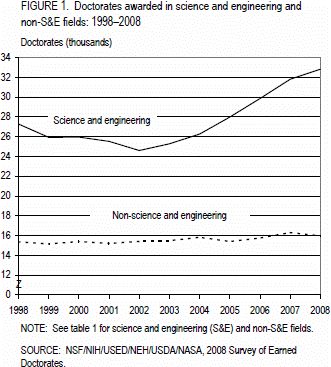
More people are going to college, graduate school, and obtaining PhDs in STEM fields than ever before (Figure 1), and a growing minority of these PhD candidates are non-traditional or not white affluent males. While we celebrate this change, let us not forget that academia was built by – and for – the “traditional” student. My favourite analogy to explain this type of ingrown privilege is bicycles on USA streets. Bicycles are legally allowed to be on streets, some streets even have extra space just for bicycles, but streets were designed for automobiles. You may be allowed and, in some areas, encouraged to get on the street with your bicycle, but biking a street is going to be intrinsically more difficult than if you were driving a car.

fig1

Like Marconi and La Bamba in a city built on rock and roll, you will inevitably end up in situations that conflict with your way of life. You will not receive a warning before you stumble upon these bumps, and you will be judged by how quickly you accept traditional standards (if you can).  I remember a conversation with traditional tenured and tenure-track scientists discussing proposals for a large grant scheme. One tenure-track scientist was lamenting the process of shopping for editors for his proposal. He talked about it freely, how there were two companies that charged different rates and he was in talks with one but that company felt a conflict of interest that he had worked with another rival editing company. The rest of the traditional scientists nodded in mutual understanding. Finding good, cheap editors to improve your work is hard. My working-class ethos was busy screaming inside my head.  How can hiring someone to edit and improve written works that you will ultimately be rewarded for be so blithely acceptable? You’re not allowed to hire editors for any task throughout your training. You learn how to write from earning disappointing grades (or failing grant applications). You read more, you study written works, you develop a voice, and you try again. The results get better until you are at an appropriate level to move up another notch on the ladder, right? Not for traditionals.

Here are some more bizarre “traditional” customs you should expect if you are biking down the academic street:

Read More “Trading blue collars for scarlet robes, my working-class experience of academic life” »

Fun Science FRIEDay – The worlds largest sponge.

Posted on June 3, 2016 By Kersey Sturdivant
Conservation, Science

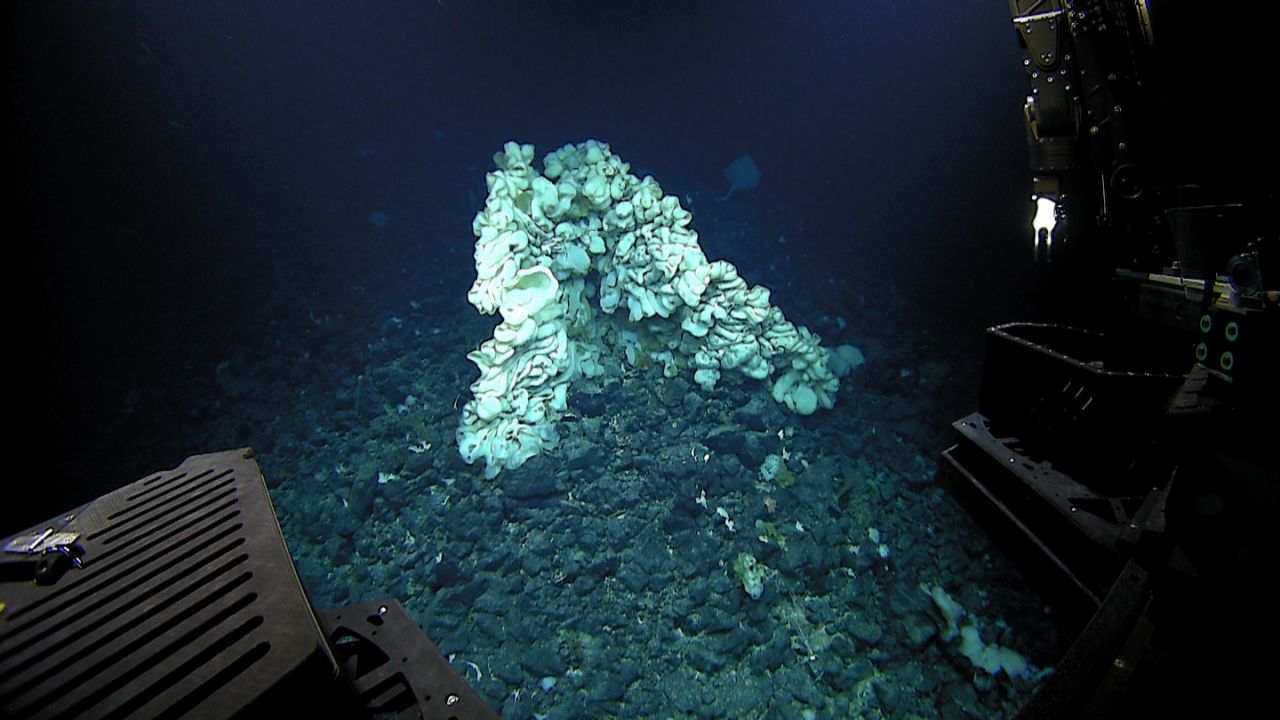
Recently a team of scientists on a deep sea expedition in the Northwestern Hawaiian Islands aboard the R/V Okeanos Explorer made a monumental discovery… pun intended. While exploring the depths of the seafloor in Papahānaumokuākea Marine National Monument, with their remotely operated vehicles (ROV) Seirios and Deep Discover, they discovered and documented the largest sponge ever observed on this planet… or any planet for that matter.

Large hexactinellid sponge found in Papahānaumokuākea Marine National Monument (Photo credit: NOAA's Office of Exploration and Research)
Large hexactinellid sponge found in Papahānaumokuākea Marine National Monument (Photo credit: NOAA’s Office of Exploration and Research)
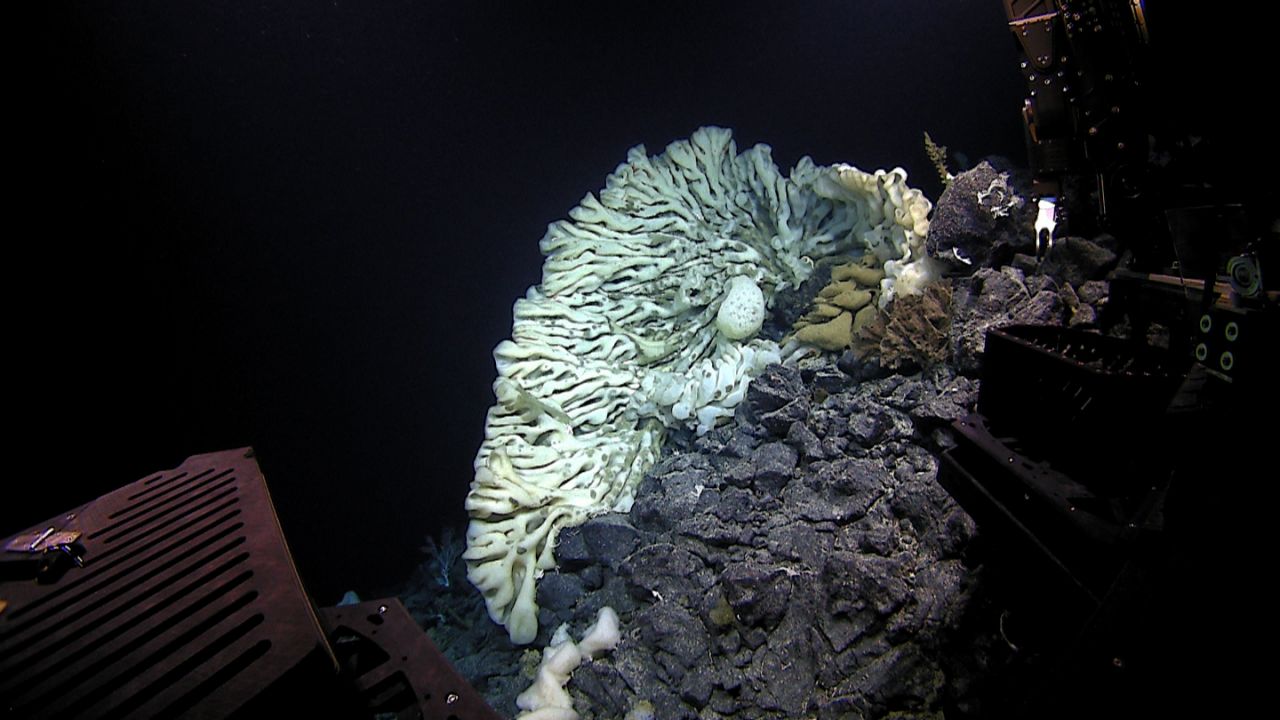
Lateral view of a large hexactinellid sponge found in Papahānaumokuākea Marine National Monument (Photo credit: NOAA's Office of Exploration and Research)
Lateral view of a large hexactinellid sponge found in Papahānaumokuākea Marine National Monument
(Photo credit: NOAA’s Office of Exploration and Research)


Read More “Fun Science FRIEDay – The worlds largest sponge.” »

Six thoughts about Greenpeace’s attack on Ray Hilborn.

Posted on May 13, 2016June 2, 2016 By Andrew Thaler 6 Comments on Six thoughts about Greenpeace’s attack on Ray Hilborn.
Conservation, Science

Update: Both the University of Washington and the Proceedings of the National Academy of Sciences have reviewed Greenpeace’s claims and concluded that Hilborn did not violate their disclosure policy.

First, some background:

  • Fisheries Scientist Under Fire For Undisclosed Seafood Industry Funding
  • Ray Hilborn: Overfishing Denier
  • Hilborn’s Response to Greenpeace

Or, just read Trevor Branch’s timeline.

1. The idea that scientists should declare every source of funding over the history of their career on every scientific paper is impractical and wholly unnecessary in a connected world where anyone can effortlessly access a researcher’s CV. Non-profit NGOs only need to file one financial disclosure statement every year, not attach it to every press release, and that is also perfectly adequate.

2. Transparency in funding is important. Claiming that a researcher is failing to disclose funding information when that information clearly is available and accessible erodes public trust in science and makes everyone’s job harder. Greenpeace didn’t send a team of stealth lawyers on an o’dark thirty raid of the UW mainframe, they asked for the information and were given it.

Read More “Six thoughts about Greenpeace’s attack on Ray Hilborn.” »

Introducing Field School: A Resource for Marine Science Research and Education

Posted on May 9, 2016May 9, 2016 By Guest Writer
Conservation, Education, Science

julia_staffJulia Wester  is the Director of Program Development for Field School. She received her PhD from the Abess Center for Ecosystem Science and Policy at the University of Miami in 2016. Her dissertation studied the psychology of decision making about the environment, specifically with regard to limited water resources. She also received a Msc with Distinction in Biodiversity Conservation and Management from Oxford University and worked as a Legislative Aide in South Florida, focusing on environmental policy. She has consulted with nonprofit programs to evaluate their educational programs and assisted with training staff to conduct effective public outreach.

Field School logoThe folks at Southern Fried Science, as part of their commitment to research and education, have generously given us this platform to talk about our educational start-up, Field School. (Thanks, SFS!). They’ve also been kind enough to get excited about working with us to develop and test new research techniques, study awesome animals and ecosystems, and improve marine science field education—so stay tuned for some of those upcoming collaborations!

What is field school? 

Field School is a hybrid company on a mission to support field research in marine and environmental science, and create high-quality educational and training opportunities for students and the public. We offer hands-on, research focused courses on a variety of topics, from corals to sharks, on our 55’ custom live-aboard research vessel.

Field School offers researchers and students opportunities to engage with and study tropical marine ecosystems. Photo credit: Kristine Stump

Part of what makes Field School special is the team we’ve brought together. Our captain and crew all have doctoral and/or masters degrees in marine or environmental science, have authored numerous scientific publications, and have a combined 25 years of experience in field education and outreach. We have developed short- and long-term training and mentoring opportunities for students, teach highly reviewed and award-winning university courses, and work with partner non-profits to create outreach programs for the public. We collaborate closely with our scientific advisory board and partner universities to develop the conservation and research projects our students work on, ensuring their time in our courses is professionally relevant and meaningful.

Read More “Introducing Field School: A Resource for Marine Science Research and Education” »

The BeagleBox 2: a dirt-cheap, tough-as-nails, 3D-printed, versatile field laptop.

Posted on May 9, 2016May 12, 2016 By Andrew Thaler
Science
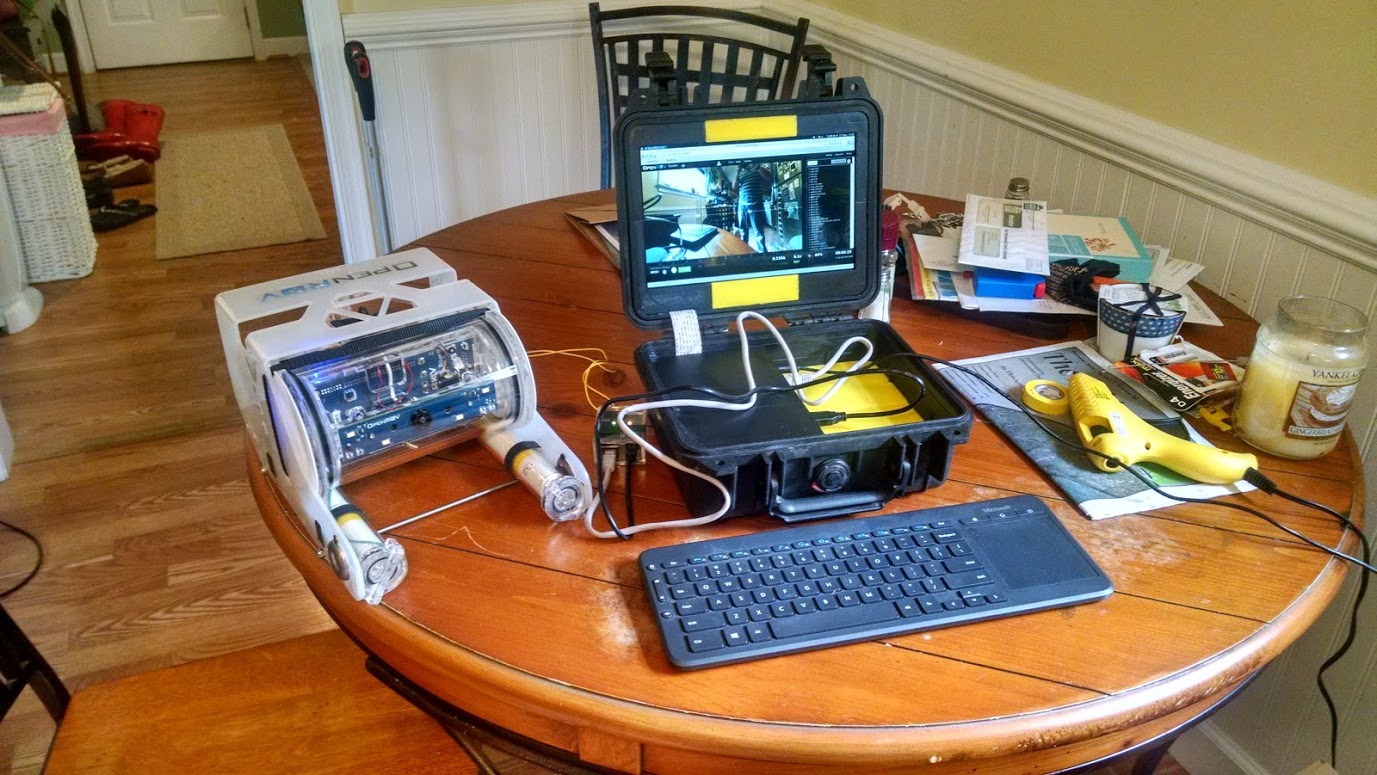
The BeagleBox 2
The BeagleBox 2

Last year, as part of Oceanography for Everyone, we debuted the BeagleBox, a small, cheap, tough, basic field computer powered by a BeagleBone Black. The first BeagleBox didn’t promise much, it was designed for basic field work and, most importantly, to be cheap enough that researchers (particularly grad students) wouldn’t be too worried about damaging it. It wasn’t designed to be your only computer but to replace your more valuable computer when participating in fieldwork.

In the last year, the single board computer landscape has changed, with new systems running off tiny, powerful 64bit ARM chips. One of the first of this new breed of SCB to hit the market was the massively Kickstarted, and rocky-launching Pine64. I received my 1GB Pine64 late last week, and immediately set to work redesigning the BeagleBox to house this larger board (and correct for some other annoyances in the original design). So here it is, an even beefier, cheaper, tougher field machine.

Yes, it will run an OpenROV. It will not run it well.

Read More “The BeagleBox 2: a dirt-cheap, tough-as-nails, 3D-printed, versatile field laptop.” »

Big ideas and little robots: Using the OpenROV in interdisciplinary STEM projects

Posted on May 4, 2016May 3, 2016 By Guest Writer 1 Comment on Big ideas and little robots: Using the OpenROV in interdisciplinary STEM projects
Conservation, Education, Science

portrait-joeyJoey Maier is a biology professor at Polk State College where he uses every possible opportunity to encourage his students to spend time in the water, play with technology, and do #CitizenScience. As an undergraduate, he did a stint as an intern for Mark Xitco and John Gory during their dolphin language experiments.  He then spent the years of his M.Sc. at the University of Oklahoma thawing out and playing with bits of decaying dolphin.  After discovering that computers lack that rotten-blubber smell, Joey became a UNIX sysadmin and later a CISSP security analyst.  
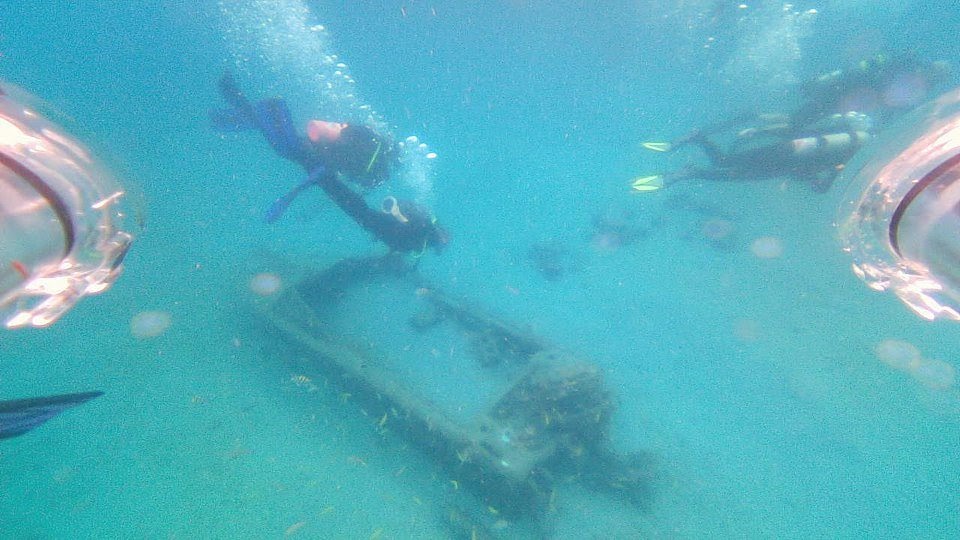
While his pirate game is weak, he is often seen with a miniature macaw on his shoulder. His spare time is spent SCUBA diving and trying to hang out with people who have submersibles.  You can follow him on Twitter or Facebook.


There’s a Klingon bird of prey hanging from the ceiling in my office.

I may teach biology, but at heart I’m a sci-fi nerd.  Naturally, I’m interested in futurism, robots, lasers and all manner of techy paraphernalia.  I’d been watching the OpenROV project for a while, but hadn’t gotten one yet.  They were obviously awesome little machines that gave me a serious case of gadget envy, and I knew that some of our students would love to pilot an ROV.  I needed a much better reason than that, however, to justify getting one.  There’s no line item in our budget for, “Wow, that’s cool!” and I was fairly certain that the college administration would tend to favor lower cost and more familiar forms of student engagement

Photo courtesy Joey Maier.

This tweet changed everything.  When I found out that Andrew had designed a mini-Niskin bottle, the wheels in my head started turning.  Assembling an OpenROV would, naturally, be a very STEM-oriented project.  The times our students piloted the ROV could become water sampling field trips, and the kids could analyze their samples back at school as a laboratory activity. If students recorded the process, they could make a short film. I mulled over the possibilities and bounced ideas off of my dive buddies during the hours we spent traveling to and from the coast.

Read More “Big ideas and little robots: Using the OpenROV in interdisciplinary STEM projects” »

Posts pagination

Previous 1 … 18 19 20 … 83 Next

Popular Posts

At least 74 practicing shark researchers: How a silly thing I said online raised thousands for conservationAt least 74 practicing shark researchers: How a silly thing I said online raised thousands for conservationFebruary 26, 2025David Shiffman
Why the new Trump order to shoot wolves is both illegal and a dreadful precedent for endangered speciesWhy the new Trump order to shoot wolves is both illegal and a dreadful precedent for endangered speciesSeptember 5, 2026Ali Gaster
Severely injured great white shark found, are scientists responsible?Severely injured great white shark found, are scientists responsible?March 29, 2011David Shiffman
5 things I learned helping to reassess the global conservation status of every species of tuna and billfish5 things I learned helping to reassess the global conservation status of every species of tuna and billfishSeptember 15, 2026David Shiffman
That's not a blobfish: Deep Sea Social Media is Flooded by AI SlopThat's not a blobfish: Deep Sea Social Media is Flooded by AI SlopDecember 19, 2025Andrew Thaler
Getting a sense of porpoiseJanuary 20, 2009Andrew Thaler
How to build a canoe from scratch on a graduate student stipendHow to build a canoe from scratch on a graduate student stipendApril 17, 2010Andrew Thaler
13 wrong things about sharks that conservation advocates should stop saying in 2013 (and what they should say instead)December 27, 2012David Shiffman
What is a Sand Shark?What is a Sand Shark?November 12, 2017Chuck Bangley
The Trump Administration’s latest attack on endangered speciesThe Trump Administration’s latest attack on endangered speciesSeptember 17, 2026Ali Gaster
Subscribe to our RSS Feed for updates whenever new articles are published.

We recommend Feedly for RSS management. It's like Google Reader, except it still exists.

Southern Fried Science

  • Home
  • About SFS
  • Authors
  • Support SFS


If you enjoy Southern Fried Science, consider contributing to our Patreon campaign.

Copyright © 2026 Southern Fried Science.

Theme: Oceanly Premium by ScriptsTown