Skip to content

Southern Fried Science

Over 15 years of ocean science and conservation online

  • Home
  • About SFS
  • Authors
  • Support SFS

Category: Uncategorized

Seagrass restoration, seabirds, and sea turducken! Thursday Afternoon Dredging: November 2, 2017

Posted on November 2, 2017November 2, 2017 By David Shiffman
Uncategorized

Cuttings (short and sweet): 

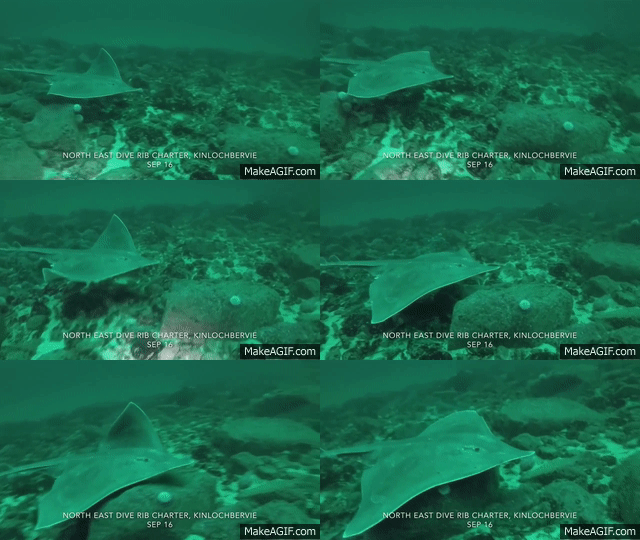
  • Watch this skate seen on a SCUBA dive in Scotland! Video by Catherine Hollingdale

    Video by Catherine Hollingdale
  • Follow fish parasitologist Isaure de Buron on twitter!
  • Judge halts Hawaii aquarium fishing until environmental review. By the AP.
  • There are more fish in the sea, because the Magnusson-Stevens Act is working. By George Leonard, for the Ocean Conservancy blog.

Read More “Seagrass restoration, seabirds, and sea turducken! Thursday Afternoon Dredging: November 2, 2017” »

Reducing seabird bycatch, rescuing vaquita, and cod comebacks: Thursday Afternoon Dredging: October 26, 2017

Posted on October 26, 2017 By David Shiffman
Uncategorized

Cuttings (short and sweet): 

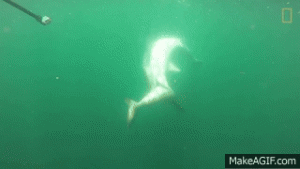
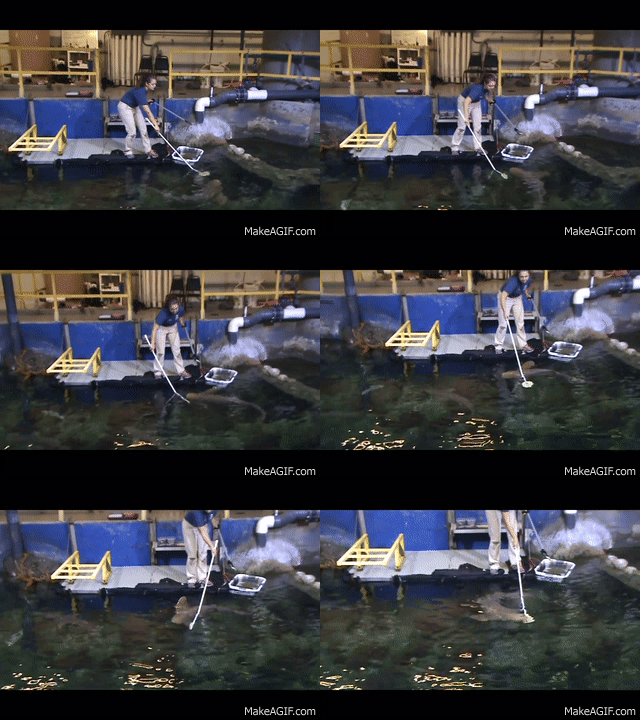
  • Watch aquarists at the PPG Aquarium at the Pittsburgh zoo target train a zebra shark so it comes when it’s called

    Video by PennLive.com
  • Follow PNG Sharks and Rays, a twitter account associated with a project studying “one of the last frontiers of marine biodiversity research,” on twitter.
  • 5 things you should know about the Marine Mammal Protection Act. By Katie Hogge, for the Ocean Conservancy blog.
  • First vaquita “rescued” in effort to save the species. By John Cannon, for MongaBay.

Read More “Reducing seabird bycatch, rescuing vaquita, and cod comebacks: Thursday Afternoon Dredging: October 26, 2017” »

Applications now open for the 2018 YPRF diversity in elasmobranch science scholarship

Posted on October 24, 2017 By David Shiffman
Uncategorized
The American Elasmobranch Society is the world’s oldest and largest professional association of shark and ray scientists

The American Elasmobranch Society, the world’s oldest and largest professional society focusing on the scientific study and management of sharks and their relatives, is now welcoming applications for the 2nd year of our Young Professional Recruitment Fund diversity initiative. Awardees will be given one year of Society membership, in addition to specialized professional development training, mentorship, and networking opportunities specific to their needs as scientists and professionals from developing nations or historically underrepresented minority groups. 

Read More “Applications now open for the 2018 YPRF diversity in elasmobranch science scholarship” »

Fun Science FRIEDay – Life After Death

Posted on October 20, 2017October 20, 2017 By Kersey Sturdivant
Uncategorized

That ominous specter of death. The one certainty in life that we are all careening towards. But how much do we really understand about death? Medically death is defined as the moment the heart stops beating and cuts off blood to the brain. Within seconds after heart failure the brain’s cerebral cortex — the “thinking part” of the brain — slows down instantly and flatlines (meaning no brainwaves are visible on an electric monitor). This initiates a chain reaction of cellular processes that eventually results in the death of brain cells; as a result the brain’s functions also stop and can no longer keep the body alive. The big question is after the heart stops beating, and both heart and brain activity flatlines, how quickly does cognition or awareness fade? A relatively recent study  suggests that consciousness continues even after death.

(Photo credit: Getty)

Read More “Fun Science FRIEDay – Life After Death” »

The most shocking, insightful ocean conservation solutions, as presented by a poorly-built Twitter bot.

Posted on October 4, 2017 By Andrew Thaler
Uncategorized

We made a bot. It’s not a very good bot but it does prognosticate on novel ocean conservation solutions. @OceanCon_Bot has been running for almost a month and it’s produced some real gems. Solid, salt-of-the-earth, diamond-in-the-rough, gabbro-in-your-lab, bro, solutions. And these are among my favorites.

We definitely need to stop presenting those condescending academics, but why so down on transparency, @OceanCon_Bot?

Catalyze lionfish and address Caribbean extinction? I guess you can’t really do both.

Ok, it’s possible we created an evil ocean bot.

Read More “The most shocking, insightful ocean conservation solutions, as presented by a poorly-built Twitter bot.” »

Japan becomes the first nation to mine a deep-sea hydrothermal vent

Posted on September 27, 2017 By Andrew Thaler 1 Comment on Japan becomes the first nation to mine a deep-sea hydrothermal vent
Uncategorized

Sixteen hundred meters deep, off the coast of Okinawa, a new kind of mining just cut it’s teeth.

Earlier today, the Japan Times reported that a mining tool has successfully extracted zinc and other metals from a hydrothermal vent on the seafloor. There’s not much to go on yet. We don’t know if these were active or dormant vents (though dormant doesn’t mean biologically dead). We don’t know the specific location of the experimental mine site. And we don’t know the footprint of the ore prospect. But we do know that Japan has identified at least 6 potential mining sites within its exclusive economic zone and that plans are moving forward for a commercial mining venture in mid-2020. I’ve only found one report in English and from the look of things, there’s only a press release circulating right now, but I’m certain we’ll be hearing much more about this in the coming weeks.

Japan Agency for Natural resources and Energy

We’re still watching to see what Nautilus Minerals does at Solwara 1 and how manganese nodule mining proposals in the Clarion Clipperton fracture zone are progressing but Japan’s mining efforts present a sea change in how to anticipate future deep-sea mining efforts. Private commercial ventures are dependent on the whims of the global commodities market and subject to national and international regulation. National efforts are driven by the need for resource independence. I was aware of Japan’s efforts, but didn’t realize that they were as close as they are to being ready for production.

For the last 10 years, we’ve been saying that deep-sea mining of hydrothermal vents is imminent. Well, it’s here.

Read More “Japan becomes the first nation to mine a deep-sea hydrothermal vent” »

Fun Science FRIEDay – Au Revoir Cassini

Posted on September 15, 2017September 15, 2017 By Kersey Sturdivant
Uncategorized

Roughly 20 years ago the Cassini orbiter launched from Cape Canaveral for a seven year journey to the ringed planet Saturn. Towing with it was the Huygens probe, built and maintained by the European Space agency. On its journey to Saturn the orbiter flew by Venus through the asteroid belt, past Jupiter with its giant red eye, before finally arriving at Saturn. After spending countless years investigating Saturn and its moons, today is the culmination of that journey as Cassini begins its death orbit down into Saturn.

Photo Credit: NASA/JPL-Caltech

Cassini was a triumph of science and engineering, sending back amazing views and increasing the state of knowledge in astronomy. Cassini discovered two previously unknown moons orbiting Saturn (bringing Saturn’s total known moon count to 60), discovered ice plumes from Enceladus (another Saturn moon) via magnetometer, and detached and sent the Huygens probe  down to the surface of Titan (Saturn’s largest moon). The landing of Huygens on Titan is the first and only landing on the surface of a world in the outer solar system.

Cassini orbiter sees Earth from Saturn (Photo Credit: NASA/JPL-Caltech)

Read More “Fun Science FRIEDay – Au Revoir Cassini” »

A new kind of robot to save the ocean!

Posted on September 15, 2017 By Andrew Thaler
Uncategorized

It’s the Ocean Conservation Bot! @OceanCon_Bot creates new an novel ocean conservation solutions by drawing from a vast and deep archive of randomly generate ocean jargon. @OceanCon_Bot is currently capable of generating 3.2 quadrillion potential ocean conservation solutions. @OceanCon_Bot is incapable of determining whether a solution is good, bad, gibberish, or really, really gibberish. @OceanCon_Bot … Read More “A new kind of robot to save the ocean!” »

Lions, Whales, and the Web: Transforming Moment Inertia into Conservation Action

Posted on September 14, 2017 By Andrew Thaler
Uncategorized

I have a new paper out today with an incredible team of co-authors: Naomi Rose, Mel Cosentino, and Andrew Wright.

Thaler and friends (2017) Lions, Whales, and the Web: Transforming Moment Inertia into Conservation Action. DOI: 10.3389/fmars.2017.00292.

In it, we look at three case-studies of online and offline reactions to the deaths of specific, charismatic animals, and discuss how preparation, planning, and tactical thinking can be used to promote effective conservation messaging in the wake of these haphazard events. We talk about how outrage, empathy, and curiosity play a role in the global conversation and how to effectively mobilize this attention into conservation action.

Conservation activism following moment inertia is a balancing act between strategic planning and a quick, tactical response. When the catalyst is moral outrage, it is important to allow people to be angry, rather than to try and curb such responses. In these circumstances, it is possible to leverage predictable moral signaling into tangible conservation gains.

Regardless of the emotional reaction—outrage, curiosity, or empathy—the general guidelines for conservationists leveraging moment inertia are the same. First, planning for pseudorandom events is essential to produce meaningful outcomes. Second, understanding the limitations of campaigning on an inertial moment will help establish and achieve concrete, realistic goals. Third, the call to action must be informed by the local context, address local cultural values, and be delivered by those who can connect with the public. Finally, it is critical to maintain a factual basis while acknowledging the emotions involved.

With foresight, a focus on concrete goals, and an understanding of the strengths and limitations inherent in moment inertia, these events can be harnessed to help achieve lasting conservation successes.

Thaler and friends (2017)

What is Moment Inertia: Moment Inertia is a phenomenon that arises from focus of attention around a single, clarifying event, or moment, which propagates, undirected, through media unless acted upon by outside forces.

Read More “Lions, Whales, and the Web: Transforming Moment Inertia into Conservation Action” »

Thursday Afternoon Dredging: September 14th, 2017

Posted on September 14, 2017September 13, 2017 By David Shiffman
Uncategorized

Cuttings (short and sweet): 

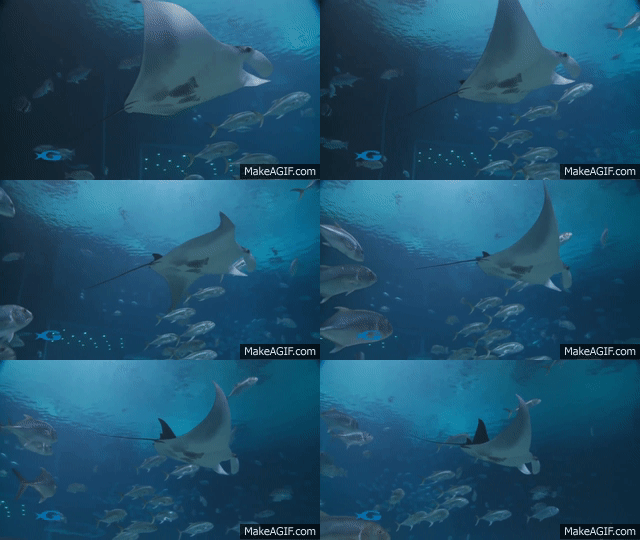
  • Watch this bat ray at the Monterey Bay Aquarium
  • Follow Marie Auger-Méthé, an Arctic ecologist, on twitter!
  • How sea creatures change color. From Nature Research Highlights.
  • Global fingerprints of sea level rise revealed by satellites. By Rachael Lallensack for Nature News.


Read More “Thursday Afternoon Dredging: September 14th, 2017” »

Posts pagination

Previous 1 … 12 13 14 … 119 Next

Popular Posts

Playing God - How the ESA "God Squad" just voted for the extinction of a uniquely American whalePlaying God - How the ESA "God Squad" just voted for the extinction of a uniquely American whaleApril 9, 2026Southern Fried Science
The story of the pride flag made from NASA imagery: Bluesky's most-liked imageThe story of the pride flag made from NASA imagery: Bluesky's most-liked imageSeptember 27, 2024David Shiffman
Here's how to join my IMCC8 symposium, "Ocean Science Communication: What's New and What's Next?"Here's how to join my IMCC8 symposium, "Ocean Science Communication: What's New and What's Next?"April 22, 2026David Shiffman
What Ocean Ramsey does is not shark science or conservation: some brief thoughts on "the Shark Whisperer" documentaryWhat Ocean Ramsey does is not shark science or conservation: some brief thoughts on "the Shark Whisperer" documentaryJuly 2, 2025David Shiffman
Our favorite sea monsters – Ningen (#4)Our favorite sea monsters – Ningen (#4)September 7, 2010Andrew Thaler
Join Me at Upwell: A Wave of Ocean Justice — Our Fourth Year!Join Me at Upwell: A Wave of Ocean Justice — Our Fourth Year!March 24, 2026Angelo Villagomez
On the clarity of animals: the art and science of clearing and stainingOn the clarity of animals: the art and science of clearing and stainingDecember 17, 2013Guest Writer
Shark of Darkness: Wrath of Submarine is a fake documentaryShark of Darkness: Wrath of Submarine is a fake documentaryAugust 10, 2014Michelle Jewell
What can the funniest shark memes on the internetz teach us about ocean science and conservation?What can the funniest shark memes on the internetz teach us about ocean science and conservation?November 8, 2013David Shiffman
That's not a blobfish: Deep Sea Social Media is Flooded by AI SlopThat's not a blobfish: Deep Sea Social Media is Flooded by AI SlopDecember 19, 2025Andrew Thaler
Subscribe to our RSS Feed for updates whenever new articles are published.

We recommend Feedly for RSS management. It's like Google Reader, except it still exists.

Southern Fried Science

  • Home
  • About SFS
  • Authors
  • Support SFS


If you enjoy Southern Fried Science, consider contributing to our Patreon campaign.

Copyright © 2026 Southern Fried Science.

Theme: Oceanly Premium by ScriptsTown