
Skip to content

Southern Fried Science

Over 15 years of ocean science and conservation online

  • Home
  • About SFS
  • Authors
  • Support SFS

Recent Posts

Here’s how to join my IMCC8 symposium, “Ocean Science Communication: What’s New and What’s Next?”
April 22, 2026
Deep Sea Mining Symposium Announcement
April 21, 2026
Join Me at Upwell: A Wave of Ocean Justice — Our Fourth Year!
March 24, 2026
How close did the world’s first deep-sea mining come to the dredging the world’s largest cold-water coral reef?
March 17, 2026
Here are some ocean conservation technologies that I’m excited about
February 19, 2026
Walking Backwards Into the Future: Applying Indigenous Knowledge to Deep Sea Mining
February 5, 2026

Bad Gas Episode 2!

Posted on June 18, 2014June 18, 2014 By Andrew Thaler
Science

Watch it now! httpv://youtu.be/QXHV0c8juXQ

Good fish, bad fish: new draft FDA guidance considering mercury exposures

Posted on June 12, 2014June 13, 2014 By Bluegrass Blue Crab 2 Comments on Good fish, bad fish: new draft FDA guidance considering mercury exposures
Uncategorized

After years of scaring pregnant women away from fishy nutrition, the FDA is finally updating its recommendations to encourage them to eat 8-12  ounces of low-mercury fish a week. That’s 2 or 3 meals per week in order to support fetal growth and development. Curious about what fish are low mercury? Stay away from tilefish from the Gulf of Mexico, swordfish, shark, and king mackerel and limit albacore tuna to 6 ounces a week. Better options include “some of the most commonly eaten fish such as shrimp, pollock, salmon, canned light tuna, tilapia, catfish, and cod”. For locally caught fish, you should check with your local authorities. The new recommendations aren’t final – read the draft and write in if you want more information that would help you make safe and healthy seafood choices. Here’s some things you should consider.

Read More “Good fish, bad fish: new draft FDA guidance considering mercury exposures” »

Absurd headlines about sharks, adjusted for accuracy

Posted on June 11, 2014June 11, 2014 By David Shiffman 1 Comment on Absurd headlines about sharks, adjusted for accuracy
Blogging

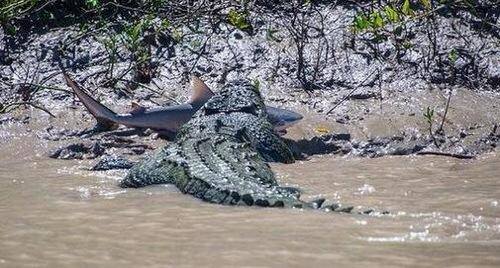
The mainstream media doesn’t always have the greatest reputation for accuracy when it comes to reporting stories about sharks. Inspired by this brilliant campaign, I decided to “adjust” the headlines of some particularly absurd recent news stories about sharks.

This story about a shark that may have been eaten by another shark. 

1


Read More “Absurd headlines about sharks, adjusted for accuracy” »

Bad Gas: a step-by-step guide to experimenting with Ocean Acidification in your kitchen

Posted on June 10, 2014June 10, 2014 By Andrew Thaler
Science

After over a month of planning, it’s finally time to unveil my new ocean acidification project: Bad Gas! Watch this video to learn how to turn a Soda Stream into a miniature ocean and explore the impact of ocean acidification.

httpv://youtu.be/KBJiUWcDGpM

As this experiment continues, it will develop into a series of lesson plans for science teachers to use in the classroom. If you’re following along or joining in with your own tiny ocean, leave a comment below and keep us updated on your progress.

Read More “Bad Gas: a step-by-step guide to experimenting with Ocean Acidification in your kitchen” »

Selected conference tweets from Sharks International #Sharks14

Posted on June 9, 2014June 9, 2014 By David Shiffman
Conservation, Science

I’ve just returned from the second Sharks International, a scientific conference for shark and ray researchers, which was held in South Africa. With nearly 300 researchers and conservationists from more than 38 countries in attendance, the conference was a fantastic learning and networking experience, and a huge success.

In addition to countless talks focusing on cool discoveries about amazing animals and important conservation issues from all over the world,  I don’t think I ate one meal at a table with fewer than 4 countries represented.   Our lab, the RJ Dunlap Marine Conservation Program at the University of Miami, gave 3 scientific  presentations, including my own, which was well-received and resulted in some fascinating discussions. The “social media for scientific outreach” workshop I gave had more than 50 people attend, resulting in a couple of dozen scientists newly joining twitter.

Speaking of twitter, more than 7,000 tweets (including re-tweets) were shared using the conference hashtag #Sharks14 ! Below are links to 8 Storify stories I made: 4 plenary sessions and 4 days of scientific presentations. * Scientists, if any of the tweets about your talk are incorrect, please alert me in the comments and I’ll edit or delete them immediately. *

Read More “Selected conference tweets from Sharks International #Sharks14” »

Exploring new models to fund ocean science and outreach

Posted on May 28, 2014May 28, 2014 By Andrew Thaler
Blogging

It’s an open secret that I’ve been struggling over the last few years to keep Southern Fried Science growing while making it financially sustainable. Ocean outreach matters, because the oceans matter. Many of us believe that protecting the oceans is the most important thing we’ll ever do. Our survival depends on a healthy ocean. So we write about overfishing and shark finning, climate change and ocean acidification, mining and trawling and bycatch runoff. And, since, as St. Jacques once said, “people protect what they love”, we do what we can to make people love the ocean as much as we do.

For most of its existence, Southern Fried Science and my other outreach projects have been funded by science. Research grants, outreach fellowships, even graduate student stipends went towards keeping our servers running. But science funding is in crisis, and that model is no longer valid. In a disturbing reversal, today, income from outreach related work–selling articles, consulting for NGO’s, running workshops–is being used to fund my scientific research. Neither model is viable.

It’s time to try something new.

Read More “Exploring new models to fund ocean science and outreach” »

Nerds for Nature harnesses citizen scientists to monitor environmental change

Posted on May 26, 2014May 27, 2014 By Andrew Thaler
Conservation, Science

[Note, this is a press release for an ongoing project of which Amy and myself are involved.]

n4nMonday, May 26, 2014 — In September 2013, a large wildfire, ignited by careless target shooters, blazed across Mt. Diablo, leaving 3,100 acres of state park scorched. Wildfires are an important component of chaparral ecosystems, clearing the way for younger growth to take hold, but monitoring recovery after wildfires is an intensive prospect for over-committed park staff. Enter the Nerds for Nature and their change monitoring brackets.

Inspired by monitorchange.org (created by Sam Droege of the U.S. Geological Survey), Nerds for Nature combined low-tech angle brackets with high-tech smart phones to allow hikers to help monitor the ongoing fire recovery. Park visitors are invited to take pictures at predefined locations, aligning their phones against a simple angle bracket that ensures images will center on the same area. Photos are then uploaded to one of several social media services, where a program scrapes the publicly available images and compiles a time lapse video.

morganfire02

Read More “Nerds for Nature harnesses citizen scientists to monitor environmental change” »

Dawn take you all: Bilbo Baggins’ approach is better than “don’t feed the trolls”

Posted on May 21, 2014 By David Shiffman 4 Comments on Dawn take you all: Bilbo Baggins’ approach is better than “don’t feed the trolls”
Blogging, Science

“Dawn take you all, and be stone to you!”For just at that moment the light came over the hill, and there was a mighty twitter in the branches. William never spoke for he stood turned to stone as he stooped; and Bert and Tom were stuck like rocks as they looked at him. And there they stand to this day, all alone, unless the birds perch on them; for trolls, as you probably know, must be underground before dawn, or they go back to the stuff of the mountains they are made of, and never move again. – “The Hobbit,” J.R.R. Tolkien. (Yes, it really says twitter in this section of text. This is the only place in “The Hobbit” or any of the Lord of the Rings books where the word twitter appears.)

Trolls at the world premiere of "The Hobbit: An Unexpected Journey". Creative Commons license from Flickr user Kewl
Trolls at the world premiere of “The Hobbit: An Unexpected Journey”. Creative Commons license from Flickr user Kewl


Though I have largely enjoyed my experiences with online outreach, there are, to put it mildly, lots of unpleasant people on the internet. An extremist opinion and an anonymous forum for expressing it can be a recipe for some particularly nasty conversations. Some people seem to take pleasure in disrupting a conversation even when they have no particular stake in it, and these people are commonly referred to as “trolls.” There are various strategies for dealing with them (for example, here’s an explanation of this blog’s comment policy). In general, “don’t feed the trolls”  is a common piece of advice for those engaged in online discussions. “Don’t feed the trolls” means that if someone is behaving in an inflammatory manner, you should simply not respond. While it’s certainly true that many internet trolls enjoy a combative discussion and that engagement may give an extremist idea more exposure than it would otherwise receive, I’ve never liked the idea of “don’t feed the trolls.”

Read More “Dawn take you all: Bilbo Baggins’ approach is better than “don’t feed the trolls”” »

Six reasons why Menhaden are the greatest fish we ever fished.

Posted on May 21, 2014May 24, 2014 By Andrew Thaler 2 Comments on Six reasons why Menhaden are the greatest fish we ever fished.
Science

Image from Maine Department of Marine Resources.

Menhaden, Brevoortia tyrannus, is, without a doubt, the single most important fish in the western Atlantic. This oily filter-feeder swims in schools so large that they block the sun from penetrating the water’s surface as it regulates ocean health. Earlier this week, we were greeted by news that menhaden stocks were rebounded, yet despite their near-universal importance in the western Atlantic and Gulf of Mexico, most Americans have near heard of a menhaden.

Let’s fix that. Here are six reasons you should know what a menhaden is.

1. Menhaden go by many names.

The Narragansett called them munnawhatteaug. Colonists called them poghaden, bony-fish, whitefish, pogy, mossbunker, fat-bat. Perhaps most endearingly, menhaden were called bug-heads, thanks to the parasitic isopod that was often found in place of their tongues. They have also been called “the most important fish in the sea“.

Read More “Six reasons why Menhaden are the greatest fish we ever fished.” »

Don’t build a new inter-ocean canal across Nicaragua

Posted on May 21, 2014 By Guest Writer 1 Comment on Don’t build a new inter-ocean canal across Nicaragua
Conservation

ProsantaDr.Prosanta Chakrabarty is an Assistant Professor at Louisiana State University and an ichthyologist and evolutionary biologist. He is also Curator of Fishes at LSU’s Museum of Natural Science. You can learn more about him from his website www.prosanta.net and follow him on Twitter @LSU_FISH.

The National Assembly of Nicaragua approved the rights to build a new canal through the country to connect the Carribean (Atlantic) to the Pacific just as the Panama Canal does about 400 miles to the south. The approval of this contract was done largely without any scientific insights and largely without warning. The rights were given to a Chinese firm, the Hong Kong Nicaragua Development (HKND) and gives them power over this property for up to 100 years. The HKND has no experience with a project of this scale, and was largely unknown until this deal.

CanalThe new canal would be enormous, and cut across Lake Nicaragua (Cocibolca) and also adjacent rivers and waterbodies. No environmental impact studies have been completed. The Academia de Ciencias de Nicaragua recently published a manuscript detailing the problems with this proposed canal, “EL CANAL INTEROCEÁNICO POR NICARAGUA: Aportes al debate” [Available here: ]

It is multi-authored, thoughtful and level-headed: it is also a searing criticism of the stupidity of the idea of this new canal. The report thoroughly examines cultural, environmental, and economic impacts of the proposed canal.

Here are the top reasons I’ve learned from that report (with pg.#s) why this canal is ‘muy malo’ for the people and environment of Nicaragua.

Read More “Don’t build a new inter-ocean canal across Nicaragua” »

Posts pagination

Previous 1 … 105 106 107 … 272 Next

Popular Posts

Playing God - How the ESA "God Squad" just voted for the extinction of a uniquely American whalePlaying God - How the ESA "God Squad" just voted for the extinction of a uniquely American whaleApril 9, 2026Southern Fried Science
The story of the pride flag made from NASA imagery: Bluesky's most-liked imageThe story of the pride flag made from NASA imagery: Bluesky's most-liked imageSeptember 27, 2024David Shiffman
What Ocean Ramsey does is not shark science or conservation: some brief thoughts on "the Shark Whisperer" documentaryWhat Ocean Ramsey does is not shark science or conservation: some brief thoughts on "the Shark Whisperer" documentaryJuly 2, 2025David Shiffman
Here's how to join my IMCC8 symposium, "Ocean Science Communication: What's New and What's Next?"Here's how to join my IMCC8 symposium, "Ocean Science Communication: What's New and What's Next?"April 22, 2026David Shiffman
Our favorite sea monsters – Ningen (#4)Our favorite sea monsters – Ningen (#4)September 7, 2010Andrew Thaler
Shark of Darkness: Wrath of Submarine is a fake documentaryShark of Darkness: Wrath of Submarine is a fake documentaryAugust 10, 2014Michelle Jewell
Join Me at Upwell: A Wave of Ocean Justice — Our Fourth Year!Join Me at Upwell: A Wave of Ocean Justice — Our Fourth Year!March 24, 2026Angelo Villagomez
On the clarity of animals: the art and science of clearing and stainingOn the clarity of animals: the art and science of clearing and stainingDecember 17, 2013Guest Writer
That's not a blobfish: Deep Sea Social Media is Flooded by AI SlopThat's not a blobfish: Deep Sea Social Media is Flooded by AI SlopDecember 19, 2025Andrew Thaler
What can the funniest shark memes on the internetz teach us about ocean science and conservation?What can the funniest shark memes on the internetz teach us about ocean science and conservation?November 8, 2013David Shiffman

squishy

Subscribe to our RSS Feed for updates whenever new articles are published.

We recommend Feedly for RSS management. It's like Google Reader, except it still exists.

Southern Fried Science

  • Home
  • About SFS
  • Authors
  • Support SFS


If you enjoy Southern Fried Science, consider contributing to our Patreon campaign.

Copyright © 2026 Southern Fried Science.

Theme: Oceanly Premium by ScriptsTown